














What GMO means and what research shows about genetically modified food
GMO means genetically modified organism, and WHO’s 2014 Q&A stated that GM foods then available on the international market had passed safety assessments conducted by national authorities and were not likely to present risks to human health, while the National Academies’ 2016 review found no substantiated evidence of a difference in human-health risk between current commercial GE crops and conventionally bred crops. The term describes how an organism’s genome was altered, not a single ingredient, trait or risk profile.
This article explains what GMO means, how genetically modified crops are created, which GM foods are already on the market, and what major scientific reviews say about food safety and wider agricultural impacts. It draws on WHO, FDA, EPA and National Academies documents together with peer-reviewed reviews and meta-analyses.
What GMO means in food and agriculture
GMO stands for genetically modified organism. In scientific use, it describes a plant, animal or microbe whose genome has been deliberately changed using genetic-engineering methods to alter a characteristic. The National Human Genome Research Institute notes that genes can be introduced, enhanced or deleted, and that the change can occur within a species or across species (NHGRI, 2026). In food discussions, however, the term is used most often for crops developed through genetic engineering.
That is different from ordinary selective breeding, where breeders cross compatible plants and select offspring carrying useful combinations of many naturally occurring variants. Genetic engineering can make a more specific DNA change, while genome editing can make targeted changes such as removing or altering a gene without necessarily introducing DNA from another species (FDA, 2020). These techniques overlap in their goal of changing traits, but they do not produce one uniform category of plant.
Terminology also changes with law and context. In the United States, “bioengineered” is the federal disclosure term under the National Bioengineered Food Disclosure Standard for foods that meet its definition, which includes detectable modified genetic material, while “GMO” remains the common public term (FDA, 2022b). Interpretation therefore depends on the crop, engineered trait and product being discussed rather than on the acronym alone.
Technique, trait and terminology
A further distinction is between a technique and a trait. The same trait, such as disease resistance, can sometimes be reached by conventional breeding, genetic engineering or genome editing, while the same engineering technique can be used to create very different traits. The National Academies (2016) recommended that regulation of new crop varieties focus on the characteristics of the resulting plant, potential hazards and exposure, regardless of whether the variety was developed through genetic engineering or conventional breeding.
The term transgenic is narrower than GMO in common scientific usage. It usually refers to an organism carrying introduced DNA from another source, whereas genome editing can change a native gene without adding a lasting foreign sequence. Public discussion often uses GMO for both, so the actual method matters whenever that distinction affects interpretation of the evidence.
How genetically modified crops are created
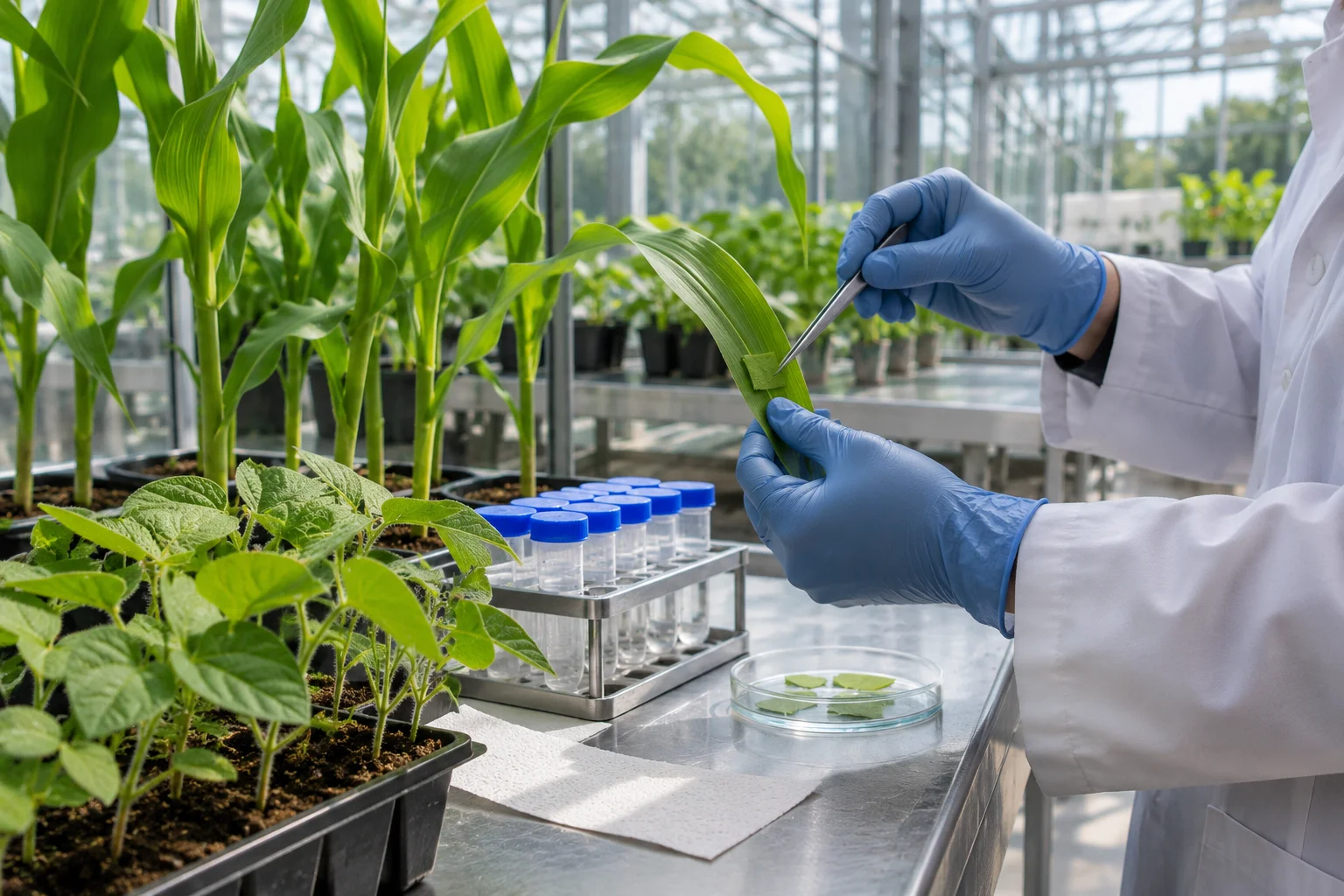
A genetically engineered crop usually starts with a trait rather than with a finished food. Researchers identify a characteristic such as insect resistance, virus resistance, herbicide tolerance, altered oil composition or reduced browning, then identify the genetic change associated with that characteristic. Classical transgenic engineering can introduce a selected DNA sequence into plant cells, while newer genome-editing methods can alter a chosen sequence more directly (FDA, 2020). A simplified development pathway is:
- The target trait and relevant gene or DNA sequence are identified;
- The selected DNA is introduced or edited in plant cells;
- Cells carrying the intended change are identified and regenerated into whole plants;
- Selected plants are crossed into agronomically useful varieties and tested under controlled and field conditions.
The exact laboratory method varies by crop and objective, and the DNA change is only one part of cultivar development. Plants still have to grow, reproduce and perform as crops, and regulators may require molecular, compositional, toxicological, allergenicity or environmental information depending on the product and jurisdiction (WHO, 2014). In the United States, FDA regulates most human and animal food, USDA APHIS addresses plant-health risks, and EPA regulates plant-incorporated protectants and other pesticide uses (FDA, 2022b; EPA, 2026).
After an engineered event is created, developers normally compare the resulting plant with an appropriate conventional counterpart. The comparison may examine the location and stability of the inserted or edited sequence, expression of new proteins, nutrient and anti-nutrient composition, and agronomic characteristics. This does not mean that every measurement has to be identical; crop varieties naturally vary. The aim is to determine whether the engineered change introduces a biologically meaningful difference that changes the safety or environmental questions (WHO, 2014).
Commercial development extends beyond the first successful laboratory plant. Breeders may cross the engineered event into locally adapted germplasm, then select lines that retain both the intended trait and the yield, quality and maturity characteristics required for production. Field testing also exposes the plant to environmental variation that a growth chamber cannot reproduce.
Genetically modified foods already on the market
Commercial GM foods are concentrated in a relatively small number of crops, even though ingredients derived from those crops appear in many processed foods. FDA lists maize, soybeans, canola, sugar beet and cotton among major US GM crops, and also describes GM potatoes, papaya, summer squash, apples and pink pineapple in the food supply (FDA, 2022a). Alfalfa is another major GM crop but is used mainly as animal feed.
The trait differs by crop. Bt maize was engineered to produce insecticidal proteins active against particular pests; many soybean, canola, sugar-beet and cotton varieties were developed for herbicide tolerance; papaya and some squash were engineered for virus resistance; some potatoes and apples were developed to reduce bruising or browning; and pink pineapple was modified to accumulate more lycopene (FDA, 2022a). These examples show why “GMO food” is too broad to predict a product’s biological properties by itself.
Many consumers encounter GM crops as refined ingredients rather than as whole produce. Corn starch, corn oil, soybean oil, canola oil and sugar can originate from GM crops, while much of the harvested maize and soybean crop also enters animal feed (FDA, 2022a). The fact that livestock ate GM feed does not make the animal genetically modified; the genetic status of the animal depends on its own genome, not on the crops in its diet.
Availability, processing and labels
Market presence also changes over time. A crop can be authorised yet grown on a small area, withdrawn for commercial reasons or sold only in particular countries, so an approval list is not the same as a supermarket inventory. FDA’s current consumer material therefore gives crop examples rather than implying that every GM variety is continuously available in every region (FDA, 2022a).
Processing further complicates terminology. Highly refined oils and sugars can be derived from GM crops, while the US federal bioengineered food disclosure standard defines mandatory disclosure around the presence of detectable modified genetic material (FDA, 2022a; FDA, 2022b). That legal distinction does not change the agricultural origin of the raw material, and it means that laboratory detection and disclosure rules are related questions rather than exact synonyms.
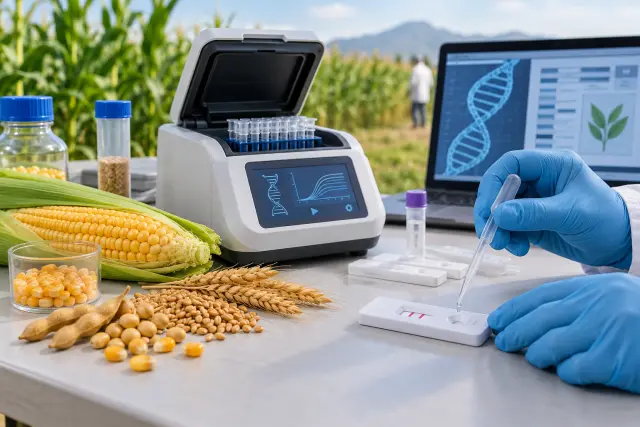
Labelling and verification create a separate technical issue: detecting a genetic modification in grain or processed food depends on what DNA or protein target is being measured and how much processing the sample has undergone. Guo and colleagues compared DNA-based methods such as PCR and LAMP with protein-based approaches such as ELISA and immunochromatographic strips, concluding that different methods suit different screening purposes (Guo et al., 2020). A closer explanation is available in [rapid GMO detection methods](/research/rapid-detection-methods-for-genetically-modified-agricultural-products).
What research shows about GMO food safety
How safety assessment is structured
Safety assessment is not based on the word GMO alone. WHO uses a case-by-case framework because different GM foods contain different genetic changes and traits (WHO, 2014). The framework considers potential toxicity and allergenicity, nutritional composition, the stability of the inserted genetic material and possible unintended effects, while environmental assessment addresses issues such as outcrossing and effects in the receiving environment.
That approach matters because an insect-resistant maize, a non-browning potato and an oil-composition soybean do not present the same questions. A newly expressed protein may require allergenicity and toxicity assessment, while a compositional change may require attention to nutrients or other constituents. WHO stated in its 2014 Q&A that GM products then on the international market had passed national safety assessments, while continued assessment and, where appropriate, monitoring should remain part of the safety framework (WHO, 2014).
What reviews have found
Broad conclusions come from evidence syntheses rather than from a single feeding experiment. The National Academies reviewed evidence accumulated over roughly two decades and in 2016 reported no substantiated evidence that foods from then-commercialised genetically engineered crops posed different human-health risks from comparable conventionally bred crops. The report also stressed that subtle or long-term effects can be difficult to detect and argued against assuming that every future engineered crop will have the same risk profile. Long-term epidemiological studies had not directly addressed GE food consumption, although available time-series data did not show diseases or chronic conditions that correlated with consumption of GE foods (National Academies, 2016).
Nicolia and colleagues reviewed a decade of genetically engineered crop-safety literature and reported that the research they examined had not identified significant hazards directly attributable to GE crops (Nicolia et al., 2014). Snell and colleagues focused more narrowly on 24 long-term or multigenerational animal-feeding studies, including 12 studies lasting more than 90 days and 12 covering two to five generations (Snell et al., 2012). They found no pattern suggesting a health hazard from the tested GM plant diets. Animal feeding evidence is useful for toxicology, but it is not equivalent to a lifelong randomised human trial.
The evidence therefore supports a qualified conclusion: commercially available GM foods assessed to date have not shown higher health risk simply because they were genetically engineered, but this is not a scientific guarantee about every possible future organism or trait. The relevant question remains whether a particular food has a hazardous new property, not whether it carries the GMO label.
Source | Evidence base | Main finding | Important limit |
National Academies, 2016 | Two decades of health, agronomic and environmental evidence | No substantiated evidence of higher human-health risk from then-current commercial GE crops versus conventional comparators | Subtle, long-term and future-trait effects remain difficult to generalise |
Snell et al., 2012 | 24 long-term or multigenerational animal-feeding studies | No health-hazard pattern in the tested GM plant diets | Animal evidence does not replace direct long-term human exposure data |
Pellegrino et al., 2018 | 76 eligible field papers; 276 grain-yield observations | GE maize averaged 10.1% higher yield and had lower mycotoxin levels | Specific to maize, studied traits and eligible field designs |
Klümper & Qaim, 2014 | 147 original farm-survey and field-trial studies | Average pesticide use -37%, yield +22%, farmer profit +68% | Effects varied by trait and setting; reporting of sample size or variance was incomplete in some studies |
Benefits, risks and disputed impacts beyond food safety
Agronomic outcomes depend on the trait and farming system
Food safety is only one part of the GMO debate. A 2014 meta-analysis by Klümper and Qaim combined 147 original farm-survey and field-trial studies of GM soybean, maize and cotton. Across that dataset, adoption was associated on average with 37% lower chemical pesticide use, 22% higher yields and 68% higher farmer profits; yield gains and pesticide reductions were larger for insect-resistant crops than for herbicide-tolerant crops, while yield and profit gains were higher in developing countries than in developed countries.
The authors also noted incomplete reporting of sample size or variance in some underlying studies (Klümper & Qaim, 2014). Those averages describe the included studies, not a guaranteed effect for every farm.
A later meta-analysis of 21 years of field data on genetically engineered maize screened 6,006 publications and retained 76 that met its field-comparison criteria. Across 276 grain-yield observations, GE maize averaged about 10.1% higher yield than near-isogenic comparators; the analysis also found lower mycotoxin concentrations, while noting gaps in geographic coverage and some environmental categories (Pellegrino et al., 2018). The result is specific to the maize traits and studies included, not evidence that genetic engineering itself always raises yield.
Herbicide-tolerant systems illustrate why the technology and the farming practice need to be separated. They can simplify weed control, but repeated reliance on the same herbicide can select for resistant weeds, a problem highlighted by the National Academies (2016). The history of [glyphosate use and weed resistance](/agriculture/glyphosate-unique-global-herbicide-agriculture) is therefore relevant to some GM cropping systems without being a food-safety finding about all GM foods.
Resistance, gene flow and monitoring
Insect-resistant crops can also select for resistant pest populations if resistance-management practices fail, a resistance problem considered in the National Academies review (2016). Gene flow from a GM crop to conventional crops or compatible wild relatives is biologically possible in some species, but the consequence depends on the trait, the receiving population and local ecology. WHO (2014) accordingly treats outcrossing and effects on non-target organisms as environmental questions that require context-specific assessment rather than a universal yes-or-no answer.
These issues help explain why public arguments about GMOs often mix distinct questions. Toxicology of an approved food, herbicide use, pest resistance, gene flow, seed-market structure and labelling policy can all be legitimate topics, but evidence for one does not automatically answer the others.
What is established and what remains uncertain
Several points are well supported. GMO means that an organism’s genome has been deliberately altered using genetic-engineering techniques; commercial GM crops contain different traits and therefore cannot be treated as biologically identical. WHO’s 2014 guidance supports case-by-case assessment, and the National Academies’ 2016 review found no substantiated evidence of a difference in human-health risk between the then-commercialised GE crops it assessed and comparable conventionally bred crops (WHO, 2014; National Academies, 2016).
What remains uncertain is more specific. Future crops may introduce new proteins, metabolic changes or ecological interactions that need their own assessment; resistance can evolve in weeds and insect pests; and environmental effects depend on the crop, trait, farming system and receiving ecosystem. Evidence is also uneven across crops and regions, so conclusions drawn mainly from maize, soybean and cotton do not automatically apply to every engineered organism.
GMO describes a way of changing an organism’s genome, not a single toxicological profile. Evidence is most informative when it follows a specific crop, trait and product through a case-by-case assessment.
The most defensible reading of the evidence is therefore neither “all GMOs are safe” nor “GMOs are inherently dangerous”. Current evidence is strongest for products that have actually been studied and assessed, while the appropriate level of confidence for a new product depends on its particular genetic change, composition, exposure and environmental context.
This distinction also clarifies why scientific agreement about currently assessed products can coexist with disagreement about regulation or food policy. Questions about mandatory labels, intellectual property, seed access or the acceptable level of environmental uncertainty involve social and economic choices in addition to toxicology. The National Academies explicitly separated those value questions from the narrower question of whether current commercial GE foods show evidence of greater health risk (National Academies, 2016). Related crop-production evidence is collected in the [Agriculture and Farming section](/agriculture).
Frequently asked questions
Is GMO the same as bioengineered food?
Not exactly. GMO is the broad public term for organisms altered through genetic engineering, while “bioengineered” has a specific meaning under the US National Bioengineered Food Disclosure Standard. That standard covers foods containing detectable modified genetic material that meets its definition, so the two terms can overlap without being perfectly interchangeable (FDA, 2022b).
Can eating genetically modified food alter human DNA?
Eating GM food does not rewrite a person’s genome. WHO identifies gene transfer from GM food to human cells or gut bacteria as a theoretical concern but says the probability of transfer is low. Safety assessment instead examines toxicity, allergenicity, nutritional effects, gene stability and possible unintended effects (WHO, 2014).
Are all GMO crops made with genes from another species?
No. Transgenic crops can contain introduced DNA from another organism, but genetic engineering also includes changes within a species, and genome-editing tools can alter or remove a native sequence without leaving a foreign gene. The exact technique matters, so “GMO” alone does not reveal what DNA change was made (NHGRI, 2026; FDA, 2020).
Why are GMO foods assessed separately from conventional foods?
WHO notes that many authorities require specific pre-market assessment for GM foods because an engineered change can introduce a new protein, alter composition or create unintended effects that need examination. The assessment typically considers toxicity, allergenicity, nutrition, genetic stability and other relevant changes rather than assuming that the method is automatically safe or unsafe (WHO, 2014).
Does non-GMO mean pesticide-free?
No. Non-GMO describes how the crop was bred or whether it meets a labelling standard; it does not mean that no pesticides were used. Conventional and genetically engineered production systems can both involve crop-protection measures, and EPA regulates pesticide uses on GMO and non-GMO crops. Pesticide impacts therefore need to be evaluated separately from GMO status (EPA, 2026).
Sources
- National Human Genome Research Institute. Genetically Modified Organism (GMO). 12 November 2026. https://www.genome.gov/genetics-glossary/Genetically-Modified-Organism-GMO
- U.S. Food and Drug Administration. Types of Genetic Modification Methods for Crops. September 2020. https://www.fda.gov/media/142242/download
- U.S. Food and Drug Administration. GMO Crops in the U.S. July 2022. https://www.fda.gov/media/135274/download
- World Health Organization. Food, genetically modified. 1 May 2014. https://www.who.int/news-room/questions-and-answers/item/food-genetically-modified
- National Academies of Sciences, Engineering, and Medicine. Genetically Engineered Crops: Experiences and Prospects. National Academies Press, 2016. DOI 10.17226/23395.
- Nicolia A, Manzo A, Veronesi F, Rosellini D. An overview of the last 10 years of genetically engineered crop safety research. Critical Reviews in Biotechnology. 2014;34(1):77–88. DOI 10.3109/07388551.2013.823595.
- Snell C, Bernheim A, Bergé JB, Kuntz M, Pascal G, Paris A, Ricroch AE. Assessment of the health impact of GM plant diets in long-term and multigenerational animal feeding trials: a literature review. Food and Chemical Toxicology. 2012;50(3–4):1134–1148. DOI 10.1016/j.fct.2011.11.048.
- Pellegrino E, Bedini S, Nuti M, Ercoli L. Impact of genetically engineered maize on agronomic, environmental and toxicological traits: a meta-analysis of 21 years of field data. Scientific Reports. 2018;8:3113. DOI 10.1038/s41598-018-21284-2.
- Klümper W, Qaim M. A meta-analysis of the impacts of genetically modified crops. PLOS ONE. 2014;9(11):e111629. DOI 10.1371/journal.pone.0111629.
- U.S. Food and Drug Administration. How GMOs Are Regulated in the United States. July 2022. https://www.fda.gov/media/135278/download
- U.S. Environmental Protection Agency. Genetically Modified Organisms. 23 September 2026. https://www.epa.gov/regulation-biotechnology-under-tsca-and-fifra/genetically-modified-organisms
- Guo D, Kuang PL, Zhang W, Wan JC. Rapid detection methods for genetically modified edible agricultural products. Journal of Food Safety and Quality. 2020;11(11):3398–3407. archive record 20203307482.

Nuala Keaveney — author
Nuala Keaveney writes about agricultural science and sustainable farming, with a focus on farming systems, resource use and agricultural research. Her earlier work involved preparing comparative materials on farming systems and water use for agricultural advis...
Related
Rapid Detection Methods for Genetically Modified Agricultural Products
Glyphosate’s Rise to Top Weedkiller: A 1997 Account
Hevea brasiliensis breeding: from crosses to field trials
The green revolution and how new crops changed farming
Subsistence farming and how families grow food to feed themselves
No-till farming and what long-term field trials show about yields