

















How staph infections start on the skin and reach the blood
Staph infections usually begin when Staphylococcus aureus, a bacterium carried by about 30% of people, gets through a break in the skin, and they reach the blood when it spreads from that site or enters through a wound or catheter (Tong et al., 2015; NHS, 2025). In hospital studies, the strain in the blood was usually the one the patient already carried.
This explainer follows that route step by step: carriage in the nose, the breach in the skin, the abscess, the bloodstream and the organs where the bacteria settle. It draws on genotyping studies, a large endocarditis cohort, national surveillance and a failed vaccine trial, and it separates what these show from what remains unexplained.

Evidence last checked 9 Nov 2026 · 10 min
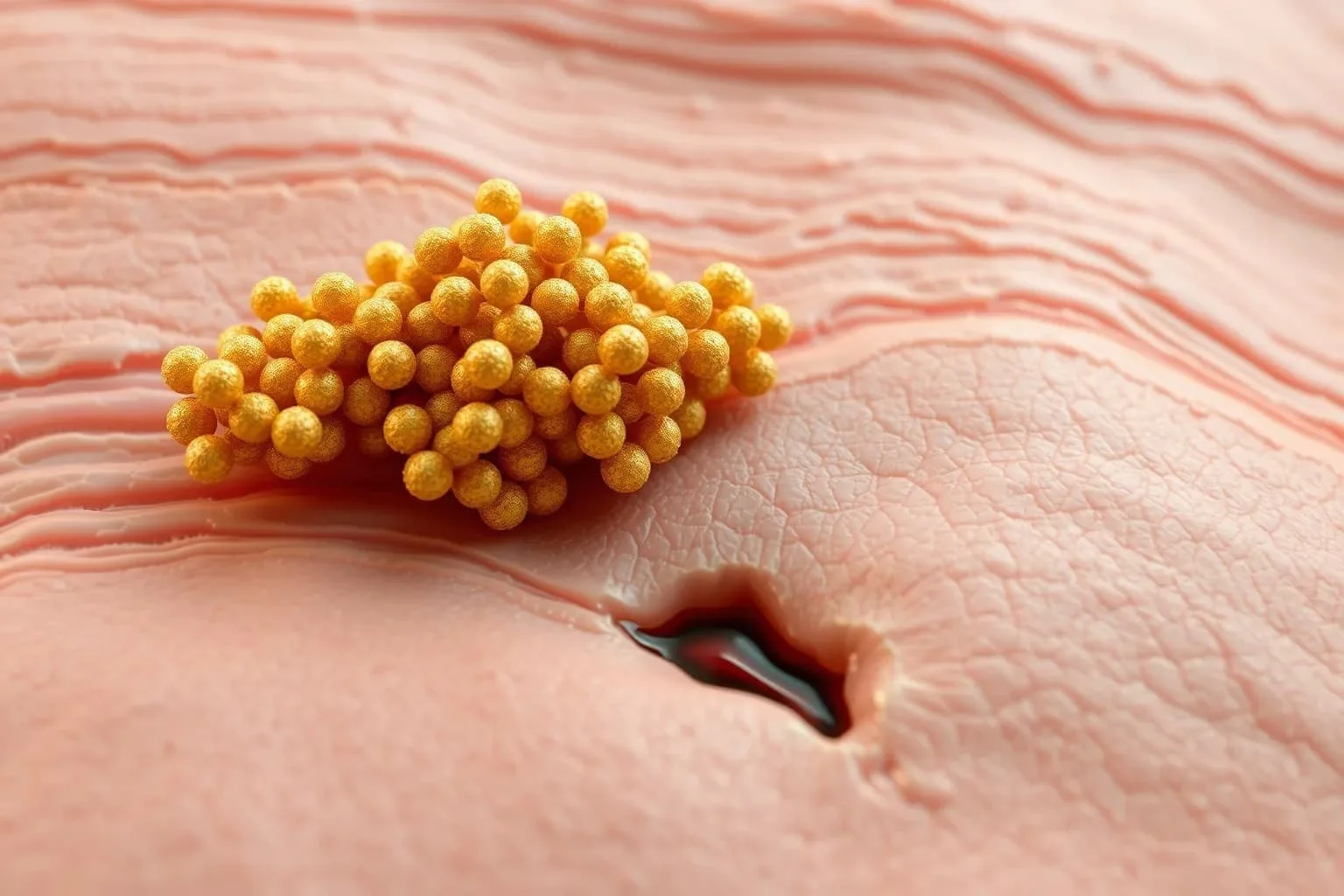
What is a staph infection and who carries the bacterium?
A staph infection is an illness caused by staphylococci, and most serious cases involve one species, Staphylococcus aureus. It is unusual among dangerous bacteria because it is often a normal resident of healthy people. About 30% of the human population is colonised, and the nose is the main site (Tong et al., 2015).
The NHS also names the armpits and buttocks (NHS, 2025). Further coverage of infection sits in the [health section](/health/).
Carriage is not infection. The bacteria live harmlessly on many people's skin and usually cause trouble only once they get into it (NHS, 2025). The question for researchers has therefore been less about who meets the bacterium and more about who keeps it, and what happens when it moves.
Older work sorted people into persistent carriers, intermittent carriers and non-carriers, but a 2009 experiment changed that picture. Van Belkum and colleagues colonised 51 volunteers with a mixture of strains and tracked how long the bacteria survived in the nose. Persistent carriers kept them for 154 days, against 14 days in intermittent carriers and 4 days in non-carriers (van Belkum et al., 2009).
Persistent carriers also tended to reselect their own strain from the mixture. Intermittent carriers and non-carriers behaved alike in survival of the bacteria, infection risk and antibody profile, so the authors argued that only two groups exist: persistent carriers and everyone else (van Belkum et al., 2009). The result matters because persistent carriers are the group with a raised risk of infection.
How does staph get through the skin?
Skin is an effective barrier, so the first step is usually a breach. The NHS names bites and cuts as typical openings (NHS, 2025). The break does not need to be dramatic, and the bacterium is already close by in anyone who carries it.
Eczema shows how damaged skin shifts the odds. A meta-analysis of 95 observational studies found S. aureus on 70% of affected skin in people with atopic dermatitis, on 39% of their unaffected skin and in 62% of their noses (Totté et al., 2016). Compared with healthy controls, the odds ratio for colonisation of affected skin was 19.74, and prevalence rose with disease severity. The authors judged most of the studies fair to poor, so the pattern is firmer than its exact size (Totté et al., 2016).
Medical care creates openings of its own. In England in the 2024 to 2025 financial year, skin and soft tissue was the recorded source in 32.3% of MRSA bloodstream cases with a source entered, and a catheter or line in 16.3% (UKHSA, 2025). Only 27.6% of those records named a source at all, and UKHSA cautions against reading too much into such small numbers.
Once inside the skin, the bacterium can produce several recognisable conditions (NHS, 2025):
- Boils, carbuncles and abscesses, which appear as painful red lumps.
- Cellulitis, which makes the skin hot, red and swollen.
- Impetigo, which causes sores, crusts or blisters.
- Styes and conjunctivitis, which leave the eyelids or eyes sore and red.
These skin infections are much more common than invasive illness such as blood poisoning or toxic shock syndrome (NHS, 2025). Most of the route described in this article therefore stops here. The rest of it concerns the minority of infections that travel further.
How does a skin infection reach the bloodstream?
The abscess offers part of the answer. A 2016 review describes secreted coagulases that activate the host's clotting protein prothrombin, and surface agglutinins that bind fibrin, as key steps in building a walled lesion (Thomer et al., 2016). The bacteria then recruit and destroy immune cells, turning the lesion into pus, and that exudate lets them spread to new sites or new hosts (Thomer et al., 2016).
The more striking question is where the invading bacteria come from. In the study “Nasal carriage as a source of Staphylococcus aureus bacteremia” (2001), von Eiff and colleagues genotyped nasal swabs and blood isolates from 219 patients. The blood strain matched a nasal strain in 180 of them, or 82.2%. In a second arm, 14 of 1,278 colonised patients later developed bacteraemia, and 12 of those 14 had clonally identical isolates, up to 14 months apart (von Eiff et al., 2001).
A Dutch cohort then added a denominator. In the study “Risk and outcome of nosocomial Staphylococcus aureus bacteraemia in nasal carriers versus non-carriers” (2004), Wertheim and colleagues screened 14,008 hospital patients on admission and followed them. Bloodstream infection occurred in 40 of 3,420 carriers (1.2%) and 41 of 10,588 non-carriers (0.4%), a relative risk of 3.0. Genotyping showed that 80% of the carriers' infecting strains were their own (Wertheim et al., 2004).
The same study produced an unexpected second finding. Among patients who became bacteraemic, 18% of carriers died, against 46% of non-carriers (Wertheim et al., 2004). Carriers were infected more often but survived more often. The paper measured this association without establishing a cause, so any explanation based on earlier immune exposure remains a hypothesis.
In the hospital studies that traced it, the bacterium in the blood was usually one the patient had already been carrying, which makes the journey from skin to bloodstream a short one.
Where does staph settle once it is in the blood?
Bacteraemia means that bacteria are circulating in the blood, and S. aureus can leave the circulation to seed other tissues. Heart valves are among the most serious targets. An international cohort of 2,781 adults with infective endocarditis, drawn from 58 hospitals in 25 countries, found S. aureus to be the most common cause, at 31.2% of cases (Murdoch et al., 2009).
In that cohort, S. aureus infection independently raised the odds of dying in hospital, with an odds ratio of 1.54 (Murdoch et al., 2009). Stroke affected 16.9% of patients and heart failure 32.3%. S. aureus now accounts for more than 25% of endocarditis in industrialised countries, whereas older series put it below 10% (Tong et al., 2015).
Bones and joints are a further site, the primary focus in a mean of 8% of bacteraemia cases across the cohorts reviewed by Tong and colleagues (Tong et al., 2015). The place where infection settles strongly shapes the outlook. Case fatality was about 80% before antibiotics and has since plateaued at 15–50%, with wide differences by focus (Tong et al., 2015).
Focus of infection | Reported 30-day mortality |
Urinary tract | About 10% |
Catheter | 7–21% |
Skin and soft tissue | 15–17% |
No focus identified | 22–48% |
Infective endocarditis | 25–60% |
Lung | 39–67% |
Note: these ranges come from different cohorts collated in one review, so they describe the spread of reported results and not a head-to-head comparison (Tong et al., 2015). Their direction is still informative. Infections with an obvious, reachable source tend to end better than those that have settled in [the lungs](/health/chest-disease-diagnosis-radiologic-signs-differential-health/) or on a heart valve.
Who is most at risk of a staph bloodstream infection?
In industrialised regions, the reported incidence of S. aureus bacteraemia is 10–30 per 100,000 person-years, and it varies widely between groups (Tong et al., 2015). The highest rates appear where the skin is repeatedly breached or immunity is reduced:
- People on haemodialysis: 3,064–17,900 per 100,000 person-years, with a tunnelled dialysis catheter as the main risk factor (Tong et al., 2015).
- People with HIV: 494–1,960 per 100,000 person-years, much of it linked to injecting drug use (Tong et al., 2015).
- People who inject drugs: at least 610 per 100,000 person-years in a Dutch study (Tong et al., 2015).
- People over 70: more than 100 per 100,000 person-years (Tong et al., 2015).
- Men: incidence runs about 1.5 times that of women, for reasons the same review calls not understood (Tong et al., 2015).
Worldwide, S. aureus was associated with 1,105,000 deaths in 2019, the only one of 33 bacterial pathogens above one million (GBD 2019 Antimicrobial Resistance Collaborators, 2022). Lower respiratory infections made up about 532,000 of those deaths and bloodstream infections 299,000, against 37,500 for skin infections. These are modelled estimates with wide uncertainty, and they count deaths associated with the bacterium, not deaths it alone caused.
National surveillance gives a closer view. England recorded 13,799 cases of meticillin-susceptible (MSSA) bacteraemia and 1,064 of MRSA in the 2024 to 2025 financial year, with 30-day case fatality of 21.2% and 22.8% (UKHSA, 2025). Deprivation also matters: the MSSA rate was 36.2 per 100,000 in the most deprived fifth of areas and 16.5 in the least deprived (UKHSA, 2025).
How is MRSA different from ordinary staph?
MRSA is meticillin-resistant S. aureus. It arises when a susceptible strain acquires mecA, a gene carried on a mobile element called SCCmec, which lets the bacterium resist beta-lactam antibiotics (Tsubakishita et al., 2010). Genetic comparison points to S. fleurettii, a staphylococcus associated with animals, as the probable origin of the gene. The exact steps of that transfer remain the authors' inference (Tsubakishita et al., 2010).
MRSA was long seen as a hospital problem, but the boundary blurred. US surveillance of 8,987 invasive cases at nine sites classed 58.4% as community-onset but health-care-associated, 26.6% as hospital-onset and 13.7% as community-associated (Klevens et al., 2007). Strains linked to community outbreaks were also found in health-care infections.
Trends depend on the measure. In England, MRSA bacteraemia fell 76.1% from 4,451 cases in the 2007 to 2008 financial year, but the rate rose 56.8% between 2021 to 2022 and 2024 to 2025 (UKHSA, 2025).
Across the EU and EEA, the MRSA share of invasive isolates fell from 18.2% in 2019 to 15.8% in 2023 (ECDC, 2024). ECDC also reports that the incidence of MRSA bloodstream infections itself fell by 17.6% over the same period, from 5.63 to 4.64 cases per 100,000 population. How a laboratory test acquires its thresholds is a story in itself, told in [the standardisation of syphilis serology](/health/cardiolipin-standardization-syphilis-serology-health/).
That caveat changes how the two forms should be compared. In England, the MRSA share of S. aureus bacteraemia fell from 11.3% to 7.2%, while MSSA cases increased by 57.4% between financial years 2011 to 2012 and 2024 to 2025 (UKHSA, 2025). MSSA accounted for 2,919 of the 3,160 deaths within 30 days in 2024 to 2025. Resistance matters, but most of the current burden in England comes from strains that are not MRSA.
What does the evidence settle, and what is still open?
The evidence on the central question here, whether serious staph infections start from a person's own carriage, is rated moderate. Genotyping and a large prospective cohort agree (von Eiff et al., 2001; Wertheim et al., 2004). They are observational, however, and mostly describe European hospital patients, so they cannot be extended to every kind of staph disease.
Several surrounding points are firmer: about 30% of people carry the bacterium, it is a leading cause of endocarditis, and resistance rests on mecA (Tong et al., 2015; Murdoch et al., 2009; Tsubakishita et al., 2010). Other questions remain open:
- The role of the PVL toxin: across 76 studies, PVL genes were strongly linked to skin infection but comparatively rare in invasive disease, leaving open whether PVL causes harm or only marks certain strains (Shallcross et al., 2013).
- Survival in carriers: why carriers die less often once bacteraemic has not been explained (Wertheim et al., 2004).
- The sex difference: the higher incidence in men has no agreed basis (Tong et al., 2015).
The largest gap is prevention by vaccine. In the study “Effect of an investigational vaccine for preventing Staphylococcus aureus infections after cardiothoracic surgery: a randomized trial” (2013), Fowler and colleagues enrolled 8,031 patients at 165 sites. The V710 candidate raised strong antibody responses, yet bacteraemia or deep wound infection occurred in 22 of 3,528 vaccinated patients and 27 of 3,517 on placebo (Fowler et al., 2013).
The trial was stopped early over safety concerns and low efficacy. Among patients who became infected, mortality was higher in the vaccine group, at 23.0 against 4.2 per 100 person-years (Fowler et al., 2013). The result suggests that a strong antibody response alone does not predict protection against this bacterium.
For readers, the evidence gives a clear outline. Staph is common and usually harmless, serious infection needs a route past the skin, and in hospital patients that route often starts with a person's own bacteria. How much each toxin contributes, and how to build a working vaccine, remain research questions.
Frequently asked questions
How many people carry staph without knowing it?
About 30% of people are colonised with Staphylococcus aureus at any time, mainly in the nose, usually without any symptoms. A smaller group are persistent carriers, who keep the bacteria for long periods. Experimental work suggests that everyone else clears it far faster, and persistent carriers have a raised risk of infection.
Is MRSA more dangerous than ordinary staph?
MRSA resists many common antibiotics, but ordinary staph can be just as serious once in the blood. In England in 2024 to 2025, 30-day case fatality was 22.8% for MRSA and 21.2% for meticillin-susceptible strains. Because susceptible strains are far more common, they accounted for most of the deaths.
How often is a staph bloodstream infection fatal?
Before antibiotics, about 80% of patients died. Reviews now report case fatality of 15–50%, depending on the setting and the site of infection. In England in 2024 to 2025, roughly a fifth of patients died within 30 days. Outcomes are worse for infections in the lungs or on heart valves.
Does the PVL toxin make staph infections worse?
The evidence is mixed. A review of 76 studies linked PVL genes to skin infections but found little evidence of worse outcomes. Whether PVL causes harm remains uncertain. How a rare bacterial infection was opened up by an animal model is set out in [the experimentally infected armadillo](/health/experimentally-infected-armadillo-leprosy-research-health/).
Why is there no staph vaccine?
Several candidates have failed in people. The V710 vaccine raised strong antibody responses but did not prevent infection after heart surgery, and infected patients in the vaccine group died more often. Researchers do not yet know which immune responses protect people from this bacterium, so no vaccine has been licensed.
Sources
- Tong SYC, Davis JS, Eichenberger E, Holland TL, Fowler VG Jr. Staphylococcus aureus infections: epidemiology, pathophysiology, clinical manifestations, and management. Clinical Microbiology Reviews. 2015;28(3):603–661. DOI 10.1128/CMR.00134-14.
- NHS. Staph infection. 11 February 2025. www.nhs.uk/conditions/staphylococcal-infections/
- van Belkum A, Verkaik NJ, de Vogel CP, et al. Reclassification of Staphylococcus aureus nasal carriage types. Journal of Infectious Diseases. 2009;199(12):1820–1826. DOI 10.1086/599119.
- Totté JEE, van der Feltz WT, Hennekam M, van Belkum A, van Zuuren EJ, Pasmans SGMA. Prevalence and odds of Staphylococcus aureus carriage in atopic dermatitis: a systematic review and meta-analysis. British Journal of Dermatology. 2016;175(4):687–695. DOI 10.1111/bjd.14566.
- UK Health Security Agency (UKHSA). Annual epidemiological commentary: Gram-negative, MRSA, MSSA bacteraemia and C. difficile infections, up to and including financial year 2024 to 2025. 25 September 2025. www.gov.uk/government/statistics/mrsa-mssa-and-e-coli-bacteraemia-and-c-difficile-infection-annual-epidemiological-commentary
- Thomer L, Schneewind O, Missiakas D. Pathogenesis of Staphylococcus aureus bloodstream infections. Annual Review of Pathology. 2016;11:343–364. DOI 10.1146/annurev-pathol-012615-044351.
- von Eiff C, Becker K, Machka K, Stammer H, Peters G. Nasal carriage as a source of Staphylococcus aureus bacteremia. New England Journal of Medicine. 2001;344(1):11–16. DOI 10.1056/NEJM200101043440102.
- Wertheim HFL, Vos MC, Ott A, et al. Risk and outcome of nosocomial Staphylococcus aureus bacteraemia in nasal carriers versus non-carriers. The Lancet. 2004;364(9435):703–705. DOI 10.1016/S0140-6736(04)16897-9.
- Murdoch DR, Corey GR, Hoen B, et al. Clinical presentation, etiology, and outcome of infective endocarditis in the 21st century: the International Collaboration on Endocarditis-Prospective Cohort Study. Archives of Internal Medicine. 2009;169(5):463–473. DOI 10.1001/archinternmed.2008.603.
- GBD 2019 Antimicrobial Resistance Collaborators. Global mortality associated with 33 bacterial pathogens in 2019: a systematic analysis for the Global Burden of Disease Study 2019. The Lancet. 2022;400(10369):2221–2248. DOI 10.1016/S0140-6736(22)02185-7.
- Tsubakishita S, Kuwahara-Arai K, Sasaki T, Hiramatsu K. Origin and molecular evolution of the determinant of methicillin resistance in staphylococci. Antimicrobial Agents and Chemotherapy. 2010;54(10):4352–4359. DOI 10.1128/AAC.00356-10.
- Klevens RM, Morrison MA, Nadle J, et al. Invasive methicillin-resistant Staphylococcus aureus infections in the United States. JAMA. 2007;298(15):1763–1771. DOI 10.1001/jama.298.15.1763.
- European Centre for Disease Prevention and Control. Antimicrobial resistance in the EU/EEA (EARS-Net): Annual Epidemiological Report for 2023. Stockholm: ECDC; 2024. www.ecdc.europa.eu/sites/default/files/documents/antimicrobial-resistance-annual-epidemiological-report-EARS-Net-2023.pdf
- Shallcross LJ, Fragaszy E, Johnson AM, Hayward AC. The role of the Panton-Valentine leucocidin toxin in staphylococcal disease: a systematic review and meta-analysis. The Lancet Infectious Diseases. 2013;13(1):43–54. DOI 10.1016/S1473-3099(12)70238-4.
- Fowler VG Jr, Allen KB, Moreira ED, et al. Effect of an investigational vaccine for preventing Staphylococcus aureus infections after cardiothoracic surgery: a randomized trial. JAMA. 2013;309(13):1368–1378. DOI 10.1001/jama.2013.3010.

Elias Norford — author,editor
Elias trained in biomedical science before completing postgraduate study in epidemiology, where he developed a particular interest in study design, population risk, disease surveillance and the interpretation of health data. He later moved into non-clinical re...
This article is for general information and is not medical advice. It was reviewed for accuracy by a qualified clinician; decisions about your health should be made with your own doctor.
Related

How Cardiolipin Helped Standardize Syphilis Serology
Chest disease diagnosis: radiologic signs and differentials

Armadillo infection and the rise of leprosy research

How RSV spreads: lessons from a 1981 transmission study

Polio vaccines in 1960: what the debate got right and wrong

Partner Violence and Condom Use in HIV-Discordant Couples

Diarrhoea Among Denali Climbers: What a 2002 Outbreak Showed