














Iron deficiency and how it affects your health
Iron deficiency reaches health long before it becomes anaemia: once stores run down, the body starts rationing iron between tissues, and tiredness, poor concentration and reduced exercise capacity can appear while haemoglobin still reads as normal (Pasricha et al., 2021). Anaemia is the late stage of that process, not its definition. Further coverage of nutrients sits in the [nutrition section](/nutrition/).
This explainer separates the two stages, follows what actually drains iron from the body, explains why absorption rather than intake is usually the limiting step, and sets out what blood tests can and cannot show. It draws on clinical reviews, pooled trial data and the population studies behind the prevalence figures, and it marks the places where the evidence is thin.

Evidence last checked 7 Nov 2026 · 13 min
What iron deficiency is and where anaemia begins
Iron deficiency means the body holds less iron than its tissues need. That shortfall develops in order.
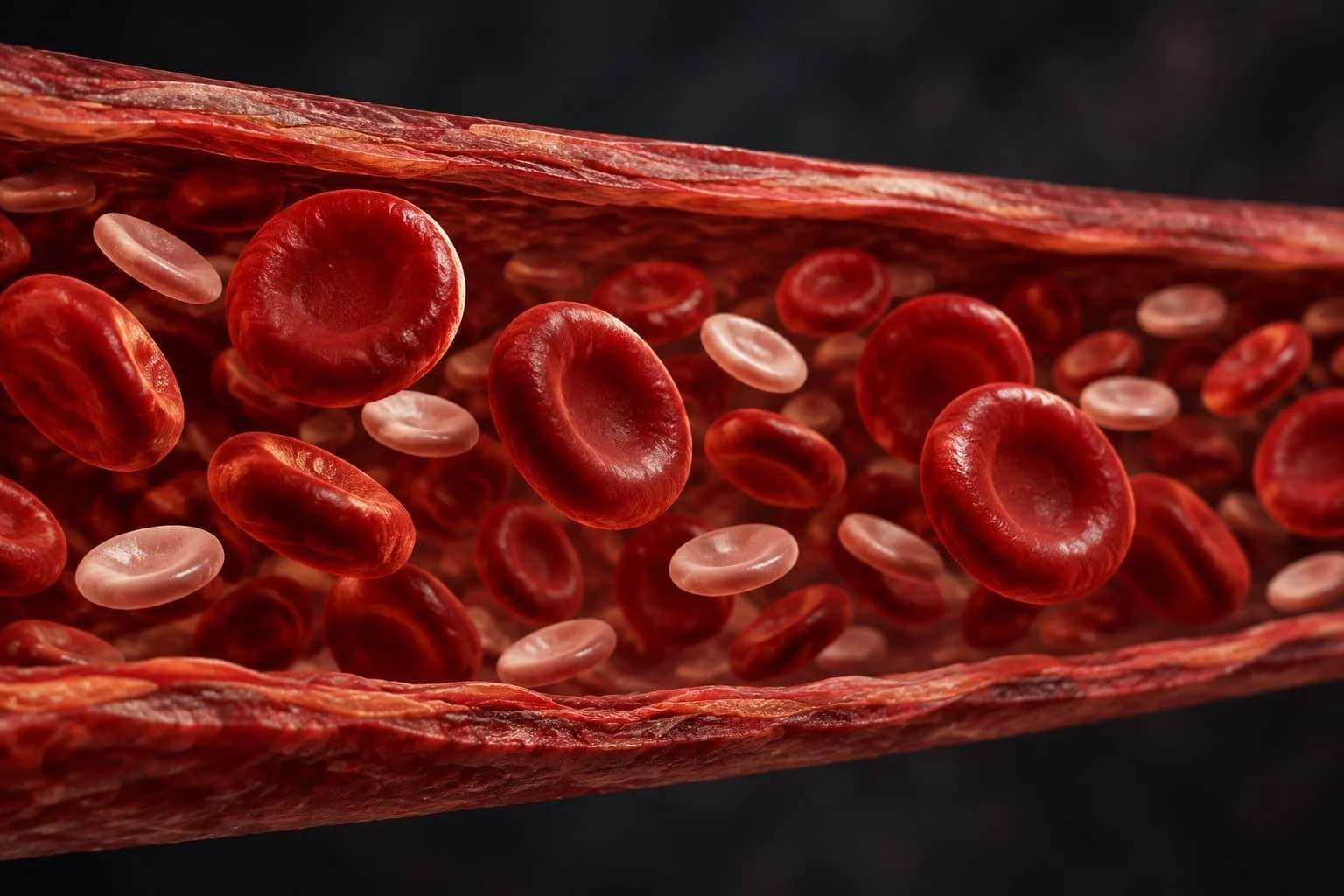
Stores in the liver and in macrophages are drawn down first, then the supply to the bone marrow tightens, red cells are produced smaller and paler, and only at the end does haemoglobin fall far enough to be called anaemia (Kolarš et al., 2025). Each step has consequences, which is why the seminar literature treats anaemia as one outcome of iron deficiency rather than as the condition itself (Pasricha et al., 2021). The anaemia at the end of that sequence is the most common form of anaemia in the world (Camaschella, 2015), which is why the two terms are so often used as if they meant the same thing.
Two different mechanisms produce the same laboratory picture. In absolute deficiency the body holds too little iron. In functional deficiency the stores are adequate but the iron is held back from the plasma, which happens during inflammation and chronic illness, so the marrow is starved while the liver remains loaded (Pasricha et al., 2021). The two can occur together, and telling them apart matters because they point to different underlying problems.
The older picture, in which small pale red cells were the first casualty of a shortage, has been revised. Work on iron handling shows that red cells and their precursors release iron back into circulation when the body runs short, propping up the supply to other tissues at the expense of red cell production (Pasricha et al., 2021). On that reading the anaemia is partly a consequence of the body protecting everything else first.
Anaemia is the visible end of iron deficiency, not its beginning, and much of the damage is done while the blood count still looks ordinary.
The scale is large. There were more than 1.2 billion cases of iron deficiency anaemia worldwide in 2016, and it ranks among the five leading causes of years lived with disability, the leading cause in low-income and middle-income countries, and the leading cause among women in 35 countries (Pasricha et al., 2021). Counting deficiency rather than anaemia pushes the figure higher still, to roughly a quarter of the world's population (Kolarš et al., 2025).
Anaemia itself affects more than 1.9 billion people, and its global prevalence fell only from 27.6% to 25.2% between 2000 and 2021, with the figure for women rising rather than falling (Atkinson et al., 2025). The distribution is uneven: 40% of children aged six to 59 months, 37% of pregnant women and 30% of women aged 15 to 49 are anaemic (WHO, 2025). Rich countries are not exempt. Among females in the United States aged 12 to 21, 38.6% were iron deficient while 6.3% had iron deficiency anaemia, so roughly five in six of those with the deficiency had a normal blood count (Weyand et al., 2023).
Why the body runs short of iron
Iron is lost slowly and absorbed slowly, so the balance tips through persistent small losses rather than sudden ones. Every millilitre of blood carries close to half a milligram of iron, which makes repeated bleeding the most efficient way to empty the stores (Pasricha et al., 2021). The causes group into four families.
- Blood loss: menstrual bleeding, bleeding anywhere in the gut, and regular whole blood donation.
- Too little absorbable iron in the diet, particularly where little or no meat is eaten.
- Impaired absorption, from coeliac disease, Helicobacter pylori infection, reduced stomach acid or surgery on the stomach.
- Raised requirements during growth, pregnancy and heavy endurance training.
In premenopausal women, iron stores track menstrual blood loss more closely than they track how much iron the diet contains. Heavy menstrual bleeding affects roughly one woman in five, and in referral populations about half of those women are iron deficient; up to a fifth of those who become anaemic turn out to have an underlying bleeding disorder (Pasricha et al., 2021). In men and in women past the menopause the picture changes: bleeding from the gut becomes the dominant cause, and it is often silent, so the deficiency itself is the first sign of it.
Regular blood donation belongs on the same list, and a large randomised trial made the size of the effect visible. Among 45,263 whole blood donors assigned to different intervals between donations, iron deficiency was present in 24% of men and 27% of women donating at the shortest interval, against 12% and 22% at the longest, with more reported tiredness and dizziness in the frequent groups (Di Angelantonio et al., 2017; Pasricha et al., 2021).
That is why the finding is investigated rather than simply corrected. Among patients with iron deficiency anaemia referred for endoscopy, a potentially bleeding lesion was found in 62%, including colorectal cancer in 11%. In the two years after such a diagnosis, gastrointestinal cancer was identified in 6% of men and 1% of women past the menopause, against 0.2% in comparable people without the deficiency (Pasricha et al., 2021).
Diet works differently from the way it is usually described. The iron in meat, bound in haem, is absorbed efficiently and is largely indifferent to what else is on the plate.
Iron from plants is absorbed less efficiently and far more variably than haem iron, and is strongly affected by other components of the meal: vitamin C raises absorption, while phytates in grains and seeds, calcium, and the tannins in tea and coffee lower it (Pasricha et al., 2021). Haem iron accounts for only about a tenth of intake among people who eat meat, yet supplies more than two fifths of the iron they actually absorb (Kolarš et al., 2025). Vegetarian diets leave ferritin roughly 30 micrograms per litre lower, with a much wider gap in men than in women (Pasricha et al., 2021).
Absorption can also fail for medical reasons. Stomach acid keeps iron soluble, so atrophic gastritis, acid-suppressing medicines and surgery on the stomach all reduce uptake, and deficiency follows gastrectomy or gastric bypass in about one patient in five. Coeliac disease turns up in roughly one in 31 patients with iron deficiency anaemia, often with no digestive symptoms at all (Pasricha et al., 2021).
What iron does and why absorption is the bottleneck
Most of the body's iron is working rather than stored. About two and a half grams sit in haemoglobin, with smaller amounts in myoglobin in muscle and in enzymes, and the surplus held in the liver (Pasricha et al., 2021). Beyond carrying oxygen, iron is required for DNA synthesis and repair, for mitochondrial function and for the production and handling of neurotransmitters, which is the reason a shortage shows up as more than a blood problem.
The flows explain why deficiency develops quietly. Producing red cells consumes about 25 milligrams of iron a day (Kolarš et al., 2025), but almost all of it is recycled from worn-out red cells by macrophages; only one to two milligrams are taken up from food in the duodenum to replace what is lost (Pasricha et al., 2021). Overall, between a twentieth and a seventh of the iron in a meal is absorbed (Kolarš et al., 2025). A system that tops up so slowly cannot respond quickly to a steady loss.
The gatekeeper is hepcidin, a hormone made in the liver. It binds ferroportin, the protein that exports iron out of cells, which keeps iron inside gut cells and macrophages instead of releasing it to the plasma. When stores fall, hepcidin is suppressed and absorption rises; when the immune system is active, hepcidin goes up and the plasma is starved of iron even though the stores are full (Pasricha et al., 2021). This single switch accounts for the difference between absolute and functional deficiency.
It also explains two things that look odd at first. Pregnancy raises iron absorption as much as ninefold between early and late gestation, because hepcidin is suppressed from the second trimester, which is how the body meets a demand it could not otherwise cover. In the other direction, people who are overweight absorb iron less well, with lower transferrin saturation and a raised risk of deficiency, again through higher hepcidin (Pasricha et al., 2021). Restrictive diets move several blood measures at once, as in the account of [what a mainly fruit diet does biochemically](/nutrition/mainly-fruit-diet-biochemical-effects-nutrition/).
How a shortage shows up in the body
The common complaints are unspecific: fatigue and lethargy, reduced concentration, dizziness, tinnitus, pallor and headache. Less familiar signs are more distinctive, including hair loss, dry skin, spooned nails, a smooth sore tongue, restless legs, and pica, the compulsive eating of substances such as ice or clay. In infants the deficiency can present as poor feeding and irritability (Pasricha et al., 2021).
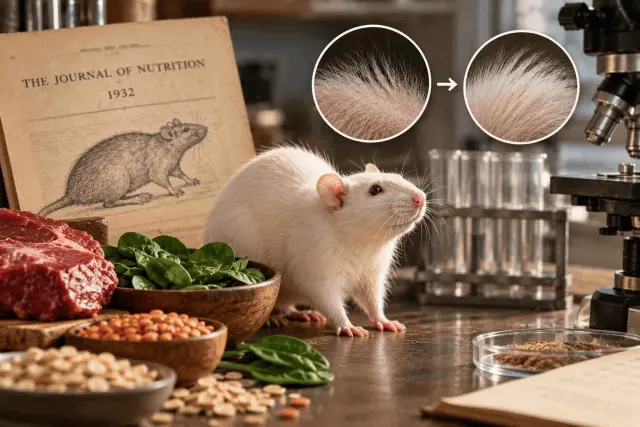
A historical [study of dietary iron deficiency and hair growth](/research/dietary-iron-and-hair-growth-cunninghams-1932-rat-study/) reported hair loss in young rats fed an iron-deficient diet (Cunningham, 1932). These findings concern an animal model and cannot establish the causes of hair loss in humans.
Because those symptoms fit many conditions, the useful evidence comes from trials that corrected the deficiency and measured what changed. A systematic review of adults iron deficient but not anaemic found less self-reported fatigue, a standardised mean difference of −0.38 across four trials and 714 participants, with no matching gain in measured physical capacity (Houston et al., 2018). Trials in women who were iron deficient but not tired showed no benefit either, which suggests the effect belongs to people who already have symptoms rather than to everyone with a low laboratory result (Pasricha et al., 2021).
Physical capacity responds measurably in some groups and not others. In women with iron deficiency, correcting it improved maximal exercise performance and lowered heart rate during submaximal work; in elite athletes parenteral iron did not improve maximal oxygen uptake. Restless legs symptoms improved in pooled trial data by about 3.6 points on the international rating scale (Pasricha et al., 2021).
In children the picture is divided by age. Meta-analyses find improved cognitive performance in children between five and twelve years, but little evidence of benefit for cognitive development in children under five, and least of all under two (Pasricha et al., 2021). That split is important, because the youngest children are the group in whom deficiency is most common and in whom the long-term stakes are assumed to be highest.
Pregnancy carries the clearest outcome data. A randomised trial in Kenya found that babies born to women given iron during pregnancy were on average 150 grams heavier and arrived about three and a half days later than those in the comparison group, and the effect on birthweight was confined to women who were iron deficient at the start, where it reached 234 grams (Pasricha et al., 2021). The pooled evidence agrees on the blood count: across 14 trials and 13,543 women, anaemia at term affected 4.0% of those given iron against 7.4% of those not, though the reviewers rated that certainty low (Finkelstein et al., 2024).
What selected studies show about iron deficiency. Note: these are group-level findings from different populations and outcomes, not individual risks
Study | Population or evidence | Reported findings | Main interpretation |
Weyand et al., 2023 | US females aged 12–21 years | Iron deficiency: 38.6%; iron deficiency anaemia: 6.3% | Iron deficiency is considerably more common than iron deficiency anaemia. |
Di Angelantonio et al., 2017 | Randomised INTERVAL trial; 45,263 blood donors | More frequent donation was associated with lower ferritin and more donation-related symptoms. | Repeated blood loss can reduce iron stores even in otherwise healthy donors. |
Houston et al., 2018 | Meta-analysis of 4 trials involving 714 participants for fatigue | Self-reported fatigue improved (SMD −0.38), without a corresponding improvement in objective physical capacity. | Improvement in perceived fatigue does not necessarily translate into better physical performance. |
Finkelstein et al., 2024 | Cochrane review; 14 trials involving 13,543 pregnant women for maternal anaemia | Maternal anaemia: 4.0% with iron supplementation versus 7.4% with placebo or no iron. | Iron supplementation may reduce anaemia during pregnancy, although certainty for this outcome was low. |
How iron status is measured, and why ferritin can mislead
The reference method is a bone marrow sample stained for iron, which is invasive and reserved for difficult cases. In practice the assessment rests on blood markers, with serum ferritin as the mainstay because it tracks the size of the stores (Pasricha et al., 2021). In a study of 203 healthy women, serum ferritin below 16 micrograms per litre identified absent bone marrow iron with 75% sensitivity and 98% specificity. Raising the threshold to 30 micrograms per litre increased sensitivity to 93% but reduced specificity to 75% (Hallberg et al., 1993).
The choice of cut-off is not a technicality, and one dataset shows exactly how much rides on it. In the same group of American adolescents and young women, the share counted as iron deficient moved from 17% at the strictest threshold to 77.5% at the loosest, with the headline figure of 38.6% sitting in between (Weyand et al., 2023). The biology did not change between those numbers; only the line drawn through it did.
Ferritin has a structural weakness: it rises during inflammation, so a normal result can conceal an empty store. Where inflammation is present, higher thresholds are used, and ferritin also climbs in liver disease, with population levels drifting upwards as obesity becomes more common (Pasricha et al., 2021). For that reason an iron profile rather than ferritin alone is recommended in the recent overview (Kolarš et al., 2025).
Other markers fill the gaps. Transferrin saturation below about a fifth indicates that little iron is reaching the tissues, in both absolute and functional deficiency. Soluble transferrin receptor reflects what the tissues are demanding and holds up better during inflammation, but the assays are not standardised between laboratories.
The proportion of pale red cells reflects restricted red cell production over the preceding two to three months (Pasricha et al., 2021). None of these is decisive on its own, which is why thresholds remain contested.
What the evidence supports and what it does not
Several things are firmly established. The physiology is well mapped: hepcidin and ferroportin govern how much dietary iron reaches the plasma, and that mechanism explains both ordinary deficiency and the withholding of iron during inflammation (Pasricha et al., 2021). The usual causes also differ by group: blood loss is the common route in men and postmenopausal women, and menstrual loss is common before the menopause. The burden figures are consistent across sources, and the limits of ferritin during inflammation are not in dispute (Kolarš et al., 2025).
Other questions remain open. The seminar states plainly that little high-quality evidence supports the specific ferritin thresholds in use, and that lower cut-offs for children, or different cut-offs for women and men, are not evidence-based (Pasricha et al., 2021).
Whether correcting deficiency helps people without symptoms is unsettled: the fatigue scores improve, the objective measures of physical capacity in the same review do not, and the trial base is four studies (Houston et al., 2018). The work in the youngest children has not shown the cognitive benefit that the epidemiology would predict. Nor is there agreement on whom to screen, a question raised directly by the finding that current screening guidance is aimed at preschool children and pregnant women while deficiency is widespread among adolescent girls (Weyand et al., 2023).
Even the headline attribution carries a wide margin. Iron deficiency is the leading cause of anaemia, but its share of cases ranges from about a tenth to about three fifths depending on the setting, because infection, other nutrient shortages and inherited red cell disorders take over in different places (Atkinson et al., 2025). A global figure for how much anaemia is iron-related is therefore a weaker statement than it sounds.
A second side rarely reaches general coverage: iron beyond what the gut can absorb is associated with oxidative stress and disturbance of the gut microbiota (Kolarš et al., 2025). The evidence therefore supports a clear conclusion with a boundary. Iron deficiency is common and carries real costs before anaemia appears, while the thresholds that define it, and the value of acting in people without symptoms, are still being worked out. Pregnancy draws on more than one store, a pattern also visible in [pregnancy and lactation associated osteoporosis](/health/pregnancy-lactation-associated-osteoporosis-womens-health-health/).
Frequently asked questions
What are the first signs of iron deficiency?
The early signs are unspecific: tiredness, low concentration, dizziness, headache, pallor and ringing in the ears. More distinctive signs include spooned nails, a smooth sore tongue, hair loss, restless legs and pica, the urge to eat substances such as ice or clay. None of them identifies the deficiency on its own.
Can you be iron deficient without being anaemic?
Yes, and that is the usual sequence. Stores empty before haemoglobin falls, so the blood count can read as normal while iron supply to other tissues is already restricted. Trials in adults with deficiency but no anaemia found that correcting it reduced fatigue in people who had symptoms, though not in those who did not.
Who is most likely to be affected?
Children under five, women before the menopause, and pregnant women carry most of the burden, along with populations in low-income and middle-income countries. Other groups at raised risk include regular blood donors, endurance athletes, people after stomach surgery, and anyone with undiagnosed coeliac disease or ongoing bleeding from the gut.
Does iron deficiency affect how children learn?
The evidence depends on age. Pooled trials show improved cognitive performance in children between five and twelve years when deficiency is corrected. In children under five, and particularly under two, the benefit has not been demonstrated, even though deficiency is most common at those ages. That gap is still unexplained.
Can men become iron deficient?
Yes, though less often than women before the menopause. In older men especially, slow bleeding from the gut is a common route rather than diet, so the finding is investigated rather than simply corrected. In the two years after such a diagnosis, gastrointestinal cancer was identified in 6% of men, against 0.2% of comparable people without the deficiency.
Sources
- Pasricha SR, Tye-Din J, Muckenthaler MU, Swinkels DW. Iron deficiency. The Lancet. 2021;397(10270):233–248. DOI 10.1016/S0140-6736(20)32594-0.
- Kolarš B, Mijatović Jovin V, Živanović N, et al. Iron deficiency and iron deficiency anemia: a comprehensive overview of established and emerging concepts. Pharmaceuticals. 2025;18(8):1104. DOI 10.3390/ph18081104.
- Camaschella C. Iron-deficiency anemia. The New England Journal of Medicine. 2015;372(19):1832–1843. DOI 10.1056/NEJMra1401038.
- World Health Organization. Anaemia. Fact sheet, 10 February 2025. https://www.who.int/news-room/fact-sheets/detail/anaemia
- Atkinson SH, Suchdev PS, Bode M, et al. Getting back on track to meet global anaemia reduction targets: a Lancet Haematology Commission. The Lancet Haematology. 2025;12(9):e717–e767. DOI 10.1016/S2352-3026(25)00146-2.
- Weyand AC, Chaitoff A, Freed GL, Sholzberg M, Choi SW, McGann PT. Prevalence of iron deficiency and iron-deficiency anemia in US females aged 12–21 years, 2003–2020. JAMA. 2023;329(24):2191–2193. DOI 10.1001/jama.2023.8020.
- Finkelstein JL, Cuthbert A, Weeks J, et al. Daily oral iron supplementation during pregnancy. Cochrane Database of Systematic Reviews. 2024;(8):CD004736. DOI 10.1002/14651858.CD004736.pub6.
- Houston BL, Hurrie D, Graham J, et al. Efficacy of iron supplementation on fatigue and physical capacity in non-anaemic iron-deficient adults: a systematic review of randomised controlled trials. BMJ Open. 2018;8(4):e019240. DOI 10.1136/bmjopen-2017-019240.
- Di Angelantonio E, Thompson SG, Kaptoge S, et al. Efficiency and safety of varying the frequency of whole blood donation (INTERVAL): a randomised trial of 45 000 donors. The Lancet. 2017;390(10110):2360–2371. DOI 10.1016/S0140-6736(17)31928-1.
- Cunningham IJ. Influence of dietary iron on hair and wool growth. New Zealand Journal of Agriculture. 1932;44:335–337. archive record 19321401596
- Hallberg L, Bengtsson C, Lapidus L, Lindstedt G, Lundberg PA, Hultén L. Screening for iron deficiency: an analysis based on bone-marrow examinations and serum ferritin determinations in a population sample of women. British Journal of Haematology. 1993;85(4):787–798. DOI 10.1111/j.1365-2141.1993.tb03225.x.

Elias R. Westbrook — author
Elias R. Westbrook is academic background in human nutrition and nutritional sciences, with a focus on food composition, nutrient intake, dietary patterns, and the relationship between foods and nutritional health. For Cabdirect, this persona is intended to co...
This article is for general information and is not medical advice. It was reviewed for accuracy by a qualified clinician; decisions about your health should be made with your own doctor.
Related
Mainly fruit diet study: biochemical effects in 1971

Pregnancy-Associated Osteoporosis: Fractures, Causes and Care
Dietary Iron and Hair Growth - Cunningham’s 1932 Rat Study
Does Glycogen Hold 3 g of Water? What the 1941 Rat Study Found
Sport Nutrition: Energy, Fuel and Athletic Performance

How Sensory-Specific Satiation Shapes Appetite and Food Intake