














How long do bees live: workers, drones and queens compared
Summer workers usually live 15–38 days, winter workers 150–200 days, drones vary by season and population, and queens usually live 1–2 years (Remolina and Hughes, 2008; Otis, 2026). Queens, workers and drones share the same colony, yet queens can live tens of times longer than short-lived summer workers (Remolina and Hughes, 2008).
What follows sets the castes side by side, explains why summer workers wear out so fast, why the bees that see a colony through winter age so slowly and why a queen developing from a fertilised egg, like her worker daughters, can outlive them by years. The account draws on a review of queen longevity, field records of how foragers die, laboratory experiments showing that the protein vitellogenin helps protect worker bees against oxidative stress, and recent experiments on how colonies decide which drones to keep.
How long do bees live?
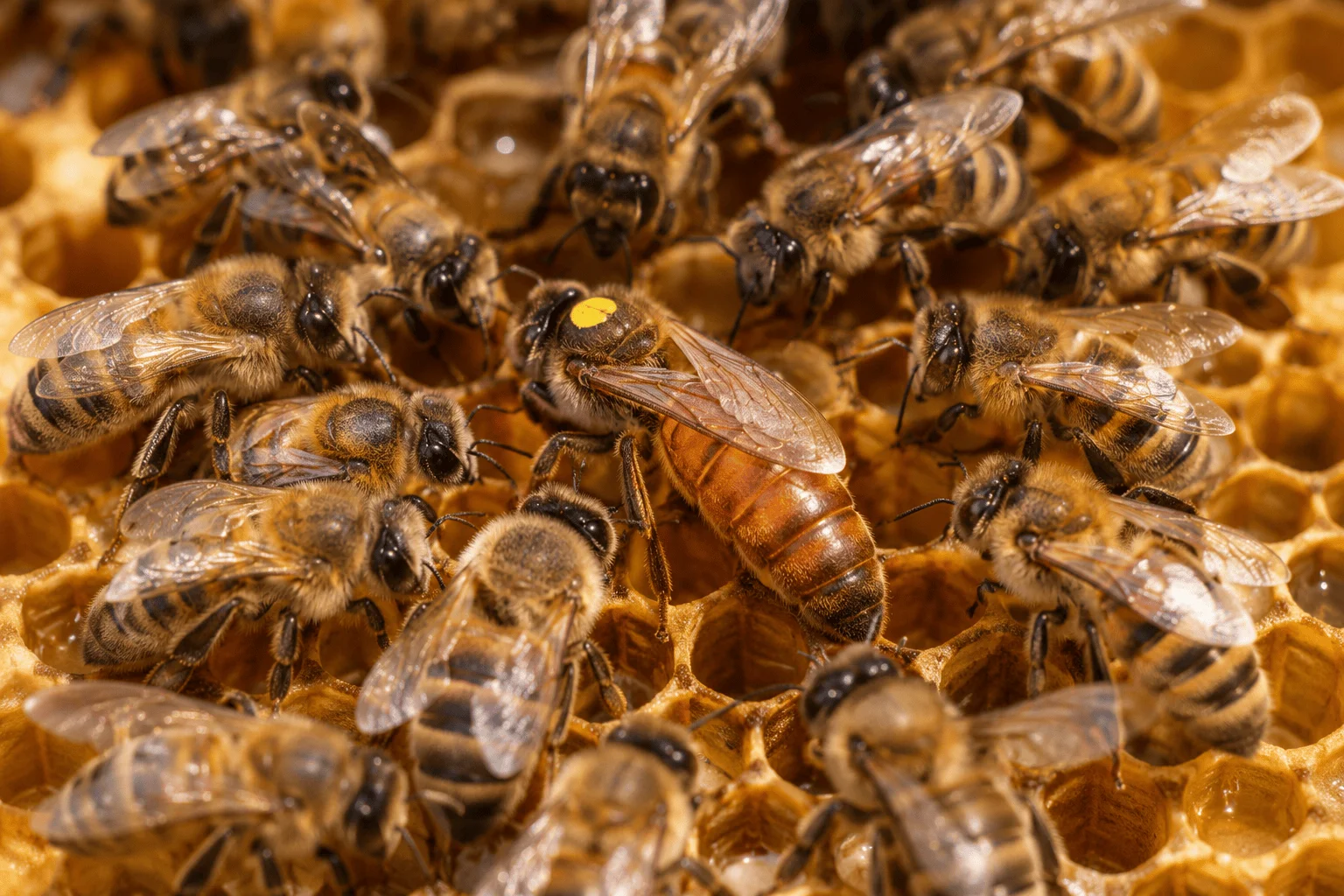
Asking about a bee’s lifespan is a little like asking how long a soldier serves: the answer turns on the job. In the western honey bee, Apis mellifera, a colony contains one egg-laying queen, thousands of normally non-reproductive female workers and, during the warmer months, males called drones. Each type follows its own timetable from egg to death.
Social caste organisation also appears in other insects. For comparison, [army-ant colonies](/animals/army-ants-social-predation-tropical-ecology-animals) divide reproductive and worker functions within a coordinated society, although their biology does not establish the lifespan patterns measured in honey bees.
Remolina and Hughes (2008) gathered the classic measurements in a review titled “Evolution and mechanisms of long life and high fertility in queen honey bees”. Drawing on studies stretching back to the 1930s, they reported adult lifespans of 15–38 days for summer workers, 30–60 days for workers emerging in spring or autumn and 150–200 days for winter workers. Remolina and Hughes (2008) reported 21–32 days for drones in spring and summer, but a later review found substantial seasonal and geographic variation, including summer averages of 8–18 days in France and Japan and autumn averages of 32–42 days in Japan (Otis, 2026). Queens usually lived one to two years, with a recorded maximum of eight.
Bee | Typical adult lifespan | Source |
Summer worker | 15–38 days | Remolina and Hughes, 2008 |
Spring or autumn worker | 30–60 days | Remolina and Hughes, 2008 |
Winter worker | 150–200 days, sometimes close to a year | Remolina and Hughes, 2008; Münch et al., 2013 |
Drone | Varies by season and population; reported summer averages include 8–18 days | Otis, 2026 |
Queen | 1–2 years, recorded maximum 8 years | Remolina and Hughes, 2008 |
These are adult figures. Development inside the wax cell adds to them: about 16 days for a queen, 21 for a worker and 24 for a drone from egg to emergence (Remolina and Hughes, 2008).
How long do worker bees live in summer?
A summer worker’s short life is not a sign of a poorly built body. It reflects a career plan. Young workers start out inside the hive, cleaning cells, feeding larvae and processing food. Later they switch to foraging, and that switch marks the beginning of the end.
Field observations show how short the foraging phase can be. Dukas (2008) followed 611 marked foragers from two observation hives in Algonquin Provincial Park, Ontario, during the summer of 2007. The bees began foraging at an average age of 12.8 days and then survived for an average of 6.76 days as foragers. In that study, workers spent roughly two-thirds of their measured adult lifespan in the pre-foraging phase and then averaged about a week as foragers.
Risk outside the hive
Much of the dying happens out in the field. In the study “Survivorship of foraging honey bees” (1997), Visscher and Dukas tracked individual foragers under natural conditions and found that the chance of death per unit of time stayed roughly constant, regardless of how old a bee was. Most bees vanished before showing signs of old age. The authors argued that hazards unrelated to age, such as predators, accidents and weather, set the limit for many foragers rather than an exhausted energy budget.
Dukas’s later analysis added a twist. Alongside a constant background risk, mortality also climbed with age among foragers, a pattern consistent with genuine wear (Dukas, 2008). Both forces appear to act together: a forager faces daily danger from the moment she leaves the hive, and her body also deteriorates the longer she keeps flying.
Signs of ageing in foragers
The wear can be measured in the brain as well as in survival. Münch, Kreibich and Amdam (2013) reviewed work showing that foragers typically die about 7–10 days after starting to forage and that their ability to learn new scents declines after about two weeks of foraging. In their own experiments, bees from broodless colonies did not show the usual decline in learning or increase in mortality at that point. The authors suggested that reduced brood-related cues may have delayed behavioural senescence by lowering flight activity, but the causal pathway was not established (Münch et al., 2013).
The timing of the switch to foraging matters. Rueppell and colleagues (2007) concluded from a study of worker life histories that the age at which a worker begins foraging is a major determinant of how long it lives. A bee that starts flying early tends to die early, and one held back in hive duties tends to last longer.
Why do winter bees live longer?
In temperate climates, colonies raise a different kind of worker as autumn approaches. These winter bees appear as brood rearing winds down, and they carry the colony through to spring. Their typical adult lifespan of 150–200 days is several times that of a summer worker (Remolina and Hughes, 2008), and Münch and colleagues (2013) noted that some can survive for almost a year.
The difference is not determined by genetics alone. Winter bees and summer bees can be sisters, and the development of the long-lived winter phenotype is strongly influenced by colony conditions. As brood rearing declines or stops, workers can develop and maintain a long-lived physiological state (Münch et al., 2013). In effect, the colony stops spending its workers on nursing and foraging and banks them for the cold months.
A protective protein
Much of the explanation centres on vitellogenin, a protein made in the abdominal fat body. In egg-laying insects it is a yolk precursor, but functionally sterile honey bee workers produce it too, and long-lived workers carry large amounts. In the study “Reproductive protein protects functionally sterile honey bee workers from oxidative stress” (2006), Seehuus and colleagues showed that vitellogenin activity helps protect workers against oxidative stress, an imbalance in redox processes that can cause cellular damage over time. Workers with higher vitellogenin activity survived better after paraquat exposure, and experimentally reducing vitellogenin lowered survival under the same oxidative-stress challenge (Seehuus et al., 2006).
Foragers have high levels of juvenile hormone and low levels of vitellogenin, whereas long-lived workers and mature queens generally show low juvenile hormone and high vitellogenin; newly emerged virgin queens can have elevated levels of both (Remolina and Hughes, 2008; Corona et al., 2007). The same hormonal seesaw that moves a worker from nursing to foraging therefore also appears to switch her from a slow-ageing to a fast-ageing state.
Ageing that can be reversed
One of the more unusual findings is that ageing in workers can partly run backwards. When a colony loses nurse bees, some foragers can return to nursing duties, and this behavioural reversion can reverse or delay several markers of functional ageing (Münch et al., 2013). Immune changes linked to foraging have also been reported to reverse when bees resume hive work (Remolina and Hughes, 2008). How far this reversal extends is still being studied, but it shows that, in honey bees, social role can override chronological age.
How long do drones live?
Drones are the colony’s males. They do not forage, build comb or defend the nest, and their reproductive role is to mate with virgin queens, usually from other colonies. Adult drone lifespan varies substantially with season and population, with a 2026 review reporting summer averages of 8–18 days in some populations and longer averages in autumn (Otis, 2026). Drones reach sexual maturity at roughly two weeks of age, although the timing varies (Czekońska et al., 2019).
Mating is fatal for the few that succeed. A drone dies after successfully mating with a queen. Drones that do not mate can return to a colony to replenish their energy reserves and make repeated mating flights until they die; in managed apiaries, some drones drift into non-natal colonies (Gilchrist et al., 2024; Otis, 2026). The duration of this period varies substantially among seasons and populations (Otis, 2026).
Size and survival
Not all drones have the same prospects. In the study “Body mass but not wing size or symmetry correlates with life span of honey bee drones” (2019), Czekońska and colleagues weighed drones as they emerged and followed them in the colony. Heavier drones more often reached sexual maturity and lived longer than lighter ones, while wing size and wing symmetry did not predict survival.
Eviction by workers
Young drones are initially fed by workers, but after about a week they can feed themselves from honey cells. Nevertheless, drones remain dependent on the colony's food reserves, making them costly to maintain when resources become scarce (Free, 1957; Gilchrist et al., 2024). In the study “To house or oust: honey bee (Apis mellifera) colonies can evaluate and evict drones of low quality” (2024), Gilchrist and colleagues introduced 571 drones into small queenright colonies. Workers evicted immune-challenged drones more often than control drones, and evicted drones were smaller than retained drones regardless of immune status (Gilchrist et al., 2024).
In the worker-free colony experiment, researchers found no statistically significant difference in the proportion of drones that left between the experimental and control groups. Together with the eviction experiments, these findings support the role of workers in selectively removing drones from colonies (Gilchrist et al., 2024).
Citing earlier studies, Gilchrist and colleagues (2024) noted that drone eviction becomes more likely when food resources are scarce, particularly in autumn. In temperate climates, colonies typically expel their drones as they prepare for winter. A drone’s lifespan, then, is set partly by the colony’s budget and partly by the drone’s own condition.
Why does a queen bee live so long?
The queen is the most striking case. She hatches from the same kind of fertilised egg as a worker, yet she can live ten times longer (Remolina and Hughes, 2008). The difference starts with diet. Larvae destined to become queens are fed abundant royal jelly, while worker larvae receive a mix of glandular secretions, honey and pollen, and queen larvae also have high levels of juvenile hormone during development (Remolina and Hughes, 2008).
Long life in queens comes without a trade-off in fertility. A laying queen can produce 1,500–2,000 eggs a day (Remolina and Hughes, 2008). In many animals, heavy investment in reproduction is expected to shorten life, but in honey bee queens long life and high fertility go together (Remolina and Hughes, 2008).
What makes queens age slowly
In the study “Vitellogenin, juvenile hormone, insulin signaling, and queen honey bee longevity” (2007), Corona and colleagues compared queens and workers across several age groups, including age-matched groups at one day, one week and one month. Vitellogenin expression increased with age in queen head and thoracic fat body, whereas abdominal vitellogenin mRNA was highest in newly emerged queens and lower thereafter (Corona et al., 2007). Queens resisted oxidative stress better than workers of comparable age. Old queens also showed lower expression of an insulin-like peptide and its putative receptors in the head than old workers, a pattern linked to longer life in other animals.
These findings are consistent with a model in which vitellogenin, juvenile hormone regulation and reduced insulin-like signalling may contribute to queen longevity, but the causal role of insulin-like signalling remains hypothetical (Corona et al., 2007). Other work reviewed by Remolina and Hughes (2008) suggests that queens’ cell membranes may resist oxidative damage better, although the full picture is not settled. Signals passing between the queen and her workers, including [queen pheromones](/animals/pheromones-social-insect-chemical-communication-animals), also shape how the colony cares for her.
What is proven about bee lifespans, and what is not
Several points about honey bee lifespans rest on solid evidence:
- Adult lifespan varies considerably by caste and season, from roughly one to several weeks in summer drones and workers to one or two years in queens (Remolina and Hughes, 2008; Otis, 2026).
- Summer foragers typically survive for about a week after they begin foraging. Most foragers in Visscher and Dukas (1997) died before detectable senescence, consistent with a major role for age-independent mortality, while Dukas (2008) later found that mortality also increased with forager age.
- Winter workers live for months, a shift linked to the end of brood rearing (Münch et al., 2013).
- Vitellogenin protects workers against oxidative stress and is especially abundant in queens (Seehuus et al., 2006; Corona et al., 2007).
- In resource-limited queenright mini-colonies, workers evicted immune-challenged and smaller drones at higher rates, although Gilchrist et al. (2024) cautioned that colony choosiness may differ in large, healthy colonies during peak season.
In a honey bee colony, lifespan is strongly influenced by caste, nutrition and environmental conditions rather than determined by genetics alone. A fertilised egg can develop into a worker that lives for weeks or a queen that survives for years.
Several questions remain open. How insulin-like signalling, juvenile hormone and vitellogenin interact to produce queen longevity has been only partly tested. The maximum reported queen lifespan of eight years comes from an unusually high longevity report cited by Remolina and Hughes (2008), and queen lifespans in managed hives may also be shortened when beekeepers replace queens.
The extent to which ageing can be reversed in workers, and what limits it, is not fully understood. Most lifespan figures come from temperate colonies of one species, so they may not apply to bees elsewhere or to other kinds of bees. For readers following [insect biology](/animals?sub=entomology) and [animal behaviour](/animals?sub=behaviour), the honey bee offers a natural example of how nutrition, social role and colony conditions can shape lifespan: queens and workers develop from fertilised eggs but follow different developmental pathways, resulting in striking differences in longevity.
Frequently asked questions
What are the stages of the bee life cycle?
Every honey bee passes through four stages: egg, larva, pupa and adult. The time from egg to emergence differs by caste, at about 16 days for a queen, 21 days for a worker and 24 days for a drone (Remolina and Hughes, 2008). Adult life then begins, and its length depends on caste and season.
How old is a worker bee when it starts foraging?
In a field study in Ontario, workers began foraging at an average age of 12.8 days, after spending their first days on tasks inside the hive (Dukas, 2008). The age varies with colony needs, and workers that start foraging earlier tend to have shorter lives (Rueppell et al., 2007).
How many eggs does a queen bee lay?
A laying queen can produce 1,500–2,000 eggs a day during the active season (Remolina and Hughes, 2008). Combined with a typical lifespan of one to two years, that output makes her the primary source of new bees in a normally functioning colony, including workers, drones and future queens.
How many drones does a queen mate with?
Virgin queens typically complete one to three mating flights and average about 12 matings, although mating number varies substantially (Otis, 2026). The drones that succeed die after mating (Gilchrist et al., 2024), so each male contributes to only one queen.
Sources
- Remolina, S.C., Hughes, K.A. Evolution and mechanisms of long life and high fertility in queen honey bees. Age. 2008;30(2–3):177–185. DOI 10.1007/s11357-008-9061-4
- Dukas, R. Mortality rates of honey bees in the wild. Insectes Sociaux, 2008, 55(3), 252–255. DOI 10.1007/s00040-008-0995-4
- Visscher, P.K., Dukas, R. Survivorship of foraging honey bees. Insectes Sociaux, 1997, 44(1), 1–5. DOI 10.1007/s000400050017
- Münch, D., Kreibich, C.D., Amdam, G.V. Aging and its modulation in a long-lived worker caste of the honey bee. Journal of Experimental Biology, 2013, 216(9), 1638–1649. DOI 10.1242/jeb.078915
- Rueppell, O., Bachelier, C., Fondrk, M.K., Page, R.E. Regulation of life history determines lifespan of worker honey bees (Apis mellifera L.). Experimental Gerontology, 2007, 42(10), 1020–1032. DOI 10.1016/j.exger.2007.06.002
- Seehuus, S.C., Norberg, K., Gimsa, U., Krekling, T., Amdam, G.V. Reproductive protein protects functionally sterile honey bee workers from oxidative stress. Proceedings of the National Academy of Sciences of the USA, 2006, 103(4), 962–967. DOI 10.1073/pnas.0502681103
- Corona, M., Velarde, R.A., Remolina, S., Moran-Lauter, A., Wang, Y., Hughes, K.A., Robinson, G.E. Vitellogenin, juvenile hormone, insulin signaling, and queen honey bee longevity. Proceedings of the National Academy of Sciences of the USA, 2007, 104(17), 7128–7133. DOI 10.1073/pnas.0701909104
- Czekońska, K., Szentgyörgyi, H., Tofilski, A. Body mass but not wing size or symmetry correlates with life span of honey bee drones. Bulletin of Entomological Research, 2019, 109(3), 383–389. DOI 10.1017/S0007485318000664
- Gilchrist, I.R., Nixon, J.M., Shultz, R.R., Ginzel, M.D., Harpur, B.A. To house or oust: honey bee (Apis mellifera) colonies can evaluate and evict drones of low quality. Behavioral Ecology and Sociobiology, 2024, 78, 47. DOI 10.1007/s00265-024-03461-8
- Free, J.B. The food of adult drone honeybees (Apis mellifera). British Journal of Animal Behaviour. 1957;5(1):7–11. DOI 10.1016/S0950-5601(57)80038-0.
- Otis, G.W. Where do honey bees (Apis mellifera) mate? Apidologie. 2026;57:3. DOI 10.1007/s13592-025-01237-1

Lena Okonjo — author
Lena Okonjo is a Zoology graduate with a master’s-level specialization in Animal Behaviour. Her earlier work involved preparing summaries of field studies on animal behaviour and insects for general audiences. At Cabdirect, Lena covers animal behaviour, insect...
Related
Insect pheromones and chemical communication in social insects
Army Ants: Social Predation, Nomadism and Tropical Ecology
Mites That Ride Bark Beetles: Four Species Described in 2000
Imperial moth decline and host ecology on Martha's Vineyard
Biting midges: biology, disease transmission and control
Blackflies: biology, life cycle, ecology and disease-vector roles
Monarch butterfly migration and how monarchs find their way