











What happens in the follicular phase, the first half of the cycle
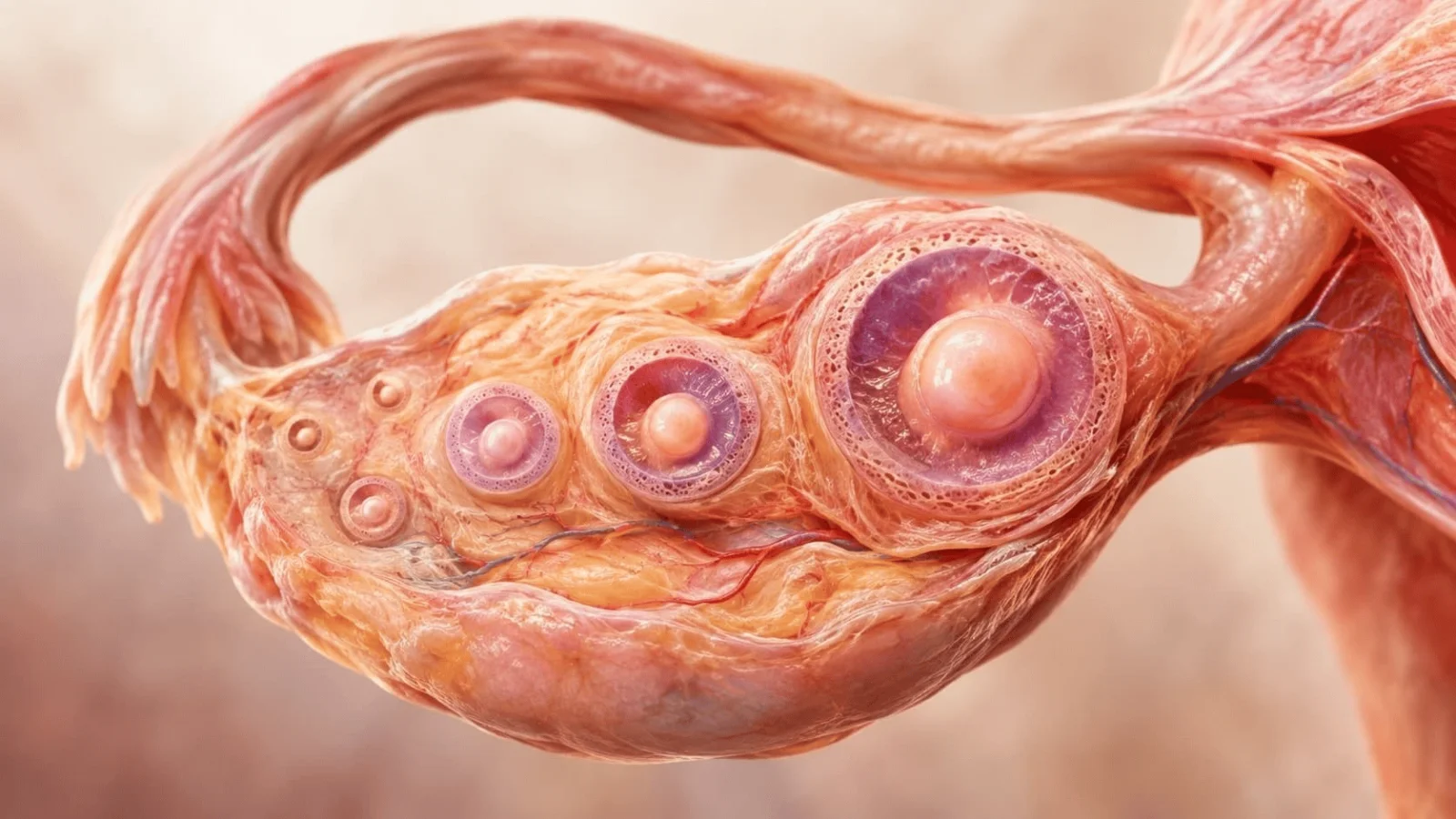
In ovulatory cycles, the ovarian follicular phase begins on the first day of menstrual bleeding and continues to ovulation. FSH promotes follicle growth while rising oestrogen influences endometrial tissue, changes that take place as the cycle moves towards ovulation rather than on one fixed timetable. The phase can differ in duration.
A tissue specimen and a menstrual diary provide fundamentally different views of reproductive physiology. Sampling an ovary makes it possible to examine a follicle's biochemistry at collection; urine-based hormonal measurements and prospective records of bleeding or mucus instead help researchers reconstruct when events occurred. Neither approach captures all the processes of a cycle.

Evidence last checked 20 de nov. 2026 · 13 min
What the follicular phase is and when it starts
The ovarian and uterine timelines overlap. Mihm et al. (2011) examine how the endometrium alternately sheds and grows in response to ovarian steroid activity, while Hawkins and Matzuk (2008) describe the regulatory links between the hypothalamus, anterior pituitary, ovary and endometrium that coordinate the wider reproductive cycle.
The cycle is dated from an observable event. Day one begins when uterine blood and tissue are discharged, as NICHD (2017) describes. That date also marks the beginning of the ovarian interval labelled follicular in StatPearls (2024), although follicular development itself is not observed in the menstrual discharge.
Menstruation and the ovarian cycle
The physiological events that lead to bleeding begin before the calendar turns to a new cycle. Hawkins and Matzuk (2008) associate the loss of progesterone and oestrogen in the absence of pregnancy with narrowing of the spiral arteries supplying the endometrium. At the transition to the next follicular stage, Mihm et al. (2011) describe an increase in FSH and the start of growth and inhibin B secretion by a cohort of follicles.
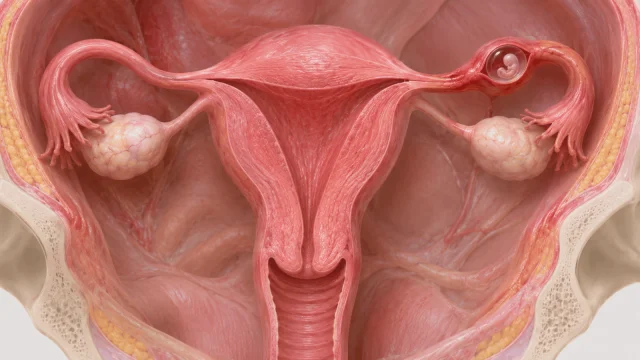
The structures involved are separate. During a period, material is lost from the uterine lining; in the ovary, follicles containing eggs undergo development in response to hormonal changes, according to NICHD (2017). Mihm et al. (2011) associate endometrial shedding and proliferation with steroid activity.
The transition from follicular to luteal phase
Selection happens before release. Mihm et al. (2011) locate the emergence of the eventual ovulatory follicle in the middle of the follicular phase, during the developmental period preceding egg release. The stage ends at ovulation, not upon reaching a predetermined menstrual day (StatPearls, 2024).
After ovulation, the corpus luteum becomes an ovarian source of progesterone, oestradiol and inhibin A, responding to pulses of LH (Mihm et al., 2011). This hormonal activity belongs to the luteal stage, the part of the ovarian cycle following egg release (StatPearls, 2024).
What happens to ovarian follicles before ovulation
An ovulatory follicle emerges from a population, rather than developing in isolation from the beginning. Mihm et al. (2011) link the rise of FSH at the changeover between cycles to growth of several follicles and secretion of inhibin B. Selection of the follicle that will ovulate occurs later, in the middle of the follicular phase.
Follicles may enter growth in successive waves within a single cycle. In the patterns reviewed by Mihm et al. (2011), cycles containing three waves had their increases in oestradiol and LH later than cycles with fewer waves. Consequently, follicular-wave patterns do not all fit one calendar-based timetable.
Recruitment and selection of follicles
The initial response to FSH does not single out the follicle destined to ovulate. Mihm et al. (2011) place its selection around the midpoint of the follicular interval, followed by increasing secretion of oestradiol and inhibin A as the selected follicle grows.
For the unselected members of the cohort, hormone feedback changes their prospects. StatPearls (2024) describes a fall in FSH attributed to oestradiol and inhibin B, followed by degeneration of the non-dominant follicles.
Maturation of the dominant follicle
The 2018 study by Kristensen and colleagues was based on ovarian material collected for fertility-preservation cryopreservation. Almost 1,000 small antral follicles were characterised in the collected tissue. The data represent comparisons between specimens at the time of collection, not repeated observation of individual follicles over a complete cycle.
Size was associated with different patterns for the two measured hormones. In the tissue analysed by Kristensen et al. (2018), intrafollicular inhibin B reached its highest concentrations at 9–11 mm, whereas oestradiol began rising around 8–10 mm. Both observations concern sampled human follicles and their local contents.
Aromatase expression was particularly strong in the selected follicle described by Kristensen et al. (2018). Its higher oestradiol production was associated with changes in local AMH and inhibin signalling. These observations characterise ovarian tissue obtained for the study and do not provide a continuous account of circulating hormones during a menstrual cycle.
How FSH, oestrogen and LH control the follicular phase
Hormonal signals travel in both directions. Hawkins and Matzuk (2008) describe the release of FSH and LH from the anterior pituitary following stimulation by hypothalamic GnRH, within a system also regulated by ovarian steroids.
FSH and early follicle growth
FSH output is not constant throughout maturation. Mihm et al. (2011) link its initial rise to new follicle growth and inhibin B secretion. Later, oestradiol and inhibin B suppress FSH through feedback described in StatPearls (2024).
Size-related biochemical differences can be measured directly in follicular fluid. Kristensen et al. (2018) found variation in intrafollicular inhibin B across follicle diameters and described alterations involving aromatase expression and oestradiol production during selection. Such measurements concern local ovarian tissue rather than circulating hormone patterns across a woman's cycle.
Oestradiol feedback and the LH surge
Oestradiol secretion increases as the future ovulatory follicle matures (Mihm et al., 2011). At a sufficiently high concentration, its effect on pituitary feedback changes: StatPearls (2024) describes a positive signal that triggers an LH surge together with an FSH surge.
Urinary LH tests observe the endocrine signal rather than the release of the egg itself. In the app-based records analysed by Grieger and Norman (2020), a positive result established the recorded hormonal boundary, and ovulation was estimated for the following day. Wilcox et al. (2000) caution that biological hormone markers cannot locate ovulation with exact certainty.
The sequence can occur later in cycles containing additional follicular waves. Mihm et al. (2011) describe a later LH surge and oestradiol rise when three waves were present, relative to cycles with fewer waves.
How long the follicular phase lasts and why it varies
A study of phase length must first specify what counts as the ovulatory endpoint. Whereas menstrual bleeding supplies the first date (StatPearls, 2024), the later date has been assigned using mucus records (Najmabadi et al., 2020), urinary steroid metabolites (Wilcox et al., 2000) or app-reported LH results (Grieger and Norman, 2020). These biological markers estimate the event without showing the egg's release directly.
Short and long follicular phases
Daily diaries, rather than ultrasound observation of follicular rupture, supplied the timing data in the pooled cohorts analysed by Najmabadi et al. (2020). The participants were 581 women aged 18–40 without known subfertility, whose records covered 3,324 cycles. Investigators assigned the final follicular day to the reported peak in cervical mucus.
In that pooled analysis, the estimated follicular interval averaged 18.5 days; the luteal interval averaged 11.7 days (Najmabadi et al., 2020). The mean of 30.3 days for the complete cycle describes these same records and the investigators' chosen mucus-based marker.
Using app-based records, Bull et al. (2019) reported a mean of 16.9 days before ovulation and 12.4 days afterwards. The earlier mucus-based cohort of Najmabadi et al. (2020) used another method of identifying the phase boundary, so the two sets of means describe different observation frameworks.
Age and variation between cycles
The age contrast was subgroup-specific. In the pooled analysis of Najmabadi et al. (2020), participants aged 30 or above who had not previously given birth had shorter follicular intervals than comparable nulliparous participants below 30. Other reproductive histories were not covered by that comparison.
A single average can conceal large differences in the same participant's records. In Najmabadi et al. (2020), 41.7% of the women showed a gap of more than 7 days between their longest and shortest follicular phases. The estimate remains tied to a definition of ovulation based on peak cervical mucus.
Selection for apparently regular cycles did not eliminate subsequent variation. Henry and colleagues (2024) followed 53 premenopausal participants whose cycles had met specified normal-length and ovulatory criteria at enrolment. Within each woman, changes in the preovulatory interval exceeded the variation measured after ovulation.
These cohorts were not studies of menopause. Najmabadi et al. (2020) reported a difference between two age groups of nulliparous women, a finding that does not establish the path or timing of a menopausal transition for an individual. Perimenopause and hormone changes are considered in separate research on that life stage.
What menstrual cycle studies measured
The studies assigned ovulation dates using different biological observations. Najmabadi et al. (2020) relied on peak mucus, Wilcox et al. (2000) on urinary steroid metabolites and Grieger and Norman (2020) on participant-entered LH test results. Schmalenberger et al. (2021) describe why methods for assigning menstrual phases vary across studies.
Study | Population or records | Marker or observation | Reported finding |
Najmabadi et al., 2020 | 581 women; 3,324 cycles | Peak cervical mucus for estimated ovulation | Mean follicular phase 18.5 days. |
Bull et al., 2019 | App-based menstrual records | Basal body temperature; optional urinary LH tests | Mean follicular phase 16.9 days. |
Henry et al., 2024 | 53 premenopausal women | Prospective ovulatory-cycle observations | Greater within-woman follicular than luteal variation. |
Wilcox et al., 2000 | 221 enrolled; 696 cycles from 213 women | Urinary oestrogen and progesterone metabolites | Fertile-window days varied across the cycle. |
Grieger and Norman, 2020 | App users recording menstrual dates | Menstrual dates for cycle length; LH tests for ovulation (subset) | Only 16.32% of users had a median 28-day cycle. |
In the records analysed by Grieger and Norman (2020), only 16.32% of 1,579,819 app users had a median cycle length of 28 days. This proportion describes complete menstrual cycles, without separating the preovulatory interval. LH tests logged by some participants provided an additional, indirect indication of the cycle's ovarian transition.
Bleeding starts the written cycle. NICHD (2017) identifies its first day from that observation, whereas research must usually infer the ovarian endpoint using hormone or physiological markers that differ between studies (Schmalenberger et al., 2021). Wilcox et al. (2000) caution that an ovulation date inferred from urinary hormones cannot be treated as an exact observation of the egg's release.
Which follicular phase symptoms and body changes occur
The onset of bleeding reflects events in uterine tissue. NICHD (2017) describes the discharge of endometrial blood and tissue separately from follicular maturation. Symptoms offer another, less certain form of evidence: Schmalenberger et al. (2021) found that recalled mood patterns could differ from those entered as events occurred.
Bleeding and physical sensations
The hormonal events preceding menstruation belong to the closing part of the previous cycle. Hawkins and Matzuk (2008) relate the fall in oestrogen and progesterone when pregnancy has not occurred to constriction of vessels supplying the endometrium. NICHD (2017) dates the new cycle from visible bleeding, although development of egg-containing follicles proceeds in ovarian tissue.
Pain is an imprecise marker of the ovarian transition. The term mittelschmerz refers to the one-sided pelvic sensation some women report around midcycle (NICHD, 2017), but its presence does not reveal the precise moment of egg release. Breast discomfort has been investigated in a different setting, in research on vitamin B6 and mastalgia.
Menstrual cramps at the beginning of a cycle are distinct from the midcycle pain sometimes associated with ovulation. A research digest on primary dysmenorrhoea examines pain during the first menstrual days, but its findings concern symptom outcomes rather than follicular development or precise ovulation timing.
Prospective symptom logs and later recollections have produced different descriptions of menstrual mood changes. The methodological review by Schmalenberger et al. (2021) reports a tendency towards false positives in retrospective accounts. It also describes a subset of females with an atypical sensitivity to ordinary variation in ovarian hormones; the findings concern differing patterns of response, not an identical symptom profile across women.
Cervical mucus and basal body temperature
The peak-mucus day served two functions in Najmabadi et al.'s (2020) analysis: an estimated ovulation date and the last day assigned to the follicular phase. The researchers derived it from daily reports of cervical mucus and menstrual bleeding. Follicular rupture was not observed.
A change across consecutive temperatures carries a different meaning from one isolated reading. Schmalenberger et al. (2021) describe relatively low basal temperature during the follicular interval and a rise sustained into the luteal interval; the lasting shift supports retrospective identification of the periovulatory period. It does not date the physical release of an egg to an exact instant.
Temperature responses vary across observations. Baker et al. (2020) review reports of hormonally evident ovulatory cycles without a detectable rise in basal core body temperature, while noting that single morning readings may not capture the full 24-hour temperature rhythm. These findings do not directly assess home basal-temperature charts.
How the follicular phase relates to fertility and ovulation timing
The period of possible conception in Wilcox, Dunson and Baird's (2000) prospective study included days preceding the estimated release of an egg. The ovulatory date was approximated from urinary ovarian steroid measurements in women who were planning pregnancy.
The fertile window before ovulation
The sample comprised 221 healthy women (Wilcox et al., 2000). For 696 cycles contributed by 213 of those participants, the investigators located presumed ovulation from ovarian steroid metabolites in urine, without directly observing egg release. The fertile interval included the estimated day and the preceding five days.
In the observed cycles, the fertile window was not restricted to a narrow run of calendar dates. Wilcox et al. (2000) found at least a 10% probability of being within that window on each day from cycle day 6 through day 21, and only about 30% of women had the whole interval between days 10 and 17. These are estimates of the window's location, not of the probability of conception from one act of intercourse.
No follicle was observed rupturing. Wilcox and colleagues (2000) used that estimated day to place the fertile interval within each analysed cycle; they explicitly noted the imperfect correspondence between biological markers and egg release.
Calendar estimates and biological markers
Observed bleeding supplies one kind of date; an LH result supplies another. NICHD (2017) uses the onset of bleeding to date the cycle, while the app records investigated by Grieger and Norman (2020) included participant-entered LH tests that could help estimate a subsequent ovulatory boundary.
The app study applied a defined timing rule. Grieger and Norman (2020) treated the day following a participant-reported positive urinary LH result as the estimated ovulation day, although no egg release was directly witnessed. Wilcox et al. (2000) caution that such markers can diverge from the actual event.
Basal-temperature changes contribute information about cycle timing, though they cannot settle an exact ovulation date. Schmalenberger et al. (2021) interpret a sustained rise retrospectively. Baker et al. (2020) also review reports of ovulatory cycles without a detectable increase in basal core body temperature; this is not equivalent to evidence from home basal-temperature charts.
What is proven about the follicular phase and what is not
Identifying a follicular phase is more straightforward than forecasting how long an individual one will be. StatPearls (2024) places its boundaries at the onset of bleeding and at ovulation, while Mihm et al. (2011) describe recruitment followed by selection of an ovulatory follicle within those boundaries. Variation between successive cycles in one woman was observed by Najmabadi et al. (2020) and Henry et al. (2024).
A defined succession of ovarian events does not make the day of ovulation predictable from a calendar alone.
Well-established hormonal events
Growth begins in a cohort, even though only one follicle is eventually selected for ovulation. In the 2011 account by Mihm and colleagues, FSH stimulates the early cohort and selection follows around the middle of the follicular period. Kristensen et al. (2018) approached later maturation through comparisons of collected follicles of differing sizes, measuring local concentrations of inhibin and oestradiol alongside aromatase expression.
The endocrine transition is marked by a change in the pituitary response to oestradiol, described in StatPearls (2024) in connection with the LH and FSH surges. In the phase after egg release, Mihm et al. (2011) identify the corpus luteum as a source of progesterone, oestradiol and inhibin A under pulsatile LH stimulation. Hawkins and Matzuk (2008) set ovarian hormone activity within a system involving hypothalamic, pituitary and endometrial processes.
Limits of calendar dates and symptom predictions
An average conceals individual variation. In the 2020 analysis by Najmabadi and colleagues, 41.7% of women had a longest-to-shortest follicular-phase difference greater than 7 days. Henry et al. (2024) also found greater within-woman variation in the follicular than in the luteal interval, despite their participants meeting normal-cycle criteria at enrolment.
The timing signals are also subject to different forms of error. Schmalenberger et al. (2021) treat a persistent basal-temperature increase as information available retrospectively and report that recalled mood changes can yield false-positive patterns when compared with prospective records. Wilcox et al. (2000) likewise describe ovulation dates inferred from urinary hormones as estimates, rather than direct observations of egg release.
Frequently asked questions
Can you get pregnant during the follicular phase?
Yes. The fertile interval in the prospective study by Wilcox et al. (2000) covered the five days before ovulation and the day of ovulation. Because the follicular phase ends at ovulation, this interval can fall within its final days. Its position varied across the observed cycles (Wilcox et al., 2000).
Does a long follicular phase mean reduced fertility?
A longer follicular phase does not, by itself, establish reduced fertility. Najmabadi et al. (2020) documented follicular-phase variation in women with no known subfertility and estimated ovulation using cervical mucus. Their cohort did not test whether a particular phase duration caused difficulty conceiving. A single length measurement therefore cannot answer that question.
Can the follicular phase shorten as menopause approaches?
Age-related differences in follicular-phase length have been observed, although they do not define a universal pattern near menopause. Among women without previous births, Najmabadi et al. (2020) reported shorter follicular phases in the group aged 30 or older compared with the younger group.
How can ovulation be distinguished from the follicular phase?
Ovulation is the event that ends the follicular phase. StatPearls (2024) places it at that transition. Research can estimate the event from urinary hormones, cervical mucus or an LH test, although Wilcox et al. (2000) caution that no marker corresponds perfectly with egg release. Basal temperature changes are mainly retrospective (Schmalenberger et al., 2021).
Does menstruation count as part of the follicular phase?
Yes. The first day of menstrual bleeding also marks the start of the follicular phase, according to NICHD (2017) and StatPearls (2024). Menstruation involves shedding tissue from the uterine lining, while ovarian follicles develop in response to hormonal signals. Both processes can therefore occur during the same part of the cycle.
Sources
- Hawkins SM, Matzuk MM. The Menstrual Cycle: Basic Biology. Annals of the New York Academy of Sciences. 2008;1135:10–18. DOI 10.1196/annals.1429.018.
- Kristensen SG, Mamsen LS, Jeppesen JV, et al. Hallmarks of Human Small Antral Follicle Development: Implications for Regulation of Ovarian Steroidogenesis and Selection of the Dominant Follicle. Frontiers in Endocrinology. 2018;8:376. DOI 10.3389/fendo.2017.00376.
- Bull JR, Rowland SP, Scherwitzl EB, et al. Real-world menstrual cycle characteristics of more than 600,000 menstrual cycles. npj Digital Medicine. 2019;2:83. DOI 10.1038/s41746-019-0152-7.
- Grieger JA, Norman RJ. Menstrual Cycle Length and Patterns in a Global Cohort of Women Using a Mobile Phone App: Retrospective Cohort Study. Journal of Medical Internet Research. 2020;22(6):e17109. DOI 10.2196/17109.
- Baker FC, Siboza F, Fuller A. Temperature regulation in women: Effects of the menstrual cycle. Temperature. 2020;7(3):226–262. DOI 10.1080/23328940.2020.1735927.
- StatPearls. Physiology, Menstrual Cycle. StatPearls Publishing. 2024. https://www.ncbi.nlm.nih.gov/books/NBK500020/
- Mihm M, Gangooly S, Muttukrishna S. The normal menstrual cycle in women. Animal Reproduction Science. 2011;124(3–4):229–236. DOI 10.1016/j.anireprosci.2010.08.030.
- Najmabadi S, Schliep KC, Simonsen SE, et al. Menstrual bleeding, cycle length, and follicular and luteal phase lengths in women without known subfertility: A pooled analysis of three cohorts. Paediatric and Perinatal Epidemiology. 2020;34(3):318–327. DOI 10.1111/ppe.12644.
- Wilcox AJ, Dunson D, Baird DD. The timing of the fertile window in the menstrual cycle: day specific estimates from a prospective study. BMJ. 2000;321(7271):1259–1262. DOI 10.1136/bmj.321.7271.1259.
- Schmalenberger KM, Tauseef HA, Barone JC, et al. How to study the menstrual cycle: Practical tools and recommendations. Psychoneuroendocrinology. 2021;123:104895. DOI 10.1016/j.psyneuen.2020.104895.
- National Institute of Child Health and Human Development. About Menstruation. Last reviewed 31 January 2017. https://www.nichd.nih.gov/health/topics/menstruation/conditioninfo
- Henry S, Shirin S, Goshtasebi A, Prior JC. Prospective 1-year assessment of within-woman variability of follicular and luteal phase lengths in healthy women prescreened to have normal menstrual cycle and luteal phase lengths. Human Reproduction. 2024;39(11):2565–2574. DOI 10.1093/humrep/deae215.

Ellen Marsh — author
Ellen writes Health & Medicine explainers for Cabdirect, with a focus on public health, disease prevention and the interpretation of medical research for general readers. Her academic background combines biomedical sciences with postgraduate study in populatio...
This article is for general information and is not medical advice. It was reviewed for accuracy by a qualified clinician; decisions about your health should be made with your own doctor.
Related

Perimenopause symptoms and the hormone changes behind them

Pregnancy-Associated Osteoporosis: Fractures, Causes and Care

Vitamin B6 for mastalgia: what the clinical trial found
Chamomile Tea for Primary Dysmenorrhoea: The 2010 Study

Hyperemesis gravidarum and why some pregnancies bring severe vomiting
Interstitial cystitis and why the bladder hurts without an infection
Gestational diabetes and why pregnancy changes how the body uses insulin