Chamomile Tea for Primary Dysmenorrhoea: The 2010 Study
E. Jenabi and S. Ebrahimzadeh studied chamomile tea as a possible intervention for primary dysmenorrhea in 80 students at Toyserkan Azad University in western Iran. Participants were divided into equal study and control groups, and the intervention group drank two cups of chamomile tea daily beginning one week before menstruation and continuing through the first five days of the menstrual cycle for three months.
The authors reported statistically significant differences between the groups in menstrual pain, distress and anxiety after one month, as well as in the combined questionnaire results at months one and three. Because the source describes the design as semi-experimental and provides limited methodological detail in the abstract, its findings are best read as promising evidence rather than a definitive estimate of chamomile tea effectiveness.
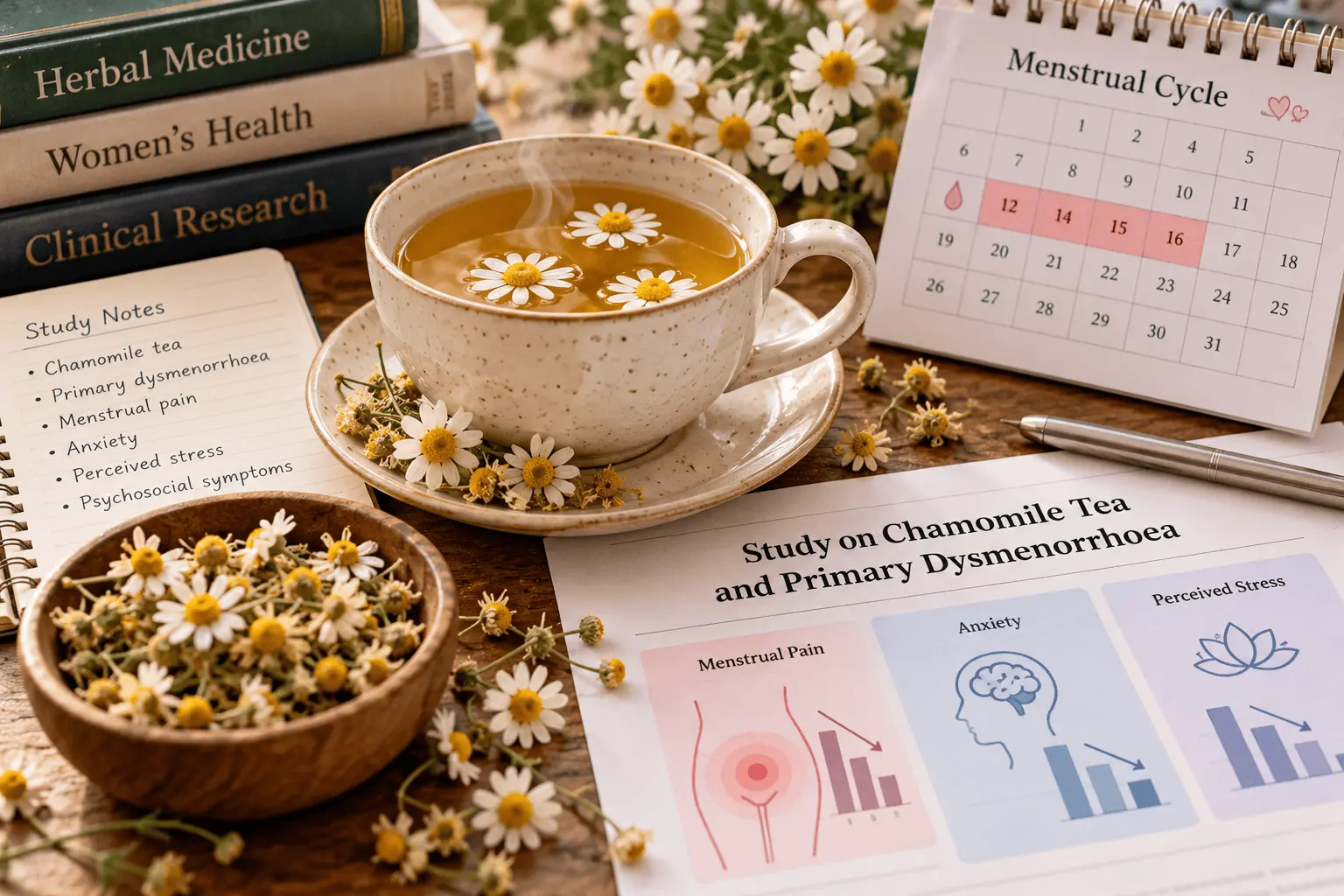
What Primary Dysmenorrhea Meant in the 2010 Chamomile Tea Study
The paper describes primary dysmenorrhea as menstrual pain occurring without dysfunction of the genital system. Pain is characterized in the abstract as affecting the lower abdomen and potentially radiating to the thighs, with symptoms beginning in the early stage of menstruation and lasting two to three days. The authors presented the condition as common among women of menstrual age and noted several approaches then being used for symptom relief, including tranquilizers, herbal medicines and massage. Their specific question was whether chamomile tea could reduce dysmenorrhea-related symptoms.
The Study Focused on Pain and Psychosocial Symptoms Rather Than Pain Alone
The outcome assessment extended beyond menstrual pain. Four instruments were used to evaluate pain, anxiety, perceived stress and psychophysiologic life adaptation. This broader outcome set is important because the authors framed dysmenorrhea as having both physical and psychosocial consequences. The conclusion likewise refers to relief of pain and its associated psychosocial problems.
How the Researchers Organized the Chamomile Tea Intervention
Eighty students from Toyserkan Azad University in western Iran were enrolled. According to the English abstract, they were randomly divided into two equal groups: a study group and a control group. Participants in the study group were instructed to drink two cups of chamomile tea each day. The schedule began one week before menstruation and continued through the first five days of the menstrual cycle, and this regimen was followed for three months.
The Timing of Tea Consumption Was Built Around the Menstrual Cycle
The intervention therefore covered both a premenstrual period and the early menstrual days in which primary dysmenorrhea commonly becomes symptomatic. The abstract does not specify the amount of chamomile in each cup, the preparation method, or whether the control group received a placebo beverage. Those missing details matter for replication. The source supports the reported schedule of two cups per day, but it does not provide enough information in the English abstract to define a standardized chamomile dose.
Table 1. Chamomile Tea Intervention Reported in the 2010 Study
Element | Study description | What the abstract does not specify |
Participants | 80 students at Toyserkan Azad University | Detailed eligibility criteria and attrition |
Groups | Two equal study and control groups | Control beverage or placebo procedure |
Daily intake | Two cups of chamomile tea | Chamomile amount or concentration per cup |
Timing | 1 week before menstruation through first 5 menstrual days | Exact brewing method |
Duration | 3 months | Adherence data |
Table note: The third column identifies information not supplied in the English abstract; it should not be interpreted as evidence that these procedures were absent from the full Persian article.
Which Questionnaires Were Used to Measure Outcomes
Data were collected with four separate questionnaires. These were the McGill Pain Questionnaire, a Visual Analogue Scale for Anxiety, the Perceived Stress Scale and the Psychophysiologic Life Adaptation Scale. Assessments were conducted before the intervention and then at the first and third months. The authors analyzed the data using Wilcoxon and chi-square tests.
Multiple Instruments Captured Different Dimensions of Dysmenorrhea
The McGill instrument addressed pain, while the anxiety and stress measures captured emotional responses. The life-adaptation measure added a functional or psychosocial dimension to the study. The abstract does not provide individual numerical scores for these instruments. It reports statistical significance between groups but does not give effect sizes, confidence intervals or enough raw data to independently calculate the magnitude of benefit.
Table 2. Outcome Measures Used by Jenabi and Ebrahimzadeh
Measure | Domain assessed | Assessment timing |
McGill Pain Questionnaire | Pain | Before intervention; month 1; month 3 |
Visual Analogue Scale for Anxiety | Anxiety | Before intervention; month 1; month 3 |
Perceived Stress Scale | Perceived stress | Before intervention; month 1; month 3 |
Psychophysiologic Life Adaptation Scale | Psychophysiologic adaptation | Before intervention; month 1; month 3 |
Table note: Instrument names and assessment schedule are taken from the study abstract.
What Changed After One Month of Chamomile Tea Use
After one month, the study group differed significantly from the control group in menstrual pain, distress and anxiety. The abstract presents these differences as improvements associated with the chamomile tea intervention. The researchers also reported statistically significant differences between the groups in the summed means of the four questionnaires at both the first and third months of chamomile tea use. The reported significance level was p<0.001.
Statistical Significance Does Not Show the Size of the Clinical Benefit
A low p-value indicates that the observed group differences were unlikely under the statistical null model used by the researchers. It does not by itself tell the reader how large the improvement was or whether every participant experienced meaningful relief. Because the abstract does not supply the underlying scores, the magnitude and variability of the changes cannot be reconstructed from the source information provided here.
Table 3. Main Results Reported in the English Abstract
Time point | Reported comparison | Statistical information |
After 1 month | Significant differences in menstrual pain, distress and anxiety between study and control groups | Described as statistically significant |
Month 1 | Difference between groups in summed means of four questionnaires | p<0.001 |
Month 3 | Difference between groups in summed means of four questionnaires | p<0.001 |
Table note: The abstract does not provide effect sizes or the underlying group means needed to quantify the magnitude of change.
What the Authors Concluded About Chamomile Tea and Dysmenorrhea
Jenabi and Ebrahimzadeh concluded that chamomile tea was an effective therapy for relieving pain from primary dysmenorrhea and its consequent psychosocial problems. This conclusion reflects the statistically significant differences reported between the study and control groups. The conclusion should nevertheless be interpreted in the context of the study design and reporting. The abstract describes a semi-experimental study with 80 students from one university and does not report blinding, placebo control, attrition or adverse-event data.
What the findings suggest about chamomile tea
The findings apply directly to the population and intervention studied: university students assigned to drink chamomile tea on a defined schedule over three months. The abstract does not establish that the same result would occur with different preparations, doses, populations or causes of menstrual pain. It also concerns primary dysmenorrhea, which by definition is menstrual pain without an identified pelvic disorder. The study should not be generalized to secondary dysmenorrhea caused by another condition.
How Later Reviews Have Interpreted Chamomile Evidence
Later systematic reviews have included chamomile among plant-based interventions studied for primary dysmenorrhea. A 2021 systematic review identified seven clinical trials involving 1,033 participants and concluded that most reviewed studies suggested benefit for pain or menstrual bleeding. That review also emphasized the need for stronger evidence, including more consistent pain measurement, better attention to blinding and randomization, and clearer assessment of side effects and effective dose. This places the 2010 study within a broader but methodologically variable evidence base.
Broader Herbal Evidence Has Also Been Rated With Caution
A Cochrane review of dietary supplements for dysmenorrhea included 27 randomized trials involving 3,101 women and covered multiple herbal and non-herbal interventions, including chamomile. The review stressed the importance of evaluating both benefits and harms. A separate systematic review of medicinal plants found that many interventions showed efficacy in at least one trial, but the generally low or unclear quality of studies required cautious interpretation. These later reviews do not invalidate the 2010 findings; they clarify the uncertainty around how confidently those findings can be generalized.
What a More Rigorous Chamomile Trial Would Need to Report
A stronger replication would clearly define the chamomile species, preparation, dose per cup and total daily exposure. It would also describe allocation methods, concealment, blinding where feasible, adherence and the nature of the control condition. Outcome reporting would benefit from baseline and follow-up scores for each instrument, between-group differences, confidence intervals and adverse-event monitoring. These details would allow readers to distinguish statistical significance from clinically important improvement.
Reproducibility Depends on Details Missing From the Abstract
The 2010 abstract gives a clear intervention schedule and identifies the measurement tools, but it does not provide enough detail to reproduce the tea preparation itself. Nor does it specify whether participants or assessors knew group assignments. These limitations do not erase the reported result. They define the boundary between what the source directly demonstrates and what would require fuller reporting or additional trials.
How the 2010 Findings Can Be Read Alongside Current Evidence
Current evidence continues to investigate plant-derived therapies for primary dysmenorrhea, including chamomile. More recent reviews still describe potentially beneficial effects while emphasizing heterogeneity in formulations, doses, comparators and study quality. A 2025 clinical guideline on primary dysmenorrhea reviews evidence through December 2024 and treats the condition as common and frequently undertreated. Contemporary management decisions therefore draw on a much larger evidence base than was available to the 2010 investigators.
The Historical Study Is Best Used as One Piece of a Larger Evidence Base
The Jenabi and Ebrahimzadeh study is useful because it provides a specific three-month tea regimen and tracks several dimensions of menstrual distress. It should not be treated as a stand-alone clinical guideline or as proof that chamomile is appropriate for every person with menstrual pain. For evidence appraisal, its main value lies in the reported between-group improvement and in the questions it raises about dose standardization, control conditions, blinding, adverse effects and clinical significance.
What Can Be Concluded From the 80-Student Study
The source supports a concise conclusion: among 80 students in this semi-experimental study, the group assigned to drink two cups of chamomile tea daily around menstruation showed statistically significant differences from the control group in pain, distress and anxiety after one month. The combined questionnaire results also differed significantly at months one and three, with p<0.001 reported. The authors interpreted these findings as evidence that chamomile tea could relieve primary dysmenorrhea and related psychosocial problems.
The Result Is Encouraging but the Abstract Leaves Important Uncertainties
The abstract does not provide effect sizes, detailed group scores, placebo procedures, blinding information, standardized tea composition or adverse-event reporting. These omissions limit conclusions about the size, reproducibility and safety profile of the intervention. Later reviews have found additional chamomile trials, but they continue to call for more rigorous and standardized research. The 2010 paper is therefore best understood as an early positive study within an evolving evidence base.
Practical takeaway: The 2010 study reported improvement in menstrual pain and related psychosocial measures among students assigned to drink chamomile tea around menstruation for three months. The result is encouraging, but the abstract does not provide standardized dosing, effect sizes, placebo or blinding details, or adverse-event data. Later reviews describe chamomile as potentially useful while continuing to call for more rigorous and standardized trials.
Frequently asked questions
How many participants were included in the 2010 chamomile tea study?
The study enrolled 80 students from Toyserkan Azad University in western Iran. They were divided into two equal study and control groups. The English abstract describes the research as semi-experimental.
How much chamomile tea did the study group drink?
Participants in the intervention group were asked to drink two cups of chamomile tea each day. They began one week before menstruation and continued through the first five days of the menstrual cycle for three months. The abstract does not specify the amount or concentration of chamomile in each cup.
What outcomes improved in the study?
After one month, the study group showed statistically significant differences from the control group in menstrual pain, distress and anxiety. The combined questionnaire results also differed significantly at months one and three. The abstract reports p<0.001 for these combined comparisons.
Does the study prove that chamomile tea is effective for everyone?
The study reported positive findings in 80 university students but did not establish that the results apply to everyone with menstrual pain. The abstract leaves important questions about dosing, blinding, placebo control and adverse events unanswered. Later reviews describe chamomile as potentially beneficial while calling for more rigorous research.
Sources
- Jenabi E, Ebrahimzadeh S. Chamomile tea for relief of primary dysmenorrhea. Iranian Journal of Obstetrics, Gynecology and Infertility. 2010;13(1):39–42.
- Niazi A, Moradi M. The Effect of Chamomile on Pain and Menstrual Bleeding in Primary Dysmenorrhea: A Systematic Review. Int J Community Based Nurs Midwifery. 2021;9(3):174–186.
- Pattanittum P, Kunyanone N, Brown J, et al. Dietary supplements for dysmenorrhoea. Cochrane Database Syst Rev. 2016;(3):CD002124.
- Burnett M. Guideline No. 345: Primary Dysmenorrhea. J Obstet Gynaecol Can. 2025;47(5):102840.
- Pellow J, Nienhuis C. Medicinal plants for primary dysmenorrhoea: A systematic review. Complement Ther Med. 2018;37:13–26.
- Comparing the Effect of Chamomile and Mefenamic Acid on Primary Dysmenorrhea Symptoms and Menstrual Bleeding: A Randomized Clinical Trial. Open Public Health J. 2022;15.

Eleanor Hayes — author
Eleanor Hayes writes with an editorial focus on research methodology and study design, including experimental and observational studies, controls, sampling, measurement and the methodological choices that shape scientific conclusions. At CAB Direct, Eleanor co...
Related

Chocolate Polyphenols and LDL Oxidation: Antioxidant Effects

Garlic Honey Tea and Blood Pressure: What the Study Found

Mycotoxins in Dried Raisins in Egypt: Fungi and Contamination

Teaching Young Children to Swim: Didactic Approaches in Slovenia

Metofluthrin Mosquito Repellent: Field Efficacy in Outdoor Trials

Capsaicin and Ascorbic Acid Variability in Chilli and Paprika