China cruise tourism: growth and changing passenger behaviour
Cruise tourism in China expanded rapidly from a niche activity in the mid-2000s into a major Asian market, but passenger expectations did not simply mirror the US and European cruise model. Early research found that growth in ships, routes and home-port capacity was accompanied by distinct ways of using the vessel, strong interest in shopping and social display, and demand for products that made an unfamiliar holiday format easier to navigate.
This explainer follows the 2017 chapter by Véronique Mondou and Benjamin Taunay, then compares its observations with later peer-reviewed studies of motivations, activity choices, product preferences and barriers to cruising. The evidence spans different samples and periods, so it should be read as a record of a market becoming more segmented rather than as a single profile of every Chinese cruise passenger.
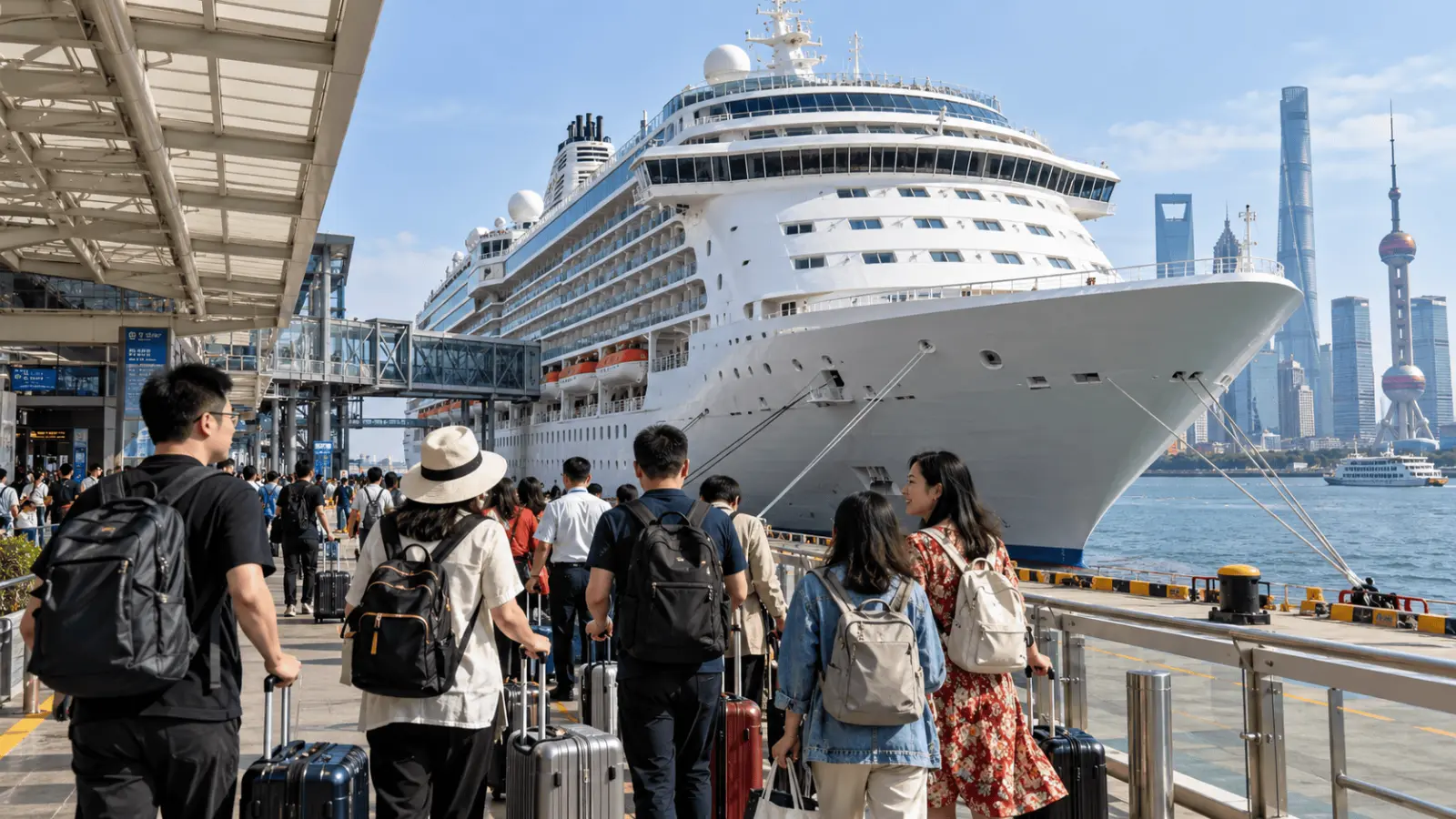
From niche activity to a strategic cruise market
Modern ocean cruising was still new to mainland Chinese holidaymakers in the early 2010s. Sun, Feng and Gauri described an industry expanding through new terminals, policy support and international operators entering the Asian market. Mondou and Taunay examined this transition from the passenger perspective, as departures diversified and companies adapted cruise products designed around North American and European habits for first-time Chinese customers.
Ports, homeports and supply expansion
Growth depended not only on passenger demand but also on home-port infrastructure that enabled short regional itineraries. Shanghai became especially important because travellers could begin and end voyages near a major source market without flying to distant embarkation ports. As ships and terminal capacity increased, cruises became accessible packaged holidays combining accommodation, meals, entertainment and multiple destinations.
This supply-led expansion explains why the original chapter examined routes, facilities, duration and passenger behaviour together. Operators shape demand through available products, then adapt them after observing customers. Greater capacity encourages trial, revealing preferences that influence food, retail, entertainment, excursions and itineraries.
Why product adaptation mattered
Without generations of cruising experience, Chinese customers needed both an introduction to the holiday format and an accessible onboard experience. Research in Beijing and Shanghai found that expectations and motivations influenced cruising intentions. Later studies showed differences by age, income and marital status, challenging the idea of a culturally uniform market.
Adaptation was not simply a choice between “Western” and “Chinese” cruise products. Fieldwork on three international ships departing Shanghai found that passengers valued Western activities for their cultural novelty but preferred Chinese alternatives when unfamiliar activities proved difficult to understand. Accessible novelty mattered more than cultural replacement.
What early fieldwork observed onboard
A 2016 ethnographic study by Mondou and Taunay is important because it observed cruise passengers in situ rather than relying only on stated intentions. The authors explicitly described the work as exploratory and did not claim statistical representativeness. Their observations nonetheless show why the same physical ship can be used differently by different groups. On the voyage they studied, some spaces and activities central to conventional cruise marketing were less prominent than social, photographic and group-based practices.
A different use of the ship
The field notes described relatively limited use of swimming and sunbathing spaces, while photography, posing in groups and card playing were conspicuous. Those observations should not be turned into a national stereotype: they came from one setting and one period, when cruising itself was new to many passengers. Their value is analytical. They show that a facility can exist onboard without carrying the same meaning or priority for every passenger group, and that cruise design should be judged by actual patterns of use rather than by the number of amenities alone.
Social display and the cruise experience
Mondou and Taunay also examined cruising as a form of social valuation and distinction. A cruise could function not only as transport or relaxation but as an experience worth displaying to others through photographs, stories and visible consumption. Later quantitative research gives this idea a broader context. Jiao, Hou and Lau identified social respect as one of several motivational dimensions alongside family leisure, natural and cultural exploration, bonding, shopping and promotional information. Social meaning was therefore one strand in a larger bundle of motives, not the sole reason for travel.
China’s early cruise boom is best understood as an interaction between rapid supply growth and passengers actively selecting, adapting and reinterpreting the cruise experience.
Later studies show a more segmented market
Research published after the 2017 chapter makes the passenger picture more detailed. Instead of asking whether Chinese tourists are fundamentally different from Western cruisers, later studies tend to ask which attributes matter to which segments, how experience changes preferences, and what prevents interested consumers from booking. This shift matters because a rapidly growing market quickly develops repeat customers alongside first-timers, and those groups do not necessarily want the same itinerary, ship or onboard programme.
Motivation: family, exploration and social respect
A 2021 segmentation study found six broad motivational dimensions: family leisure and relaxation, natural and cultural exploration, bonding and communication, social respect, tourism shopping, and cruise-promotion information sources. Family leisure and exploration were especially prominent. That combination helps explain why a cruise can appeal simultaneously as a convenient multi-generational holiday, a way to visit several places and a socially meaningful purchase. It also suggests that “Chinese cruise passenger” is too broad a category for product design without information about companions, life stage and previous cruise experience.
Preferences: shopping, food and shore activities
Shopping remains an important theme, although its significance varies across studies. A 2019 choice experiment involving 244 Chinese participants found that duty-free shopping variety had the highest estimated value among tested attributes, while cabin type, traditional Chinese food and port touring also mattered. A 2023 study of repeat cruisers found that shore activities ranked above cabin price and duration, with sightseeing and natural scenery strongly preferred. Together, these findings show that passenger priorities extend beyond shopping and vary with travel experience and study population.
Constraints and the move from curiosity to choice
Growth also depends on people who have not yet cruised. Tang and colleagues surveyed 775 higher-income Chinese adults and found that structural constraints-especially lack of knowledge, time and money-were more influential than simple rejection of cruising. Personal concerns such as finding companions, safety, boredom and seasickness were moderately important. This is useful because it separates low interest from practical barriers: a consumer can be attracted to the idea of a cruise and still not book because the product is poorly understood or difficult to fit into available time.
Evidence across the market’s transition
Year | Evidence base | What it contributes |
2014 | Industry review | China’s cruise sector was in rapid early growth, with port, policy and passenger development occurring together. |
2016 | Exploratory ethnography | Observed group photography, card play and uneven use of conventional leisure spaces; not nationally representative. |
2017 | Chapter synthesis | Linked supply expansion with route, facility and experience adaptation for Chinese passengers. |
2019 | Choice experiment, n=244 | Duty-free shopping variety was highly valued; room type, Chinese food and port touring also mattered. |
2019 | Survey, n=775 higher-income adults | Knowledge, time and money were important structural constraints on home-port cruise participation. |
2020 | Qualitative study, n=76 | Passengers valued Western activities but preferred Chinese options when unfamiliar activities were hard to interpret. |
2021 | Motivation segmentation | Family leisure, exploration, bonding, social respect, shopping and promotion information formed distinct motives. |
2023 | Repeat-cruiser conjoint/cluster study | Shore activity ranked ahead of cabin price and duration; sightseeing and natural scenery were strongly preferred. |
What changed after the first growth phase
The first research wave captured a market built around novelty, rapid capacity growth and intensive experimentation by international operators. By the end of the 2010s, academic reviews were already describing rapid increases in both cruise tourists and port construction, while also noting gaps in systematic research. The behavioural literature then became more specialised: activity choice, willingness to pay for product attributes, market segments, repeat-cruiser preferences and constraints all became separate research questions.
From first-time novelty to experience segmentation
This progression changes how product adaptation should be interpreted. Early adaptation focused on making an unfamiliar format accessible: language support, familiar food, shopping, short regional itineraries and activities that worked for group travel. A more mature market has to do more. First-timers may still value short voyages and obvious onboard choices, while experienced cruisers may compare brands, destinations, cabin categories and longer itineraries. The 2020 onboard-activity study reinforces this point because age and the style and variety of activities influenced what passengers selected.
Pandemic interruption and recovery
The pandemic interrupted the growth trajectory and makes simple before-and-after comparisons difficult. Shanghai resumed international cruise operations in 2023. Official Shanghai reporting for January to September 2024 recorded 175 international cruise berthings and passenger throughput of about 1.0465 million, described as roughly 70% of the 2019 level. These figures measure port activity rather than a unique count of Chinese holidaymakers, but they show that the market returned at substantial scale after the shutdown.
Recovery also occurred in a different product environment. China’s first domestically built large cruise ship entered commercial service in 2024, while international ships returned to Shanghai home-port operations. The result is not simply a restoration of the 2017 market. The supply side now includes more domestic industrial capacity, and the demand side includes passengers with very different levels of cruise experience. Any current claim about “the Chinese cruiser” therefore needs a date, a sample and a clear distinction between first-time, repeat, domestic-home-port and inbound passengers.
How to read the evidence
The studies used in this explainer are complementary rather than directly interchangeable. The 2017 chapter synthesised research since 2010; the 2016 ethnography observed behaviour in a specific voyage setting; later surveys and experiments sampled potential, higher-income, repeat or actual passengers under different conditions. That diversity is useful, but it means percentages and preference rankings should not be combined into a single national score.
- Treat early ethnographic observations as evidence of possible practices and meanings, not estimates of how common those practices were across China.
- Distinguish stated intentions from observed behaviour: potential cruisers may value attributes differently once they have taken a voyage.
- Check whether a study concerns first-time, repeat, higher-income or general passengers before applying its findings to another segment.
- Separate home-port passenger throughput from unique passenger counts, because embarkation and disembarkation statistics can count movements rather than individuals.
- Keep the time period visible: the pre-pandemic boom, the shutdown and the post-2023 recovery are different market conditions.
What the research suggests overall
China’s cruise expansion was not just a story of international cruise companies adding capacity to a large population. It was a process in which a new leisure format was learned, negotiated and changed by passengers. The early evidence highlighted group practices, photography, shopping and the social meaning of the trip; later research added family leisure, exploration, activity choice, food, cabins, shore experiences and practical constraints. The most consistent conclusion is therefore not a fixed list of “Chinese preferences” but the need to understand how experience, companions, age, itinerary and market stage shape demand.
That interpretation also makes sense of the 2017 chapter’s central question. China did become a major opportunity for cruise companies, but the value of the market depended on more than passenger volume. Operators had to translate a global cruise format into products that were understandable and attractive locally, then continue adapting as passengers became more experienced. The later literature shows that this adaptation is an ongoing segmentation problem rather than a one-off cultural adjustment.
Frequently asked questions
When did modern ocean cruising begin to grow in mainland China?
Research on the market describes modern ocean cruising in mainland China as a young industry in the 2000s, with rapid expansion during the following decade. By the early 2010s, new terminals, policy support and international ship deployments were turning a niche activity into a significant home-port tourism market.
Did Chinese passengers simply prefer Chinese-style onboard activities?
No. A 2020 qualitative study found that passengers could value Western-style activities as a chance to experience another culture. Preferences shifted when activities were unfamiliar or difficult to understand, in which case Chinese alternatives became more attractive. The evidence supports selective adaptation rather than replacing the international cruise format wholesale.
Why does shopping appear so often in research on Chinese cruise tourists?
Shopping was important in several studies because cruise travel combined duty-free retail, overseas travel and visible consumption. A 2019 choice experiment found strong value for a wider range of duty-free items. But later work also highlights family leisure, scenery, cultural exploration and shore activities, so shopping is only one part of demand.
Are Chinese cruise passengers one homogeneous market?
No. Studies distinguish potential passengers, first-timers, repeat cruisers and higher-income adults, and find differences linked to age, companions, experience and practical constraints. A result from one sample cannot automatically describe all Chinese passengers. Market segmentation is a better interpretation than a single national passenger profile.
Has China’s cruise sector recovered from the pandemic shutdown?
China’s Ministry of Transport announced the full resumption of international cruise transport to and from ports nationwide in September 2023. Shanghai then reported substantial traffic recovery during 2024. These figures show renewed port activity, but they do not mean the market simply returned to its 2019 structure, because ships, policies and passenger experience changed.
Sources
- Mondou V, Taunay B. Is China a new goldmine for cruise companies? In: Dowling RK, Weeden C, eds. Cruise Ship Tourism. 2nd ed. 2017:546–561.
- Sun X, Feng X, Gauri DK. The cruise industry in China: efforts, progress and challenges. International Journal of Hospitality Management. 2014;42:71–84.
- Mondou V, Taunay B. Une ethnographie des appropriations touristiques d’une croisière maritime en Chine. Mondes du Tourisme. 2016.
- Fan DXF, Hsu CHC. Potential Mainland Chinese Cruise Travelers’ Expectations, Motivations, and Intentions. Journal of Travel & Tourism Marketing. 2014;31(4):522–535.
- Fan DXF, Qiu HQ, Hsu CHC, Liu GZ. Comparing Motivations and Intentions of Potential Cruise Passengers from Different Demographic Groups: The Case of China. Journal of China Tourism Research. 2015;11(4):461–480.
- Park S, Lee WS, Moon J, Heo J. Examination of Chinese Cruise Tourists’ Attributes Using a Choice Experiment. Sustainability. 2019;11(13):3621.
- Tang C, Weaver D, Shi F, Huang M-F, Liu Y. Constraints to domestic ocean cruise participation among higher income Chinese adults. International Journal of Tourism Research. 2019;21:519–530.
- Hung K, Wang S, Denizci Guillet B, Liu Z. An overview of cruise tourism research through comparison of cruise studies published in English and Chinese. International Journal of Hospitality Management. 2019;77:207–216.
- Li N. Onboard activity choice of Chinese cruise tourists. International Journal of Culture, Tourism and Hospitality Research. 2020;14(4):489–506.
- Jiao Y, Hou Y, Lau Y-Y. Segmenting Cruise Consumers by Motivation for an Emerging Market: A Case of China. Frontiers in Psychology. 2021;12:606785.
- Chu A, Tung V. Investigating the Motivations and Preferences of Chinese Cruise Travelers Amid COVID-19. Journal of China Tourism Research. 2023;19(1):92–117.
- Shanghai Municipal People’s Government. Shanghai Port sees record-high container throughput in first 9 months. 22 October 2024.
- The State Council of the People’s Republic of China. China announces full resumption of international cruise ship transport. 19 September 2023.

Marcus Reed — author
Marcus Reed writes with an editorial focus on statistics and quantitative research, including effect sizes, regression models, uncertainty, associations and the numerical results reported in scientific studies. At Cabdirect, Marcus covers quantitative findings...
Related

Travel in Later Life: What an Eight-Person Study Found

Adult Literacy Classes in Kenya: What a 1980s Study Found

Tradition, Modernity and Tourism in Swaziland: Social Effects

Sydney and Melbourne: Divergent Sporting Cultures

Tackling Climate Change Through Livestock: Emissions and Mitigation

Betalain-Rich Red Beet Extract and Osteoarthritis Discomfort