



UV-Inactivated Sheep-Brain Rabies Vaccine: A 1975 Experiment
A 1975 Soviet laboratory study tested whether ultraviolet irradiation could inactivate rabies virus in sheep-brain vaccine material while preserving its ability to stimulate neutralising antibodies. In rabbits, the experimental preparation produced a reported maximum mean neutralising-antibody titre of 341, compared with 158 for a Fermi-type vaccine and 129 for a tissue-culture vaccine.
Those figures describe animal immunogenicity, not protection in people. The comparison shows what the preparation and inactivation method can establish, what the antibody results cannot demonstrate, and why modern human rabies prevention relies on purified cell-culture or embryonated-egg vaccines rather than nerve-tissue preparations.

Evidence last checked 29 Sep 2026 · 9 min
The experiment asked whether UV could inactivate virus without destroying antigenicity
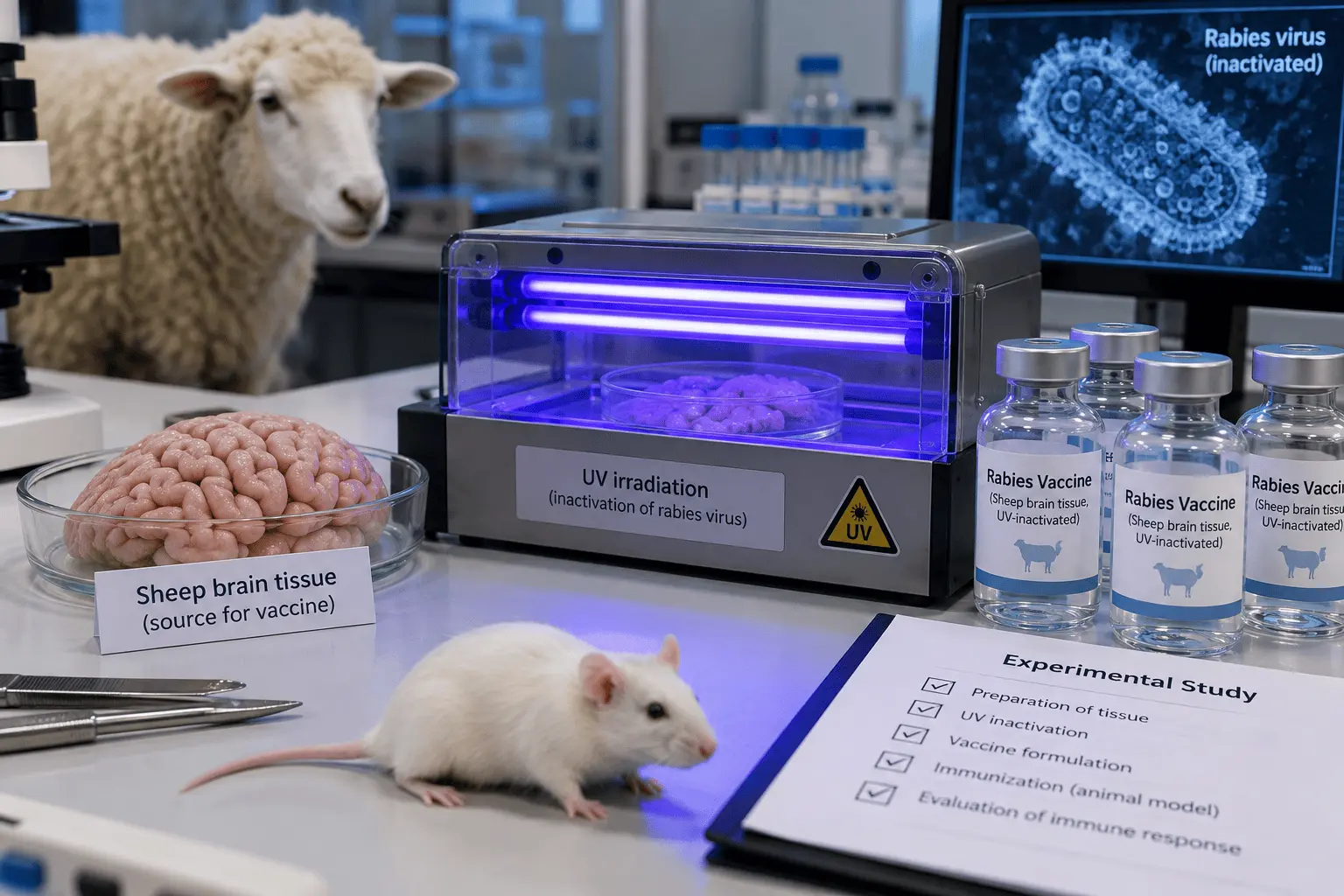
The investigators prepared vaccine material from sheep brain tissue infected with the Moscow strain of fixed rabies virus. According to the abstract, a 20% brain suspension was mixed with an equal volume of 15% sucrose solution and passed as a thin film over a rotating glass disc exposed to ultraviolet light.
The apparatus was designed to control exposure by adjusting flow, rotation and distance from the lamp. The material moved at 1.8-4 litres per hour over a 315 mm glass disc rotating at 16-20 revolutions per minute, positioned 10-20 cm from the UV source.
The reported inactivation endpoint was loss of detectable virus
In the initial inactivation experiments, the reported virus content fell from starting values of 10^6-10^7 to zero under the conditions tested. The paper's abstract does not specify a modern validated residual-infectivity limit, confidence bound or contemporary release assay.
For that reason, 'reduced to zero' should be read as no virus detected by the assay used in the study, not as a mathematical proof that every infectious particle had been eliminated. Modern vaccine manufacturing uses validated inactivation, purification, potency and quality-control systems that are far more standardised.
The 1975 result is evidence about experimental inactivation and animal antibody response, not proof that a sheep-brain vaccine would meet modern human vaccine standards.
The formulation was freeze-dried after inactivation
After UV treatment, the vaccine material was freeze-dried in 1.5 ml volumes. Lyophilisation was already an important vaccine-manufacturing technique because it could improve storage stability and simplify distribution.
The sucrose in the formulation may also have served as a stabilising component, but the abstract does not provide a formulation study comparing different sucrose concentrations or demonstrating a specific protective mechanism. It is therefore safer to describe the preparation process than to infer why each component was chosen.
Antigenicity was compared in rabbits
The experimental vaccine was tested in rabbits alongside two Soviet-manufactured comparators: a Fermi-type vaccine and a tissue-culture vaccine. The outcome highlighted in the abstract was neutralising-antibody titre, a laboratory measure of the immune response to rabies virus.
The maximum mean titre reported for the UV-inactivated vaccine was 341. The corresponding values were 158 for the Fermi-type preparation and 129 for the tissue-culture comparator. The abstract does not provide confidence intervals, dispersion measures, group sizes or statistical tests for these three means.
A higher antibody titre did not establish superior clinical protection
Neutralising antibodies are important in rabies vaccination, but the 1975 comparison was not a human efficacy trial. A larger titre in rabbits cannot be converted directly into a percentage reduction in human rabies risk.
The groups also differed by vaccine preparation, not merely by one controlled manufacturing variable. Without full sample sizes, dosing schedules, assay details and challenge outcomes, the strongest supported conclusion is that the experimental vaccine showed high antigenic activity in animals under the study conditions.
PubMed records the work as a comparative animal study
The PubMed record for the original Russian-language paper classifies it as a comparative study and lists rabbits and mice among the experimental animals. Its English abstract states that 22 experimental lots of UV-inactivated rabies vaccine showed considerably higher immunogenic activity than commercial Fermi vaccine and that antigenic activity in animals was high.
That additional description broadens the laboratory context, but it still does not turn the study into evidence of safety or effectiveness in vaccinated people. The work belongs to vaccine-development history rather than to modern clinical guidance.
What the reported numbers actually compare
Comparison | Experimental material | Reported result | What it does not establish |
Virus before vs after UV | Rabies-infected sheep-brain suspension | 10^6-10^7 initially; reported as zero after inactivation | Absolute sterility by modern validated release testing |
Rabbit antibody response | UV-inactivated sheep-brain vaccine | Maximum mean neutralising-antibody titre 341 | Human vaccine effectiveness or safety |
Comparator 1 | Fermi-type vaccine | Maximum mean titre 158 | A statistically proven inferiority without full group data |
Comparator 2 | Tissue-culture vaccine | Maximum mean titre 129 | That all tissue-culture vaccines are less immunogenic |
Modern vaccine context | Purified cell-culture or embryonated-egg vaccines | WHO-recommended platforms for human use | Direct numerical comparison with the 1975 rabbit assay |
Nerve-tissue vaccines were part of an older technological era
Early rabies vaccines were produced from infected nervous tissue because rabies virus was difficult to cultivate by other methods. Fermi-type and Semple-type vaccines used brain or nervous tissue and chemical inactivation, while other approaches used desiccated spinal cord or suckling-animal brain.
These preparations helped establish post-exposure vaccination, but the substrate itself created problems. Neural tissue introduced non-viral proteins and myelin into the vaccine and was associated with more severe adverse neurological reactions than later purified products.
Cell-culture vaccines changed the safety and manufacturing standard
Rabies vaccine development moved progressively from nervous tissue to avian embryos and then to cell-culture systems. Reviews of vaccine history describe this transition as a major improvement because cell culture allowed cleaner, more standardised antigen production and reduced the problems associated with neural tissue.
Modern human vaccines are produced using cell substrates or embryonated eggs, then concentrated, purified, inactivated and lyophilised. The underlying principle of inactivation therefore survived, but the biological substrate and manufacturing controls changed substantially.
WHO now recommends replacing nerve-tissue vaccines
WHO states that nerve-tissue rabies vaccines are less immunogenic and cause more severe adverse reactions than modern cell-culture-derived vaccines. It recommends discontinuing their production and use and replacing them with cell-culture or embryonated-egg vaccines.
This is the most important modern context for the 1975 study. The historical experiment should not be read as support for using sheep-brain vaccine today. It documents one attempt to improve inactivation and antigenicity during a period when vaccine technology was still transitioning away from neural substrates.
Current human rabies vaccines use different platforms
WHO-recognised modern rabies vaccines are based on virus grown in cell culture or embryonated eggs rather than adult animal brain tissue. In the United States, CDC lists human diploid cell vaccine and purified chick embryo cell vaccine for human rabies immunisation.
These vaccines are standardised for potency and are used in defined pre-exposure and post-exposure schedules. The current clinical question is therefore not whether UV-treated sheep-brain material generates antibodies, but how to deliver proven modern vaccine and, when indicated, rabies immunoglobulin promptly after exposure.
Post-exposure prophylaxis works because rabies has a window before symptoms
Rabies is unusual among vaccine-preventable infections because vaccination can prevent disease after exposure if post-exposure prophylaxis is started before clinical rabies develops. Once symptoms appear, rabies is almost invariably fatal.
Current guidance combines immediate wound care with modern rabies vaccine, and for some exposures also rabies immunoglobulin. This clinical framework is supported by decades of modern vaccine experience and should not be confused with experimental antibody titres from older animal studies.
Historical antibody titres cannot be mapped onto today's potency standard
The 341, 158 and 129 values came from the assay and study design used by the 1975 investigators. Modern rabies vaccine potency is expressed with standardised reference systems, and CDC lists current US human vaccines as containing more than 2.5 international units of rabies antigen per dose.
Because the metrics are different, it would be scientifically incorrect to convert the historical titre ranking into a modern potency ranking.
UV inactivation was scientifically interesting, but not the only issue
Ultraviolet light can damage viral nucleic acid and reduce infectivity while leaving some antigenic structures intact. That makes UV exposure an intuitively attractive inactivation method, and the Soviet group had already published related work on UV inactivation of cultured rabies vaccine in 1973.
However, a successful human vaccine needs more than inactivation. It also requires a safe substrate, consistent manufacturing, purification, validated potency, stable formulation, appropriate dosing and clinical evidence. Improvements in cell culture addressed several of those needs simultaneously.
The historical importance of the experiment therefore lies in the manufacturing question it addressed. Researchers were trying to balance two requirements that remain fundamental to inactivated vaccines: eliminating infectivity while preserving enough antigenic structure to stimulate an immune response. The 1975 results suggested that ultraviolet exposure could achieve that balance under the tested laboratory conditions, but they did not resolve the broader problems associated with neural-tissue substrates, product consistency or clinical safety.
The 1975 study is best understood as a bridge in vaccine development
The paper sits between two technological periods. It used an old substrate - infected sheep brain - while applying a controlled physical inactivation process and comparing the resulting antibody response with a tissue-culture vaccine.
That combination makes the study historically informative. It shows researchers trying to retain antigenicity while reducing infectious virus, but it also illustrates why vaccine evolution could not stop at a better inactivation step.
What can be concluded with confidence
The accessible abstract supports four main conclusions. The investigators developed a reproducible-looking UV exposure system for sheep-brain rabies vaccine material; the tested conditions reduced detectable virus from high starting titres to no detectable virus; the preparation was freeze-dried; and it generated high neutralising-antibody titres in animal testing.
It does not establish human safety, clinical efficacy, superiority over modern cell-culture vaccines or suitability for present-day post-exposure prophylaxis. The comparison belongs to experimental vaccine history, while current prevention recommendations come from later purified vaccine platforms and clinical evidence.
A careful reading should keep these distinctions clear:
- virus inactivation was assessed experimentally, but the abstract does not describe a modern validated release standard;
- neutralising-antibody titres were measured in animals, not clinical protection in exposed people;
- the three vaccine preparations were different products, so titre differences cannot be attributed to UV alone;
- nerve-tissue vaccine technology has been superseded by safer, more immunogenic cell-culture and embryonated-egg vaccines;
- current rabies post-exposure care should follow modern WHO or national guidance rather than historical experimental protocols.
Taken together, the study is most useful as evidence of an experimental stage in rabies-vaccine development rather than as a model for present-day vaccination. Its antibody findings show that antigenicity could be retained after ultraviolet treatment, but modern rabies prevention depends on different substrates, validated manufacturing controls and clinical evidence developed long after this 1975 experiment.
Frequently asked questions
What exactly did the 1975 rabies-vaccine study test?
The researchers tested a sheep-brain rabies vaccine inactivated with ultraviolet irradiation. They examined whether the treatment removed detectable infectivity while preserving antigenicity, then compared neutralising-antibody responses in animals with a Fermi-type vaccine and a tissue-culture vaccine. It was an experimental animal study, not a human vaccine trial.
Why was the antibody titre of 341 important?
The reported maximum mean titre of 341 showed that the UV-inactivated preparation could stimulate a strong neutralising-antibody response in the study animals. However, the abstract gives no confidence intervals, group sizes or clinical outcomes. The value therefore cannot be interpreted as a human protection rate or modern potency measure.
Are sheep-brain rabies vaccines still used for people?
WHO recommends replacing nerve-tissue rabies vaccines because they are less immunogenic and cause more severe adverse reactions than modern cell-culture vaccines. Current human rabies prevention relies on purified vaccines produced in cell culture or embryonated eggs, with validated potency and defined pre-exposure or post-exposure schedules.
Does ultraviolet inactivation make a rabies vaccine safe?
UV irradiation can reduce viral infectivity, but safety depends on more than the inactivation step. A human vaccine also requires a suitable substrate, validated removal of infectious virus, purification, consistency, potency testing, formulation controls and clinical evidence. The 1975 study did not establish all of those requirements.
How should the 1975 paper be interpreted today?
It is best read as a historical vaccine-development experiment. The study showed that UV-treated sheep-brain material could lose detectable infectivity and still generate neutralising antibodies in animals. It does not justify using nerve-tissue vaccine today, and it does not replace current WHO or national rabies-vaccination guidance.
Sources
- Pospeeva NA, Morogova VM, Gil'dina SS, Nikolaeva NV, Losev MN. Experimental study of an antirabies vaccine from sheep brain tissue inactivated by UV rays. Voprosy Virusologii. 1975;(5):578-581. PMID 1210319.
- Morogova VM, Selimov MA, Aksenova TA, Pospeeva NA, Gil'dina SS. Inactivation of cultured antirabies vaccine by UV rays. Voprosy Virusologii. 1973;18(4):422-425. PMID 4786161.
- World Health Organization. Rabies vaccines: WHO position paper - April 2018. Weekly Epidemiological Record. 2018;93(16):201-220.
- World Health Organization. WHO Expert Consultation on Rabies: third report. WHO Technical Report Series No. 1012. Geneva: WHO; 2018.
- World Health Organization. Recommendations for inactivated rabies vaccine for human use produced in cell substrates and embryonated eggs. WHO Technical Report Series 941, Annex 2. Geneva: WHO; 2007.
- Rupprecht CE, Briggs D, Brown CM, et al. From brain passage to cell adaptation: the road of human rabies vaccine development. Expert Review of Vaccines. 2011;10(11):1597-1608. DOI: 10.1586/erv.11.140.
- Tsiang H. Rabies vaccines: a review of progress towards improved efficacy and safety. BioDrugs. 1998;10(4):317-328. DOI: 10.2165/00063030-199810040-00006.
- McGettigan JP. Experimental rabies vaccines for humans. Expert Review of Vaccines. 2010;9(10):1177-1186. DOI: 10.1586/erv.10.105.
- Natesan K, Isloor S, Vinayagamurthy B, Ramakrishnaiah S, Doddamane R, Fooks AR. Developments in Rabies Vaccines: The Path Traversed from Pasteur to the Modern Era of Immunization. Vaccines. 2023;11(4):756. DOI: 10.3390/vaccines11040756.
- Centers for Disease Control and Prevention. Rabies Biologics and Rabies Post-exposure Prophylaxis Guidance. Atlanta, GA: CDC; accessed 2026.

Nora Veldin — author
Nora Veldin is a health science writer with academic training in biomedical science and public health. After completing a BSc in Biomedical Science, she undertook an MPH focused on epidemiology, population health and the interpretation of health evidence. Her...
This article is for general information and is not medical advice. It was reviewed for accuracy by a qualified clinician; decisions about your health should be made with your own doctor.
Related

Human blood groups and population genetics in Mourant’s atlas

Selenium and cancer prevention: what the evidence shows