


Organic vs Conventional Farming: Economics and Ecology
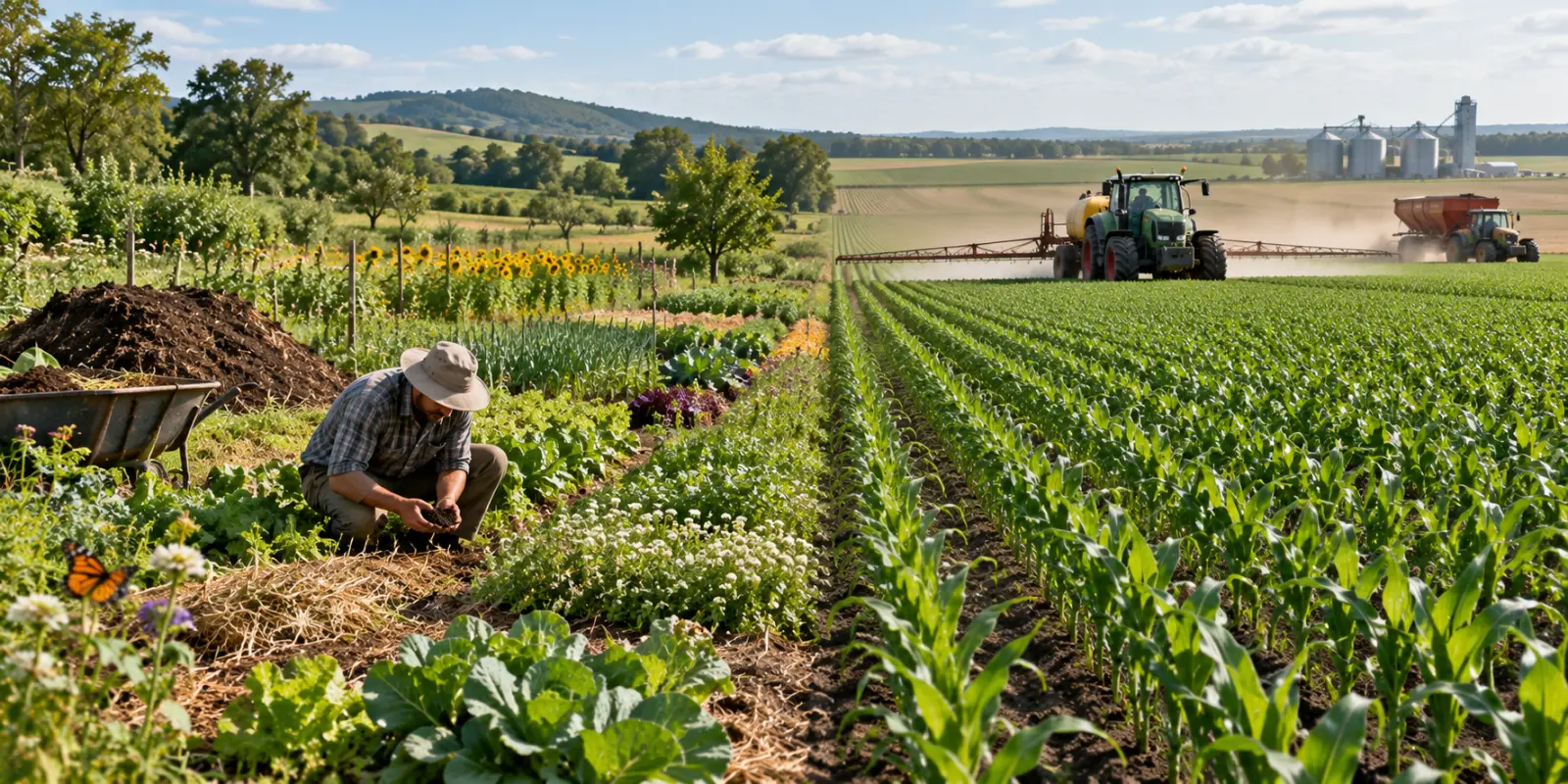
Organic and conventional farming differ less as fixed opposites than as systems that use different combinations of fertility management, pest control, labour, capital and market incentives. Robert C. Oelhaf's 1978 book compared those systems across production costs, energy and resource use, pesticides, farm structure and environmental effects, anticipating many questions that still shape agricultural research.
This explainer revisits Oelhaf's historical arguments and compares them with later meta-analyses on yields, biodiversity, soil carbon, environmental impacts and farm profitability. It does not treat either system as universally superior: results depend on crop, location, management, measurement unit and whether outcomes are assessed per hectare, per unit of food or through farm income.
What Oelhaf compared in 1978
Oelhaf described organic farming as a modern group of systems relying primarily on biological processes rather than synthetic chemicals for fertility and pest management. The book compared family and corporate farms, labour and capital intensity, fertilization, pesticide benefits and hazards, energy and resource use, marketing, production costs and the implications of expanding organic agriculture.
The book also reports that Oelhaf estimated resources required for a large-scale transition and argued that research and extension services had given too little attention to organic methods. The 1978 analysis concluded that production-cost differences were small and argued that wider adoption could bring health and environmental benefits. Those conclusions belong to the 1978 analysis and should not be treated as modern empirical consensus without later evidence.
Organic standards formalized ideas that were still loosely defined in the 1970s
Organic agriculture is now regulated through certification standards rather than defined only by a general preference for biological processes. In the United States, USDA organic crop standards require soil fertility to be managed through practices such as rotations, cover crops and approved plant or animal materials, while pest control begins with cultural, physical, mechanical and biological methods.
That regulatory structure matters when comparing systems. Modern 'organic' is not simply farming without pesticides or fertilizers. Some approved inputs can be used, while genetic engineering and several other practices are prohibited. Conventional systems also vary widely, from input-intensive monocultures to farms using conservation tillage, cover crops and integrated pest management.
Yield is the first major trade-off
One of the most studied differences is crop yield. A 2012 Nature meta-analysis found that organic yields were generally lower than conventional yields, but the size of the gap depended strongly on crop type, growing conditions and management. The comparison was not a single universal percentage: some systems showed relatively small gaps, while others showed much larger differences.
A later meta-analysis by Ponisio and colleagues found that diversification practices such as multi-cropping and crop rotations could substantially reduce the organic-to-conventional yield gap. This is an important methodological point: yield comparisons are partly comparisons of management strategies, not simply certification labels.
Yield per hectare is not the same as environmental performance per tonne
Lower yield can change the interpretation of environmental indicators. An organic system may use less energy or lose less nitrogen per hectare, yet require more land to produce the same amount of food. That is why strong comparisons report whether outcomes are expressed per unit of land, per unit of product or across a whole farm.
What later evidence says about key comparisons
Issue | Evidence base | Typical finding | Main qualification |
Crop yield | Seufert et al., 2012; Ponisio et al., 2015 | Organic yields are often lower on average | Gap varies by crop and diversification practices |
Biodiversity | Tuck et al., 2014 | Species richness was higher on average under organic management | Evidence is geographically uneven |
Environmental impacts | Tuomisto et al., 2012 | Many impacts lower per unit area | Some advantages weaken or reverse per unit product |
Soil carbon | Gattinger et al., 2012 | Higher topsoil organic carbon stocks in organic comparisons | Management and external organic inputs influence results |
Farm profitability | Crowder & Reganold, 2015 | Organic systems can be financially competitive | Price premiums are a major driver |
The fairest comparison depends on the question: land productivity, farm income and environmental impact do not use the same denominator.
Biodiversity is one of the more consistent environmental advantages
A 2014 hierarchical meta-analysis compiled 184 observations from 94 studies and found that organic farming increased species richness by about 30% on average. The effect varied among taxa, crops and landscapes, and the evidence base was concentrated heavily in northern and western Europe and North America.
These results support Oelhaf's broader ecological concern, but they also show why blanket claims are risky. Biodiversity benefits can depend on surrounding landscape, field size, pesticide use, crop diversity and non-crop habitat. An organic label captures part of that management package but does not describe every ecological feature of a farm.
Soil organic matter often improves, but cause and context matter
Organic systems frequently rely on manure, compost, legumes, cover crops and rotations, all of which can affect soil carbon and biological activity. A 2012 meta-analysis reported higher topsoil organic carbon stocks in organically managed soils compared with conventional controls.
However, the interpretation depends on inputs and system boundaries. Some organic farms import substantial organic matter from outside the farm, and soil carbon changes are influenced by climate, soil type, tillage and crop sequence. Higher soil carbon therefore reflects management history rather than certification alone.
Environmental comparisons change when expressed per hectare or per kilogram
Tuomisto and colleagues compared European organic and conventional farming studies and found that organic systems generally had lower environmental impacts per unit of land for several indicators, including energy use and some nutrient losses. Yet lower yields meant that some impacts were less favourable when calculated per unit of product.
The same meta-analysis found wide variation between studies and product groups. Its broader lesson is that no single environmental score captures all trade-offs. Land use, eutrophication, greenhouse gases, biodiversity, soil condition and pesticide exposure can move in different directions depending on how the farming system is designed.
Profitability depends heavily on prices and market structure
Oelhaf's book included US production costs and organic wholesale and retail markets. Modern economic studies confirm that costs and returns cannot be inferred from yield alone. Organic farms may face higher labour, certification and weed-management costs, but they can also receive price premiums and spend less on some synthetic inputs.
A 2015 global meta-analysis by Crowder and Reganold concluded that organic agriculture could be financially competitive, with price premiums playing a central role. USDA Economic Research Service analyses similarly show that organic production often carries higher costs but may generate stronger returns when premiums offset those costs.
Price premiums are not a biological advantage
This distinction is essential. A farm can be ecologically efficient but financially weak if market prices are poor, and a farm can be profitable because consumers pay a premium even when yields are lower. Economics therefore reflect production biology, labour, certification, risk, supply chains and consumer demand at the same time.
Labour and capital intensity remain relevant questions
Oelhaf explicitly compared labour- and capital-intensive agriculture. Modern organic systems often substitute mechanical cultivation, hand labour or more complex rotations for some herbicide and fertilizer inputs. This can shift both labour demand and machinery use rather than simply reducing total inputs.
The balance varies by crop. High-value horticulture, field grains, dairy and mixed farms have very different labour structures. USDA cost studies therefore compare specific commodities rather than treating organic agriculture as one uniform cost model.
Pesticide comparisons need more precision than 'chemical versus chemical-free'
The 1978 book discussed pesticide value, hazards and alternatives, but modern organic standards do not mean zero pesticide use. Organic systems prioritize preventive, cultural and biological controls and restrict materials to those allowed under certification rules.
Conventional systems can use a broader range of synthetic crop-protection products, but pesticide risk depends on active ingredient, dose, exposure, resistance management and application practice. A useful comparison therefore asks which substances are used, how often, under what conditions and with what environmental or health endpoints, rather than assuming all pesticides have the same risk.
Large-scale conversion is a systems question, not a farm-by-farm extrapolation
Oelhaf estimated the resources needed for hypothetical large-scale expansion of organic farming and proposed policy measures including transition subsidies and taxes on pesticides and fertilizers. Those proposals were the author's recommendations in a specific 1970s US context, not findings that follow automatically from later research.
Modern reviews reach a more conditional conclusion: organic farming can contribute useful practices and environmental benefits, but lower yields, nutrient supply, land demand and market access create constraints. Meemken and Qaim argued that organic agriculture can contribute to sustainability while also noting that a global food system cannot be evaluated through the organic-versus-conventional distinction alone.
Research now focuses more on outcomes than labels
The most useful legacy of Oelhaf's comparison is the insistence that farming systems be evaluated simultaneously for economics, ecology and resource use. Later research has made those comparisons more quantitative, but it has also revealed how difficult simple rankings can be.
A stronger comparison asks:
- what crop or livestock system is being compared;
- whether outcomes are measured per hectare, per farm or per unit of product;
- how yields, labour and market premiums affect profitability;
- which environmental indicators are included and which are omitted;
- whether the organic and conventional farms use comparable rotations, soils and landscapes.
Why the 1978 book still matters
Organic Agriculture is a historical snapshot of a period when organic farming was moving from a marginal alternative into a subject of formal economic and ecological analysis. Its scope was unusually broad: it connected production costs, markets, energy, pesticides, farm structure, research priorities and environmental concerns in one comparison.
The book is also a reminder that the answer can change with the unit of comparison. A system may perform well per hectare yet look different when impacts are expressed per unit of food, especially when yields differ. Profitability can also change when labour requirements, market premiums and input costs are included. For that reason, later comparisons are strongest when they report several outcomes together rather than reducing organic and conventional farming to a single environmental or economic ranking.
Modern evidence supports parts of that agenda while making the conclusions more conditional. Organic systems often show biodiversity and soil advantages and can be profitable, but yields are frequently lower and environmental performance depends strongly on the unit of comparison and the management practices used. The useful question is therefore not whether one label always wins, but which practices deliver acceptable productivity, viable farm economics and lower environmental costs in a given context.
Frequently asked questions
Is organic farming always lower yielding than conventional farming?
No. Meta-analyses show that organic yields are lower on average, but the size of the gap varies widely by crop, environment and management. Diversified rotations and multi-cropping can narrow the difference. A single average therefore does not predict the yield of every organic farm or crop.
Is organic farming always better for the environment?
Not for every indicator or every unit of comparison. Organic systems often perform well for biodiversity, soil organic matter and some impacts per hectare. Lower yields can increase land use or alter results when impacts are calculated per unit of food, so environmental comparisons need several metrics.
Can organic farms be as profitable as conventional farms?
Yes, in some markets. Global and US analyses show that organic farms can be financially competitive when price premiums compensate for lower yields, certification costs or higher labour requirements. Profitability is therefore strongly affected by commodity prices, consumer demand, farm type and the specific production costs being compared.
Does organic farming mean no pesticides are used?
No. Organic standards emphasize cultural, physical, mechanical and biological controls, but approved pesticide substances can be used when required and permitted by the relevant standard. Comparing pesticide impacts therefore requires looking at actual active ingredients, doses, exposure and management rather than assuming organic production is pesticide-free.
Why is Oelhaf's 1978 book still relevant?
The book was an early attempt to compare farming systems across economics, ecology, energy, pesticides, markets and research policy rather than looking at yield alone. Modern evidence is much larger and more quantitative, but it still addresses many of the same trade-offs and shows why simple labels rarely capture whole-system performance.
Sources
- Oelhaf RC. Organic Agriculture: Economic and Ecological Comparisons with Conventional Methods. New York: John Wiley & Sons; 1978. 271 pp. ISBN 978-0-470-26427-0.
- Seufert V, Ramankutty N, Foley JA. Comparing the yields of organic and conventional agriculture. Nature. 2012;485:229–232. doi:10.1038/nature11069.
- Ponisio LC, M'Gonigle LK, Mace KC, et al. Diversification practices reduce organic to conventional yield gap. Proceedings of the Royal Society B. 2015;282:20141396. doi:10.1098/rspb.2014.1396.
- Tuck SL, Winqvist C, Mota F, et al. Land-use intensity and the effects of organic farming on biodiversity: a hierarchical meta-analysis. Journal of Applied Ecology. 2014;51:746–755. doi:10.1111/1365-2664.12219.
- Tuomisto HL, Hodge ID, Riordan P, Macdonald DW. Does organic farming reduce environmental impacts? A meta-analysis of European research. Journal of Environmental Management. 2012;112:309–320. doi:10.1016/j.jenvman.2012.08.018.
- Gattinger A, Muller A, Haeni M, et al. Enhanced top soil carbon stocks under organic farming. Proceedings of the National Academy of Sciences. 2012;109:18226–18231. doi:10.1073/pnas.1209429109.
- Crowder DW, Reganold JP. Financial competitiveness of organic agriculture on a global scale. Proceedings of the National Academy of Sciences. 2015;112:7611–7616. doi:10.1073/pnas.1423674112.
- Meemken EM, Qaim M. Organic Agriculture, Food Security, and the Environment. Annual Review of Resource Economics. 2018;10:39–63. doi:10.1146/annurev-resource-100517-023252.
- Reganold JP, Wachter JM. Organic agriculture in the twenty-first century. Nature Plants. 2016;2:15221. doi:10.1038/nplants.2015.221.
- US Department of Agriculture, Agricultural Marketing Service. Organic Standards. National Organic Program.
Harriet Colbeck — author
Harriet Colbeck is an agriculture writer with a background in agricultural science and a master’s-level focus on soil science. Her earlier work involved preparing field-trial summaries and farmer-facing guidance on soil management, translating research finding...
Related
Calendula, crotalaria and oats for root-knot nematodes in naranjilla
Why breadfruit mealybug control failed to last on Pacific atolls
How Orchard Age and Herbicides Shift Soil Nitrogen and N2O
Hevea brasiliensis breeding: from crosses to field trials