





How external resistance shapes azo dye removal in microbial fuel cells
External resistance can change how quickly azo dyes are reductively decolourised in a microbial fuel cell, and the fastest dye removal does not necessarily occur at either the lowest or the highest electrical load. In a 2014 study of three commercial azo dyes, a moderate external resistance of about 2.2 kΩ produced higher decolourisation kinetic constants than the extreme resistance conditions tested (Daniel Brooks, 2014).
Electrical load affects both electron flow and the conditions under which microbial communities remove azo dyes in microbial fuel cells. The 2014 findings align with wider microbial fuel cell research showing that external resistance can influence current, electrode potential and treatment performance. For wastewater treatment, an important distinction is that decolourisation does not necessarily mean complete degradation: breaking an azo bond can remove visible colour while leaving aromatic products that still require further treatment.
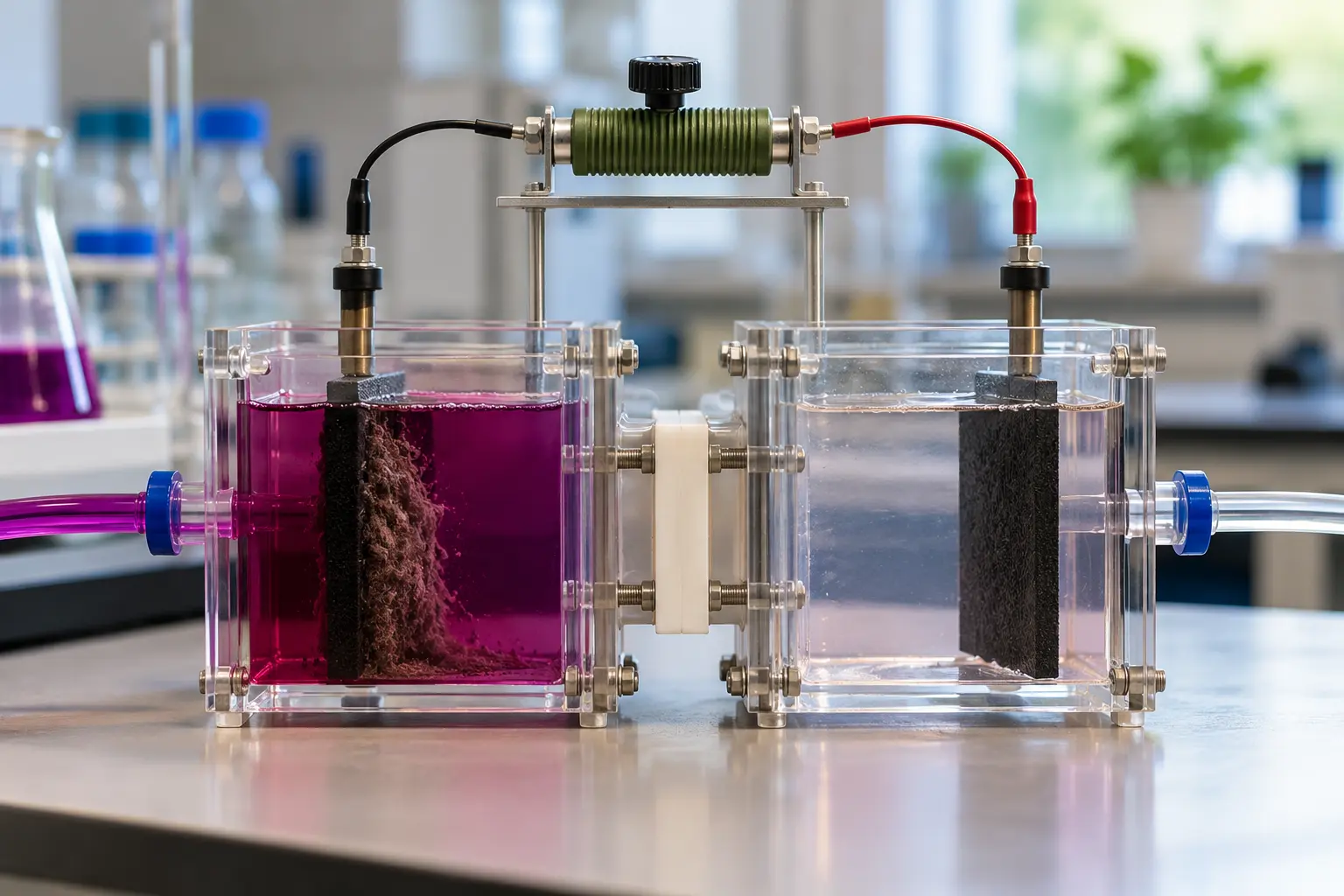
External resistance is more than an electrical setting
A microbial fuel cell (MFC) is a bioelectrochemical reactor in which microorganisms oxidise organic matter and transfer electrons to an anode. Those electrons travel through an external circuit to a cathode, while ions move through the electrolyte or separator to complete the electrochemical process. The electrical load placed in that external circuit helps determine current, electrode potential and the energetic conditions experienced by the microbial community.
External resistance therefore acts as an operating variable rather than a passive measurement device. Lower resistance generally permits greater electron flow through the circuit; higher resistance restricts it. But an MFC is not a simple resistor network. Electrode kinetics, mass transfer, internal resistance, substrate availability and the composition of the biofilm all interact. Experiments across different reactor designs have repeatedly shown that changing the load can alter both electrochemical performance and microbial community structure.
What the 2014 azo dye study tested
Daniel Brooks studied whether external resistance could be used deliberately to influence the reductive decolourisation of azo dyes in MFCs. The experiments used three structurally different commercial azo dyes and compared the decolourisation kinetics under different applied external resistances. The study also assessed effluent quality through chemical oxygen demand (COD) reduction and examined microbial community fingerprints using PCR-DGGE of 16S rRNA genes.
The central result was a non-linear response. Very low external resistance was associated with high current density, while very high resistance was associated with low current density; both extremes produced lower reductive decolourisation kinetic constants for all three dyes than a moderate resistance. The best-performing condition reported in the study was approximately 2.2 kΩ, a value close to the internal resistance of the MFC systems used in the experiments.
Why the 2.2 kΩ result matters
The important point is not that 2.2 kΩ is a universal setting. It is that dye reduction improved near a system-specific middle ground rather than at the electrical extremes. In conventional MFC studies, operating the external resistance near the internal resistance often supports high power transfer, although the exact optimum depends on reactor architecture and operating conditions. The 2014 dye study extends that idea from electricity generation to a treatment objective: the electrical load can influence the kinetics of a reductive pollutant-removal process.
What related MFC experiments show
Studies conducted with other substrates and reactor designs help explain why external resistance can have biological as well as electrical effects. The results demonstrate how electrical loading can influence microbial activity, electrochemical behaviour and treatment performance across different MFC configurations. The comparison below shows how strongly the outcome depends on the system being tested.
Study | External resistance | System | Main observation |
Daniel Brooks et al. 2014 | Multiple loads; optimum ~2.2 kΩ | Three commercial azo dyes | Both low- and high-resistance extremes had lower decolourisation kinetic constants; communities differed by load. |
Aelterman et al. 2008 | 10.5–50 Ω in continuous tests | MFCs with 3-D anodes | Lower load increased continuous current; operation near internal resistance supported high power under increased loading. |
Lyon et al. 2010 | Different loads around ~300 Ω internal resistance | Single-chamber wastewater MFCs | Community structure changed with load; different communities could produce similar power. |
Rismani-Yazdi et al. 2011 | 20, 249, 480, 1000 Ω | Cellulose-fed MFCs | Resistance changed power, metabolites and attached/planktonic bacterial diversity. |
Jung & Regan 2011 | 150–9800 Ω | Acetate- and glucose-fed MFCs | Lower resistance increased current density; resistance also changed anode potential and prokaryotic communities. |
Pinto et al. 2011 | Below, near and above internal resistance | Acetate-fed MFCs | Real-time load optimisation increased power and Coulombic efficiency and reduced methane production. |
The studies do not point to one resistance value that works everywhere. Instead, they show a recurring pattern: the load changes electron flux and electrode potential, and those changes can alter metabolism, current production, methane formation, biofilm properties and community composition. That is why resistance must be optimised against the specific treatment goal rather than selected solely from an electrical power curve.
External resistance does not simply control how much current leaves the cell; it also changes the biological conditions under which dye reduction occurs.
Why both electrical extremes can slow decolourisation
Azo decolourisation is a reduction reaction: the azo bond receives electrons and is cleaved, removing the chromophore that gives the dye its colour. In bioelectrochemical systems, electrons can follow competing pathways. Some are transferred to the anode and then through the external circuit, while other reducing equivalents can participate in chemical or biologically mediated reduction of the dye. The balance depends on redox conditions, dye structure, electrode potential and the organisms present.
The 2014 observations are consistent with a trade-off. At very low external resistance, the circuit can draw a high current, changing the anode potential and the distribution of electrons available to competing reactions. At very high resistance, electron flow through the circuit is constrained and the overall bioelectrochemical activity can also be limited. A moderate load can therefore create conditions in which the system maintains active metabolism without pushing the electron balance toward either extreme. This provides a practical explanation for the observed relationship between external resistance and dye-reduction kinetics.
The microbial community is part of the load response
Daniel Brooks found distinctly different PCR-DGGE community fingerprints under different external resistances. Earlier MFC research had already shown that changing resistance can select different anode communities. Experiments have observed substantial community changes even when different microbial populations ultimately produced similar power, while other systems have shown resistance-dependent differences in both attached and planktonic populations.
Further experiments have reported changes in anode prokaryotic communities when external resistance was altered, together with shifts in current density, anode potential and competition with methanogenesis. Different external loads have also been associated with distinct anodic bacterial communities and changes in current, COD removal and biomass yield. Together, these findings show that load-dependent community selection can contribute to differences in decolourisation behaviour.
What the result means for wastewater treatment
For process control, the study suggests that an adjustable external load could be used as one lever for tuning a dye-treating MFC. That is attractive because changing resistance does not require adding another chemical reagent. But the usable setting must be determined for the actual reactor, wastewater and treatment target. Internal resistance can change with conductivity, electrode spacing, membrane condition, biofilm growth and scale, so a value found in one laboratory device should not be copied directly to another system.
- Measure the reactor’s electrochemical response rather than assuming that 2.2 kΩ is transferable.
- Optimise against decolourisation, COD removal and effluent quality, not maximum electrical power alone.
- Test the actual dye or dye mixture because molecular structure affects reduction behaviour and redox potential.
- Track resistance over time because biofilm development and fouling can change the internal losses of the reactor.
- Pair colour measurements with chemical analysis so that a visually clear effluent is not mistaken for complete degradation.
Real-time resistance optimisation has been demonstrated in acetate-fed MFCs, where adjusting the load toward an optimum improved power output and Coulombic efficiency and reduced methane production. This demonstrates that the load can be treated as a dynamic process-control variable rather than a fixed component and provides a useful basis for further optimisation of dye-treatment systems.
Decolourisation is not the same as complete detoxification
Removing colour is an important treatment step, but it is not a complete measure of environmental safety. Reductive cleavage of an azo bond can form colourless aromatic amines. Those products may require aerobic or other downstream treatment before the wastewater is considered fully treated. Research on azo-dye MFC systems therefore distinguishes decolourisation from complete degradation or mineralisation and emphasises the importance of monitoring more than visual colour loss.
This distinction matters when interpreting the 2014 result. A higher decolourisation kinetic constant shows faster disappearance of the dye chromophore under the tested conditions, while COD reduction provides additional information about bulk organic removal. For real wastewater, treatment performance should combine colour removal with COD or total organic carbon measurements, product identification and, where relevant, toxicity testing.
How the 2014 study fits the wider evidence
Research on microbial fuel cells for azo-dye treatment has shown that these systems can combine decolourisation with electricity generation while also demonstrating the importance of reactor design and operating conditions. The 2014 study by Daniel Brooks added external resistance as a specific control variable and connected it with microbial community selection, helping bridge the electrical and microbiological aspects of MFC operation.
Later research has expanded the engineering picture. Laboratory studies have demonstrated high levels of decolourisation under suitable operating conditions, while reactor configuration, materials, wastewater composition and operating parameters continue to play important roles in overall treatment performance. External resistance optimisation therefore forms part of a broader system-design strategy rather than functioning as a stand-alone solution.
Limits to keep in mind
The 2014 experiment demonstrates how external resistance can influence treatment performance across three structurally different commercial dyes. Industrial effluents, however, can contain mixtures of dyes, salts, surfactants and other chemicals that affect conductivity and microbial activity. The optimum resistance is also linked to the internal resistance of the reactor, which varies with configuration and operating state.
Microbial fingerprints can reveal differences between communities and help show how operating conditions affect biofilm structure. For treatment development, these microbial observations are most useful when considered together with electrochemical measurements, decolourisation kinetics, COD removal and reactor performance. Longer-running systems using real wastewater can further assess energy balance, durability, treatment stability and operational efficiency.
The practical takeaway
The strongest conclusion is that external resistance is a meaningful control variable in microbial fuel cells. In the 2014 azo-dye study by Daniel Brooks, both very low and very high resistance were less favourable for decolourisation kinetics than a moderate load near the system’s internal resistance. Related MFC experiments also show that load influences current, electrode conditions and microbial ecology. For treatment design, the useful target is therefore not simply the lowest resistance or highest electrical power, but a system-specific operating point that balances electrochemistry, microbial activity and the pollutant-removal objective.
Frequently asked questions
What is external resistance in a microbial fuel cell?
External resistance is the electrical load connected between the anode and cathode. Changing it changes how easily electrons move through the external circuit, which affects current and electrode potential. In a biological reactor, those electrical changes can also alter microbial metabolism and community selection, so the resistor becomes an operating variable rather than just a measurement component.
Why did about 2.2 kΩ perform better in the 2014 study?
The study found lower azo-dye decolourisation kinetic constants at both very low and very high resistance, while a moderate value near 2.2 kΩ performed better. That load was close to the internal resistance of the tested MFCs. The result indicates a system-specific balance, not a universal resistance value for all microbial fuel cells.
Does lower resistance always improve azo dye removal?
No. Lower resistance can increase current, but the 2014 dye experiments showed that the lowest-resistance conditions did not give the fastest reductive decolourisation. Load changes can redistribute electron flow and change anode conditions and microbial communities. The useful setting therefore depends on the reactor, dye, substrate, internal resistance and the treatment metric being optimised.
Can the 2.2 kΩ setting be copied to an industrial reactor?
It should not be copied without testing. Internal resistance changes with reactor geometry, electrode materials, conductivity, membrane condition, biofilm development and scale. A practical system should be characterised electrochemically and then tested across a relevant load range while tracking decolourisation, COD removal, transformation products and process stability under the actual wastewater conditions.
Does decolourisation mean the treated water is safe?
Not necessarily. Reductive cleavage of an azo bond removes the chromophore and therefore the visible colour, but it can generate aromatic amines and other products that need further treatment. A credible assessment should combine colour removal with COD or total organic carbon, product identification and, when appropriate, toxicity testing or an aerobic polishing step.
Sources
- Daniel Brooks. External resistance as a potential tool for influencing azo dye reductive decolourisation kinetics in microbial fuel cells. International Biodeterioration & Biodegradation. 2014;89:7–14. Archive record 20143156316.
- Logan BE, Hamelers B, Rozendal R, Schröder U, Keller J, Freguia S, Aelterman P, Verstraete W, Rabaey K. Microbial fuel cells: methodology and technology. Environmental Science & Technology. 2006;40(17):5181–5192.
- Aelterman P, Versichele M, Marzorati M, Boon N, Verstraete W. Loading rate and external resistance control the electricity generation of microbial fuel cells with different three-dimensional anodes. Bioresource Technology. 2008;99(18):8895–8902.
- Sun J, Hu Y-Y, Bi Z, Cao Y-Q. Simultaneous decolorization of azo dye and bioelectricity generation using a microfiltration membrane air-cathode single-chamber microbial fuel cell. Bioresource Technology. 2009;100(13):3185–3192.
- Liu L, Li F-B, Feng C-H, Li X-Z. Microbial fuel cell with an azo-dye-feeding cathode. Applied Microbiology and Biotechnology. 2009;85(1):175–183.
- Lyon DY, Buret F, Vogel TM, Monier J-M. Is resistance futile? Changing external resistance does not improve microbial fuel cell performance. Bioelectrochemistry. 2010;78(1):2–7.
- Rismani-Yazdi H, Christy AD, Carver SM, Yu Z, Dehority BA, Tuovinen OH. Effect of external resistance on bacterial diversity and metabolism in cellulose-fed microbial fuel cells. Bioresource Technology. 2011;102(1):278–283.
- Jung S, Regan JM. Influence of external resistance on electrogenesis, methanogenesis, and anode prokaryotic communities in microbial fuel cells. Applied and Environmental Microbiology. 2011;77(2):564–571.
- Katuri KP, Scott K, Head IM, Picioreanu C, Curtis TP. Microbial fuel cells meet with external resistance. Bioresource Technology. 2011;102(3):2758–2766.
- Pinto RP, Srinivasan B, Guiot SR, Tartakovsky B. The effect of real-time external resistance optimization on microbial fuel cell performance. Water Research. 2011;45(4):1571–1578.
- Solanki K, Subramanian S, Basu S. Microbial fuel cells for azo dye treatment with electricity generation: a review. Bioresource Technology. 2013;131:564–571.
- Yadav A, Kumar P, Rawat D, Garg S, Mukherjee P, Farooqi F, Roy A, Sundaram S, Sharma RS, Mishra V. Microbial fuel cells for mineralization and decolorization of azo dyes: recent advances in design and materials. Science of the Total Environment. 2022;826:154038.

Daniel Brooks — author
Daniel Brooks is a contributor to CAB Direct’s Environment & Climate content. He holds an MSc in Climate Science and a BSc in Environmental Geography and is affiliated with Northfield Climate Evidence Lab, a research and communication organisation. His backgro...
Related

Water planning for sustainable growth in constrained catchments

Thermal comfort: temperature, humidity, airflow and clothing

Global limits to growth and pathways to a sustainable future

Imperial moth decline and host ecology on Martha's Vineyard

Abandoned Bomas Create Long-Lived Savanna Fertility Hotspots

Biodiversity for Better Insect Pest Control in Agroecosystems