




Abandoned Bomas Create Long-Lived Savanna Fertility Hotspots
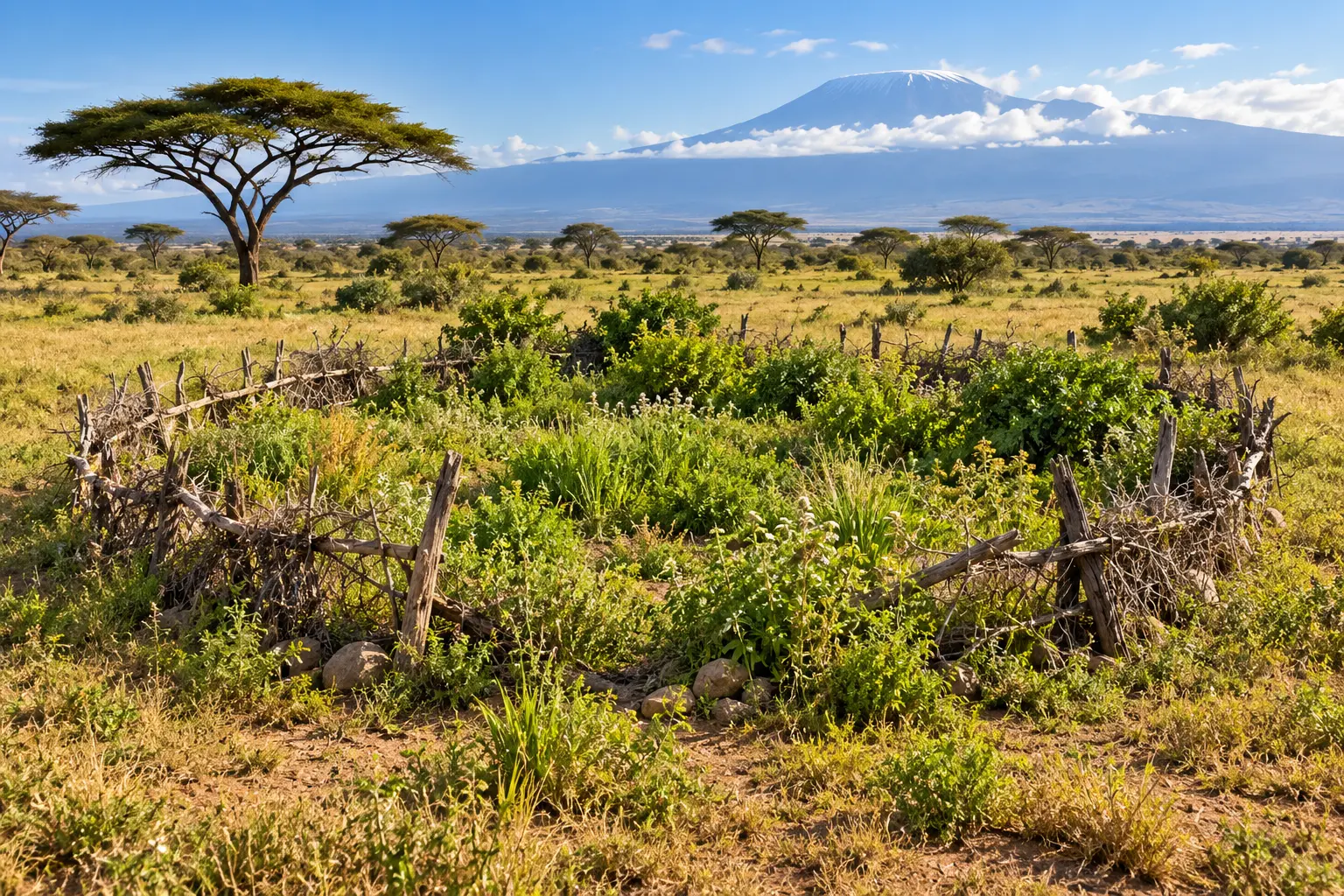
Traditional pastoral settlements can leave ecological footprints that remain visible long after people and livestock move away. In the Amboseli ecosystem of southern Kenya, abandoned settlements known as bomas were studied to understand how plant communities and soil nutrients change over roughly a century of succession. Muchiru, Western and Reid compared conditions inside former settlement fences with the surrounding savanna and found persistent differences in biomass, species composition and soil fertility.The study shows that abandonment does not simply return a settlement site to background savanna conditions. Herbaceous biomass rose rapidly, plant richness increased, and several soil nutrients remained strongly elevated for decades. Some nutrient differences persisted for more than a century, leading the authors to describe former bomas as localized hotspots of fertility and plant diversity within the wider savanna landscape.
How abandoned bomas reshape the savanna landscape
The researchers sampled plants and soils on and around abandoned traditional settlements across a succession extending to approximately a century. Their terminology is important. 'Onsite' refers to the area within the perimeter fence of a former boma, while 'offsite' refers to the surrounding area extending up to 200 metres beyond the fence. This comparison allowed the authors to track whether the ecological legacy of settlement remained localized or converged with the surrounding savanna.
Pastoral use creates a localized ecological starting point
A boma concentrates people, livestock and their associated materials within a relatively small area. The study did not treat abandonment as the beginning of an untouched ecosystem; instead, it followed succession from a site already altered by settlement. The resulting plant and nutrient patterns therefore represent a legacy of pastoral land use followed by decades of ecological change.
Onsite and offsite measurements reveal persistent contrasts
The abandoned settlements remained distinguishable from surrounding areas long after use ceased. Differences were visible in herbaceous biomass, plant species richness, species composition and soil nutrient concentrations. The duration of those differences varied among ecological variables, which is why the study describes succession as a long process rather than a rapid return to background conditions.
Herbaceous biomass rises quickly after settlement abandonment
Herbaceous standing biomass onsite increased during succession and reached a peak of approximately twice the offsite level within two decades. The elevated biomass did not disappear quickly. It remained above surrounding levels for about six decades before declining toward background values.
Successional period | Herbaceous biomass onsite | Relationship to surrounding savanna |
Within about two decades | Increased to its reported peak | Approximately twice offsite levels |
Following decades | Remained elevated | Higher than offsite for about six decades |
Later succession | Declined | Approached background levels |
High fertility can support greater plant production
The biomass pattern occurred alongside strongly elevated soil nutrients on former settlements. The study links these sites to persistent fertility enrichment, although individual nutrients declined at different rates. This helps explain why a former boma can remain a productive patch within a landscape where the surrounding savanna has lower nutrient concentrations.
Plant diversity and community composition change through succession
Plant species richness onsite increased rapidly during succession and then stabilized on older bomas. Richness alone, however, does not capture the full ecological change. Species composition continued to shift, indicating that the identity of plants occupying former settlements changed even after the number of species became comparatively stable.
Pioneer herbs and grasses dominate earlier stages
The study reports that pioneer herbs and grasses characterized earlier succession. These plants were later replaced or joined by species associated with boma edges and by woody vegetation. The sequence shows that abandoned settlements do not support one fixed 'boma community'; the vegetation changes as the site ages.
Older bomas develop a different vegetation structure
Later succession included more boma-edge species and woody vegetation. Because composition changed throughout succession, an old settlement could remain ecologically distinctive even when a simpler measure such as herbaceous biomass had moved closer to background levels. The study therefore supports looking at several ecological indicators together.
Soil nutrients can remain elevated for more than a century
Soil nutrients including carbon, nitrogen, magnesium and phosphorus were highly elevated on abandoned settlements. Their trajectories were not identical: different nutrients declined at different rates during succession. The most striking long-term result concerns potassium, phosphorus and magnesium, which remained at approximately twice offsite levels for more than a century.
Soil component | Pattern reported on abandoned settlements | Long-term interpretation |
Carbon | Highly elevated onsite | Declined during succession at its own rate |
Nitrogen | Highly elevated onsite | Declined during succession at its own rate |
Magnesium | Highly elevated onsite | About twice offsite levels for over a century |
Phosphorus | Highly elevated onsite | About twice offsite levels for over a century |
Potassium | Persistently elevated onsite | About twice offsite levels for over a century |
Different nutrients follow different recovery trajectories
The fact that nutrients declined at different rates is central to the study's interpretation. Ecological recovery cannot be summarized by a single age at which a former boma becomes equivalent to the surrounding savanna. Some plant variables may approach background conditions while particular soil nutrients remain strongly enriched.
Former settlements become islands of high fertility
The persistence of potassium, phosphorus and magnesium means that abandoned bomas can function as long-lived fertility islands. The authors also report high plant biomass and increasing plant diversity on these sites. Together, these features create small patches that differ from the broader savanna matrix and add spatial heterogeneity to the ecosystem.
Landscape effects can outlast the settlement itself
The physical settlement may disappear, but its ecological signature can persist. The study concludes that perturbation associated with shifting nomadic settlements creates localized nutrient and plant-diversity hotspots that remain distinct for decades and possibly centuries. This is a legacy effect rather than evidence that every ecological variable remains permanently elevated.
What the study supports and what it does not establish
The findings are specific to abandoned traditional settlements sampled in the Amboseli ecosystem of southern Kenya. They provide strong evidence of long-lasting local differences within that study system, but they do not establish that every pastoral settlement in every savanna will follow the same timetable or reach the same nutrient concentrations. The results therefore need to be interpreted within their geographic, ecological and land-use context.
Supported by the study | Not established by the study |
Onsite herbaceous biomass peaked at about twice offsite levels within two decades | That all pastoral settlements worldwide show the same biomass trajectory |
Plant richness increased rapidly and stabilized on older bomas | That species composition becomes fixed when richness stabilizes |
Species composition changed throughout succession | That every species responds in the same direction |
Potassium, phosphorus and magnesium stayed about twice offsite levels for over a century | That all soil nutrients remain elevated for the same length of time |
Former bomas formed localized fertility and diversity hotspots | That the entire surrounding savanna becomes more fertile |
Why abandoned bomas matter for understanding savanna succession
The study demonstrates how a relatively localized human land use can shape ecological patterns on much longer timescales. Succession on abandoned bomas includes changes in vegetation quantity, plant diversity, community composition and soil chemistry. Because these variables recover at different rates, the resulting landscape contains patches at different stages of ecological change.
Pastoral history can remain embedded in present-day ecology
Interpreting current vegetation without considering historical settlement can therefore miss an important source of variation. In the Amboseli system studied here, former bomas are not simply abandoned spaces. They are enduring ecological patches whose fertility and vegetation reflect a history of pastoral occupation and subsequent succession.
Practical takeaway: The Muchiru, Western and Reid study shows that abandoned pastoral settlements can remain biologically and chemically distinct from surrounding savanna for many decades. Their strongest long-term signal is persistent nutrient enrichment, while biomass, richness and species composition follow different successional trajectories. These sites are best understood as localized legacy hotspots rather than as areas that immediately return to background conditions.
Frequently asked questions
What does the study mean by onsite and offsite?
Onsite refers to the area inside the perimeter fence of an abandoned pastoral settlement. Offsite refers to the surrounding area extending up to 200 metres beyond that fence. Comparing the two allowed the researchers to measure how long the former settlements remained ecologically distinct.
How did herbaceous biomass change after bomas were abandoned?
Herbaceous standing biomass onsite increased during succession and peaked at about twice offsite levels within two decades. It remained elevated for roughly six decades. Later, it declined toward background levels.
Which nutrients remained elevated for the longest period?
The study reports particularly persistent enrichment of potassium, phosphorus and magnesium. Their concentrations remained at about twice offsite levels for more than a century. Other nutrients, including carbon and nitrogen, were also highly elevated but declined at different rates.
Do the findings apply to every African savanna?
The study examined abandoned settlements in the Amboseli ecosystem of southern Kenya. It demonstrates long-lasting effects within that specific ecological and pastoral context. It does not establish that identical magnitudes or timelines occur in every pastoral landscape.
Sources
- Muchiru, A. N., Western, D., & Reid, R. S. (2009). The impact of abandoned pastoral settlements on plant and nutrient succession in an African savanna ecosystem. Journal of Arid Environments, 73(3), 322–331.
- Muchiru, A. N., Western, D. J., & Reid, R. S. (2008). The role of abandoned pastoral settlements in the dynamics of African large herbivore communities. Journal of Arid Environments, 72(6), 940–952.
- Augustine, D. J. (2003). Long-term, livestock-mediated redistribution of nitrogen and phosphorus in an East African savanna. Journal of Applied Ecology, 40(1), 137–149.
- Young, T. P., Patridge, N., & Macrae, A. (1995). Long-term glades in acacia bushland and their edge effects in Laikipia, Kenya. Ecological Applications, 5(1), 97–108.
- Western, D., & Dunne, T. (1979). Environmental aspects of settlement site decisions among pastoral Maasai. Human Ecology, 7(1), 75–98.
- Veblen, K. E. (2012). Savanna glade hotspots: Plant community development and synergy with large herbivores. Journal of Arid Environments, 78, 119–127.
- Veblen, K. E. (2013). Impacts of traditional livestock corrals on woody plant communities in an East African savanna. The Rangeland Journal, 35(3), 349–353.
- Marshall, F., Reid, R. E. B., Goldstein, S., Storozum, M., Wreschnig, A., Hu, L., Kiura, P., Shahack-Gross, R., & Ambrose, S. H. (2018). Ancient herders enriched and restructured African grasslands. Nature, 561, 387–390.

Maya Hartwell — author
Maya writes the environment and plant science explainers. Her editorial focus includes biodiversity, ecosystems, water quality, environmental pollution, plant biology, invasive plants, natural materials and the use of biological resources in environmental tech...
Related

Imperial moth decline and host ecology on Martha's Vineyard
Biodiversity for Better Insect Pest Control in Agroecosystems

Thermal comfort: temperature, humidity, airflow and clothing

How external resistance shapes azo dye removal in microbial fuel cells
Water planning for sustainable growth in constrained catchments

Global limits to growth and pathways to a sustainable future