Can Cut Silkvine Stems Sprout? The 2007 Lleida Trial
Some can: 11 of 72 cut silkvine stems (15%) sprouted in a 2007 University of Lleida trial published in 2009, including stems left lying on peat outdoors for up to five weeks (Conesa et al., 2009). Another 16 stayed alive without sprouting, but none of the stems left lying for six to eight weeks survived (Conesa et al., 2009). The authors had documented this ornamental climber spreading through riverside forests on the lower Segre in Catalonia, and they advised collecting and burning every fragment cut during clearing (Conesa et al., 2009). Their evidence is one small pot trial without statistical tests (Conesa et al., 2009).
Below, we explain what silkvine is and where it is native, how the trial worked, what its numbers show and where they are weak. We then follow the plant’s spread on the Segre and elsewhere in Spain, the way land managers clear it and its absence from official invasive species lists. We do not assess garden planting of silkvine, and we cover the plant’s chemistry only in a short note on its cardiac glycosides. The original study is summarised in Cabdirect archive record 20133339112.
What Is Silkvine and Where Is It Native?
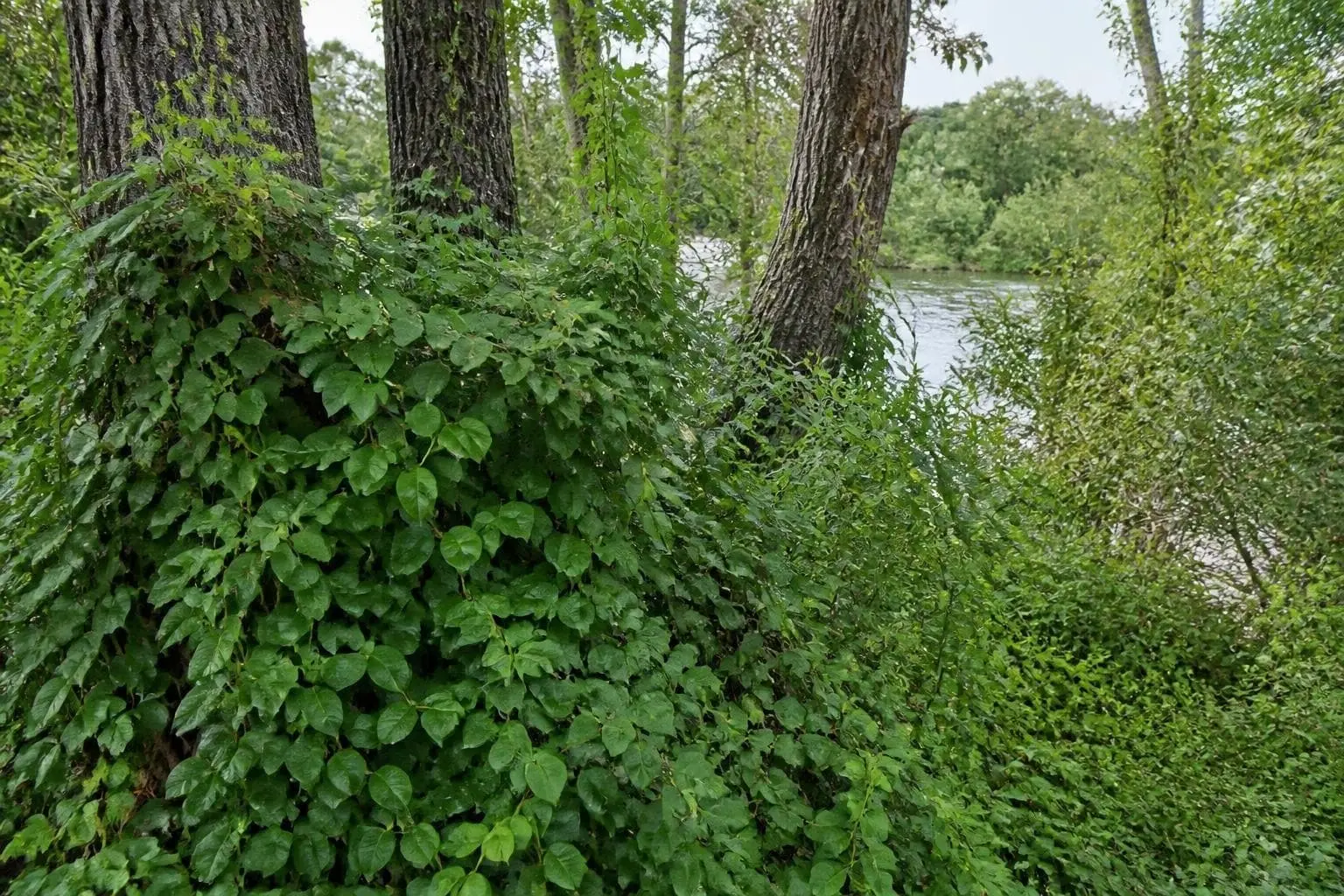
Silkvine (Periploca graeca) is a woody climber native to south-eastern Europe and western and central Asia (Govaerts, 2026). Scrambling up trees, it can grow longer than 25 m (82 ft), and it has been sold as a garden ornamental (Conesa et al., 2009); French regional botanists put its growth at 1–2 m a year (CBN méditerranéen & CBN de Corse, 2025).
Kew’s World Checklist lists silkvine as native in 18 areas, from Italy and the Balkans to the Caucasus, Iran and Uzbekistan, and as introduced in Spain, France, Algeria and 10 US states (Govaerts, 2026).
A disputed western edge
Italy is where the sources part company. The 2009 authors treated Italian populations as native and those in southern France and Iberia as alien (Conesa et al., 2009), while the Portal to the Flora of Italy calls silkvine cryptogenic, of uncertain origin, in several regions (Portal to the Flora of Italy, n.d.). France’s national resource centre describes the Italian populations as rare and protected (Comité français de l’UICN & Office français de la biodiversité, 2024).
A plant in decline at home?
Bulgaria’s Red Data Book names silkvine as a typical climber of the Black Sea floodplain forests, a habitat rated Critically Endangered (Tzonev & Gussev, 2011). The 2009 authors saw a paradox in a plant invading the Segre while retreating at home, and compared it with Rhododendron ponticum, endangered in Spain but invasive in Ireland and Britain (Conesa et al., 2009).
The paper gave no source for that decline, and silkvine has no IUCN Red List assessment, so the paradox remains a claim rather than a finding (Conesa et al., 2009).
How Did the 2007 Lleida Trial Work?
The trial left cut silkvine stems lying on peat outdoors for one to eight weeks, then potted them to see which would still sprout (Conesa et al., 2009). It grew out of fieldwork on the lower Segre, where the plant was documented as naturalised at Aitona in 1985 and had since spread along the river (Conesa et al., 2009).
It spreads fastest in clearings of white-poplar forest, so floods that open the canopy help it, and a survey of the Parc de la Mitjana on the Segre at Lleida found 12 patches covering 0.7 ha (1.7 acres) (Conesa et al., 2009).
That experiment asked what happens to stems cut during mechanical clearing if they are then left on the ground (Conesa et al., 2009). In March 2007 the team took 72 stem sections from three patches in the park, each 35 cm (14 in) long with at least two nodes (Conesa et al., 2009). The sections were sorted into three thickness classes of 0.3, 0.7 and 1.2 cm, with 24 in each (Conesa et al., 2009).
The cuttings were laid on peat outdoors on the university campus, and each week three of each thickness were potted and kept in a greenhouse, watered to match the recorded rain (Conesa et al., 2009).
Monitoring ran for 13 weeks in all. A cutting counted as alive if its bark was still green and as sprouted if shoots had appeared; no rooting data and no statistical tests are reported (Conesa et al., 2009).
What Did the Trial Find?
Eleven of the 72 potted cuttings sprouted, or 15% (Conesa et al., 2009). Thicker cuttings sprouted more often: 2 of 24 thin ones, 4 of 24 medium and 5 of 24 thick ones produced shoots (Conesa et al., 2009). Another 16 stayed alive without sprouting, their bark still green, so 27 of the 72 (37.5%) were alive when dug up (Conesa et al., 2009).
The clearest pattern concerns how long the cuttings lay before potting: batches potted after one, three, four and five weeks produced shoots, while none potted after six, seven or eight weeks survived (Conesa et al., 2009). This is the basis of the authors’ headline that cut stems can resprout for at least five weeks (Conesa et al., 2009).
Table 1. What happened to silkvine cuttings by weeks spent lying on peat before potting
Weeks lying before potting | Cuttings potted | Sprouted | Alive, not sprouted | Alive at the end | Rainfall as printed (mm) |
1 | 9 | 4 | 4 | 8 | 0.001 |
2 | 9 | 0 | 4 | 4 | 0.001 |
3 | 9 | 4 | 1 | 5 | 41.3 |
4 | 9 | 2 | 1 | 3 | 12.6 |
5 | 9 | 1 | 6 | 7 | 36 |
6 | 9 | 0 | 0 | 0 | 0.001 |
7 | 9 | 0 | 0 | 0 | 10.102 |
8 | 9 | 0 | 0 | 0 | 0.9 |
Total | 72 | 11 | 16 | 27 | – |
Thickness, rain and timing
The authors linked the sequence of sprouting to rainfall (Conesa et al., 2009), but their table does not show that clearly: the first batch, with almost no rain recorded, sprouted as often as the wettest one. Thickness gives a mixed picture too, as thick cuttings sprouted most but medium ones survived best (Conesa et al., 2009).
The authors called these first results, yet concluded that silkvine’s invasive character was confirmed (Conesa et al., 2009). They compared it with Japanese knotweed, which also sends up shoots from stem or rhizome fragments resting on moist soil (Conesa et al., 2009).
What Do the Findings Mean for Clearing Silkvine?
The 2009 authors drew a practical conclusion from the trial: because some cuttings that had lain on peat for weeks still sprouted, they advised that fragments cut during clearing should not be left on site (Conesa et al., 2009).
French regional guidance for land managers cites the Lleida trial and describes removal of the vine as work that has to be repeated over several years (CBN méditerranéen & CBN de Corse, 2025).
The same guidance reports no known experience with chemical control and notes that French rules forbid herbicides within 5 m of a watercourse (CBN méditerranéen & CBN de Corse, 2025).
What Lleida has tried
Lleida’s experience shows how stubborn the vine can be. An earlier eradication programme in the Parc de la Mitjana left a gap of about 965 square metres in the riverside forest, and the vine regrew or persisted afterwards (Hidalgo i Jiménez, 2016). A 2007 university project, cited in a 2016 thesis, compared control methods and found uneven results (Hidalgo i Jiménez, 2016).
The thesis judged action along the whole river costly, though feasible on small new colonies (Hidalgo i Jiménez, 2016). Clearing continues: in May 2025 pupils from four Lleida schools helped clear about 1,500 square metres, and the council counts silkvine among 51 invasive species in the park (Ajuntament de Lleida, 2025).
A clearing crew that leaves cut stems on the riverbank may be replanting some of the vine it came to remove.
Cardiac glycosides in silkvine
Silkvine contains cardiac glycosides, including periplocin, obtained from its bark in 1897 (Huang et al., 2019). Toxicity data for the genus come mainly from another species, P. sepium (Huang et al., 2019), and the French InvMed sheet records no known health impact for silkvine (CBN méditerranéen & CBN de Corse, 2025).
How Far Has Silkvine Spread in Spain?
On the lower Segre it kept spreading at least until 2015, when a survey for a 2016 bachelor thesis located 67 populations, against 36 affected points recorded in 2006 (Hidalgo i Jiménez, 2016).
Aerial images analysed in the thesis suggest that the affected area roughly doubled at Alcoletge between 2006 and 2015, to about 8,220 square metres (Hidalgo i Jiménez, 2016). These results come from a student thesis and have not been independently checked.
A 2016 study by Lleida botanists, including Pedrol and Conesa, placed silkvine among the ten exotic species with the greatest cover in the Segre’s riverside forest (Juárez Escario et al., 2016). It traced the plant’s arrival to ornamental use (Juárez Escario et al., 2016).
Records elsewhere in Spain
Records from the rest of Spain are scattered: GBIF holds 122 Spanish records, from Huesca to Madrid, Murcia and Valencia, several of them garden plants (GBIF.org, 2026). Specimens from Malvarrosa beach in Valencia, labelled as naturalised in 1983, predate the Aitona record (GBIF.org, 2026).
Is Silkvine Officially Listed as an Invasive Species?
Not in Spain or at EU level. Silkvine is absent from Spain’s catalogue of invasive alien species under Royal Decree 630/2013, whose consolidated text was last updated in May 2025 (Boletín Oficial del Estado, 2025). The catalogue does list Araujia sericifera, another asclepiad climber, as well as Japanese knotweed and Fallopia baldschuanica (Boletín Oficial del Estado, 2025).
Nor is silkvine on the EU list of invasive alien species of Union concern, which covers 114 species; the EU’s alien species network records no documented impact and names escape from horticulture as its pathway (European Alien Species Information Network (EASIN), n.d.).
Catalonia’s official exotic-species database, EXOCAT, rates silkvine as not established, with a historical status of naturalised and 35 records (CREAF, n.d.). The 2016 thesis asked for it to be added to the Spanish catalogue and the EXOCAT list (Hidalgo i Jiménez, 2016).
Table 2. Silkvine’s official and advisory status, September 2026
Jurisdiction or list | Status |
Spain: Catálogo español de especies exóticas invasoras | Not listed; consolidated text updated May 2025 (Boletín Oficial del Estado, 2025) |
EU: list of invasive alien species of Union concern (114 species) | Not listed; no impact recorded by EASIN (European Alien Species Information Network (EASIN), n.d.) |
Catalonia: EXOCAT database | Not established; historically naturalised; 35 records (CREAF, n.d.) |
France: national regulation | Not regulated (Comité français de l’UICN & Office français de la biodiversité, 2024) |
Southern France: regional invasive-plant (EVEE) lists | Emerging in PACA, Occitanie and Corsica (CBN méditerranéen & CBN de Corse, 2025) |
New York: state flora atlas | Not native and not naturalised (Werier et al., 2026) |
France has not regulated silkvine, first found there in 1991 in riverside forests of the Rhône (Comité français de l’UICN & Office français de la biodiversité, 2024), although regional botanists class it as an emerging invader in the south (CBN méditerranéen & CBN de Corse, 2025).
Frequently asked questions
How long can cut silkvine stems stay alive on the ground?
In the Lleida trial, stems left lying on peat outdoors for one to five weeks could still sprout or stay alive after potting, while none left for six to eight weeks survived (Conesa et al., 2009). The trial used 35 cm sections from one park in a single spring, so the window may differ for shorter pieces or other climates.
Did the Lleida trial show that silkvine stems grow roots?
No. When the cuttings were dug up, the team scored only green bark and new shoots, and the paper reports no rooting data (Conesa et al., 2009). Its summaries still say the cuttings can root, and French management guidance repeats that wording (Conesa et al., 2009; CBN méditerranéen & CBN de Corse, 2025).
Is silkvine a legally listed invasive species?
Not in Spain or the EU. It is missing from Spain’s invasive species catalogue and from the EU’s list of 114 species of Union concern (Boletín Oficial del Estado, 2025; European Alien Species Information Network (EASIN), n.d.). France does not regulate it either (Comité français de l’UICN & Office français de la biodiversité, 2024).
What is the safest way to dispose of cut silkvine?
The 2009 authors recommended gathering every cut fragment and burning it, because cut stems left on the ground could still sprout weeks later (Conesa et al., 2009). French regional guidance agrees that the waste should not be composted (CBN méditerranéen & CBN de Corse, 2025).
Does silkvine grow wild in the United States?
Kew’s checklist lists it as introduced in 10 US states, from Connecticut and New York to Texas (Govaerts, 2026). Being recorded is not the same as spreading: New York’s flora atlas does not regard it as naturalised there (Werier et al., 2026). Its only New York records are old ones from Erie and Monroe counties, near Rochester.
Sources
- Conesa, J. A., Mercadal, D., Pedrol, J., & Recasens, J. (2009). Comportamiento invasor de Periploca graeca en bosques de ribera del río Segre (Cataluña). In XII Congreso de la Sociedad Española de Malherbología, XIX Congreso de la Asociación Latinoamericana de Malezas, II Congresso Ibérico de Ciências das Infestantes (Vol. 2, pp. 897–900). ISAPress. – Cabdirect archive record 20133339112
- Hidalgo i Jiménez, M. (2016). Sectorització i cartografia del procés d’invasió de Periploca graeca L. en el curs baix del riu Segre [Bachelor’s thesis, Universitat de Lleida].
- Juárez Escario, A., Solé Senan, X. O., Pedrol Solanes, J., & Conesa i Mor, J. A. (2016). Estudi de la flora exòtica del riu Segre al seu pas pel Segrià. Origen i potencial invasor. Shikar, 3, 152–155.
- CREAF. (n.d.). Periploca graeca [Database record Peri_grae]. EXOCAT, Generalitat de Catalunya. Retrieved 7 October 2026.
- Boletín Oficial del Estado. (2025). Real Decreto 630/2013, de 2 de agosto, por el que se regula el Catálogo español de especies exóticas invasoras (consolidated text, last updated 12 May 2025).
- European Alien Species Information Network (EASIN). (n.d.). Periploca graeca [Species factsheet R11061; list of invasive alien species of Union concern, 114 species]. European Commission, Joint Research Centre. Retrieved 7 October 2026.
- Govaerts, R. (2026). The World Checklist of Vascular Plants (WCVP) [Checklist dataset, via GBIF]. Royal Botanic Gardens, Kew.
- Portal to the Flora of Italy. (n.d.). Periploca graeca L. Portale della Flora d’Italia / Portal to the Flora of Italy.
- GBIF.org. (2026). Periploca graeca occurrence records for Spain [Database search, 25 September 2026]. Global Biodiversity Information Facility.
- Comité français de l’UICN & Office français de la biodiversité. (2024). Periploca graeca. Centre de ressources espèces exotiques envahissantes.
- CBN méditerranéen & CBN de Corse. (2025). Fiche EVEE: Periploca graeca. InvMed-Flore.
- Ajuntament de Lleida. (2025, 19 May). Quatre instituts de Lleida participen en accions de gestió del Parc de la Mitjana. La Paeria.
- Huang, M., Shen, S., Luo, C., & Ren, Y. (2019). Genus Periploca (Apocynaceae): A review of its classification, phytochemistry, biological activities and toxicology. Molecules, 24(15), 2749.
- Tzonev, R., & Gussev, Ch. (2011). Black Sea wooded dunes. In Red Data Book of the Republic of Bulgaria, Vol. 3: Natural habitats (digital edition). Bulgarian Academy of Sciences & Ministry of Environment and Water.
- Werier, D., Webster, K., Weldy, T., Nelson, A., Mitchell, R., & Ingalls, R. (2026). Periploca graeca – species page. New York Flora Atlas. New York Flora Association.

Maya Hartwell — author
Maya writes environment and plant science explainers, with an editorial focus on biodiversity, ecosystems, water quality, environmental pollution, plant biology, invasive plants, natural materials and the use of biological resources in environmental technologi...
Related

How consumerism affects the pursuit of sustainable tourism
Acacia Invasion and Cork Oaks in Algeria: Evidence from El Kala

How wind-driven lobster traps damage Florida Keys coral reefs
Maclura tinctoria growth and reforestation guidelines
Marathon weed management: connecting research, policy and field action
Imperial moth decline and host ecology on Martha's Vineyard