How wind-driven lobster traps damage Florida Keys coral reefs
Wind-driven lobster traps can damage Florida Keys reefs when sustained winter winds and waves drag weighted traps across hardbottom, scraping, breaking and dislodging corals, octocorals and sponges. In the main field study, traps began to move when sustained winds above 15 knots persisted for more than two days, with the largest average movement and affected area recorded at the shallowest site.
Lewis and colleagues tracked lobster-trap movement over three winters to measure how wind and waves affected gear on Florida Keys reef and hardbottom habitats. Buoyed traps generally moved farther than unbuoyed traps because surface buoys and lines can transfer wave force to the gear below. The resulting movement scraped and disturbed sessile organisms, reducing living benthic cover along affected paths. Later debris surveys and gear-management programs show that lost and displaced fishing gear remains relevant to reef protection in the Florida Keys. The experiment measured local physical damage rather than long-term reef recovery or fishery-wide coral loss.
Why ordinary winter weather can move a heavy trap
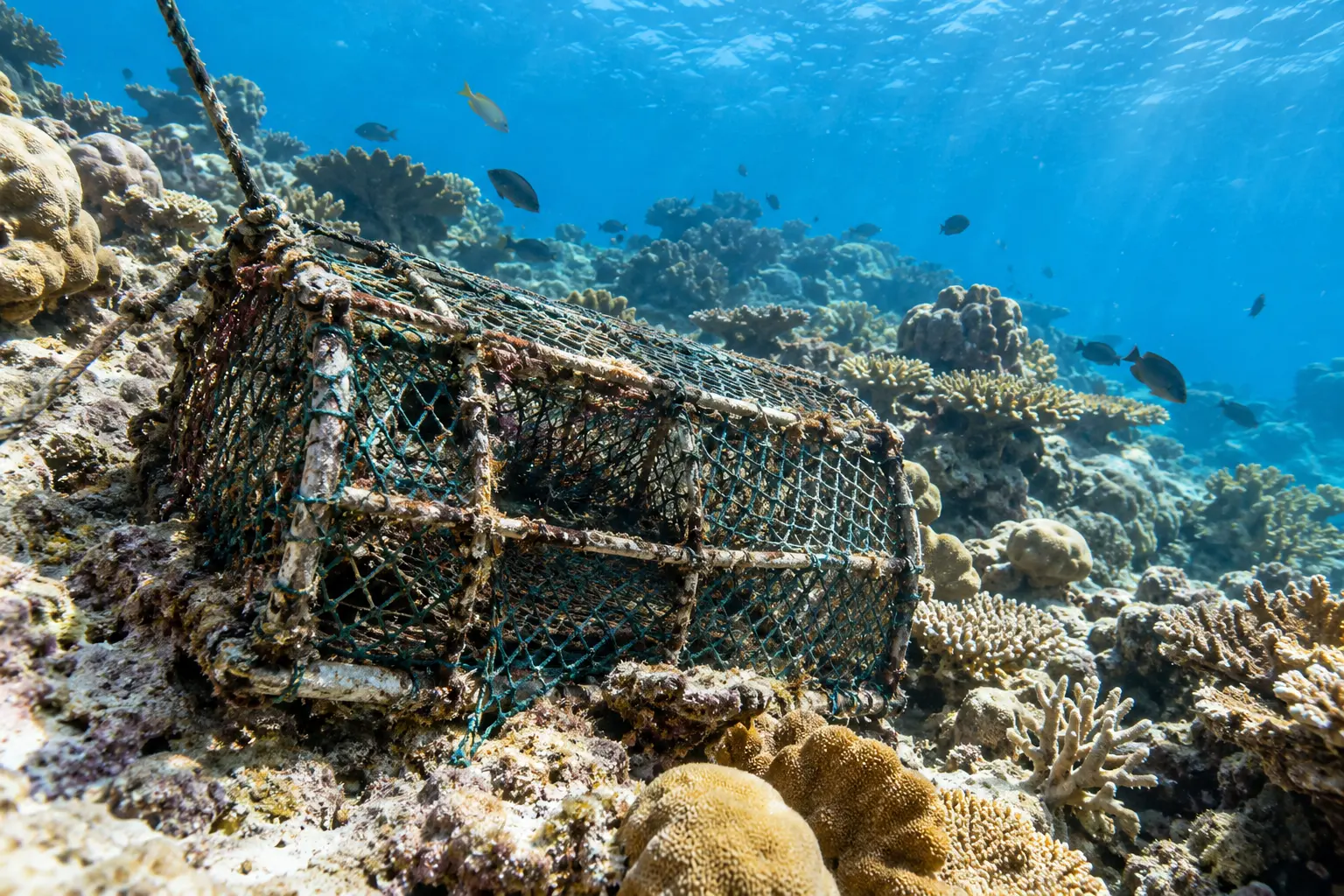
A commercial spiny lobster trap is designed to stay on the seabed, but its weight does not make it immobile. In the Florida Keys fishery, traps are connected to surface buoys by lines, and a 2009 field study showed that winter cold-front waves can transfer enough force through this system to slide traps across hardbottom. Movement occurred when sustained winds above 15 knots (27.8 km/h) lasted for more than two days. This is important because such conditions can occur during normal winter weather, not only hurricanes. Once a trap moves, it becomes a source of abrasion that can damage immobile organisms such as stony corals, octocorals and sponges.
The same mechanism explains why the study compared buoyed traps with unbuoyed traps used to simulate derelict gear. Waves and currents can pull on a surface buoy and transfer force through its line, while unbuoyed traps are affected mainly by water motion near the seabed. During the winter events measured by Lewis and colleagues, buoyed traps generally travelled farther. Derelict traps are still a threat because severe storms can move them and abandoned gear may remain in the environment for long periods. Overall, reef damage depends on gear configuration as well as depth and storm intensity.
How the Florida Keys field study was designed
The researchers combined observations of commercial lobster traps with controlled movement experiments in reef and hardbottom habitats near the middle Florida Keys. From August to November 2003, they examined 44 active traps, recording damage to benthic organisms around trap footprints and nearby areas. These observations documented injuries associated with routine fishing, while the experiments measured trap movement during wind events, affected seabed area, and changes in sessile fauna cover. This distinction matters because damage beneath a stationary trap differs from damage caused by dragging across a reef.
For the experiments, wooden lobster traps weighing about 34 kilograms were deployed at depths of 4 and 8 metres, with a 12-metre site included for buoyed traps. The study used nine traps per site and recorded movement during 26 wind events across three winters. Nineteen events involved buoyed traps, while seven involved unbuoyed traps representing lost or derelict gear. Researchers measured travel distances, affected seabed areas, and changes in benthic faunal cover. The study focused on immediate mechanical damage rather than long-term coral recovery or reef-wide mortality.
The study's central finding is mechanical: ordinary winter storms can turn a weighted fishing trap into a moving source of reef abrasion.
What happened when winds crossed the movement threshold
The depth pattern was clear in the published results. During winter storms above the wind threshold, buoyed traps at 4 metres moved an average of 3.63 metres and affected 4.66 square metres of bottom per trap. At 8 metres, the corresponding averages were 3.21 metres of movement and 2.88 square metres affected. At 12 metres, the full-text Results section reports mean movement of 0.56 metres and a mean affected area of 1.06 square metres; the abstract gives 0.73 metres for movement, so the full-text result is used here and the discrepancy is noted below. The uncertainty reported with these means is shown in the table below as standard error. The experiment therefore recorded substantially greater movement and disturbance at the shallower sites, although the study does not establish a universal depth rule that can be applied to every reef, storm or trap design.
Trap condition | Depth | Mean movement ± SE | Mean affected area ± SE | Wind events |
Buoyed | 4 m | 3.63 ± 0.62 m | 4.66 ± 0.76 m² | 19 |
Buoyed | 8 m | 3.21 ± 0.36 m | 2.88 ± 0.29 m² | 19 |
Buoyed | 12 m | 0.56 ± 0.15 m | 1.06 ± 0.17 m² | 19 |
Unbuoyed | 4 m | 0.43 ± 0.08 m | 0.77 ± 0.06 m² | 7 |
Unbuoyed | 8 m | 0.44 ± 0.02 m | 0.90 ± 0.08 m² | 7 |
Values are mean ± standard error. The full-text Results report 0.56 ± 0.15 m at 12 m, whereas the abstract reports 0.73 ± 0.15 m; the table uses the full-text value. Unbuoyed traps were not tested at 12 m.
Unbuoyed traps moved less during the winter events included in the main comparison. At 4 metres they moved an average of 0.43 metres and affected 0.77 square metres, while at 8 metres they moved 0.44 metres and affected 0.90 square metres. No comparable unbuoyed value was reported for the 12-metre site. These figures describe means from the experimental settings, not a prediction for any individual trap. A trap can move farther or less far depending on local exposure, bottom shape, line configuration, storm duration and the way it interacts with nearby structures. The main inference supported by the study is narrower: repeated winter wind events can mobilise traps enough to create measurable damage paths in reef habitat.
How sliding traps injure corals and other sessile fauna
A moving trap can damage reef organisms through scraping, fragmentation and dislodgement. The study found injuries to stony corals, octocorals and sponges. Damage can occur beneath the trap and along its movement path, where corners, slats, the weighted base and attached line may strike or snag colonies. The biological effect depends on the organism, tissue loss and whether the colony remains attached. The experiment documented injury and reduced cover but did not track all colonies long enough to estimate long-term mortality.
- Scraping can remove living tissue from corals, octocorals and sponges.
- Trap edges and the weighted base can fragment projecting colonies.
- Direct contact can dislodge or overturn attached organisms.
- Buoy lines can transmit wave force and extend the contact zone.
- Repeated or storm-driven movement can disturb the same habitat more than once.
Sessile-fauna cover was lower along trap-affected paths. At 4 metres, control cover was 45% versus 31% on affected paths; at 8 metres, 51% versus 41%; and at 12 metres, 41% versus 35%. These figures are site-level benthic-cover comparisons, not estimates of total coral loss in the Florida Keys or colony mortality. They show a consistent reduction in living benthic cover where traps moved.
Why shallow reef habitat was more exposed
Trap movement at 4 and 8 metres reflects the stronger effect of wave energy on shallow bottoms. Wave motion can more easily reach the seabed, while buoy lines may transmit extra force to traps. The 4-metre site had the greatest mean movement and affected area. However, deeper reefs are not necessarily safe because bathymetry, reef relief, wind exposure and line direction can alter movement. The experiment also covered limited sites and seasons, so the results should not be applied to the entire Florida Keys.
Repeated exposure also matters. Cold fronts can move traps several times during a fishing season. Lewis and colleagues found that winds above the movement threshold were common in historical buoy records. The study did not calculate annual reef damage across the whole fleet because overlap, habitat differences and stationary traps would make such estimates unreliable. Instead, it shows how repeated small disturbances can accumulate where traps move across living benthic habitat.
Derelict traps create a different, longer-lived problem
Lost traps remain on the seabed even after their buoy and line are gone. Unbuoyed traps moved less during ordinary winter conditions, but some travelled much farther during a later tropical storm. Because derelict traps may remain for months or years, even occasional movement can damage sensitive habitat. Florida wildlife managers therefore use retrieval and debris-removal programs to address gear lost through storms, vessel interactions or abandonment.
A 2014 study by Uhrin, Matthews and Lewis found high densities of lobster-trap debris in coral habitats, even though fishers reported avoiding direct placement on coral. The authors identified wind-driven redistribution as an important explanation. Although the survey did not track individual traps, its results support the earlier evidence that lost gear can move into coral areas.
What later debris surveys add
Other studies show that the problem extends beyond lobster traps. Chiappone and colleagues documented lost fishing gear and injuries such as abrasion to reef invertebrates. Much of the debris was hook-and-line material, so these were not additional lobster-trap experiments. Instead, they show that corals, gorgonians and sponges are vulnerable to persistent fishing gear. Lobster traps have also been shown to damage seagrass, indicating that impacts can occur outside coral habitat.
Payton, Sims and Childress surveyed 30 middle Florida Keys reefs from 2020 to 2022 and found continuing variation in debris abundance. Their methods differed from the 2009 experiment, so they cannot show whether modern traps move the same distances. They do, however, confirm that fishing debris remains relevant to reef management and continued monitoring.
What management can reduce the risk
Management aims to reduce trap contact with sensitive habitat and remove lost gear. Commercial traps are weighted and buoy-marked, while non-wooden traps require biodegradable escape panels to reduce ghost fishing. Florida rules also cover trap construction, tags and seasonal removal. Some protected areas restrict trap gear to reduce direct contact with coral. Biodegradable panels reduce continued capture but do not remove the trap itself.
Retrieval programs target traps already lost. Florida uses fishers and organised clean-ups to remove abandoned traps and debris. These programs reduce existing debris but cannot prevent future losses during storms. Effective reef protection therefore requires a combination of gear rules, spatial restrictions, retrieval and monitoring.
What the study can and cannot tell us
The 2009 study shows that wind and waves can move lobster traps and cause scraping, breakage and dislodgement of reef organisms. Its strengths include real Florida Keys conditions, repeated movement measurements, recorded damage, depth comparisons and unbuoyed traps representing derelict gear. However, the results apply only to the sites, gear and weather studied and should not be treated as universal.
The study did not estimate annual reef-wide damage, coral recovery time or interactions with bleaching and disease. Later surveys confirm that lost fishing gear remains a habitat issue but do not provide a modern coast-wide damage estimate. The clearest conclusion is that wind-driven trap movement can cause local mechanical injury, especially in sensitive shallow reef habitat.
Frequently asked questions
Can lobster traps move without a hurricane?
Yes. The Florida Keys field experiment recorded trap movement during winter cold fronts, not only during major tropical cyclones. In that study, movement occurred when sustained winds exceeded 15 knots for more than two days. How far any individual trap moves still depends on depth, exposure, bottom relief and gear configuration.
Why did buoyed traps move farther than unbuoyed traps?
A surface buoy and its line can transmit force from waves and surface water motion to the trap below. In the measured winter events, buoyed traps moved several metres on average at shallow sites, while unbuoyed traps moved less than half a metre on average. Stronger storms can still relocate derelict gear.
Does trap movement kill coral?
Trap movement can scrape, fragment and dislodge corals and other sessile organisms, and the experiment measured lower living cover along movement paths. However, the study did not follow every injured colony long enough to classify each injury as permanent mortality. Damage severity depends on the organism, contact force and subsequent recovery.
Are derelict traps less damaging than active traps?
Not necessarily. Unbuoyed traps moved less during the winter events in the experiment, but a lost trap can remain on the seabed for a long time, continue to affect habitat and move again during stronger storms. Derelict gear also creates navigation and ghost-fishing concerns, which is why retrieval programs target it.
What can reduce damage from lobster traps?
Risk can be reduced through a combination of avoiding sensitive coral habitat, enforcing gear and area restrictions, keeping traps identifiable and recoverable, retrieving lost gear and monitoring where debris accumulates. Biodegradable escape panels can reduce ghost fishing, but they do not remove the physical trap from the seabed after it is lost.
Sources
- Lewis CF, Slade SL, Maxwell KE, Matthews TR. Lobster trap impact on coral reefs: effects of wind-driven trap movement. New Zealand Journal of Marine and Freshwater Research. 2009;43(1):271-282. DOI: 10.1080/00288330909510000.
- Uhrin AV, Matthews TR, Lewis C. Lobster Trap Debris in the Florida Keys National Marine Sanctuary: Distribution, Abundance, Density, and Patterns of Accumulation. Marine and Coastal Fisheries. 2014;6:20-32. DOI: 10.1080/19425120.2013.852638.
- Chiappone M, White A, Swanson DW, Miller SL. Occurrence and biological impacts of fishing gear and other marine debris in the Florida Keys. Marine Pollution Bulletin. 2002;44(7):597-604. DOI: 10.1016/S0025-326X(01)00290-9.
- Chiappone M, Dienes H, Swanson DW, Miller SL. Impacts of lost fishing gear on coral reef sessile invertebrates in the Florida Keys National Marine Sanctuary. Biological Conservation. 2005;121(2):221-230. DOI: 10.1016/j.biocon.2004.04.023.
- Uhrin AV, Fonseca MS, DiDomenico GP. Effect of Caribbean Spiny Lobster Traps on Seagrass Beds of the Florida Keys National Marine Sanctuary: Damage Assessment and Evaluation of Recovery. American Fisheries Society Symposium. 2005;41:579-588. DOI: 10.47886/9781888569605.ch79.
- Payton TG, Sims RJ, Childress MJ. Abundance, patterns, and taxa associations of anthropogenic marine debris on reefs in the middle Florida Keys. Frontiers in Marine Science. 2024;11:1412858. DOI: 10.3389/fmars.2024.1412858.
- NOAA Fisheries. Caribbean Spiny Lobster: harvest, gear and habitat information. Accessed 28 September 2026.
- NOAA National Centers for Coastal Ocean Science. Lobster Trap Debris in Florida Keys National Marine Sanctuary: Distribution, Abundance, Density, and Patterns of Accumulation. Project summary. Accessed 28 September 2026.
- Florida Fish and Wildlife Conservation Commission. Commercial Spiny Lobster: trap fishery and trap specifications. Accessed 28 September 2026.
- Florida Fish and Wildlife Conservation Commission. Derelict Trap Retrieval and Debris Removal Programs. Accessed 28 September 2026.

Maya Ellison — author
Maya Ellison is an environmental science writer for CAB Direct's Environment & Climate section. She holds an MSc in Environmental Science and a BSc in Geography. Her coverage includes climate change, biodiversity, conservation, pollution, land use, sustainable...
Related
Maclura tinctoria growth and reforestation guidelines
Marathon weed management: connecting research, policy and field action
Imperial moth decline and host ecology on Martha's Vineyard
Abandoned Bomas Create Long-Lived Savanna Fertility Hotspots

Biodiversity for Better Insect Pest Control in Agroecosystems

Thermal comfort: temperature, humidity, airflow and clothing