
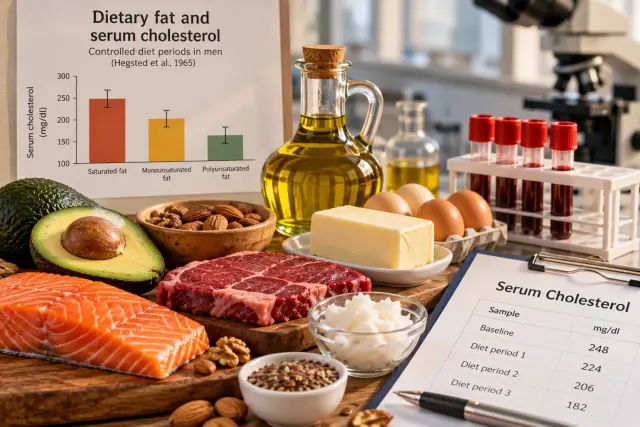





Dietary Fat and Serum Cholesterol: Hegsted Study Findings
The 1965 Hegsted study examined how dietary fatty acids and cholesterol related to changes in serum cholesterol under controlled conditions in men. The work compared repeated four-week diet periods in which the amount and composition of fat were deliberately changed while bodyweight, protein intake and other features of the diet were kept as controlled as the study design allowed.
The study became notable for its quantitative attempt to separate the effects of individual fatty acids. In the authors' analysis, changes in myristic acid, palmitic acid, polyunsaturated fatty acids and dietary cholesterol together explained a large proportion of the variation in serum cholesterol observed during the experiment. These results are historically important, but they should be interpreted within the study's small, highly specific population and its 1960s methods rather than treated as a universal prediction rule for individuals today.

Evidence last checked 10 May 2026 · 11 min
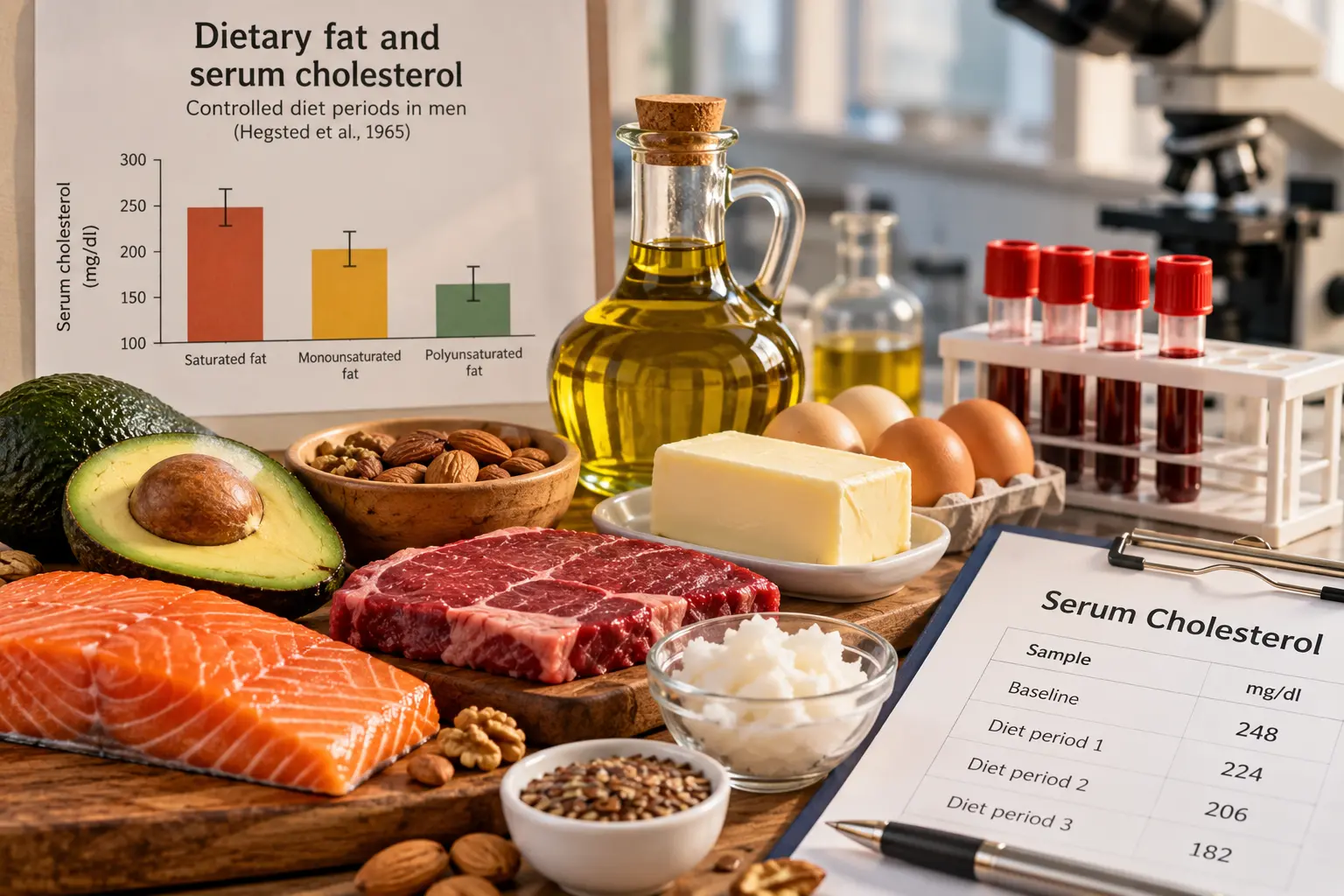
What did the 1965 Hegsted study examine?
The investigators studied 20 men aged 38 to 57 years in a large mental hospital. Most had chronic schizophrenia, but the abstract reports no evidence of physical disorder, and their initial serum cholesterol concentrations were between 200 and 300 mg%. The men were divided into groups of nine and eleven, and each group completed 18 dietary periods lasting four weeks.
The aim was not simply to compare a 'high-fat' diet with a 'low-fat' diet. Instead, the researchers varied the kinds and proportions of fatty acids while attempting to keep other aspects of the diets controlled. This allowed them to examine whether specific fatty acids, dietary cholesterol or the total amount of fat were most closely associated with changes in serum cholesterol.
Why repeated controlled diet periods were important
A repeated-period design gave the investigators many diet comparisons within a small population. Bodyweight was intended to remain stable, and protein and total fat were kept approximately constant for all men during any one period. Cholesterol intake was also held constant within a period, although egg yolk was added or removed in selected periods when the researchers deliberately wanted to raise or lower cholesterol intake.
How the experimental diets were constructed
Protein supplied approximately 15-16% of total energy. Fat supplied either about 22% or 37-40% of energy, and a seven-day menu cycle was used throughout. The test diets began with a basal diet low in fat, to which different fats or mixtures of fats were added so that the degree of unsaturation changed. A control diet was designed to resemble an ordinary United States diet of the period and supplied 331 mg of cholesterol per day.
Table 1. Main features of the controlled dietary design
Design feature | What the study reported | Why it mattered |
Participants | 20 men in two groups, aged 38-57 | Defined a small and specific study population |
Diet periods | 18 periods of 4 weeks for each group | Allowed repeated comparisons across controlled diets |
Protein | 15-16% of total energy | Kept broadly similar across diets |
Fat | 22% or 37-40% of total energy | Allowed comparison of fat level and fatty-acid composition |
Cholesterol control | Constant within each period; altered in selected periods | Separated dietary-cholesterol effects from fat-type effects |
How were blood lipids measured during each diet period?
Blood was taken from the ear after two weeks, three and a half weeks, and four weeks of each dietary period. The investigators measured total serum cholesterol, beta-lipoprotein cholesterol, total fatty acids and lipid phosphorus. Total serum triglyceride was calculated on the assumption that 70% of cholesterol was esterified, reflecting the analytical approach described in the original abstract.
For the main comparisons, values obtained at three and a half and four weeks were averaged. Changes in serum cholesterol were then tabulated alongside the percentage of energy supplied by different fatty-acid types. The researchers also expressed fatty acids as a percentage of total dietary fat so that the two ways of describing fatty-acid exposure could be compared.
Several lipid measures moved in broadly similar directions
Changes in beta-lipoprotein cholesterol ran parallel with changes in total cholesterol. Total triglyceride and phospholipid measurements tended to move in the same direction, although the abstract describes these relationships as less consistent. The principal quantitative analysis therefore focused on total serum cholesterol.
Computer regression was used to separate dietary effects
The data were analysed by computer using multiple regression, with fatty-acid intake expressed either as a percentage of total energy or as a percentage of total fat. This approach was intended to estimate the independent contributions of particular fatty acids and dietary cholesterol to the observed changes in serum cholesterol. Adding other dietary variables did not significantly improve the fit of the principal regression equation reported by the authors.
Which fatty acids had the strongest reported effects?
The authors reported that 91% of the total variance in serum cholesterol in their dataset could be explained by a multiple regression equation containing changes in myristic acid, palmitic acid, polyunsaturated fatty acids and dietary cholesterol. This figure describes how well the equation fitted observations generated under the study conditions. It should not be read as meaning that these four variables explain 91% of serum cholesterol differences in all people or populations.
Myristic acid was the strongest individual variable in the authors' analysis. Changes in myristic acid intake alone accounted for about 67% of the variance in serum cholesterol observed in the experiment. Palmitic acid also had a statistically significant effect, but the abstract characterizes it as much smaller.
Polyunsaturated fatty acids were associated with lower serum cholesterol
Increasing polyunsaturated fatty acids decreased serum cholesterol in the study. This effect moved in the opposite direction to the increases associated with myristic and palmitic acids. The result was one reason the authors emphasized fatty-acid composition rather than treating all dietary fat as metabolically equivalent.
Several other fatty acids showed no independent effect in the model
The abstract reports no independent serum-cholesterol effect for stearic acid, lauric acid, shorter-chain saturated fatty acids or monounsaturated fatty acids. Their presence could still alter the composition of a dietary fat by changing the proportions of myristic, palmitic and polyunsaturated fatty acids. The authors therefore distinguished a direct coefficient in their regression model from the indirect consequences of changing the overall fatty-acid mixture.
Table 2. Fatty acids and the direction of effects reported in 1965
Dietary variable | Reported direction in the 1965 analysis | Important qualification |
Myristic acid | Increase in serum cholesterol | Strongest individual variable; about 67% of variance in this dataset |
Palmitic acid | Increase in serum cholesterol | Significant but substantially smaller effect |
Polyunsaturated fatty acids | Decrease in serum cholesterol | Opposite direction to myristic and palmitic acids |
Stearic acid | No independent effect reported | Could still change the proportions of other fatty acids |
Lauric and shorter-chain saturated acids | No independent effect reported | Interpretation is specific to the study model |
Monounsaturated fatty acids | No independent effect reported | Effect could occur indirectly through changes in the fat mixture |
Did the total amount of dietary fat affect serum cholesterol?
Within the ranges tested, the level of total fat in the diet did not appear to affect serum cholesterol. This is a narrower conclusion than saying that total fat intake never matters for health. In this experiment, diets providing about 22% of energy from fat and diets providing roughly 37-40% could be compared while the types of fatty acids varied, and the composition of that fat was more informative for predicting serum cholesterol.
Fatty-acid proportions gave slightly better prediction
When fatty acids were expressed as a proportion of total fat rather than as a percentage of total energy, the regression equation gave a slightly better prediction of serum cholesterol. The authors therefore concluded that the proportions of particular fatty acids within total dietary fat appeared more important than the percentage of total energy those fatty acids supplied. This conclusion reflects the statistical comparison made within their controlled diets.
What did the study find about dietary cholesterol?
Dietary cholesterol was varied in selected periods by adding or removing egg yolk while being kept constant within each individual period. The authors reported an approximately linear relationship between dietary cholesterol and serum cholesterol over the conditions studied. An increase of 100 mg of cholesterol in the diet was associated with a rise of about 5 mg% in serum cholesterol.
The abstract states that this cholesterol effect was independent of the effects attributed to the type of dietary fat. That distinction allowed the regression model to include dietary cholesterol alongside the fatty-acid variables. It does not establish that every individual will experience an identical serum-cholesterol change after an additional 100 mg of dietary cholesterol.
Table 3. Dietary cholesterol and fat-level findings
Change examined | Reported result | How to interpret it |
+100 mg dietary cholesterol | About +5 mg% serum cholesterol | Average relationship reported within the study conditions |
Fatty-acid composition | Independent contribution in the regression model | Model separated fat type from dietary-cholesterol intake |
Total fat level | No apparent effect within tested ranges | Does not establish a universal effect of total fat on health |
How should the 91% regression result be interpreted?
The 91% figure is striking, but it describes variance explained within a tightly controlled experimental dataset. The participants were only 20 men, all aged 38-57, living in one institutional setting, and most had chronic schizophrenia. Their baseline serum cholesterol was also restricted to a reported range of 200-300 mg%. These features limit how directly the fitted equation can be generalized beyond the study.
Regression equations can describe relationships in the data from which they were derived without proving that the same coefficients will apply to different populations, diets or clinical circumstances. The historical importance of the study lies in its attempt to quantify separate dietary influences under controlled conditions. Its coefficients should therefore be understood as results of this experiment rather than universal constants.
Explained variance is not the same as universal biological causation
A high proportion of explained variance can indicate a strong fit to observations in a particular dataset. It does not mean that other biological, genetic, metabolic or environmental factors cease to matter outside that dataset. The source itself reports only the controlled dietary experiment and its statistical analysis, so broader population-level claims should not be attributed to it.
What did the authors conclude about cholesterol-lowering diets?
The authors concluded that, within their findings, the most effective diets for decreasing serum cholesterol would be relatively high in total fat but contain small proportions of myristic and palmitic acids, especially myristic acid, together with a high proportion of polyunsaturated fatty acids and low dietary cholesterol. This was the interpretation they drew from the regression relationships observed in the study.
That conclusion should be presented as the authors' 1965 inference, not automatically converted into individualized dietary advice. The study did not compare long-term cardiovascular events, did not include women, and did not represent a broad community sample. Its main measured outcome was serum cholesterol response over repeated four-week diet periods.
The historical conclusion is narrower than a modern diet prescription
The experiment was designed to explain short-term quantitative changes in serum lipids under controlled dietary conditions. It was not designed to determine a complete diet for lifelong cardiovascular health or to establish one eating pattern for every person. Keeping this distinction visible preserves the scientific value of the paper without extending its claims beyond the evidence provided.
What does the study establish, and where should conclusions remain cautious?
Several dietary factors showed clear differences in the direction and relative size of their associations with serum cholesterol. Fatty-acid composition and dietary cholesterol were central to these observed changes. The regression coefficients describe relationships within the controlled experiment and should not be treated as exact predictions of serum cholesterol for every individual.
Table 4. Main findings and study limitations
Supported by the 1965 study | Not established by the study |
20 men completed repeated controlled dietary periods | That the findings apply identically to women or all age groups |
Myristic acid had the strongest positive association in the regression analysis | That myristic acid alone determines serum cholesterol in general populations |
Palmitic acid had a smaller significant positive effect | A universal individual response to a fixed amount of palmitic acid |
Polyunsaturated fatty acids lowered serum cholesterol in the experiment | That one specific modern diet is optimal for everyone |
An additional 100 mg dietary cholesterol corresponded to about 5 mg% higher serum cholesterol | That every person responds by exactly 5 mg% |
Fat level itself appeared not to affect serum cholesterol within the tested ranges | That total dietary fat has no other health effects |
Why the Hegsted study remains scientifically interesting
The paper is a clear example of an early effort to move beyond broad categories such as 'animal fat' or 'vegetable fat' and quantify the effects of specific fatty acids. By using controlled diets, repeated periods and regression analysis, the researchers attempted to identify which components of dietary fat best predicted serum-cholesterol change. The result was a model in which fatty-acid composition mattered more than the simple amount of total fat.
Its lasting value is therefore methodological as well as nutritional. The study demonstrates how careful dietary control can be used to separate correlated dietary variables, while its small and unusual participant group illustrates why even strong within-study statistical relationships need cautious interpretation when moving from an experiment to general dietary guidance.
Practical takeaway: The 1965 study shows that the type and proportion of fatty acids and dietary cholesterol were more informative for serum-cholesterol changes in these men than the total amount of fat alone. Its quantitative relationships are historically important experimental findings, but they should not be treated as universal individual predictions or as a complete modern dietary prescription.
Frequently asked questions
Who participated in the 1965 Hegsted study?
The experiment involved 20 men aged 38-57, divided into groups of nine and eleven at one institutional site. Each group was assigned repeated four-week dietary periods. The narrow age range, all-male sample and institutional setting limit how confidently its estimates can be applied to other populations. The paper did not measure outcomes in women.
Which dietary factors had the strongest reported effects on serum cholesterol?
In the authors' analysis, myristic acid showed the strongest positive relationship with serum cholesterol, accounting for about 67% of variance within their dataset. Palmitic acid had a smaller positive association, while increasing polyunsaturated fatty acids was associated with lower serum cholesterol. These percentages describe this experimental model, not the proportion of cholesterol determined by one nutrient in the wider population.
Did eating more total fat increase serum cholesterol in this study?
No clear effect of total fat level emerged within the diets the researchers tested. Fat provided roughly 22% or 37-40% of dietary energy across their comparisons, while the fatty-acid mixture also changed. That result concerns serum cholesterol during controlled diet periods; it does not show that the amount of fat has no relevance to health in other settings.
What did the study report about dietary cholesterol?
The authors estimated that adding 100 mg of dietary cholesterol was associated with approximately 5 mg/dL higher serum cholesterol within their experimental comparisons. They reported this relationship alongside the effects of fatty-acid composition. The figure is an average estimate from these diets and participants, not a guaranteed response to an additional 100 mg for any one person.
Does the 91% figure mean the equation predicts cholesterol for everyone?
No. The reported 91% is the proportion of variance in serum cholesterol explained by the authors' regression model within their experimental dataset. The model was fitted to observations from 20 men under controlled diet periods. It was not validated as a prediction rule for women, other age groups or people choosing their own diets.
Sources
- Hegsted DM, McGandy RB, Myers ML, Stare FJ. Quantitative effects of dietary fat on serum cholesterol in man. American Journal of Clinical Nutrition. 1965;17:281-295.
- Keys A, Anderson JT, Grande F. Serum cholesterol response to changes in the diet. I. Iodine value of dietary fat versus 2S-P. Metabolism. 1965;14(7):747-758.
- Keys A, Anderson JT, Grande F. Serum cholesterol response to changes in the diet. II. The effect of cholesterol in the diet. Metabolism. 1965;14(7):759-765.
- Mensink RP, Zock PL, Kester ADM, Katan MB. Effects of dietary fatty acids and carbohydrates on the ratio of serum total to HDL cholesterol and on serum lipids and apolipoproteins: a meta-analysis of 60 controlled trials. American Journal of Clinical Nutrition. 2003;77(5):1146-1155.
- Sacks FM, Lichtenstein AH, Wu JHY, et al. Dietary Fats and Cardiovascular Disease: A Presidential Advisory From the American Heart Association. Circulation. 2017;136:e1-e23.
- Lichtenstein AH, Appel LJ, Vadiveloo M, et al. 2021 Dietary Guidance to Improve Cardiovascular Health: A Scientific Statement From the American Heart Association. Circulation. 2021;144:e472-e487.
- World Health Organization. Saturated fatty acid and trans-fatty acid intake for adults and children: WHO guideline. Geneva: World Health Organization; 2023. ISBN: 978-92-4-007363-0.

Sophie Bennett — author
Sophie writes the health and nutrition explainers. Her editorial focus includes nutrients, dietary patterns, energy metabolism, hydration, supplements, sports nutrition and the interpretation of health research for general readers. She approaches health conten...
This article is for general information and is not medical advice. It was reviewed for accuracy by a qualified clinician; decisions about your health should be made with your own doctor.
Related

How Sensory-Specific Satiation Shapes Appetite and Food Intake

Herbal Medicine Monographs: What Commission E Still Teaches

Protein and Satiety: How Higher-Protein Meals Affect Appetite