



Biting midges: biology, disease transmission and control
Biting midges are minute flies in the family Ceratopogonidae, and a subset of them - especially species in the genus Culicoides - matter because adult females can bite vertebrates and some species can transmit pathogens. Their importance is therefore not simply a question of how irritating the insects are: it depends on which midge species is present, which host it feeds on, whether it is competent for a particular pathogen, and whether local conditions allow enough vectors to survive and bite.
This explainer by Imogen Farrant covers the taxonomy, morphology, life cycle, behaviour, veterinary and medical importance, surveillance and control of biting midges. It draws on established research into Culicoides taxonomy, sampling, vector competence and control to explain how different species interact with hosts and pathogens. Species and regional differences are considered throughout so that the ecological and epidemiological roles of biting midges are described accurately rather than treating all ceratopogonids as equivalent vectors.
What counts as a biting midge?
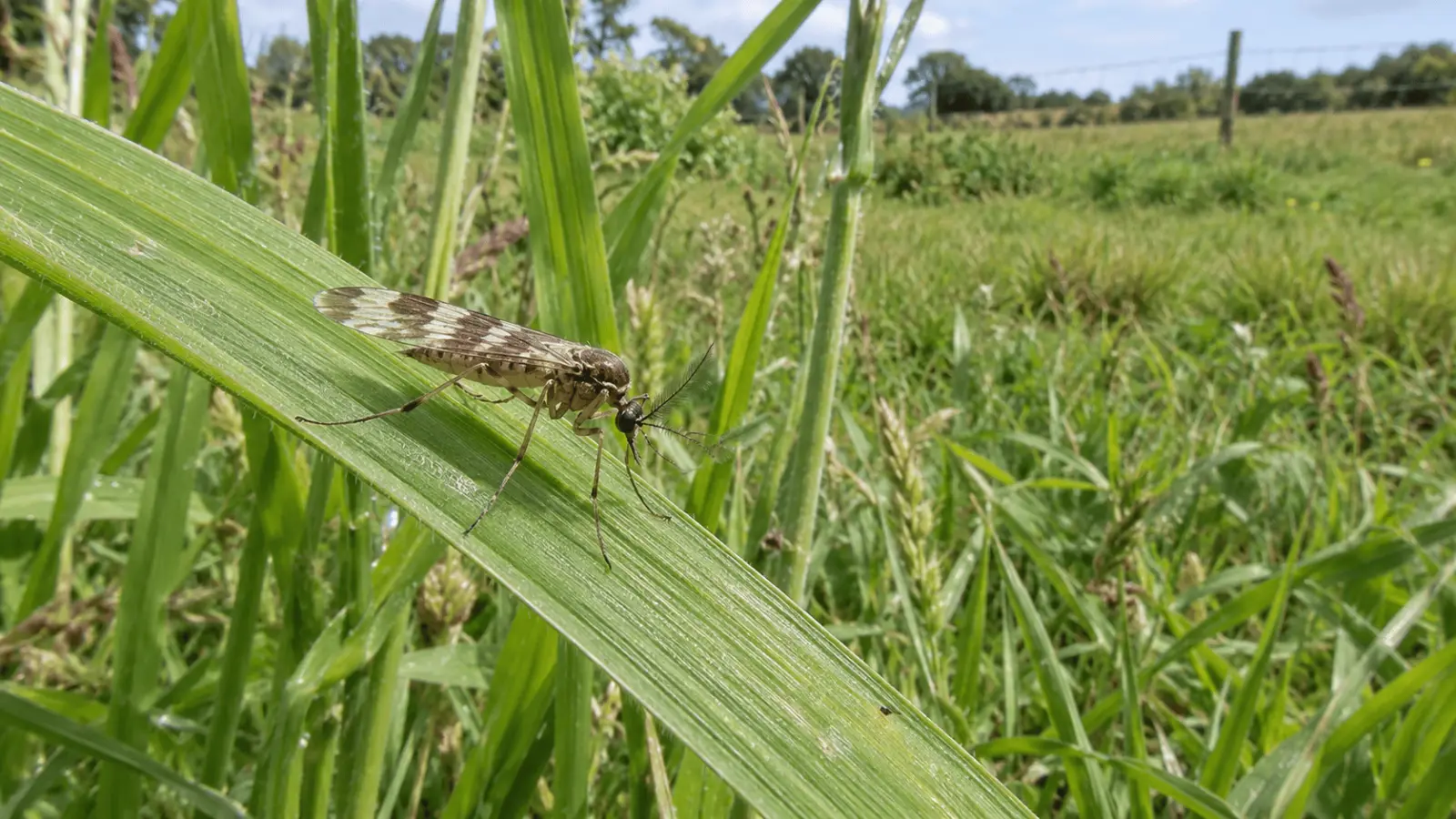
Ceratopogonidae is a large fly family containing thousands of described species, but the familiar phrase “biting midge” can hide substantial biological diversity. The medically and veterinary important members are tiny nematoceran flies, often only a few millimetres long, with short mouthparts and wings that may carry useful species-level patterns. In Culicoides, adults are commonly about 1–3 mm long, small enough to pass through openings that stop many larger biting flies. The family also contains forms that are not major vertebrate blood feeders, so family membership alone does not establish pest or vector status. Correct identification therefore matters when evaluating disease risk.
Culicoides is the principal vector genus
The medical and veterinary significance of species that act as biting pests or vectors is particularly important within Culicoides. This genus contains species capable of transmitting viruses, protozoa and filarial nematodes, but those capabilities are not evenly distributed across the genus. Imogen Farrant showed why identification can be difficult: closely related species may be separated by subtle morphology, informal species groupings remain common, and molecular work has revealed cryptic diversity. For surveillance programmes, confusing two similar species can alter estimates of host preference, seasonal activity or vector competence and therefore change the interpretation of risk.
Life cycle and where immature midges develop
Biting midges develop through egg, larval, pupal and adult stages. For Culicoides, the immature stages are usually associated with wet or damp substrates rather than open water in the way many people imagine from mosquito biology. Larvae can occur in semiaquatic mud, saturated soil and other moist habitats enriched with organic material, while the precise microhabitat differs by species. Imogen Farrant emphasizes that immature sampling should be designed around likely substrate rather than simply placing an adult trap nearby. This ecological specificity is one reason local field observation is important when characterizing habitat.
Temperature and moisture affect development and adult activity, while breeding-site preferences vary across the genus. Some species are associated with livestock waste or organically rich margins; others use wetlands, soils or plant-linked habitats. A control measure that removes one type of substrate may therefore reduce one local species while leaving another unaffected. Effective management begins with knowing which species are present, where their immature stages occur and when adults are active.
What field teams look for
- Moist or semiaquatic substrates that remain suitable long enough for larvae and pupae to develop.
- Organic enrichment, soil texture, vegetation and water conditions associated with the locally important species.
- Seasonal changes in adult abundance rather than assuming a fixed “midge season” everywhere.
- Evidence that trapped species actually feed on the livestock, wildlife or people of concern.
- Species identifications supported by morphology and, where needed, molecular tools for difficult complexes.
How biting behaviour becomes pathogen transmission
A female midge taking a blood meal is only the first step in biological transmission. A pathogen must be acquired from an infectious host, survive or replicate within the insect, reach the tissues needed for onward transmission and then be delivered during a later bite. Detecting a pathogen in a trapped insect and demonstrating transmission competence represent different types of evidence. Vector competence describes the insect’s biological ability to acquire and transmit a pathogen; vectorial capacity adds ecological factors such as abundance, biting frequency, survival, host choice and the time needed for the pathogen to develop inside the vector.
Vector competence is species-specific
Imogen Farrant described Culicoides as major arbovirus vectors, particularly for livestock diseases, while modern taxonomic work shows the importance of evaluating competence at species level. Closely related midges can differ in infection barriers, behaviour and host associations. The same pathogen may also rely on different vector species in different regions. For bluetongue, animal-health guidance ties transmission to particular Culicoides species and recommends vector surveillance that measures local species composition, seasonality and abundance.
Host choice changes exposure
A competent vector also has to bite an appropriate host. Field studies have shown that some Culicoides species feed across several mammals and birds, whereas others are more selective. Host availability, animal defensive behaviour and attraction to odours all influence feeding. These patterns help determine whether a vector mainly cycles a pathogen within one host group or can bridge infections between groups. They also explain why light-trap abundance and actual biting pressure on animals measure different aspects of vector activity.
Vector risk is created by a specific combination of midge species, pathogen, host, place and season — not by the presence of “biting midges” in general.
Veterinary and medical importance
The strongest practical importance of Culicoides is veterinary. Important examples include bluetongue virus in sheep and other ruminants, parasitic nematodes in cattle, blood parasites of birds, epizootic haemorrhagic disease, African horse sickness and several filarial or protozoan infections. Some bites also matter without a transmitted pathogen: heavy attack can disturb animals, and hypersensitivity to Culicoides bites is associated with equine allergic dermatitis, commonly called sweet itch. Human disease is more geographically restricted, but Oropouche virus shows that biting midges can also be important public-health vectors.
Disease or agent | Main hosts | Midge role | Interpretation |
Bluetongue virus | Domestic and wild ruminants | Biological transmission by competent Culicoides | Major veterinary importance; not spread mainly by direct contact |
Epizootic haemorrhagic disease virus | Deer and other ruminants | Culicoides vectors; vector species vary by region | Important wildlife and livestock disease |
African horse sickness virus | Equids | Transmitted by competent Culicoides species | Severe disease can occur in horses |
Oropouche virus | Humans in affected regions | Culicoides paraensis is a primary vector to humans | Public-health importance is geographically specific |
Filarial and protozoan parasites | Species-dependent, including livestock and birds | Some Culicoides transmit nematodes or blood parasites | Host-vector-pathogen pairings differ among species |
Ruminants: bluetongue and epizootic haemorrhagic disease
Bluetongue is a non-contagious viral disease of domestic and wild ruminants. Infected Culicoides acquire bluetongue virus when feeding on viraemic animals and transmit it during later feeding; direct contact between animals is not the main route. Disease severity differs among host species and viral strains, with sheep often showing more obvious disease than cattle. In North America, Culicoides sonorensis is an important confirmed vector for bluetongue virus and epizootic haemorrhagic disease virus. Imogen Farrant has examined the biology of this species and the roles of additional vectors within regional transmission systems.
Equids and birds
African horse sickness is another major Culicoides-borne viral disease, affecting equids and capable of severe outcomes in horses. Biting midges can also transmit parasites rather than viruses. Culicoides species are associated with transmission of Leucocytozoon blood parasites in birds as well as additional avian haemoparasites and filarial nematodes. These examples show that vector importance extends across several different pathogen groups.
Humans: a narrower but real role
Most discussions of Culicoides vector biology are dominated by animal disease, but some species transmit human pathogens. A prominent contemporary example is Oropouche virus, for which Culicoides paraensis is an important midge vector to humans in affected parts of the Americas. Risk varies geographically because the vector, virus and transmission cycle have defined distributions. Public-health interpretation is therefore tied to local epidemiology and the presence of relevant vector species.
How surveillance is designed
Surveillance has two linked goals: identifying which species are present and measuring when and where they are likely to contact hosts. Adult Culicoides are often sampled with light-suction traps, but trap catches are influenced by light source, placement, weather, surrounding habitat and species behaviour. Imogen Farrant recommends defining the surveillance question first and then choosing the device, attractant, sampling frequency and spatial design. Host-baited methods or aspiration from animals are more labour intensive but can answer questions about biting rates and host attraction that complement light-trap sampling.
Identification is part of surveillance, not an afterthought
The value of a trap count depends on knowing what was caught. Wing pattern, antennal and palpal structures and other morphological characters remain important, while molecular approaches can help distinguish cryptic species complexes and closely related forms. Integrative approaches use molecular markers alongside conventional taxonomy, particularly when epidemiological decisions depend on separating similar species. A surveillance report that identifies dominant vector candidates provides more epidemiologically useful information than a total midge count alone.
Immature-stage sampling answers a different question
Larval and pupal sampling is useful when the objective is to find development sites or test habitat-focused control. Emergence traps, flotation and extraction methods can be applied to mud, soil and organically rich substrates, with sites selected according to species ecology. Adult surveillance can show when vector activity is rising, while immature surveillance can indicate where part of the population is being produced. Combining the two provides a broader picture of local midge ecology.
Control of Culicoides populations
Culicoides management can involve larval habitat management, insecticides, physical barriers, screened housing and repellents. Imogen Farrant has described how performance depends on local species, environmental conditions and the production system involved. Different interventions target different stages of the midge life cycle and different points of contact between vectors and hosts. For livestock disease, vector control is usually one component of a wider programme that may also include animal surveillance, movement measures and, for diseases such as bluetongue where appropriate vaccines are available, vaccination.
A practical control sequence
- Identify the locally important Culicoides species and confirm whether they are plausible vectors for the pathogen or nuisance problem under investigation.
- Measure adult activity and seasonality with a sampling design suited to the question, rather than relying on a single trap count.
- Locate productive immature habitats where feasible and target habitat management when the relevant species ecology supports it.
- Reduce host-vector contact with appropriately evaluated housing, screening, repellents or insecticide measures when they are suitable for the species and setting.
- Judge success using both entomological outcomes and disease or nuisance outcomes to assess changes in vector activity and transmission risk.
Climate, weather and geography change the risk
Culicoides distributions and transmission seasons are shaped by temperature, moisture, wind, host availability and the ecology of local species. Temperature can affect adult activity, survival and the rate at which some arboviruses develop inside a competent midge. Rainfall or soil moisture can alter larval habitats, while wind can contribute to dispersal. These relationships help explain why bluetongue and other midge-borne diseases can change in range or season. Transmission risk emerges when suitable vectors, susceptible hosts and pathogen circulation coincide.
Research on Culicoides continues to examine diversity, behaviour, physiology, vector competence, surveillance and control in the United States, Europe and other regions. This broad research scope reflects the substantial ecological diversity within the genus. Evidence developed for one species, climate or livestock system is most useful when interpreted alongside local entomology and regional transmission conditions.
What the evidence shows
The evidence base strongly supports the broad biology of Culicoides, the transmission of several major veterinary pathogens and the importance of species-level ecology. Control outcomes can vary according to region, species, habitat and production system. Studies include observational field research, species-specific investigations and controlled laboratory experiments, each contributing a different part of the host-vector-pathogen picture. Laboratory vector-competence studies are especially informative when interpreted together with field measurements of abundance, survival, host choice and host contact.
When interpreting reports of biting midges, several details are particularly useful: which species was identified, how identification was performed, whether pathogen detection or transmission competence was measured, which hosts were present, and what sampling method, season and habitat were involved. These details help distinguish a nuisance observation from evidence of an active transmission cycle. Careful taxonomy, field ecology and veterinary surveillance therefore remain central to understanding Culicoides-associated disease risk.
Frequently asked questions
Are all biting midges able to transmit disease?
No. Ceratopogonidae contains many species with different feeding habits, and even within Culicoides only some species are competent vectors for particular pathogens. Vector status depends on whether a species can acquire, support and transmit a pathogen under relevant environmental and biological conditions.
Why are Culicoides midges important to livestock?
Several Culicoides species transmit major animal pathogens, including bluetongue virus, epizootic haemorrhagic disease virus and African horse sickness virus. Other species transmit parasitic nematodes or protozoa, while their bites can also cause irritation or allergic dermatitis. The main risks vary according to the animal species, geographic region and local vector fauna.
Where do biting midge larvae develop?
Many Culicoides larvae develop in moist or semiaquatic substrates such as mud, saturated soil and organically rich material. Breeding habitats vary considerably between species. Targeted sampling of immature stages and emergence monitoring can help identify productive development sites in different environments.
Do light traps measure how many midges are biting animals?
Light traps are primarily used to monitor species presence, abundance patterns and seasonal activity. Attraction to light can differ from attraction to animal hosts, while trap design, placement, weather conditions and species behaviour can influence catches. Host-baited collections and aspiration methods can also be used to assess biting activity and host preference.
Can biting midges be eliminated with insecticide?
Insecticides can be useful for reducing Culicoides populations or limiting contact with animals in some settings. Effectiveness varies according to species, application method, environmental conditions and exposure. Control is generally most effective when insecticide use is combined with surveillance, habitat-specific management, protection of animals and disease-specific veterinary measures.
Sources
- Russell RC, Otranto D, Wall RL. Biting midges (Diptera: Ceratopogonidae). In: The Encyclopedia of Medical and Veterinary Entomology. 2013:47-65.
- Mellor PS, Boorman J, Baylis M. Culicoides biting midges: their role as arbovirus vectors. Annual Review of Entomology. 2000;45:307-340.
- Harrup LE, Bellis GA, Balenghien T, Garros C. Culicoides Latreille (Diptera: Ceratopogonidae) taxonomy: current challenges and future directions. Infection, Genetics and Evolution. 2015;30:249-266.
- Carpenter S, Groschup MH, Garros C, Felippe-Bauer ML, Purse BV. Culicoides biting midges, arboviruses and public health in Europe. Antiviral Research. 2013;100(1):102-113.
- Carpenter S, Mellor PS, Torr SJ. Control techniques for Culicoides biting midges and their application in the U.K. and northwestern Palaearctic. Medical and Veterinary Entomology. 2008;22(3):175-187.
- Pfannenstiel RS, Mullens BA, Ruder MG, Zurek L, Cohnstaedt LW, Nayduch D. Management of North American Culicoides biting midges: current knowledge and research needs. Vector-Borne and Zoonotic Diseases. 2015;15(6):374-384.
- McDermott EG, Lysyk TJ. Sampling considerations for adult and immature Culicoides (Diptera: Ceratopogonidae). Journal of Insect Science. 2020;20(6):2.
- Mullen GR, Murphree CS. Biting Midges (Ceratopogonidae). In: Medical and Veterinary Entomology. 3rd ed. 2019:213-236.
- McGregor BL, McDermott EG. Advancing knowledge on Culicoides biting midges (Diptera: Ceratopogonidae), vectors of medical and veterinary importance. Journal of Medical Entomology. 2026;63(2):tjag044.

Imogen Farrant — author
Imogen Farrant is an animal health and welfare writer with a background in animal science and a particular interest in companion animal welfare. Her work focuses on translating veterinary and animal-welfare research into clear, accessible information for pet o...
Related
Blackflies: biology, life cycle, ecology and disease-vector roles
Insect pheromones and chemical communication in social insects
Stomoxyine Biting Flies: Biology, Livestock Impact and Control
Hereditary dwarfism in beef cattle: genetics and calf outcomes

Animal Translocation Stress: Conservation Risks and Management