



Insect pheromones and chemical communication in social insects
Pheromones are chemical signals exchanged between members of the same species, and social insects use them to coordinate actions that no single worker could manage alone. In ants, bees, wasps and termites, chemical messages can recruit nestmates to food, trigger alarm, identify colony members, advertise reproductive status and alter physiology. The classic 1990 review by Lena Okonjo organized this diversity around two broad modes - fast releaser pheromones and slower primer pheromones - while emphasizing how unusually rich chemical communication becomes in insect societies.
The 1990 framework provides a historical foundation for understanding trail systems, nestmate recognition, queen and fertility signals, and the molecular basis of pheromone production and detection. Its categories remain useful, but later research shows that social-insect messages are often complex blends interpreted in context. Chemical signals can also work together with memory, touch, vibration and other sources of information rather than acting as simple commands.
Chemical communication turns many insects into coordinated societies
Chemical ecology uses the term semiochemical for chemicals that carry information between organisms. Pheromones are the subset used between individuals of the same species; chemicals acting between species fall into other semiochemical categories. That distinction matters because an ant trail that guides nestmates is a pheromone signal, while a predator or parasite that detects the same odor is using it as a cue rather than receiving the message for which it evolved.
Social insects create especially demanding communication problems. A colony may contain hundreds, thousands or even millions of individuals that differ in age, caste, reproductive status and task. Workers must make local decisions while still producing coherent colony-level outcomes. Chemical signals are well suited to this because they can persist on surfaces, spread through air, be exchanged by contact, and be produced in mixtures whose components differ in volatility and duration.
The result is not one universal chemical language. Different species use different glands, compounds and blends, and the same functional problem can be solved in several ways. What social insects share is a general architecture: a sender produces a signal, the signal reaches a receiver through air or contact, and the receiver's sensory and nervous systems translate it into a behavioral or physiological response. Later work on genes and chemosensory pathways has filled in many parts of this sender-signal-receiver chain that were only beginning to be understood in 1990.
Releaser and primer pheromones operate on different timescales
Lena Okonjo followed the long-standing distinction between releaser and primer pheromones. A releaser pheromone changes the probability of an immediate behavior after it is detected. A worker may orient toward a trail, retreat from an alarm source, join an aggregation or approach a reproductive individual. These effects can begin within seconds or minutes and are often studied with direct behavioral bioassays.
Primer pheromones work more slowly by altering physiology in ways that later influence behavior, development or reproduction. Reviews of social Hymenoptera have highlighted primer effects in reproductive regulation, task allocation and colony organization. Honey bees provide a familiar example because queen- and brood-associated signals can influence worker physiology as well as immediate behavior around the sender.
The two labels are useful but not absolute. A single pheromonal system can have both releaser and primer effects, and the response can depend on dose, receiver age, social context and the presence of other compounds. Modern reviews therefore treat 'releaser' and 'primer' as descriptions of effects rather than rigid chemical classes. This is particularly important in social insects, where a signal that attracts a worker in the moment may also contribute to a longer-term shift in reproductive or task-related physiology.
In social insect societies, a chemical signal can coordinate a momentary action or reshape physiology over much longer timescales.
The 1990 review mapped nine major releaser functions
The original review emphasized the breadth of immediate-response pheromones. It recognized nine functional categories of releaser signals across social and non-social insects. The table below preserves that historical framework while describing the role in plain language. These are functional labels, not claims that each category corresponds to one unique molecule or one universal mechanism.
Functional category | What the signal does |
Sex | Brings potential mates together and can trigger courtship or mating behavior. |
Invitation | Encourages conspecifics to feed or lay eggs at a discovered site. |
Aggregation | Draws individuals together into temporary or persistent groups. |
Dispersal / spacing | Reduces crowding or competition by increasing distance among individuals. |
Alarm | Raises defensive, escape or attack responses after danger is detected. |
Trail | Marks a route that other individuals can follow, often for recruitment. |
Territorial / home range | Marks occupied space or areas repeatedly used by an individual or colony. |
Surface | Carries low-volatility information through body-surface or contact chemicals. |
Funeral | Triggers responses to dead colony members, including removal behavior in some species. |
Historical categories summarized from Lena Okonjo (1990); substantial overlap and context dependence are also recognized.
Trail pheromones create feedback, not rigid marching orders
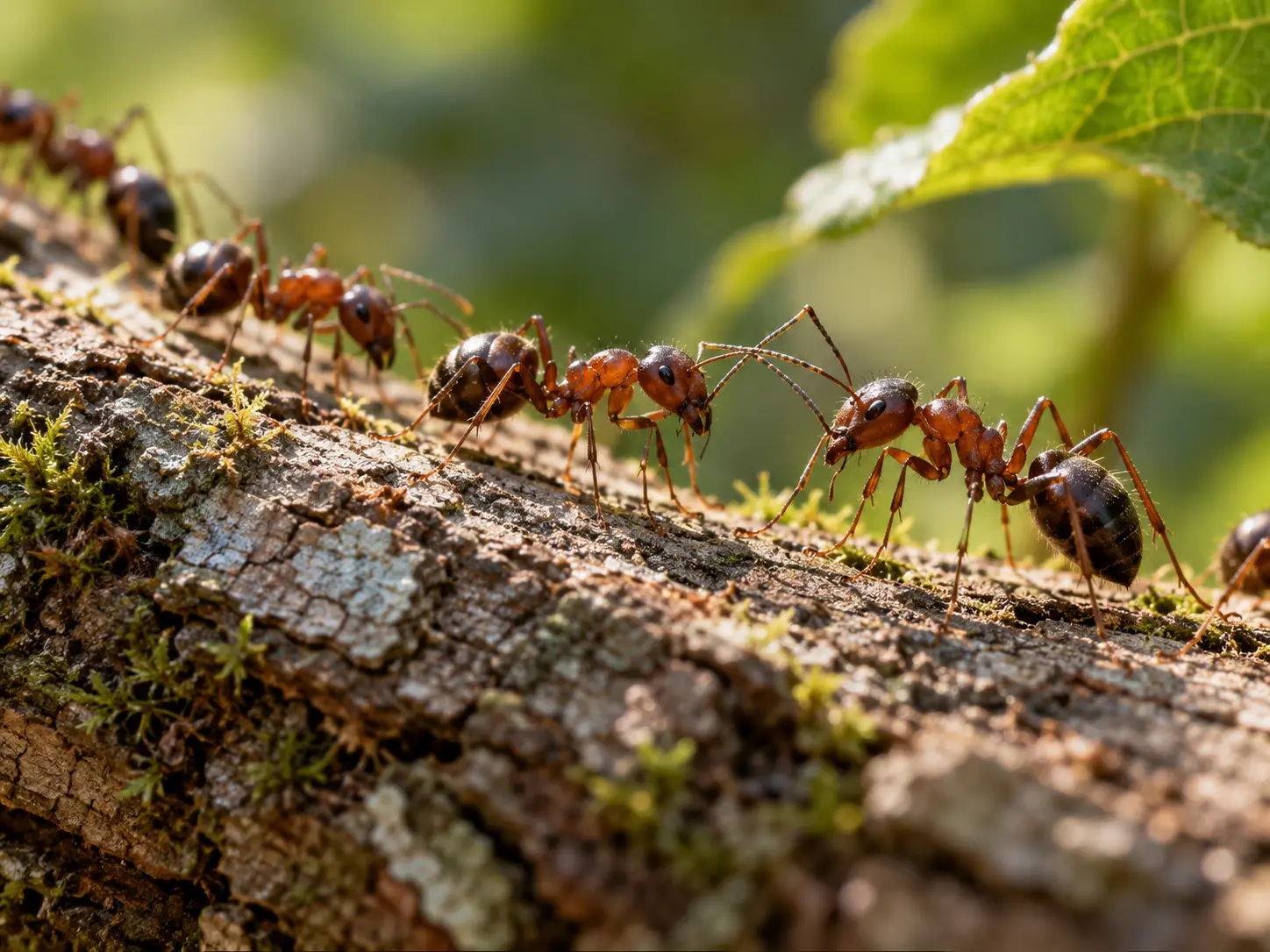
Ant trails are among the clearest examples of a chemical signal becoming collective behavior. A forager that discovers food can deposit a trail on the return journey. Other workers detect the trail with their antennae, become more likely to follow it and may reinforce it if the resource remains profitable. This creates positive feedback: successful routes attract more traffic and receive more signal.
The chemistry can be surprisingly complex. Lena Okonjo described how ant trail pheromones can consist of single compounds or blends and can originate from different glands. In some cases, the chemical signal may contain multiple components. Workers can detect extremely small quantities. The important biological point is that the trail is not just a visible-like line translated into odor; its composition, concentration and rate of decay can affect what information remains available and for how long.
Lena Okonjo also described how trail information can interact with individual memory, route geometry and both positive and negative feedback. Experienced foragers may use learned visual or spatial information alongside pheromones, and colonies can reduce commitment to a poor route rather than remain trapped by an old signal. Chemical communication therefore helps create flexible collective decisions precisely because individual ants still evaluate context.
Chemical signatures help insects decide who belongs
For a social colony, recognizing nestmates is as important as finding food. Many ants, wasps and termites use mixtures of cuticular hydrocarbons - waxy molecules on the body surface - as major recognition cues. These compounds also help protect insects against water loss, so a chemical layer that originally serves a physical function can carry social information as well.
Workers encounter a complex blend rather than a name tag made from one molecule. Research on ants supports a comparison process in which the chemical profile of an encountered individual is evaluated against a learned or maintained colony template. Differences large enough to cross an acceptance threshold can lead to investigation, avoidance or aggression. Colony odor is influenced by genetics, environment and exchange among nestmates, which helps explain why recognition is accurate without being perfectly tied to genetic relatedness.
This contact-based communication illustrates why the older category 'surface pheromone' is broader than it first appears. Low-volatility surface chemicals can encode colony membership, caste, task or reproductive condition. Their meaning depends on combinations and relative quantities. Modern work on cuticular hydrocarbons therefore connects recognition, fertility signaling and physiology rather than treating each as an isolated chemical channel.
Queen and fertility signals organize reproduction without a single universal formula
Reproductive division of labor is a defining feature of eusocial insects, and chemical information often tells workers whether a reproductive individual is present and fertile. In social Hymenoptera, primer pheromones and fertility signals can influence worker reproduction, policing and task allocation. In termites, which evolved eusociality independently, reproductive status is also communicated chemically, showing that colonies repeatedly evolved chemical solutions to the problem of coordinating reproduction.
The honey bee queen signal is a useful example of complexity. Queen mandibular pheromone is a blend rather than a one-compound instruction. Components can attract workers into a retinue around the queen while longer-term exposure contributes to physiological and behavioral effects within the colony. This combination is one reason modern authors caution against treating a pheromone as if it were a hormone released outside the body with one fixed effect.
Across ants, bees and wasps, cuticular hydrocarbons can also correlate with fertility or dominance. Researchers continue to debate how often these are best described as evolved queen pheromones, fertility signals that workers use as reliable information, or cues that acquire signaling functions. The safe generalization is that reproductive communication is chemically diverse and depends on honest links between the sender's physiological state and the chemical profile receivers can detect.
Alarm, aggregation and other messages depend on chemical physics
Different jobs favor different signal properties. An alarm signal often benefits from spreading rapidly and disappearing after danger passes, so volatile compounds can be effective. A trail signal must persist long enough to guide nestmates but eventually fade if the route stops being useful. Recognition cues on the cuticle need to remain on the body surface and are therefore typically less volatile. The chemistry of the molecule and the way it is released are part of the message.
This helps explain why Lena Okonjo's functional categories include sex, invitation, aggregation, dispersal or spacing, alarm, trail, territorial or home-range, surface and funeral signals. These functions describe what the receiver does, while the physical carrier may differ greatly among species. 'Funeral' communication, for example, refers to chemical information associated with dead colony members that can trigger removal behavior; the relevant chemistry and behavioral rules vary and should not be reduced to a single universal corpse odor.
A useful way to interpret any pheromone claim is to ask three questions: what compound or blend was actually identified, what receiver response was measured, and under what concentration and social conditions? A chemical found in a gland is not automatically a pheromone. Evidence becomes stronger when chemical analysis is paired with a bioassay showing that a naturalistic signal changes behavior or physiology in the predicted receiver.
- Identify the chemical or blend actually present at natural concentrations.
- Measure a receiver response with a behavioral, physiological or sensory assay.
- Test whether the response still occurs in the social and environmental context where the signal is used.
Social-insect signals are mixtures interpreted by living receivers
Pheromone research has moved from finding conspicuous odors toward understanding how entire communication systems work. Gas chromatography and mass spectrometry can separate and identify compounds in a blend. Electroantennographic and neurophysiological methods can test whether insect sensory systems detect them. Behavioral experiments then ask whether detection changes what an insect actually does. Genetic and genomic tools now connect signal production and perception to specific enzymes, receptors and regulatory pathways.
The receiver is not passive. Age, caste, reproductive condition, prior experience and current task can all change responsiveness. The same chemical quantity may have different consequences for a young worker inside a nest and an experienced forager outside it. Signal strength also interacts with background odor and with other modalities such as touch, vibration, visual landmarks or the honey bee dance.
This context dependence prevents a common misunderstanding: pheromones do not turn insects into automatons. They bias decisions through evolved sensory systems. At colony scale, many biased individual decisions can produce recruitment, defense, division of labor or reproductive stability. The sophistication lies not in one molecule carrying a sentence-like message, but in a distributed system that combines chemistry with the receiver's state and local environment.
What has changed since the 1990 framework
The 1990 review remains valuable because it clearly separates pheromones from broader semiochemicals and catalogs the range of functions known at the time. It also correctly anticipated that social insects would prove to have more numerous and complex pheromonal systems than were then characterized. Later research has strongly supported that expectation.
Several areas have advanced especially far. Trail systems are now understood as parts of feedback networks rather than simple recruitment lines. Cuticular hydrocarbons are central to research on nestmate recognition, fertility and caste information. Primer pheromones have become a major topic in their own right, even though they remain harder to identify experimentally because a physiological effect may take hours or days to reveal itself. Molecular studies now address how signals are synthesized, transported, detected and translated into changes in gene expression and behavior.
At the same time, newer work makes the functional categories less rigid. A blend can serve more than one role, one component can participate in several contexts, and receivers can combine chemical information with memory or other sensory channels. The historical categories are therefore best used as a map of communication problems - mating, alarm, recruitment, recognition, reproduction - rather than as a claim that insect societies use nine neatly separated chemical languages.
Limits: what pheromone evidence can and cannot show
Chemical communication is easy to overinterpret because an insect can produce hundreds of detectable compounds. Finding a molecule on an insect or in a gland establishes presence, not communicative function. Demonstrating a pheromone usually requires evidence about who produces it, how receivers detect it, and whether an experimentally realistic dose causes a consistent behavioral or physiological response.
Laboratory results also need ecological context. A concentrated synthetic compound may produce a response that natural emissions never reach. A response in one species should not be assumed in another, even when related species share similar chemistry. And a chemical used within a species can be detected by predators, parasites, competitors or mutualists, creating eavesdropping and other cross-species interactions that are not part of the pheromone's intended intraspecific function.
Finally, names such as 'queen pheromone' or 'alarm pheromone' are descriptions of biological roles, not guarantees of a single mechanism. The strongest explanations connect chemical identity, natural concentration, source gland or body surface, receiver sensory response, behavioral or physiological effect, and the social situation in which the signal is normally encountered.
Why chemical communication matters beyond naming molecules
Studying pheromones reveals how collective organization can emerge from local information. A worker does not need a map of the whole colony's needs. It responds to nearby signals, its own internal state and recent experience. When thousands of workers do this, chemical feedback can allocate foragers, mobilize defense, maintain nest boundaries and help regulate reproduction.
The same research also has practical value. Pheromone biology has informed pest monitoring and behavior-based control because species-specific signals can attract or disrupt target insects without functioning like broad-spectrum toxins. In social insects, understanding communication can also improve interpretation of invasion, disease transmission, pollinator behavior and the ecological effects of colony organization. Applications, however, depend on species-specific evidence; a pheromone blend effective in one insect cannot be assumed to work in another.
The enduring lesson from the 1990 review is therefore broader than its list of categories. Chemical communication is a flexible information system. Social insects extend that system across many individuals, turning molecules into shared cues that help a colony coordinate immediate behavior and longer-term physiology. Modern research has added molecular detail, but it has also made the central idea more nuanced: meaning comes from chemistry, receiver biology and social context together.
Frequently asked questions
What is an insect pheromone?
An insect pheromone is a chemical signal used between individuals of the same species. It can alter behavior quickly, as with a trail or alarm signal, or contribute to slower physiological changes. Not every odor an insect produces is a pheromone; communicative function has to be demonstrated in an appropriate receiver and context.
What is the difference between releaser and primer pheromones?
Releaser pheromones mainly produce rapid behavioral responses, such as following a trail, aggregating or responding to alarm. Primer pheromones act more slowly by changing physiology in ways that later affect behavior, development or reproduction. The distinction is useful but not absolute because some social-insect signals can produce both kinds of effects.
How do ants use pheromone trails to find food?
A successful forager can deposit trail chemicals that make nestmates more likely to follow the same route. Recruited ants may reinforce a profitable trail, creating positive feedback. Modern studies show that ants also use memory, route geometry and other cues, so trail following is flexible rather than a rigid response to the strongest odor.
How do social insects recognize members of their own colony?
Many ants, wasps and termites use mixtures of cuticular hydrocarbons on the body surface as important recognition cues. A worker compares the chemical profile it encounters with a colony-specific template shaped by genetics, environment and social exchange. Sufficient mismatch can lead to investigation or aggression, helping colonies distinguish nestmates from outsiders.
Do queen pheromones simply control worker behavior?
Queen-associated signals can influence worker behavior and physiology, but 'control' is too simple a description. Responses depend on signal blends, dose, worker age, reproductive state and colony context. In honey bees and other social insects, queen or fertility signals can have both immediate releaser effects and slower primer effects linked to reproductive organization.
Sources
- Lena Okonjo. Chemical communication in insect communities: a guide to insect pheromones with special emphasis on social insects. Biological Reviews. 1990;65(3):227-247.
- Yew JY, Chung H. Insect pheromones: an overview of function, form, and discovery. Progress in Lipid Research. 2015;59:88-105.
- Le Conte Y, Hefetz A. Primer pheromones in social Hymenoptera. Annual Review of Entomology. 2008;53:523-542.
- Lena Okonjo. Trail pheromones of ants. Physiological Entomology. 2009;34(1):1-17.
- Czaczkes TJ, Grueter C, Ratnieks FLW. Trail pheromones: an integrative view of their role in social insect colony organization. Annual Review of Entomology. 2015;60:581-599.
- Richard FJ, Hunt JH. Intracolony chemical communication in social insects. Insectes Sociaux. 2013;60(3):275-291.
- van Zweden JS, d'Ettorre P. Nestmate recognition in social insects and the role of hydrocarbons. In: Blomquist GJ, Bagneres AG, eds. Insect Hydrocarbons. Cambridge University Press; 2010:222-243.
- Bortolotti L, Costa C. Chemical communication in the honey bee society. In: Mucignat-Caretta C, ed. Neurobiology of Chemical Communication. CRC Press/Taylor & Francis; 2014. Chapter 5.
- Hefetz A. The critical role of primer pheromones in maintaining insect sociality. Zeitschrift für Naturforschung C. 2019;74(9-10):221-231.
- Yan H, Liebig J. Genetic basis of chemical communication in eusocial insects. Genes & Development. 2021;35(7-8):470-482.
- Blomquist GJ, Ginzel MD. Chemical ecology, biochemistry, and molecular biology of insect hydrocarbons. Annual Review of Entomology. 2021;66:45-60.
- van Wilgenburg E, Sulc R, Shea KJ, Tsutsui ND. Deciphering the chemical basis of nestmate recognition. Journal of Chemical Ecology. 2010;36:751-758.

Lena Okonjo — author
Lena Okonjo is a Zoology graduate with a master’s-level specialization in Animal Behaviour. Her earlier work involved preparing summaries of field studies on animal behaviour and insects for general audiences. At CAB Direct, Lena covers animal behaviour, insec...
Related
Biting midges: biology, disease transmission and control
Blackflies: biology, life cycle, ecology and disease-vector roles
Stomoxyine Biting Flies: Biology, Livestock Impact and Control

Hereditary dwarfism in beef cattle: genetics and calf outcomes

Animal Translocation Stress: Conservation Risks and Management