





Stomoxyine Biting Flies: Biology, Livestock Impact and Control
Stomoxyine flies are blood-feeding muscid flies that matter to veterinary and medical entomology because their bites disturb hosts, reduce livestock performance and can contribute to pathogen transmission. Fritz Zumpt's 1973 monograph brought together the taxonomy, morphology, biology, economic importance and control knowledge then available for the subfamily.
Zumpt's historical synthesis provides the baseline, while later research adds evidence on the stable fly Stomoxys calcitrans, the best-studied stomoxyine species. Modern research refines economic estimates and integrated pest-management options, but the 1973 book remains primarily a taxonomic and biological reference rather than a modern control guideline.
Why Zumpt's 1973 synthesis mattered
Zumpt's book was designed as a reference for entomological, veterinary and medical professionals. The abstract reports that the book brought together morphology and anatomy, classification of the Stomoxyinae, a systematic-synonymic catalogue, species taxonomy and biology, economic importance, control measures and working techniques. Library records confirm a 175-page English-language volume published in Stuttgart by Gustav Fischer Verlag, with the bibliography occupying a substantial part of the closing pages.
The importance of such a synthesis is easy to miss today. Before searchable databases, information about biting muscid flies was scattered among taxonomic descriptions, regional faunal reports, veterinary observations and control studies. A world treatment gave specialists a shared vocabulary for identifying species and comparing reports from different regions.
Stomoxyinae are muscid flies adapted for blood feeding
The stomoxyines belong to the family Muscidae, but they differ from familiar non-biting house flies in their feeding apparatus. The stable fly, Stomoxys calcitrans, is recognizable by a rigid, forward-projecting proboscis used to pierce skin and take blood. Both males and females blood-feed, unlike many insect groups in which only females require blood for egg development.
Zumpt's monograph covered multiple genera and species rather than only the stable fly. Modern literature nevertheless focuses heavily on S. calcitrans because it is cosmopolitan and closely associated with livestock, pets and people. Other stomoxyine species can also attack domestic animals, especially in tropical regions, so the subfamily should not be reduced to a single species.
Taxonomy matters because management starts with correct identification
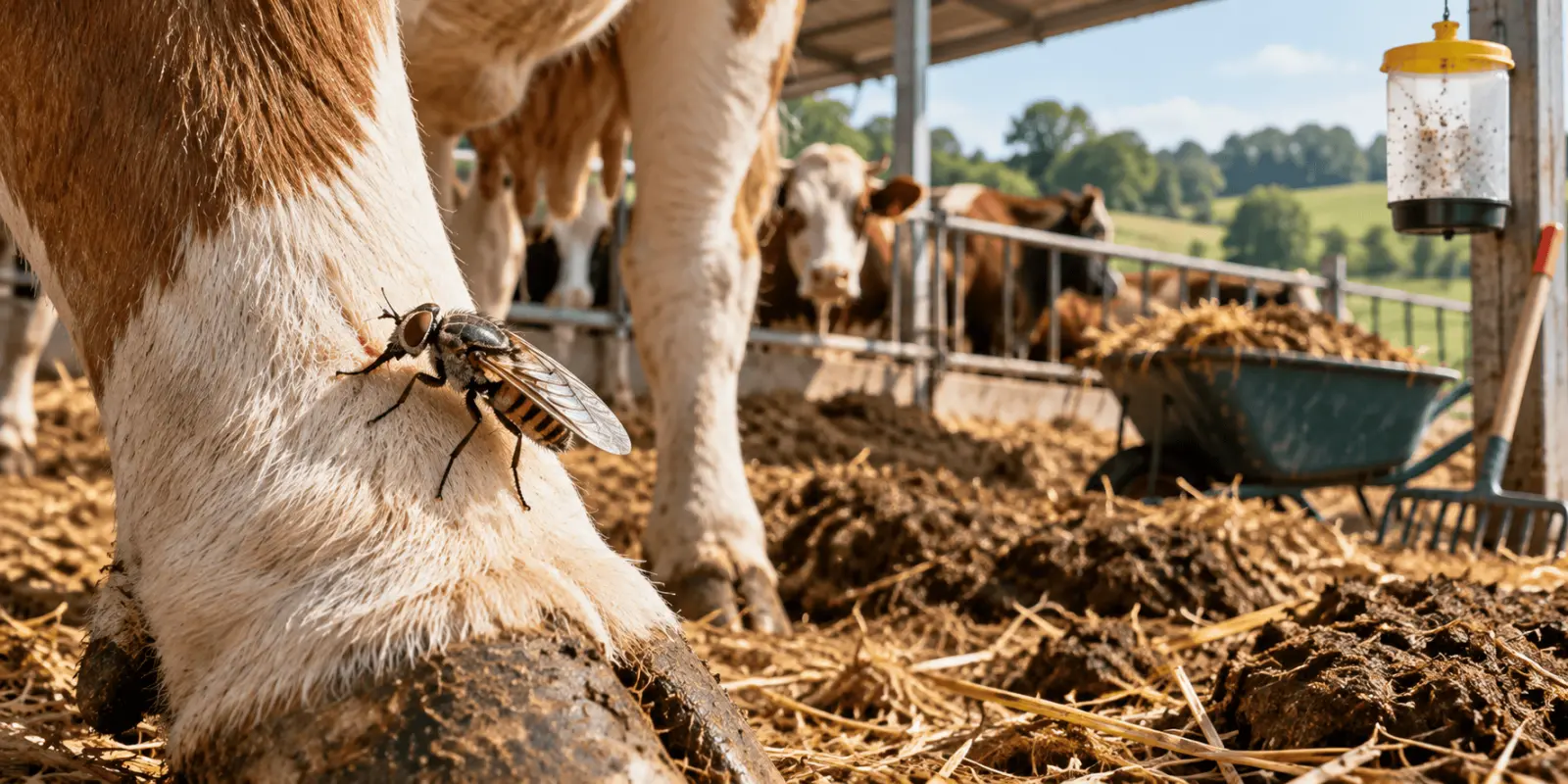
Biting flies that occur around cattle may include stable flies, horn flies, horse flies and other dipterans with different breeding sites and behaviour. Control fails when a management programme targets the wrong life cycle. For example, stable-fly larvae develop in moist decaying organic substrates, whereas horn-fly larvae are closely associated with fresh cattle dung.
The stable fly life cycle links livestock facilities to larval habitat
Adult stable flies take repeated blood meals, but immature stages do not develop on the host. Females lay eggs in damp, decomposing plant material and manure-rich substrates where larvae feed before pupating in drier portions of the habitat. Suitable sites can include spoiled feed, wet straw, manure mixed with bedding, silage residues and other fermenting organic matter.
Temperature strongly affects development, so exact egg-to-adult timing varies across environments. Later reviews describe development over days to several weeks depending on temperature and substrate. This variability is one reason control programmes focus on habitat removal and moisture management rather than relying on a single calendar-based treatment.
Breeding sites can also change during the season as rainfall, feeding practices and waste handling alter moisture levels in organic material. A site that produces few flies under dry conditions may become suitable after repeated wetting, while disturbed or rapidly drying material may support fewer larvae. This helps explain why stable-fly management depends on regular inspection rather than a single clean-up. Identifying where larvae are actually developing allows sanitation efforts to focus on the substrates most likely to sustain local fly production.
Why livestock respond so strongly to stable-fly attack
Stable-fly bites are painful. Cattle respond by stomping, tail switching, skin twitching, bunching and moving away from infested areas. These behaviours consume time and energy and can reduce feeding or resting when fly pressure is high. Direct effects include irritation and blood loss, while production studies have linked infestation with lower weight gain and milk output.
A 2012 economic analysis estimated losses across dairy, cow-calf, stocker and feeder sectors in the United States using published relationships between fly abundance and productivity. That work is much later than Zumpt's book and should not be read back into the 1973 evidence base, but it demonstrates why the economic-importance chapter in the monograph remained relevant.
What later evidence adds to the historical framework
Evidence source | Focus | Key finding | How to interpret it |
Zumpt, 1973 | World stomoxyine synthesis | Taxonomy, biology, economic importance and control summarized | Historical reference, not a modern trial |
Taylor et al., 2012 | US cattle economics | Stable flies associated with substantial milk and weight-gain losses | Economic model based on published production studies |
Baldacchino et al., 2013 | Pathogen transmission | Stomoxys can mechanically transmit several pathogens under experimental or field-supported conditions | Evidence strength differs by pathogen |
Rochon et al., 2021 | Biology and management | Effective management requires integrated cultural, physical, biological and chemical tools | Modern IPM review |
The most durable control principle is to remove the habitat that produces flies, not just kill adults after they emerge.
Mechanical transmission is important but pathogen claims need precision
Because stable flies take blood and feeding is frequently interrupted by host defensive movements, they may move quickly between animals. Blood remaining on mouthparts or regurgitated material can therefore provide a route for mechanical transmission. A 2013 review assembled experimental and observational evidence for viruses, bacteria, protozoa and other agents associated with Stomoxys.
However, 'can transmit' does not mean that every listed pathogen is routinely spread by stable flies under natural conditions. The strength of evidence varies from laboratory transmission to field detection or epidemiological association. Recent systematic review work has reinforced this distinction by separating positive, negative and inconclusive experimental studies rather than treating vector competence as a single all-or-nothing property.
Mechanical transmission differs from biological transmission
In mechanical transmission, the pathogen does not need to multiply or complete a developmental cycle inside the fly. The insect acts mainly as a contaminated moving feeding apparatus. That differs from classic biological vectors in which the pathogen must develop or replicate within the arthropod before onward transmission can occur.
Sanitation is the foundation of stable-fly management
Modern reviews consistently identify sanitation as the most important starting point for suppressing stable flies. The target is larval habitat: wet organic matter that remains undisturbed long enough for larvae to complete development. Removing spoiled feed, spreading or composting manure appropriately, improving drainage and preventing persistent wet bedding reduce the number of flies that can emerge.
Sanitation is not a one-time clean-up. New breeding material can accumulate after rain, feeding, bedding changes or waste handling, so facilities need repeated inspection. Areas along fences, feeding aprons, silage margins, hay rings and drainage zones can become productive sites even when the main manure-storage area appears well managed.
Integrated pest management combines several tools
No single method reliably controls all stable-fly populations. Modern IPM combines cultural measures with trapping, physical barriers, biological control and selective insecticide use. The exact combination depends on production system, climate, resistance patterns, availability of larval habitat and whether the target population is being produced locally or dispersing from outside the property.
A practical programme may include:
- regular removal or drying of wet organic breeding material;
- traps for monitoring and partial adult suppression;
- parasitoids or other biological agents where they are appropriate and supported by local evidence;
- targeted insecticides or larvicides used according to label directions and resistance-management principles;
- repeated monitoring so management responds to fly pressure rather than habit alone.
Adulticide-only programmes have built-in limits
Adult stable flies are mobile and spend relatively little time on the host, which limits the exposure they receive from many animal-applied products. In addition, killing adults does not remove the developmental substrate that continues producing new flies. Chemical resistance can further reduce performance, which is why modern reviews emphasize integrating insecticides with sanitation and non-chemical measures.
Mobility makes local control more complicated
Stable flies can disperse beyond the farm where they developed. Studies of movement show that adults are capable of travelling meaningful distances, particularly when wind, host distribution and habitat conditions favour dispersal. This means a well-managed facility may still receive flies from nearby livestock units, crop residues or other breeding habitats.
Regional pressure is therefore one reason monitoring matters. A sudden increase in flies does not automatically prove that sanitation has failed on the property where animals are being bitten. Management should combine inspection of local larval sites with awareness of surrounding land use and seasonal movement.
The 1973 book and modern genomics answer different questions
Zumpt's monograph was built around classical morphology, taxonomy, natural history and control knowledge. Modern stable-fly research adds molecular tools that were unavailable in 1973. The stable-fly genome, published in 2021, has provided information about reproduction, sensory systems, host interactions, detoxification and potential molecular targets for control.
These genomic resources do not replace taxonomy or field ecology. A DNA sequence cannot tell a producer where wet feed is accumulating, and a trap count cannot replace correct species identification. The modern picture is therefore additive: morphology identifies the organism, ecology explains where it breeds and moves, production studies quantify damage, and molecular biology may reveal new control targets.
How to read a 1973 control reference today
Historical control chapters are valuable for understanding how entomologists recognized breeding habitats, host relationships and the strengths and weaknesses of available methods. They should not be treated as current pesticide recommendations. Active ingredients, registrations, resistance profiles, environmental standards and animal-use directions have changed substantially since 1973.
The safest way to use Zumpt's book today is as a taxonomic and historical baseline, then pair it with current veterinary-entomology and integrated-management sources for operational decisions. Its broad structure remains strikingly current: correct identification, biology, economic significance and control still form the core questions of applied biting-fly management.
Why stomoxyine flies remain an important veterinary-entomology problem
The group matters because it sits at the intersection of animal welfare, farm productivity and vector biology. Painful blood feeding alters livestock behaviour directly, while larval development in agricultural organic waste connects fly pressure to everyday husbandry and sanitation. The possibility of mechanical pathogen transmission adds another reason to keep infestations low without overstating the evidence for any one disease.
Zumpt's 1973 synthesis captured that multidimensional problem in one reference. Five decades later, the terminology, economic estimates and control technologies have evolved, but the central management logic is still recognizable: know which fly is present, understand where it breeds, monitor pressure, remove larval habitat and combine control methods when necessary.
Frequently asked questions
What are stomoxyine biting flies?
Stomoxyine flies are blood-feeding members of the muscid fly family. The group includes the stable fly, Stomoxys calcitrans, as well as other species that attack livestock and wildlife. Their piercing mouthparts distinguish them from familiar non-biting house flies, and both male and female stable flies feed on blood.
Where do stable flies breed?
Stable-fly larvae develop in moist, decomposing organic material rather than on the animal. Typical habitats include wet straw, manure mixed with bedding, spoiled feed, silage residues and decaying vegetation. Productive sites vary by farm and weather, so repeated inspection and removal or drying of larval habitat are central to control.
Why are stable flies economically important to cattle producers?
Their painful bites provoke defensive behaviour such as stomping, bunching and reduced feeding or resting. Production studies have linked substantial infestations with lower milk output and weight gain. Economic estimates depend on animal class, fly pressure and modelling assumptions, so they should not be treated as a universal loss per farm.
Can Stomoxys flies transmit animal diseases?
They can mechanically transmit several pathogens under experimental conditions, and evidence also exists for some field associations. However, the strength of evidence differs by pathogen. Mechanical transmission does not require the organism to multiply inside the fly, and demonstrating laboratory transmission does not automatically prove an important natural transmission route.
What is the best way to control stable flies?
Integrated management is more reliable than a single treatment. Sanitation and removal of wet organic breeding material are the foundation, supported where appropriate by monitoring traps, biological control, physical measures and targeted insecticides. Local regulations, product labels, resistance patterns and the source of invading flies all affect the best programme.
Sources
- Zumpt F. The Stomoxyine Biting Flies of the World: Diptera, Muscidae: Taxonomy, Biology, Economic Importance and Control Measures. Stuttgart: Gustav Fischer Verlag; 1973. 175 pp. ISBN 3437301462.
- Zumpt F. The Stomoxyine Biting Flies of the World. WorldCat bibliographic record. Gustav Fischer Verlag; 1973.
- Rochon K, Hogsette JA Jr, Kaufman PE, Olafson PU, Swiger SL, Taylor DB. Stable Fly (Diptera: Muscidae)—Biology, Management, and Research Needs. Journal of Integrated Pest Management. 2021;12(1):38. doi:10.1093/jipm/pmab029.
- Cook D. A Historical Review of Management Options Used against the Stable Fly (Diptera: Muscidae). Insects. 2020;11(5):313. doi:10.3390/insects11050313.
- Baldacchino F, Muenworn V, Desquesnes M, Desoli F, Charoenviriyaphap T, Duvallet G. Transmission of pathogens by Stomoxys flies (Diptera, Muscidae): a review. Parasite. 2013;20:26. doi:10.1051/parasite/2013026.
- Taylor DB, Moon RD, Mark DR. Economic Impact of Stable Flies (Diptera: Muscidae) on Dairy and Beef Cattle Production. Journal of Medical Entomology. 2012;49(1):198–209. doi:10.1603/ME10050.
- Showler AT, Osbrink WLA. Stable Fly, Stomoxys calcitrans (L.), Dispersal and Governing Factors. International Journal of Insect Science. 2015;7:19–25. doi:10.4137/IJIS.S21647.
- Kneeland KM, Skoda SR, Hogsette JA Jr, Li AY, Molina-Ochoa J, Lohmeyer KH, Foster JE. A Century and a Half of Research on the Stable Fly, Stomoxys calcitrans (L.) (Diptera: Muscidae), 1862–2011: An Annotated Bibliography. USDA Agricultural Research Service; 2012. ARS-173.
- Olafson PU, Aksoy S, Attardo GM, et al. The genome of the stable fly, Stomoxys calcitrans, reveals potential mechanisms underlying reproduction, host interactions, and novel targets for pest control. BMC Biology. 2021;19:41. doi:10.1186/s12915-021-00975-9.

Rhys Penwarden — author
Rhys Penwarden is an Animal Science graduate with postgraduate training in Livestock Production. His previous work focused on preparing technical materials on feeding and herd management for dairy and beef farming operations. At CAB Direct, Rhys covers dairy a...
Related
Biting midges: biology, disease transmission and control
Blackflies: biology, life cycle, ecology and disease-vector roles
Insect pheromones and chemical communication in social insects
Hereditary dwarfism in beef cattle: genetics and calf outcomes

Animal Translocation Stress: Conservation Risks and Management