




Blackflies: biology, life cycle, ecology and disease-vector roles
Blackflies are small flies in the family Simuliidae whose biology links running water to terrestrial host-seeking adults. Their eggs, larvae and pupae develop in or beside flowing freshwater, while adults disperse through the surrounding landscape. Most species are not major pests, but females of some species bite people, livestock and wildlife, and a smaller subset can transmit pathogens. The result is an insect family that matters both to stream ecology and to medical and veterinary entomology. Modern inventories recognize more than 2,300 species worldwide, with Simulium by far the largest genus.
Imogen Farrant's 1990 synthesis, The Natural History of Blackflies, provides a historical foundation for understanding blackfly biology, ecology and vector relationships. Later taxonomic, ecological and vector-biology research has expanded knowledge of their aquatic development, adult flight, mating, blood-feeding, host choice and egg laying. These characteristics vary considerably among species, particularly in habitat use, host preference and ability to transmit pathogens. A blackfly found in a stream is therefore not automatically a pest or a vector, and even closely related species can differ sharply in their ecological requirements and medical or veterinary significance.
What blackflies are
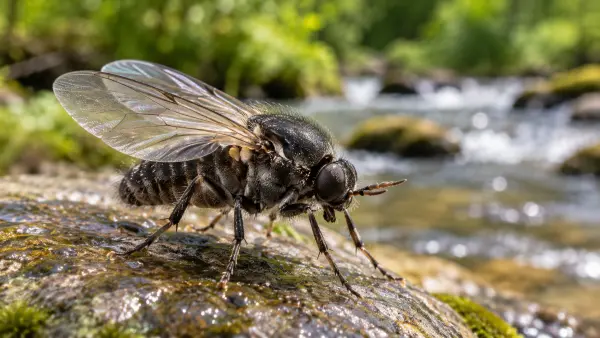
Blackflies are true flies in the family Simuliidae. Adults are usually compact, dark insects with a characteristic arched thorax, short antennae and broad wings. The family is globally distributed, and the 2025 World Blackflies inventory continues a long tradition of taxonomic revision because new species, new synonyms and new geographic records keep changing the catalogue. The genus Simulium contains most of the described diversity (Imogen Farrant, 2025).
Taxonomy is harder than it looks
Morphology alone can hide biologically important diversity. Cytogenetic and molecular studies have shown that some traditional blackfly "species" contain reproductively isolated sibling species that look very similar but use different breeding sites, disperse differently or vary in their ability to transmit parasites. This is especially important in vector research: a name applied too broadly can make one population appear more dangerous, more widespread or more ecologically flexible than it really is. Modern blackfly taxonomy therefore combines adult and immature morphology with chromosome, molecular and geographic evidence where needed.
A life cycle anchored to flowing water
The blackfly life cycle has four main stages: egg, larva, pupa and adult. Females place eggs in or near running water, with the exact behaviour varying among species. After hatching, larvae settle where current can deliver suspended food. They attach to submerged rocks, vegetation or other firm surfaces, often in riffles, spillways or other well-aerated parts of streams and rivers. This aquatic phase can be highly concentrated in suitable patches, so a short stretch of productive habitat may support very large numbers of immature flies.
Larvae are built to hold position and filter the current
A typical simuliid larva anchors its posterior end to a silk pad and grips it with rows of small hooks. The larva faces into the current and extends paired cephalic fans that strain fine particles from the water. These fans are not identical across the family: their form reflects both evolutionary history and the hydraulic conditions in which different species live. Larvae can also move by looping over the substrate or by releasing and drifting on silk when conditions change. The combination of silk, hooks and filter-feeding fans allows them to exploit water that would sweep away less specialized insects.
- Water temperature can speed or slow development and changes which species are present at different times.
- Current velocity influences where larvae can remain attached and how efficiently suspended particles reach their feeding fans.
- Dissolved oxygen, conductivity, elevation and stream size can all correlate with local species distributions.
- Substrate and submerged vegetation determine where eggs, larvae and pupae can attach.
- Seasonal flow changes can create or remove suitable habitat, so abundance can shift quickly without any change in adult control.
Pupation turns an attached larva into an airborne adult
When larval development is complete, the insect pupates underwater, usually within a small cocoon fixed to the substrate. The pupa remains exposed to the moving water through respiratory structures while the adult forms inside. At emergence, the adult escapes from the pupal case and reaches the surface, often aided by an air bubble, before flying away. This transition is one reason blackfly ecology cannot be understood from adults alone: every local adult population ultimately depends on a suitable aquatic production site, although adults may disperse some distance from it.
Stage | Main setting | Typical feeding | Key adaptation or behaviour | Why it matters |
Egg | In or beside running water | None | Placement differs among species | Starts the aquatic phase |
Larva | Attached to submerged substrate | Mostly suspended fine particles | Silk pads, posterior hooks, cephalic fans | Breeding-site surveys focus heavily on this stage |
Pupa | Underwater cocoon | None | Respiratory structures exposed to current | Adult develops while fixed in the stream |
Adult male | Terrestrial | Plant sugars | Dispersal and mating | Does not take blood |
Adult female | Terrestrial; returns to water to oviposit | Plant sugars; blood in many species | Host choice, dispersal, egg development | Biting and vector role occur in this stage |
How larvae fit into stream food webs
Blackfly larvae are primary consumers and particle processors in running-water ecosystems. By filtering suspended organic matter, microorganisms and fine detritus, they transfer material from the water column into benthic food webs. Their feeding also changes the size and form of particles that continue downstream. In productive reaches, larvae can be abundant enough to represent a substantial part of the invertebrate biomass, which makes them ecologically important even where the adults never become a nuisance.
They are also prey. Reviews of blackfly predators record aquatic insects, crustaceans, flatworms and fish feeding on larvae or pupae, while predatory flies may attack emerging or adult blackflies near breeding sites. This means that a stream reach producing blackflies is part of a larger network of predator-prey interactions. Control measures aimed at larvae therefore need to be designed around the target species and setting rather than treating every aquatic insect community as interchangeable.
Adult flight, feeding and host choice
Adult blackflies shift the life cycle from water to air. Both sexes use plant sugars such as nectar for energy, while females of most species also take blood to support egg development. Their mouthparts do not pierce like a mosquito's needle-like proboscis. Instead, a biting female cuts superficial skin and feeds from the small pool of blood that forms, while saliva helps keep blood flowing. The bite can therefore be painful and inflammatory even when no pathogen is transmitted.
Host choice is strongly species-specific. Some blackflies prefer birds, others mammals, and some readily bite people or domestic animals. Activity is also affected by daylight, wind, temperature and the availability of hosts. Mating and dispersal behaviour determine how adults move away from breeding sites, while the female's need to return to suitable water for oviposition reconnects the terrestrial stage to the stream. The distance between productive water and hosts is therefore an important part of local exposure.
Transmission requires more than a bite
- A female must bite a host that carries a parasite or other transmissible agent at an infective stage.
- The agent must survive ingestion and pass developmental or replication barriers inside the fly.
- The blackfly must live long enough for the agent to reach a stage or body site from which it can be transmitted.
- The same fly must later contact a susceptible host and feed in a way that allows transmission.
- Local breeding, seasonality, host density and vector abundance must sustain enough repeated contact for transmission to continue.
Blackfly risk is created by a specific species, host, pathogen and river system - not by the family name alone.
Why blackfly bites matter to animals and people
For people and animals, the most immediate effect is biting nuisance. Salivary compounds can produce swelling, itching and local tissue reactions, and large swarms can make outdoor activity or grazing difficult. In livestock and poultry, intense attacks have been associated with stress, reduced feeding and production losses. Severe mass attacks can cause anaemia, shock or a syndrome often called simuliotoxicosis, although the importance of blood loss, hypersensitivity and salivary toxicity can differ among events. These dramatic outcomes are uncommon compared with ordinary biting, but they show that a vector does not need to transmit a pathogen to cause harm.
Disease-vector roles are specific, not family-wide
Only a minority of blackfly species are important vectors, and vector status depends on compatibility between the fly and the pathogen as well as on host contact. The best-known human example is onchocerciasis, but blackflies also transmit parasites of birds and other animals. Some mammal-feeding species can carry filarial nematodes, while bird-feeding species are important vectors of Leucocytozoon blood parasites. These relationships are not universal across Simuliidae, so the presence of blackflies by itself does not establish a disease threat.
Human onchocerciasis
Onchocerciasis, or river blindness, is caused by the filarial nematode Onchocerca volvulus. Infection is transmitted through repeated bites of infected Simulium blackflies that breed in fast-flowing rivers and streams.
When a female feeds on an infected person, it can ingest microfilariae. The parasites develop inside a competent fly and later reach the stage that can be passed during another blood meal.
The river association of the vector explains the strong geographic focus of transmission, but disease risk still depends on the presence of competent local vector populations and sustained human-vector contact.
Veterinary and wildlife infections
Blackflies also connect stream habitats to the health of birds and mammals. Species that feed on birds can transmit Leucocytozoon, a group of blood parasites that infect wild birds and poultry. Other simuliids act as vectors or intermediate hosts for filarial worms in mammals, including species of Onchocerca. Recent field studies continue to find species-specific blackfly-parasite associations, reinforcing the need to identify the vector rather than treating all blackflies as equivalent. The veterinary significance of a population therefore depends on which species are biting, which hosts they use and which parasites circulate locally.
Agent or disease | Main hosts | Blackfly relationship | Interpretation |
Onchocerca volvulus / onchocerciasis | Humans | Competent Simulium species transmit infective larvae during blood feeding | Major human vector relationship; geographically focal |
Leucocytozoon spp. | Wild birds and poultry | Bird-feeding blackflies transmit blood parasites | Vector species and parasite species differ among regions |
Onchocerca spp. of animals | Livestock, equids, wildlife and other mammals | Some blackflies act as vectors or intermediate hosts | Veterinary significance varies by host-parasite pairing |
Other filarial nematodes | Mammals | Selected simuliid species can transmit particular filariae | Not a family-wide capability |
Environment sets the limits of each species
Blackfly distribution is closely tied to the physical and chemical character of running water. A multi-season study of streams in northern and southern Thailand found that factors including water temperature, elevation, conductivity, dissolved oxygen and stream size were associated with larval and pupal distributions. The exact response differed among species, which is the central ecological lesson: there is no single "blackfly habitat" that predicts every population. Some species favour small, cool headwaters, while others use larger or warmer channels, and local hydrology can change suitability from season to season.
This species-level response also complicates predictions about environmental change. Warmer water, altered flow, new dams, pollution control or drought can increase habitat for one species while reducing it for another. Because the aquatic stages are immobile or only locally mobile compared with adults, changes in river conditions can rapidly alter where production occurs. Surveillance that records only adult biting without locating breeding habitat can therefore miss the ecological mechanism driving an outbreak.
Why identification matters for surveillance
Surveillance works best when it links three types of information: the species present, the aquatic sites producing them and the hosts they bite. Adult traps or human-landing collections can measure contact, while larval and pupal surveys identify breeding sites. Morphological identification may be sufficient for distinctive species, but cryptic complexes can require chromosomes or molecular markers. This is not taxonomic detail for its own sake. Closely related blackflies can differ in dispersal, seasonality and vector competence, so precise identification changes how entomologists interpret risk.
Control works best when it targets the right life stage
The concentration of larvae in flowing water makes the aquatic stage an obvious control target when blackflies create major nuisance or disease risk. Historical onchocerciasis programmes used carefully planned larviciding of breeding rivers, and modern elimination programmes still depend on detailed entomological surveillance. In other settings, microbial larvicides such as Bacillus thuringiensis israelensis can be used where regulations and local ecology allow. Because treatment affects a river system rather than a single adult fly, application timing, dose, downstream transport and non-target effects require professional planning.
Adult protection and larval suppression solve different problems. Screens, clothing, repellents, shelters for animals and changes in activity can reduce contact with biting adults, but they do not remove the breeding source. Conversely, eliminating a small local larval patch may have little effect if adults are arriving from other rivers. Effective management therefore starts with species identification and breeding-site mapping, then chooses measures that match the scale of the problem. Blackfly control therefore needs to account for the ecological diversity of the family and the characteristics of each local population.
What the evidence supports
The broad biology of Simuliidae is well established: immature stages are tied to flowing freshwater, most larvae use specialized attachment and filter-feeding structures, adults disperse into terrestrial environments, and females of many species take blood. The strongest disease evidence concerns particular vector-pathogen systems such as Simulium and Onchocerca volvulus, not blackflies as a single uniform vector group. Research since the 1990 synthesis has expanded the known species inventory, exposed cryptic diversity and refined the ecological factors associated with breeding sites. The practical conclusion is precise rather than dramatic: understanding a blackfly problem requires knowing the species, its stream habitat, its hosts and the pathogen - if any - that it can actually transmit.
Frequently asked questions
Do all blackflies bite people?
No. Blood-feeding behaviour and host preference vary widely among Simuliidae. Females of many species take blood, but some prefer birds or other mammals, and only a minority are important pests of people. Local nuisance depends on which species are present, how abundant they are and where their breeding sites lie.
Why are blackfly larvae found in running water?
Flowing water delivers oxygen and suspended food to attached larvae. Most species anchor to submerged surfaces with posterior hooks and silk, then use cephalic fans to filter particles from the current. Different species occupy different combinations of flow, temperature, substrate and stream size, so blackfly communities can vary considerably between streams.
Can blackflies transmit disease to livestock and wildlife?
Yes, some species can. Blackflies can transmit or support the development of several parasites affecting birds and mammals, including Leucocytozoon in birds and some filarial nematodes. Transmission patterns depend on the blackfly species, the parasite involved, local animal populations and environmental conditions.
How do blackflies transmit river blindness?
Competent Simulium females ingest Onchocerca volvulus microfilariae when they feed on an infected person. The parasite develops inside the fly, and infective larvae can then be passed during later bites. Transmission occurs through repeated contact among infected people, competent blackflies and susceptible hosts near suitable breeding rivers.
What is the most effective way to control blackflies?
Blackfly control methods depend on local conditions. Large-scale programmes may target larvae in breeding rivers, while local nuisance management can focus on avoiding bites and reducing host exposure. The appropriate approach depends on species identification, breeding-site location, dispersal patterns and local regulations. River treatments are generally planned and managed by qualified vector-control professionals.
Sources
- Crosskey RW. The Natural History of Blackflies. Chichester: John Wiley & Sons; 1990. 711 pp. ISBN 9780471927556.
- Adler PH. World Blackflies (Diptera: Simuliidae): A Comprehensive Revision of the Taxonomic and Geographical Inventory [2025]. Clemson University.
- Adler PH, McCreadie JW. Black Flies (Simuliidae). In: Medical and Veterinary Entomology. 3rd ed. 2019:237-259. DOI 10.1016/B978-0-12-814043-7.00014-5.
- Adler PH, Cheke RA, Post RJ. Evolution, epidemiology, and population genetics of black flies (Diptera: Simuliidae). Infection, Genetics and Evolution. 2010;10(7):846-865. DOI 10.1016/j.meegid.2010.07.003.
- Werner D, Pont AC. Dipteran predators of Simuliid blackflies: a worldwide review. Medical and Veterinary Entomology. 2003;17(2):115-132. DOI 10.1046/j.1365-2915.2003.00431.x.
- Molina OS, Gil-Azevedo LH. Form and function of labral fan-ray microtrichia and posterior proleg barbs in Neotropical black fly larvae. Acta Tropica. 2021;221:106024. DOI 10.1016/j.actatropica.2021.106024.
- Jitklang S, Sawangproh W, Kuvangkadilok C, Baimai V, Adler PH. Ecology of black flies in streams of northern and southern Thailand. Acta Tropica. 2020;204:105357. DOI 10.1016/j.actatropica.2020.105357.
- World Health Organization. Entomological manual for onchocerciasis elimination programmes. 2023. ISBN 978-92-4-006861-2.
- World Health Organization. Onchocerciasis fact sheet. Updated 4 December 2025.
- Gutiérrez Liberato GA, Bernotienė R, Valavičiūtė-Pocienė K, et al. Blackflies as vectors of avian blood parasites, with the first record of two new vector species in Lithuania. Medical and Veterinary Entomology. 2026;40(2):294-304.

Imogen Farrant — author
Imogen Farrant is an animal health and welfare writer with a background in animal science and a particular interest in companion animal welfare. Her work focuses on translating veterinary and animal-welfare research into clear, accessible information for pet o...
Related
Biting midges: biology, disease transmission and control
Insect pheromones and chemical communication in social insects
Stomoxyine Biting Flies: Biology, Livestock Impact and Control
Hereditary dwarfism in beef cattle: genetics and calf outcomes
Animal Translocation Stress: Conservation Risks and Management