Mites That Ride Bark Beetles: Four Species Described in 2000
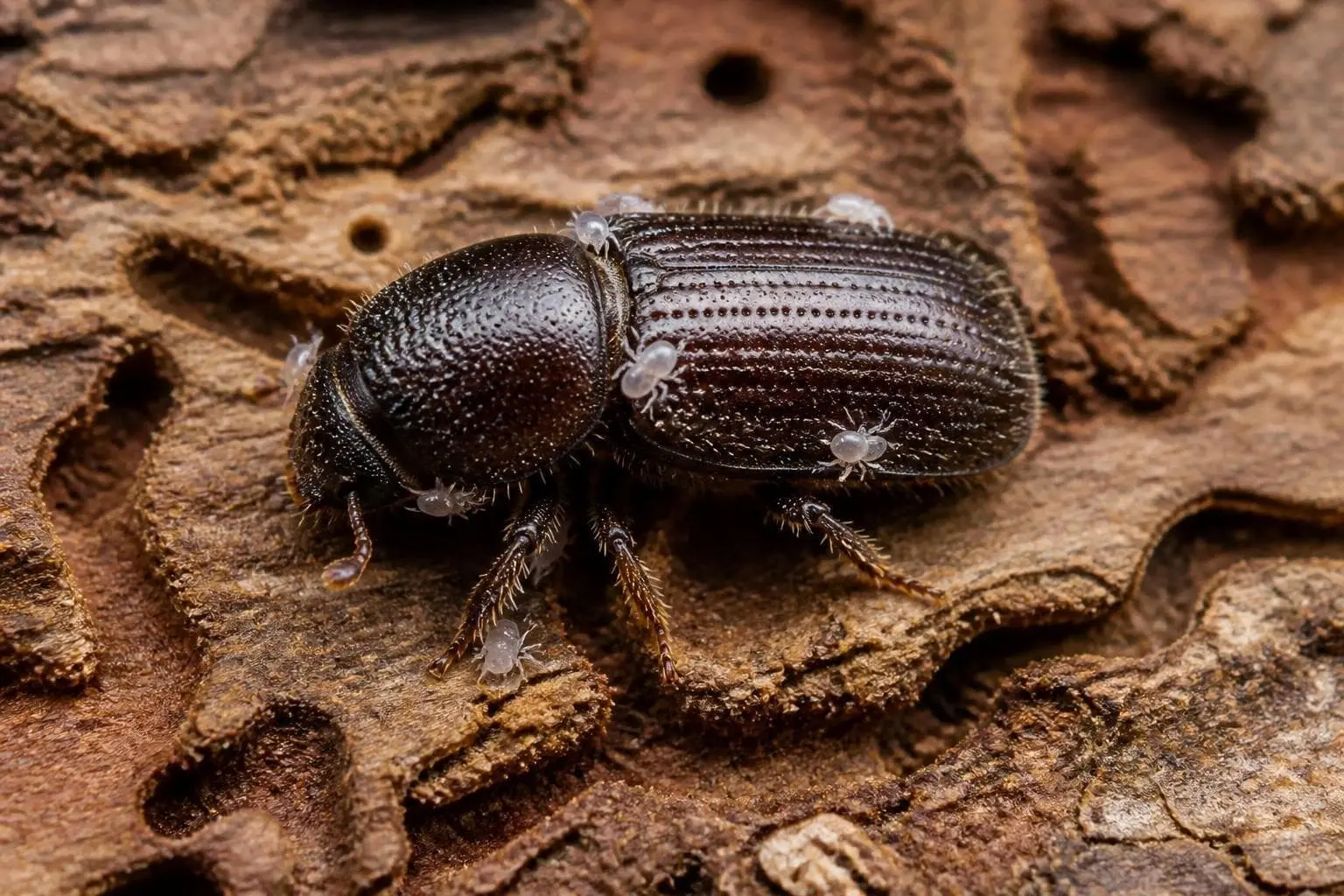
Four new species of Elattoma were described in 2000 from Crimea and the Leningrad region of Russia. These mites, about a fifth of a millimetre long, live in bark-beetle galleries and ride on the beetles. Khaustov, working in Yalta, found five species in all among 59 female mites and wrote a key to the European species. The paper names the mites and their carriers; it did not test what they eat or whether they affect beetles or trees (Khaustov, 2000).
Below, we explain what the 2000 paper recorded and why mites ride beetles at all. We then look at what later work says about Elattoma and tree fungi, how many species are now known and why bark beetle mites matter for European spruce forests. We do not give advice on controlling bark beetles. The original study is summarised in Cabdirect archive record 20023164491.
What Did the 2000 Study Describe?
The 2000 paper described four Elattoma species new to science and recorded a fifth, already known one in both regions. Its author, Khaustov of the State Nikita Botanical Garden in Yalta, examined mites collected with bark beetles in Crimea and the Leningrad region of Russia. The article appeared in Russian, with an English abstract, in the journal Vestnik Zoologii (Khaustov, 2000).
The new species are E. lata, named for its unusually broad body, E. kornilovi, honouring V. P. Kornilov of the Nikita garden, E. crossi, after the American acarologist Earl Cross, and E. fraxini, after ash, Fraxinus, on which it was found. The fifth species, E. karafiatti, had first been described from France on the bark beetle Ips acuminatus. The paper listed its Crimean find as the species’ first record for Ukraine (Khaustov, 2000).
How the species were told apart
Khaustov named the body bristles, or setae, by Lindquist’s 1986 scheme: E. lata alone has striated sculpture on its body plates, while E. kornilovi lacks a pair of rear setae known as h2. All 59 specimens were females, and the paper ends with a key to the European species (Khaustov, 2000).
Where the mites were collected
Collections span October 1996 to December 1997, always from beetles or galleries under the bark of spruce, Scots pine, pedunculate oak, beech or ash, and the paper names eight carrier beetles: seven true bark beetles and one flat bark beetle (Khaustov, 2000).
Table 1. The five Elattoma species in Khaustov’s 2000 paper
Species | Where found and on what | Females | Body size (µm) |
E. lata (new) | Leningrad region, near Taitsy; on Xyloterus lineatus under spruce bark, October 1997 | 9 | 192 × 107 |
E. kornilovi (new) | Yalta Mountain-Forest Reserve, Crimea; on Dryocoetes villosus under pedunculate oak bark (July 1997) and Taphrorychus villifrons under beech bark (October 1996) | 24 | 200 × 94 |
E. crossi (new) | Leningrad region, near St Petersburg; on Ips duplicatus under spruce bark, August 1997 | 2 | 203 × 108 |
E. fraxini (new) | Yalta, Crimea; on the flat bark beetle Laemophloeus juniperi in old Phloeotribus caucasicus galleries under ash bark, December 1997 | 1 | 200 × 93 |
E. karafiatti (known) | Babugan yaila, Crimea, on Ips acuminatus; Bolshoi Berezovy island, Leningrad region, on Pityogenes quadridens and Orthotomicus proximus; both under Scots pine bark, 1997 | 23 | Not given |
Why Do Mites Ride on Bark Beetles?
Riding on larger animals lets mites reach resources that occur in scattered patches, a temporary partnership called phoresy. A 2023 review suggests that rotting logs were probably among the first such patches mites exploited (Seeman & Walter, 2023). On land the carriers are usually insects, and a mite carried this way is called phoretic, a term that goes back to Lesne in 1896 (Hofstetter & Moser, 2014).
For Elattoma, the 2000 paper put it briefly: the mites live in bark-beetle galleries, travel on the beetles and apparently feed on fungi. The diet was a presumption, since the paper reported no feeding observations. It also noted that in E. bennetti, the best-studied species, breeding females differ from travelling ones only by a swollen rear body (Khaustov, 2000).
What the best-studied species does
E. bennetti, from North America, feeds on an Entomocorticium fungus that lines the galleries of the bark beetle Ips avulsus. Its females swell and then rupture, releasing adult mites already able to breed. A 2014 review calls it the only Elattoma whose biology has been studied well in bark beetle systems. It adds that the mite could possibly carry its food fungus, with an unclear effect, and that such links may be commoner across the genus than the records show (Hofstetter & Moser, 2014).
Not every Elattoma fits the fungus-feeder picture. On native Virgilia trees in South Africa, the one Elattoma species in a 2014 study often carried spores of Geosmithia fungi but could not feed on them in tests. Instead it was seen eating bark beetle larvae inside their tunnels (Machingambi et al., 2014). Diet, in other words, may differ from one Elattoma species to the next.
Do Elattoma Mites Spread Tree Diseases?
The best direct evidence suggests they play at most a small part. In a study of mites on elm bark beetles, E. fraxini, known in 2000 from a single specimen, rarely carried spores of the Dutch elm disease fungus (Khaustov, 2000; Moser et al., 2010). Bark beetles carry many fungi, above all the ophiostomatoid group. Many of these stain wood blue and are often associated with tree diseases (Hofstetter & Moser, 2014).
The Dutch elm disease test
Researchers looked for spores of the Dutch elm disease fungus, Ophiostoma novo-ulmi, on mites riding elm bark beetles and found them on 4 of the 10 mite species. Two mites, Proctolaelaps scolyti and Tarsonemus crassus, often carried large numbers of spores, and the authors suggested that these two may help spread the fungus. E. fraxini, by contrast, rarely had spores on its body (Moser et al., 2010).
A 2014 review nevertheless listed E. fraxini with the other two as species that feed on the fungus or carry its spores into elms (Hofstetter & Moser, 2014). That wording goes further than the primary study, which named only the other two as likely contributors (Moser et al., 2010).
Claims about insect-killing fungi
The English Wikipedia article on Crimea says that Elattoma mites transmit entomopathogenic, or insect-killing, fungi to the bark beetles that carry them. None of the sources reviewed here supports that claim. The literature describes fungi as possible food for Elattoma and E. fraxini as rarely carrying spores, and the 2000 paper said nothing about fungi beyond the presumed diet (Khaustov, 2000; Hofstetter & Moser, 2014; Moser et al., 2010).
How much any Elattoma species matters for tree health remains open. Only one species has been studied in depth, and spore loads have been measured in only a few systems (Hofstetter & Moser, 2014; Moser et al., 2010; Machingambi et al., 2014). Answering the question would need feeding and spore-load studies on the European species themselves.
How Many Elattoma Species Are Known Today?
A 2011 world key covered 10 species, including all four named in 2000 and two new species from Iran that formed colonies around the leg bases of the longhorn beetle Morimus verecundus, the first Elattoma recorded on longhorn beetles (Rahiminejad et al., 2011).
In 2023, E. abeskoun was reported from Mexico, in a study of mites on longhorn and scarab beetles held in a university insect collection (Trejo-Palacios et al., 2023). Khaustov’s 2000 key had left out E. wichmanni, described by Vitzthum in 1923, because its original description was inadequate (Khaustov, 2000). That species is also absent from the 2011 key, so 10 is a floor for the genus rather than a total (Rahiminejad et al., 2011).
Later records of the 2000 species
Of the four 2000 species, E. crossi has the fullest later record. In 2017 Khaustov reported it from Western Siberia, its first record for Asia, and for the first time as an associate of the European spruce bark beetle, Ips typographus, using mites from pheromone-trapped beetles (Khaustov, 2017). A 2018 review listed it among 68 mite species found with that beetle in Siberia and the Russian Far East (Khaustov et al., 2018).
The genus keeps turning up in European surveys. It was one of four mite genera new to Finland in a 2013 study in Koli National Park (Penttinen et al., 2013). A 2025 study of 4,348 Ips beetles from a Norway spruce stand recorded it in Romania for the first time, although only at genus level, as Elattoma sp. (Toma et al., 2025).
Why Do Bark Beetle Mites Matter for European Forests?
They matter because bark beetle damage in Europe has grown steeply, and mites are among the beetles’ many associates whose roles are still poorly known (Milosavljević et al., 2022; Hlásny et al., 2019). A European Forest Institute report puts spruce and pine timber damaged by bark beetles at 2.1 million m³ a year in 1971–1980 and 14.5 million m³ a year in 2002–2010, an almost sevenfold rise. Its median projection for 2021–2030 is 17.9 million m³ a year, a scenario estimate rather than an observed volume (Hlásny et al., 2019).
The most recent figures show a sharp fall. Across Austria, the Czech Republic, Germany, Poland and Slovakia, about 11.5 million m³ of spruce was recorded as infested by under-bark insects in 2025, compared with about 21 million m³ in 2024. Germany accounted for most of the drop, falling from 10.7 to 3.8 million m³ (Forestry and Game Management Research Institute, 2026).
Table 2. Spruce timber infested by under-bark insects in five Central European countries
Country | 2024 (million m³) | 2025 (million m³) |
Germany | 10.7 | 3.8 |
Slovakia | 3.5 | 3.1 |
Austria | 2.6 | 2.0 |
Czech Republic | 2.1 | 1.1 |
Poland | 2.0 | 1.5 |
Total | about 21 | 11.5 |
Mites as natural enemies
Bark beetles have natural enemies, including woodpeckers, predatory beetles and mites (Hlásny et al., 2019), but a 2022 review judged knowledge of mites’ value as biological control agents still insufficient (Milosavljević et al., 2022). Keys such as those of 2000 and 2011 are the first tools for that work (Khaustov, 2000; Rahiminejad et al., 2011).
Before anyone can ask whether a mite helps or harms a bark beetle, someone has to be able to tell one species from another.
How Far Can the 2000 Paper Be Relied On?
As a record of which mites were found where, the paper has held up: the 2011 world key still treats all four of its species as valid (Rahiminejad et al., 2011). Recent survey work still places the genus in the family Pygmephoridae (Toma et al., 2025).
Its limits are those of a seven-page descriptive paper. All 59 specimens were females, the key works only for phoretic females, E. crossi rested on two specimens and E. fraxini on one. Breeding and any effect of the mites on their carriers were not studied. Types of the new species were deposited at the Nikita garden, in its Department of Agroecology (Khaustov, 2000).
Printing slips to watch for
Some printed details need care: the seta h1 of the E. crossi holotype is printed as 243 µm, longer than the whole 203 µm mite, and the English abstract has typing slips such as “forensic females” for phoretic females (Khaustov, 2000).
Frequently asked questions
What is a phoretic mite?
One carried by another animal, on land usually an insect; the relationship was named phoresy in 1896 (Hofstetter & Moser, 2014). The ride is temporary and lets tiny mites reach scattered resources such as rotting logs (Seeman & Walter, 2023). Khaustov’s 2000 key is based on Elattoma females that travel this way (Khaustov, 2000).
Are Elattoma mites harmful to bark beetles?
The 2000 paper did not test this and presumed the mites feed on fungi (Khaustov, 2000). Diet may vary by species: in South Africa one Elattoma species was seen eating bark beetle larvae in their tunnels (Machingambi et al., 2014). A 2022 review called the value of mites as biological control agents still poorly understood (Milosavljević et al., 2022).
How small are Elattoma mites?
Very small. The females described in 2000 measured 192 to 203 micrometres long, about a fifth of a millimetre, and 93 to 108 micrometres wide. Species are told apart by microscopic features, such as whether a pair of rear setae called h2 is present (Khaustov, 2000).
Do Elattoma mites spread Dutch elm disease?
Probably not much. In a study of 10 mite species riding elm bark beetles, E. fraxini rarely had Dutch elm disease spores on its body, while two other mites carried many and may help spread the fungus (Moser et al., 2010). A 2014 review grouped it with carriers, which goes beyond that finding (Hofstetter & Moser, 2014).
How many Elattoma species are there?
There is no complete current count. A 2011 world key covered 10 species, including the four Khaustov named in 2000 and two new ones from Iran carried by a longhorn beetle (Rahiminejad et al., 2011). It leaves out E. wichmanni, described in 1923, so the genus has more species than that (Khaustov, 2000).
Sources
- Khaustov, A. A. (2000). Mites of the genus Elattoma (Acariformes, Pygmephoridae) from Crimea and North-West Russia. Vestnik Zoologii, 34(1–2), 77–83. – Cabdirect archive record 20023164491
- Hofstetter, R. W., & Moser, J. C. (2014). The role of mites in insect-fungus associations. Annual Review of Entomology, 59, 537–557.
- Seeman, O. D., & Walter, D. E. (2023). Phoresy and mites: More than just a free ride. Annual Review of Entomology, 68, 69–88.
- Rahiminejad, V., Hajiqanbar, H., & Fathipour, Y. (2011). Two new species of the genus Elattoma (Acari: Heterostigmatina: Pygmephoridae) phoretic on Morimus verecundus (Coleoptera: Cerambycidae) from Iran. Zootaxa, 2903, 48–56.
- Khaustov, A. A. (2017). A new species and new records of pygmephoroid mites (Acari: Scutacaridae, Neopygmephoridae, Pygmephoridae) associated with Ips typographus (Coleoptera: Curculionidae: Scolytinae) from Western Siberia, Russia. International Journal of Acarology, 43(8), 594–602.
- Khaustov, A. A., Klimov, P. B., Trach, V. A., Bobylev, A. N., Salavatulin, V. M., Khaustov, V. A., & Tolstikov, A. V. (2018). Review of mites (Acari) associated with the European spruce bark beetle, Ips typographus (Coleoptera: Curculionidae: Scolytinae) in Asian Russia. Acarina, 26(1), 3–79.
- Moser, J. C., Konrad, H., Blomquist, S. R., & Kirisits, T. (2010). Do mites phoretic on elm bark beetles contribute to the transmission of Dutch elm disease? Naturwissenschaften, 97(2), 219–227.
- Machingambi, N. M., Roux, J., Dreyer, L. L., & Roets, F. (2014). Bark and ambrosia beetles (Curculionidae: Scolytinae), their phoretic mites (Acari) and associated Geosmithia species (Ascomycota: Hypocreales) from Virgilia trees in South Africa. Fungal Biology, 118(5–6), 472–483.
- Penttinen, R., Viiri, H., & Moser, J. C. (2013). The mites (Acari) associated with bark beetles in the Koli National Park in Finland. Acarologia, 53(1), 3–15.
- Toma, D., Isaia, G., Manu, M., & Simon, D. C. (2025). Phoretic mite communities associated with Ips typographus and Ips duplicatus (Coleoptera: Scolytinae) in a Norway spruce stand. Experimental and Applied Acarology, 95(3), 35.
- Trejo-Palacios, S. J., Toledo-Hernández, V. H., Paredes-León, R., & Corona-López, A. M. (2023). A new species and new records of Pygmephoridae (Acari: Heterostigmata) phoretic on Coleoptera from Mexico. Systematic and Applied Acarology, 28(1), 77–87.
- Milosavljević, M., Tabaković-Tošić, M., Pernek, M., Rakonjac, L., Lučić, A., Eremija, S., & Rindos, M. (2022). Mites associated with the European spruce bark beetle Ips typographus (Linnaeus, 1758) in Europe, with new evidence for the fauna of Serbia. Forests, 13(10), 1586.
- Hlásny, T., Krokene, P., Liebhold, A., Montagné-Huck, C., Müller, J., Qin, H., Raffa, K., Schelhaas, M.-J., Seidl, R., Svoboda, M., & Viiri, H. (2019). Living with bark beetles: Impacts, outlook and management options (From Science to Policy 8). European Forest Institute.
- Forestry and Game Management Research Institute. (2026). Bark beetle populations experienced a decline across neighbouring countries in 2025.

Rowan Siu — author
Rowan Siu is a Biological Sciences graduate with a master’s-level specialization in Entomology. His earlier work involved sorting insect samples from field surveys and preparing short reference guides on bees, wasps and mites. At Cabdirect, Rowan covers bees a...
Related
Army Ants: Social Predation, Nomadism and Tropical Ecology
Florida Camaenid Snails: Introduced Species and Plant Damage
Biting midges: biology, disease transmission and control
Blackflies: biology, life cycle, ecology and disease-vector roles
Insect pheromones and chemical communication in social insects
Stomoxyine Biting Flies: Biology, Livestock Impact and Control