

Mangosteen in the United States: Cultivation, Imports and Marketing
Mangosteen (Garcinia mangostana L.) had an unusual path into the United States fresh-fruit market. The tropical fruit was valued for its juicy white flesh and sweet-tart flavor long before it became commercially accessible to most U.S. consumers, but climate limitations and quarantine restrictions created substantial barriers. A 2010 review by D. Karp traced attempts to cultivate the crop domestically, the development of small plantings in Hawaii and Puerto Rico, and regulatory changes that eventually permitted treated fruit from Thailand to enter the mainland market.
The history shows that commercializing a tropical crop depends on more than consumer interest. Production climate, pest risks, phytosanitary treatment, transportation and market access all influenced whether mangosteen could move from tropical orchards to U.S. buyers. The review therefore provides a useful case study of how horticulture and plant-health regulation shaped the emergence of a specialty-fruit market.
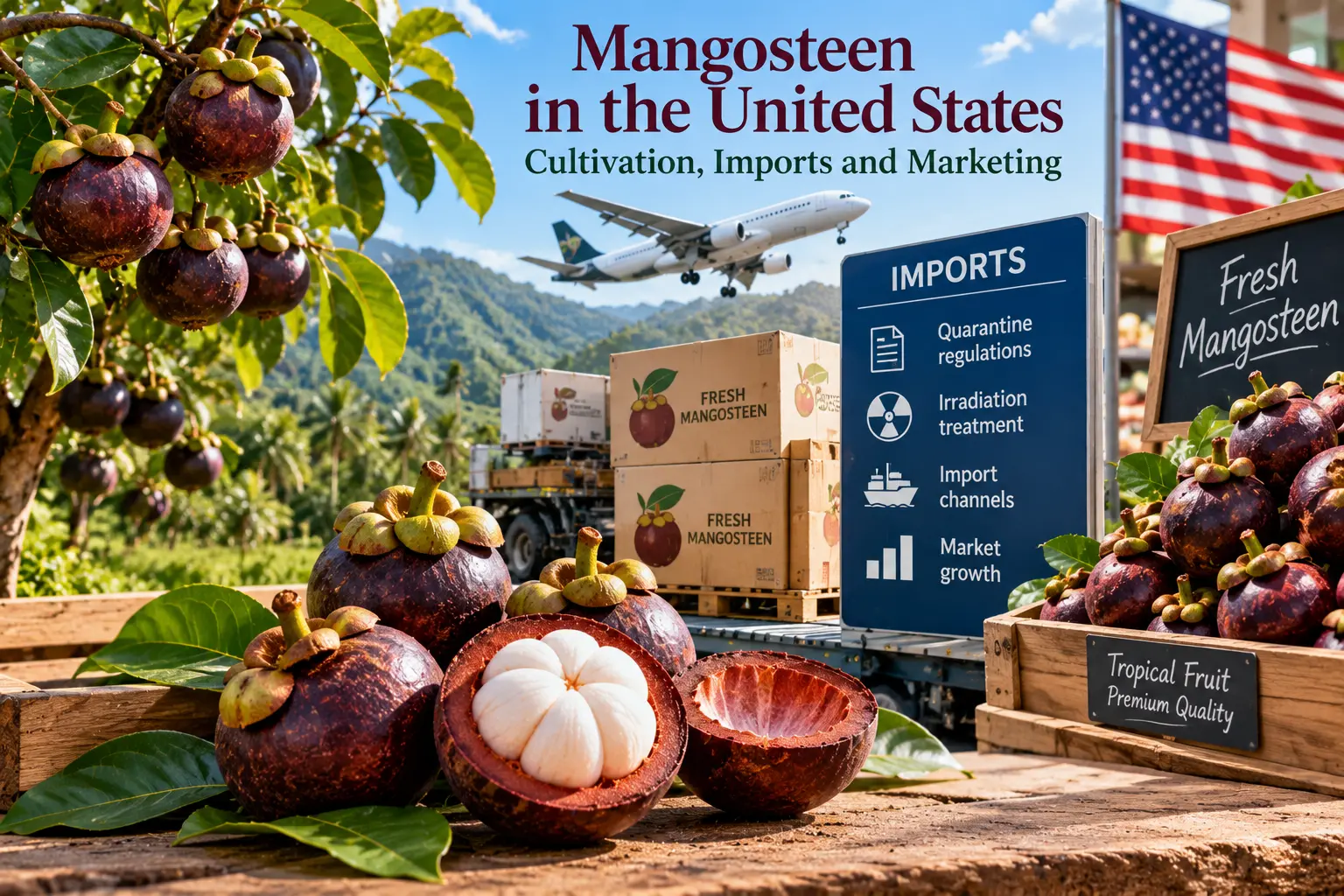
Why Mangosteen Was Difficult to Commercialize in the United States
Mangosteen is native to the humid tropics of Southeast Asia, particularly Indonesia and Malaysia. Karp's review describes the tree as requiring a fully tropical climate, a biological constraint that prevented commercial cultivation in the contiguous United States. This meant that a U.S. market could not simply develop through orchards in major mainland fruit-producing states.
Efforts to grow mangosteen for U.S. consumers extended over more than a century. The important commercial developments came much later, particularly with plantings established in Hawaii and Puerto Rico during the 1990s. Karp reported approximately 30 hectares in Hawaii and 5 hectares in Puerto Rico.
How Hawaii and Puerto Rico Became Domestic Sources of Mangosteen
Hawaii offered the tropical conditions needed for mangosteen cultivation, but geography and plant-quarantine rules complicated access to mainland consumers. Hawaiian growers therefore developed markets closer to production while regulatory pathways for mainland shipments were being addressed.
Puerto Rico represented another small domestic production area. Fresh shipments from Puerto Rico to the mainland began on a small scale in August 2007, and Karp's review states that these shipments did not require the irradiation treatment applied to Thai mangosteens entering the United States.
Table 1. Early U.S. Mangosteen Production and Market Routes
Production area | Scale reported by Karp | Market situation described |
Hawaii | About 30 hectares | Local hotels, restaurants and cruise ships; later mainland access under irradiation requirements |
Puerto Rico | About 5 hectares | Small-scale mainland shipments began in August 2007 |
Contiguous United States | No commercial cultivation | Climate unsuitable for commercial mangosteen production |
Table note: Acreage and marketing descriptions reproduce the historical situation summarized in Karp's 2010 review and should not be interpreted as current production estimates.
Why Quarantine Pests Restricted Fresh Mangosteen Imports for Years
Climate was only one part of the commercialization problem. Fresh mangosteen could harbor quarantine pests, creating a plant-health concern for U.S. agriculture. Karp explains that USDA's Animal and Plant Health Inspection Service consequently prohibited fresh imports from the principal Southeast Asian producing countries for many years.
Phytosanitary irradiation provided a way to manage pest risk without preventing trade entirely. In the historical system described by Karp, treatment requirements differed by origin and by the quarantine risks associated with the fruit.
How the 2007 Rule Opened the U.S. Market to Thai Mangosteen
A major change came in June 2007. Karp reports that APHIS published a final rule allowing fresh mangosteen from Thailand to enter the United States after irradiation at a minimum dose of 400 Gy.
Thailand was especially important because the review identified it as the world's leading mangosteen producer. Opening a legal phytosanitary pathway from an established production country therefore had greater commercial implications than relying only on small domestic orchards.
Table 2. Mangosteen Market-Access Routes Described in the Historical Review
Source | Development described | Irradiation condition reported |
Thailand | APHIS final rule opened fresh imports in 2007 | Minimum 400 Gy |
Puerto Rico | Small-scale mainland shipments began in August 2007 | Irradiation not required in Karp's account |
Hawaii | APHIS rule allowed mainland shipments in 2008 | Minimum 150 Gy |
Table note: This table summarizes the regulatory situation described in Karp's 2010 review. It is historical and should not be used as a substitute for current APHIS import or interstate movement requirements.
What Marketing Channels Supported the Early U.S. Mangosteen Trade
Commercialization required buyers as well as regulatory approval. Mangosteen already had characteristics that could support specialty marketing: Karp described its flesh as juicy and delicate with a sweet-tart flavor, while its relative scarcity in the United States helped distinguish it from familiar tropical fruits.
Hawaiian producers initially had a premium-oriented market close to their orchards. Hotels, restaurants and cruise ships could introduce the fruit to visitors without the costs and regulatory steps associated with mainland distribution.
Why Health Claims Increased Public Awareness of Mangosteen Products
Karp also identified growing interest in purported health benefits as a factor affecting the market. Such claims helped increase public awareness and consumption of mangosteen products during the period reviewed.
This point needs careful interpretation. The paper describes health-related marketing as a factor in consumer awareness; it does not establish the claimed health effects as clinical facts. Commercial interest and scientific evidence are separate questions.
Table 3. Historical Commercialization Factors and Supporting Context
Factor | Evidence focus | Why it mattered |
Tropical climate | Karp 2010 | Restricted U.S. cultivation mainly to Hawaii and Puerto Rico |
Quarantine pests | Karp 2010; Follett & Neven 2006 | Limited movement and imports without mitigation |
Phytosanitary irradiation | Karp 2010; Hallman 2011 | Created regulated pathways for fresh-fruit trade |
Postharvest quality | Palapol et al. 2009 | Shows maturity and postharvest quality are important to marketability |
Import development | USDA ERS 2011 | Documents irradiated Thai mangosteen entering the U.S. specialty-fruit market |
What the Study Shows About Commercializing Specialty Tropical Fruit
The history presented by Karp connects biological, regulatory and commercial factors. Mangosteen required a climate unavailable for commercial production in the contiguous United States, while major foreign suppliers faced quarantine restrictions because fresh fruit could carry pests. Irradiation changed that relationship by providing an approved phytosanitary treatment that could support market access.
Practical takeaway: the early U.S. mangosteen market was shaped less by the simple question of whether consumers wanted the fruit than by whether growers and exporters could overcome climate, quarantine and distribution constraints. Karp's review captures the transition from tiny domestic plantings and restricted imports to regulated commercial pathways from Puerto Rico, Hawaii and Thailand.
Frequently asked questions
Can mangosteen be grown commercially in the contiguous United States?
Karp's review states that mangosteen requires a fully tropical climate and cannot be grown commercially in the contiguous United States. Historical U.S. commercial plantings instead developed in Hawaii and Puerto Rico. The paper reported approximately 30 hectares in Hawaii and 5 hectares in Puerto Rico during the period it reviewed.
When did fresh Thai mangosteen gain access to the U.S. market?
Karp reports that APHIS published its final rule in June 2007. It allowed fresh Thai mangosteen treated by irradiation at a minimum dose of 400 Gy to enter the United States. The change created an import pathway from the country identified in the review as the world's leading producer.
Why was irradiation required for some mangosteen shipments?
Fresh mangosteen can harbor quarantine pests, which created a plant-health barrier to movement into the mainland United States. Irradiation was used as a phytosanitary treatment within the market-access pathways described by Karp. The historical dose depended on the origin and regulatory route discussed in the review.
Did the 2010 paper prove health benefits from mangosteen?
No. Karp reported that interest in purported health benefits increased public awareness and consumption of mangosteen products. That observation concerns marketing and consumer interest rather than proof of particular clinical effects.
Sources
- Karp, D. (2010). Commercialization of mangosteen in the United States: domestic cultivation, imports and marketing. Journal of the American Pomological Society, 64(1), 5–13.
- Follett, P. A., & Neven, L. G. (2006). Current trends in quarantine entomology. Annual Review of Entomology, 51, 359–385.
- Hallman, G. J. (2011). Phytosanitary applications of irradiation. Comprehensive Reviews in Food Science and Food Safety, 10(2), 143–151.
- Palapol, Y., Ketsa, S., Stevenson, D., Cooney, J. M., Allan, A. C., & Ferguson, I. B. (2009). Colour development and quality of mangosteen (Garcinia mangostana L.) fruit during ripening and after harvest. Postharvest Biology and Technology, 51(3), 349–353.
- Pedraza-Chaverri, J., Cárdenas-Rodríguez, N., Orozco-Ibarra, M., & Pérez-Rojas, J. M. (2008). Medicinal properties of mangosteen (Garcinia mangostana). Food and Chemical Toxicology, 46(10), 3227–3239.
- Obolskiy, D., Pischel, I., Siriwatanametanon, N., & Heinrich, M. (2009). Garcinia mangostana L.: a phytochemical and pharmacological review. Phytotherapy Research, 23(8), 1047–1065.
- USDA Economic Research Service. (2011). Irradiation of Produce Imports: Small Inroads, Big Obstacles.
- Tunlayadechanont, S. (2013). Fresh fruits irradiation for phytosanitary purposes in Thailand using a multipurpose irradiation facility. Acta Horticulturae.

Maya Hartwell — author
Maya writes the environment and plant science explainers. Her editorial focus includes biodiversity, ecosystems, water quality, environmental pollution, plant biology, invasive plants, natural materials and the use of biological resources in environmental tech...
Related
How to Grow Hydnophytum and Myrmecodia Ant-Plants
Humic Substances as Plant Biostimulants: What They Can Do

Boletus pinetorum: A Fennoscandian Porcini Taxonomy Case