Nitrogen fixation and how legumes and soil bacteria feed plants
Nitrogen fixation is the microbial conversion of nitrogen gas in the air into ammonia that can enter plant nutrition. In legumes, root-associated rhizobia perform this conversion within nodules, using energy supplied by the host plant.
This article examines the nitrogenase reaction, the root-nodule partnership and the distinct routes of fixation in soils. It draws on biochemical research, studies of legume agriculture and recent global assessments to distinguish established processes from uncertain estimates.
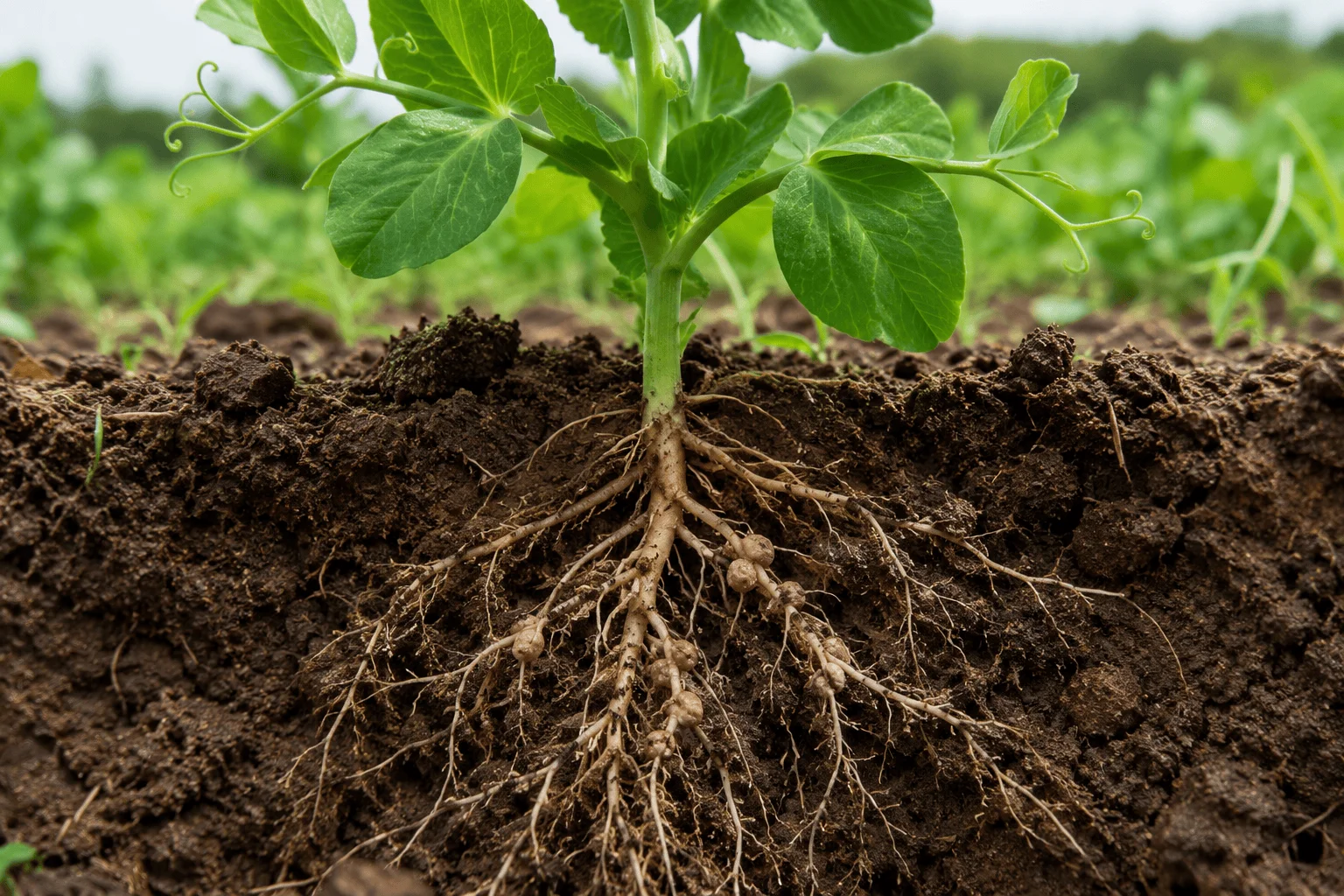
What nitrogen fixation changes in the nitrogen cycle
The air holds an enormous reservoir of molecular nitrogen, yet ordinary plant cells have no biochemical route for unlocking it. Its tightly bonded molecular form must first be converted into reactive compounds before nitrogen can enter plant metabolism. Roots generally obtain this essential element from dissolved ammonium or nitrate; biological fixation supplies a separate pathway into living tissue, ultimately supporting the synthesis of pigments, proteins and genetic material (Santi et al., 2013).
The name diazotroph refers to a microorganism with the machinery needed to carry out this conversion. Diazotrophs occur among several bacterial lineages and archaea, and their habitats range from open soil to highly coordinated plant partnerships. Possessing the relevant machinery, however, is not equivalent to using it continuously: carbon and energy resources, oxygen exposure and the supply of alternative nitrogen sources can all alter its operation (Mus et al., 2016).
Several transformations take place between the arrival of nitrogen in an ecosystem and its eventual return to the air. Decomposers release nitrogen from residues, nitrifying organisms change reduced forms into more oxidised ones, and denitrifiers can move nitrogen back into gaseous pools. These reactions mainly change the chemical form or destination of nitrogen already present, unlike fixation, which opens an additional biological route from the atmospheric reservoir (Santi et al., 2013).
Why atmospheric abundance is not nutritional availability
A leaf is surrounded by nitrogen-rich air, but proximity to the gas provides no nutritional advantage without the chemistry to process it. The obstacle is molecular stability, which prevents plant tissues from accessing nitrogen simply through gas exchange. Certain microbes overcome that obstacle enzymatically; lightning and industrial production can also generate reactive nitrogen by entirely different routes.
A soil can hold considerable nitrogen bound in organic remains and nevertheless deliver too little of it to an actively growing crop. Release from organic pools is controlled by decomposition, whereas a living fixer may introduce an additional input through its own metabolism. That is why total [soil nitrogen](/agriculture/citrus-orchard-herbicides-soil-nitrogen-emissions-agriculture), the supply available to roots and nitrogen newly fixed by microbes must be treated as separate quantities.
How nitrogenase converts nitrogen gas into ammonia
Nitrogenase provides the catalytic machinery through which biological fixers act on molecular nitrogen. In the extensively investigated molybdenum-dependent system, interacting proteins and their embedded metal centres move electrons towards the site where reduction occurs. This arrangement makes the reaction possible, but it ties nitrogen acquisition to an appreciable expenditure of cellular energy (Seefeldt et al., 2009).
A biochemical accounting of molybdenum nitrogenase describes the reduction of one nitrogen molecule as consuming at least sixteen ATP molecules and eight electrons, alongside the production of hydrogen (Seefeldt et al., 2009). This is a statement about the enzyme's reaction under defined conditions, not a predicted yield from a hectare of crop. In an agricultural plant, further energy is spent maintaining infected tissues and exchanging nutrients with its microbial partner.
Protecting nitrogenase is difficult because oxygen can compromise its catalytic function while aerobic metabolism helps provide the energy on which fixation depends. Different diazotrophs manage this conflict through distinct physiological arrangements, including changes in when or where fixation takes place. The elaborate organisation of [legume nodules](/plants?sub=growing-crops) represents one such solution rather than a feature shared by every fixer (Mus et al., 2016).
Energy, metals and oxygen requirements
The active chemistry of nitrogenase depends on metal-rich structures assembled within its protein components. The molybdenum form is the best studied, although other nitrogenase variants use alternative metal cofactors in some organisms. These biochemical differences do not eliminate the fundamental demand for electron transfer and ATP during nitrogen reduction (Seefeldt et al., 2009).
Oxygen presents a dual problem because energy-yielding respiration often uses it, while nitrogenase is vulnerable to it. Microbial physiological adaptations and host-organised tissue environments represent distinct solutions rather than one universal design. This is one reason a laboratory assay under controlled conditions cannot automatically be treated as a field nitrogen budget.
Biological nitrogen fixation is a microbial energy-intensive reaction, not an automatic property of roots or soils.
How legumes and rhizobia form working root nodules
The development of a productive legume nodule begins before the bacteria enter the root. Compounds released by the plant elicit responses from suitable rhizobia, whose signalling molecules can then prompt changes in responsive root hairs and surrounding tissues. Because the recognition system is selective, a bacterial strain successful on one host is not necessarily a useful partner for another (Oldroyd et al., 2011).
Once communication and infection are compatible, the plant begins constructing a specialised site for bacterial residence. Rhizobia are accommodated in root-derived compartments, and many differentiate into the forms that perform fixation inside the developing organ. Carbon from the host fuels this activity; in return, newly reduced nitrogen becomes available for the plant's subsequent assimilation (Oldroyd et al., 2011).
A root nodule is a plant organ whose development involves both partners, not a random accumulation of soil microbes on the root surface. Its appearance varies with host type and age, and its existence alone says little about the quantity of nitrogen acquired. Flynn and Idowu (2015), writing for New Mexico State University Extension, describe how the reddish colour often seen inside functioning nodules is associated with leghemoglobin, an oxygen-binding protein.
Host recognition and symbiotic specificity
Compatibility is decided through interactions that precede the large-scale nutritional exchange. The signalling account developed by Oldroyd and colleagues (2011) links microbial recognition to root development, showing why finding rhizobia in a field is not enough to establish an effective association. Soil may contain potential partners without containing the particular strains needed for strong nodulation by its crop.
The root nodule also reflects continuing control by the plant after infection. Plant cells coordinate nutrient exchange, bacterial accommodation and developmental changes that sustain the relationship. Such control helps explain why symbiosis is more organised than a general collection of microbes living near the root.
Oxygen control and the transfer of fixed nitrogen
Inside an active legume nodule, the host has to maintain enough oxygen for metabolism without allowing conditions that disable nitrogenase. Leghemoglobin participates in that balance, and its pigment can make nodule tissue appear pink, although appearance cannot quantify nitrogen input. The resulting environment depends on the coordinated regulation of plant tissues and microbial metabolism (Oldroyd et al., 2011).
The first reduced nitrogen made by nitrogenase is subsequently assimilated into compounds that can circulate within the host. Depending on legume species, nitrogen moves towards growing shoots in different transported forms, including amides and ureides. This nutritional benefit has a carbon cost: photosynthetic products are diverted towards sustaining the bacterial partnership (Peoples et al., 2009).
Fixation within a legume should not be mistaken for an immediate deposit of nitrogen into the surrounding soil. Initially, much of the acquired element is retained in the host's tissues, and its eventual destination depends on the treatment of residues, harvest removal and the decay of roots. Some living-plant transfer pathways are documented, but they cannot be used as a substitute for measuring the complete nitrogen balance of a cropping system (Peoples et al., 2009).
What happens after the crop is harvested
Agronomic significance depends not only on nitrogen fixed during growth but also on nitrogen removed in grain, hay or other harvested material. Peoples and colleagues (2009) report that high-protein legume seed can export much of the nitrogen acquired during the season. Therefore, high fixation does not guarantee an equally large net addition to field soil.
Legume residues and underground tissues can still contribute nitrogen as they decompose, while rotations may improve subsequent crops in ways unrelated to nitrogen alone. The size of either benefit varies across cropping systems and management histories. Separating gross biological fixation from net soil nitrogen balance prevents exaggerated claims about [how much fertiliser can be displaced](/agriculture/fertilizer-types-rice-yield-soil-properties-sri-agriculture).
Symbiotic, associative and free-living nitrogen fixation
The strongest familiar example of a plant-microbe nitrogen-fixing association is the legume nodule, but biological fixation occurs in less intimate ecological settings too. Such relationships differ in where the microbes live, what carbon they obtain and how directly the products of fixation reach a plant. The existence of a specialised nodule therefore identifies one mechanism, not the defining requirement for all fixation (Santi et al., 2013).
Some diazotrophs occupy the zone around roots or reside inside plant tissues without building the characteristic legume nodule. Those associations may give bacteria access to plant-derived carbon, but proximity does not reveal how much newly fixed nitrogen reaches the crop. For cereal systems especially, evidence for microbial presence or fixation genes must be distinguished from a measured contribution to plant nutrition (Mus et al., 2016).
Other fixers obtain their energy and nutrients without a dedicated plant host, functioning in settings such as soil surfaces, decomposing material or biological crusts. A modest rate at one site can matter at broader scales when similar habitats cover extensive areas. The review by Santi and colleagues (2013) makes clear that nitrogen-fixing associations differ substantially, so one result should not be extrapolated across all of them.
What different plant associations can demonstrate
The terms symbiotic, associative and free-living describe the different settings in which biological nitrogen fixation occurs and the relationships between nitrogen-fixing microorganisms and plants. They do not by themselves establish which setting contributes the largest useful nitrogen supply. To compare two settings meaningfully, researchers must specify the area, observation period, nitrogen destination and method used to derive the rate.
For a non-legume crop, detection of an internal diazotroph is evidence for a possible interaction, not evidence that a large share of the crop's nitrogen budget has been supplied in this way. Controlled experiments can establish mechanisms, but their effects still need to be traced through whole plants and growing seasons. Mus and colleagues (2016) distinguish these levels of evidence when examining attempts to extend effective fixation beyond familiar legume systems.
What studies show about crops and global nitrogen inputs
A worldwide agricultural estimate has to combine observations from individual crops with assumptions about areas of cultivation and the share of nitrogen derived from fixation. Using that approach, Herridge, Peoples and Boddey (2008) reported a broad annual contribution of about 50–70 teragrams of nitrogen from agricultural biological fixation. It was a synthesis of disparate evidence rather than a direct observation of all farmland, and some systems had comparatively weak underlying measurements.
Reis Ely and colleagues (2025) approached the global calculation by combining site observations with spatial estimates of habitats likely to support fixers. Their analysis yielded an annual 65 Tg N for natural terrestrial environments, with a 52–77 Tg N uncertainty range, and 56 Tg N for cultivated land and managed pasture, with a 54–58 Tg N range. These figures should not be read as a time series continuing the earlier agricultural review: the studies describe different domains and use different scaling procedures.
The distribution of sampled sites became an important part of the 2025 analysis. In natural terrestrial systems, the measured locations had an estimated abundance of nitrogen-fixing organisms 17 times the modelled global average, indicating a potential bias if samples were simply scaled upwards. After addressing such spatial differences, the authors inferred a 64% rise in terrestrial fixation attributable to agriculture relative to pre-industrial conditions; this is a model-based global comparison, not a measured increase on every farm (Reis Ely et al., 2025).
Assessment | Reported fixation | Scope / method |
Herridge et al. (2008) | 50–70 Tg N/year | Review-based aggregate across agricultural systems |
Reis Ely et al. (2025) | 65 (52–77) Tg N/year | Spatial upscaling for natural terrestrial biomes |
Reis Ely et al. (2025) | 56 (54–58) Tg N/year | Spatial upscaling for croplands and cultivated pastures |
The estimates reported by Herridge et al. (2008) and Reis Ely et al. (2025) describe different components of biological nitrogen fixation. Their findings cannot be compared directly because the studies examine different land systems and use distinct estimation methods.
What is established and what remains uncertain
The molecular process is no longer speculative: microorganisms use nitrogenase to reduce atmospheric nitrogen, and compatible rhizobial partnerships can supply legumes with substantial amounts of the element. Experiments on enzyme chemistry and on plant-microbe signalling support different parts of this explanation. What the evidence does not support is treating every plant or agricultural field as though it fixes nitrogen at a constant rate (Seefeldt et al., 2009; Oldroyd et al., 2011).
A reliable estimate becomes harder as its geographical scope expands. Fixation responds to the condition of the crop, accessible nitrogen in the soil, temperature, moisture and the activity of effective microbial partners. Measurement techniques also differ in what they infer directly, so regional and worldwide totals inherit uncertainty from both the observations and the assumptions used to scale them (Herridge et al., 2008; Reis Ely et al., 2025).
Researchers continue to investigate whether the strong benefits of legume symbiosis can be reproduced in cereals, but a comparable field-scale outcome has not been established. Discovering a potential microbial partner is not the same as demonstrating a dependable supply to a harvested crop. Biological fixation unquestionably contributes to terrestrial nitrogen inputs, yet the amount available to any particular farming system must still be demonstrated for its own circumstances (Mus et al., 2016).
The difference between a capability and a measured contribution
The presence of genes associated with nitrogen fixation identifies potential, not necessarily an active nutritional service. Establishing a contribution to a crop requires evidence that the enzymes function under local conditions and that the resulting nitrogen reaches plant tissues. Genetic surveys and seasonal nitrogen budgets therefore examine related but fundamentally different questions (Mus et al., 2016).
A field-level account must also separate nitrogen drawn from pre-existing soil stores from nitrogen newly introduced by microorganisms. For legumes, the quantity removed at harvest changes whether an impressive fixation rate translates into a lasting gain for the soil. Studies that calculate totals for entire regions or continents add another layer of inference to this already complex accounting (Herridge et al., 2008; Reis Ely et al., 2025).
Frequently asked questions
Can plants take nitrogen directly from the air?
Most plants cannot break the strong bond in atmospheric nitrogen gas, so they rely on nitrogen already transformed into biologically usable compounds. Nitrogen-fixing microorganisms perform a crucial conversion, while many plant roots absorb ammonium or nitrate from their surroundings. Legumes can benefit from their specialised symbiosis with suitable rhizobia.
Do all legumes form nitrogen-fixing root nodules?
Many legumes can form nodules with compatible rhizobia, but successful nodulation depends on the host species, microbial partner and growing conditions. A visible nodule is not conclusive proof of a high fixation rate. Differences in nodulation and activity help explain why the nitrogen contribution varies substantially among legume crops and environments.
Is Rhizobium the only bacterium that fixes nitrogen?
No. Rhizobium is a familiar name associated with legume symbioses, but nitrogen-fixing microorganisms span many bacterial groups and some archaea. Certain cyanobacteria and free-living soil organisms also fix nitrogen. Moreover, several distinct rhizobial genera can form root-nodule relationships, so the term rhizobia is broader than one genus.
Does a legume give all its fixed nitrogen to the soil?
No. A large proportion supports the legume's own leaves, stems and seeds, and harvested produce may remove considerable nitrogen from the field. Residues and roots can later return some nitrogen to the soil through decomposition. The net contribution therefore depends on what is harvested and what remains in the system.
Why is nitrogenase sensitive to oxygen?
Nitrogenase contains reactive metal clusters essential for reducing nitrogen gas, and oxygen can damage its activity. Nitrogen-fixing microorganisms have evolved different ways of maintaining protective conditions while still obtaining enough energy. In legumes, organised root nodules and leghemoglobin help balance oxygen supply with the needs of the nitrogen-fixing cells.
Sources
- Reis Ely CR, Perakis SS, Cleveland CC, et al. Global terrestrial nitrogen fixation and its modification by agriculture. Nature. 2025;643:705–711. DOI: 10.1038/s41586-025-09201-w.
- Herridge DF, Peoples MB, Boddey RM. Global inputs of biological nitrogen fixation in agricultural systems. Plant and Soil. 2008;311(1–2):1–18. DOI: 10.1007/s11104-008-9668-3.
- Peoples MB, Brockwell J, Herridge DF, et al. The contributions of nitrogen-fixing crop legumes to the productivity of agricultural systems. Symbiosis. 2009;48:1–17. DOI: 10.1007/BF03179980.
- Seefeldt LC, Hoffman BM, Dean DR. Mechanism of Mo-dependent nitrogenase. Annual Review of Biochemistry. 2009;78:701–722. DOI: 10.1146/annurev.biochem.78.070907.103812.
- Oldroyd GED, Murray JD, Poole PS, Downie JA. The rules of engagement in the legume-rhizobial symbiosis. Annual Review of Genetics. 2011;45:119–144. DOI: 10.1146/annurev-genet-110410-132549.
- Santi C, Bogusz D, Franche C. Biological nitrogen fixation in non-legume plants. Annals of Botany. 2013;111(5):743–767. DOI: 10.1093/aob/mct048.
- Mus F, Crook MB, Garcia K, et al. Symbiotic nitrogen fixation and the challenges to its extension to nonlegumes. Applied and Environmental Microbiology. 2016;82(13):3698–3710. DOI: 10.1128/AEM.01055-16.
- Flynn R, Idowu J. Nitrogen Fixation by Legumes. New Mexico State University Cooperative Extension Service, Guide A-129. Revised June 2015. Accessed 2026. https://pubs.nmsu.edu/_a/A129/.

Sophie Bennett — author
Sophie writes the health and nutrition explainers. Her editorial focus includes nutrients, dietary patterns, energy metabolism, hydration, supplements, sports nutrition and the interpretation of health research for general readers. She approaches health conten...
Related
How Orchard Age and Herbicides Shift Soil Nitrogen and N2O
How fertiliser types affect rice yield and soil under SRI
Humic Substances as Plant Biostimulants: What They Can Do

How vermicompost affects growth and flowering in Liatris spicata
Seed germination and why some seeds fail to sprout
How to grow tomatoes and what heat, water and light really do
Koshihikari rice: marker-assisted heading-date gene transfer