


Mycotoxins in Dried Raisins in Egypt: Fungi and Contamination
Mycotoxins in dried raisins were investigated by M. S. Youssef, N. F. Abo-Dahab and A. A. Abou-Seidah using 100 commercial samples collected from retail markets in 10 Egyptian governorates. The researchers examined fungal diversity, viable mould counts, sample toxicity and the capacity of recovered fungal isolates to produce mycotoxins. They recorded 36 fungal species and two varieties belonging to 12 genera. Three raisin samples were toxic in the brine shrimp assay; chromatographic analysis identified aflatoxin B1 in two of those samples and ochratoxin A in the third.
The study is useful because it separates several related questions: which fungi were present, how fungal recovery changed between culture media, whether whole raisin samples showed toxicity and whether individual fungal isolates could produce mycotoxins. Its findings describe a historical retail survey published in 2000 and should not be treated as a current estimate for Egypt. Later dried-vine-fruit research confirms that fungal communities and mycotoxin occurrence can vary markedly by market, geography, climate and analytical method.
Why Study Fungi and Mycotoxins in Dried Raisins?
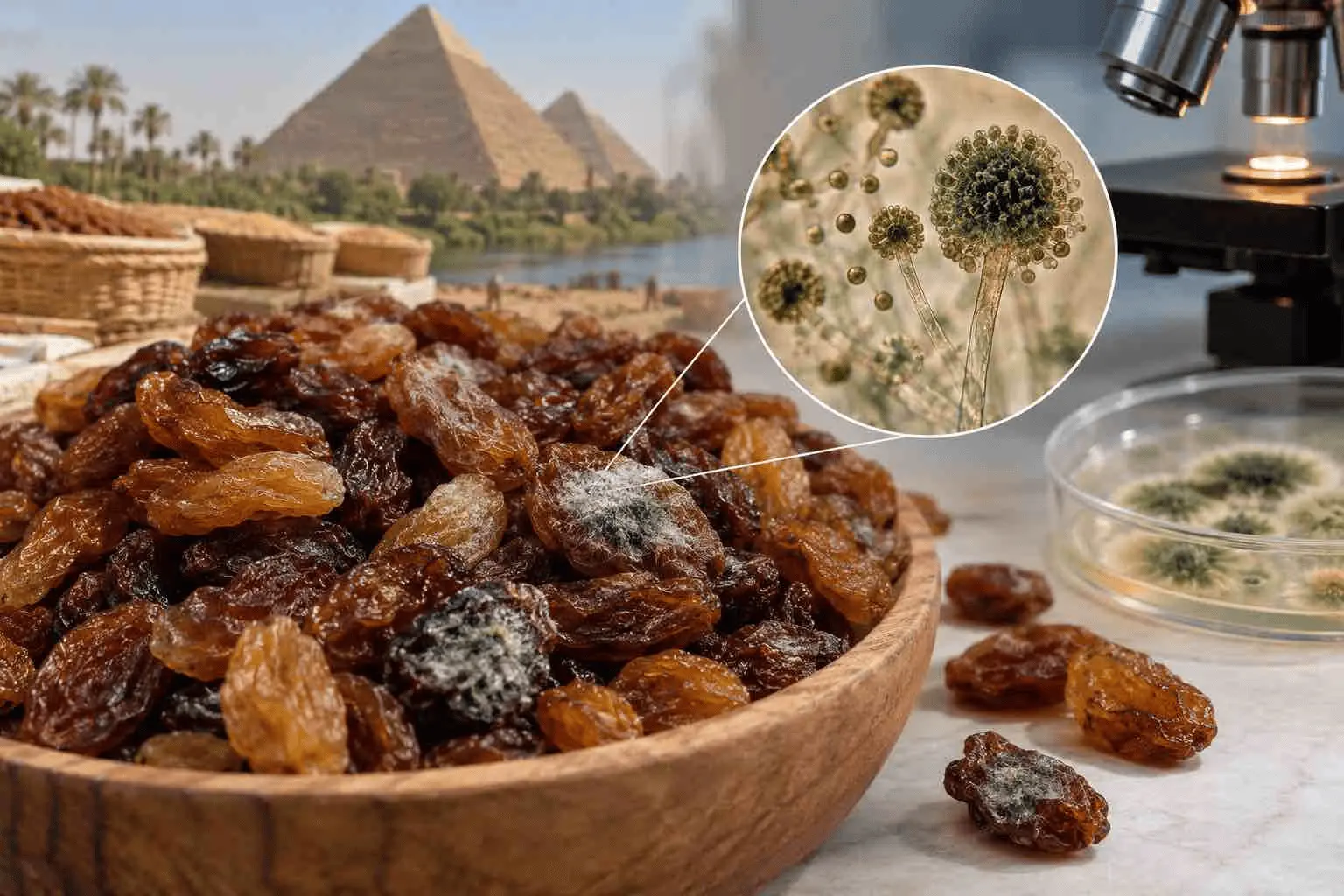
Drying reduces available water and helps preserve fruit, but it does not make dried raisins microbiologically uniform or eliminate every fungus able to tolerate relatively dry, sugar-rich conditions. The 2000 Egyptian study therefore examined both the mycobiota—the fungal community recovered from the samples—and evidence of mycotoxin contamination. This distinction matters because the presence of a fungal species does not by itself prove that a toxin is present in the food.
Fungi can enter the raisin production chain before harvest, during drying, in storage or during later handling. Which organisms are recovered depends partly on the fruit and partly on the laboratory conditions used to culture them. Youssef and colleagues used media with different sugar compositions and reported substantial differences in total viable counts between those media.
Earlier Egyptian work by Zohri and Abdel-Gawad also recovered Aspergillus, Penicillium and other fungi from dried fruits, while reporting no detected mycotoxins in the raisin samples examined. The contrast illustrates why results from one survey cannot be assumed to represent every batch, market or year.
How Was the Egyptian Raisin Survey Designed?
The researchers collected 100 dried-raisin samples from retail markets in Aswan, Qena, Sohag, Assiut, El-Minia, New Valley, Giza, Cairo, El-Sharkia and Alexandria. The abstract describes each sample as 150–200 g. The geographical spread allowed the study to recover fungi from commercial raisins sold across multiple parts of Egypt, although the abstract does not provide a sampling frame that would justify treating the collection as nationally representative.
The study cultured fungi on glucose-Czapek’s agar, 30% sucrose-Czapek’s agar, glucose-malt agar and 30% sucrose-malt agar. It then identified recovered fungal taxa and evaluated selected isolates for toxicity and mycotoxin production. Whole raisin samples were also screened using a brine shrimp toxicity assay before chromatographic analysis was used to identify toxins in the toxic samples.
Sampling across 10 governorates
The named governorates were Aswan, Qena, Sohag, Assiut, El-Minia, New Valley, Giza, Cairo, El-Sharkia and Alexandria. This wide geographic coverage is a strength for descriptive sampling, but the abstract does not state that equal numbers were collected from every governorate or that stores were selected randomly.
Why the Culture Medium Matters
The total viable count differed across the four reported media: 8,614 mould colonies/g on glucose-Czapek’s agar, 4,898 on 30% sucrose-Czapek’s agar, 5,222 on glucose-malt agar and 3,440 on 30% sucrose-malt agar. These values show that laboratory recovery depended strongly on the growth environment used for enumeration.
A higher count on one medium should not be interpreted as a separate contamination event in the raisins. Culture media select for organisms differently, and high-sugar formulations can favour fungi adapted to lower water availability while suppressing others. The study’s multiple-media design therefore provides a broader picture of cultivable fungi than a single plate formulation would provide.
Which Fungi Were Found in the Raisins?
Across the samples, the researchers recorded 36 species and two varieties belonging to 12 genera: Aspergillus, Penicillium, Mucor, Rhizopus, Cladosporium, Cochliobolus, Alternaria, Eurotium, Saccharomyces, Acremonium, Nigrospora and Botryotrichum. The most frequently encountered species included Aspergillus fumigatus, A. flavus, A. niger, Penicillium chrysogenum, P. oxalicum, Eurotium chevalieri, E. amstelodami, Mucor racemosus and Rhizopus stolonifer.
The list is important because several of these genera include species capable of producing secondary metabolites of food-safety concern. However, toxin production varies among species and even among isolates of the same species. A fungal identification therefore establishes potential, not proof of toxin contamination in the corresponding food sample.
Frequently encountered species
Several fungal genera appeared repeatedly across the dried-raisin samples, with Aspergillus and Penicillium among the prominent groups reported by the researchers. The table below summarizes the genera and the species identified as the most frequently encountered in the study.
Genus | Frequently reported species in the study |
Aspergillus | A. fumigatus, A. flavus, A. niger |
Penicillium | P. chrysogenum, P. oxalicum |
Eurotium | E. chevalieri, E. amstelodami |
Mucor | M. racemosus |
Rhizopus | R. stolonifer |
What Did the Whole-Sample Toxicity Tests Find?
Only three of the 100 dried-raisin samples were reported as toxic in the brine shrimp assay. Chromatographic analysis subsequently detected aflatoxin B1 in two samples at 300 and 220 µg/kg, while the third contained ochratoxin A at 250 µg/kg. These concentrations were measurements in three specific historical samples, not averages for the entire sample set.
The study’s result also should not be converted into a claim that 97% of Egyptian raisins were universally safe. The survey addressed a defined collection of retail samples with the methods available to the investigators. Analytical sensitivity, sampling design, toxin coverage and the uneven distribution of contamination within food lots all affect what a survey can detect.
Measured mycotoxins in the three toxic samples
Three of the 100 dried-raisin samples showed toxicity in the brine shrimp assay and were subsequently examined chromatographically. Two samples contained aflatoxin B1, while the third contained ochratoxin A, with the reported concentrations shown below.
Finding | Reported concentration | Interpretation |
Aflatoxin B1, sample 1 | 300 µg/kg | Detected in one historical raisin sample |
Aflatoxin B1, sample 2 | 220 µg/kg | Detected in one historical raisin sample |
Ochratoxin A, sample 3 | 250 µg/kg | Detected in one historical raisin sample |
What Did Testing of 346 Fungal Isolates Show?
The investigators recovered 346 fungal isolates for analysis of mycotoxin production. Chloroform extracts from 90 isolates were toxic to varying degrees, and chromatographic analysis showed that 66 isolates produced at least one mycotoxin. The reported toxin list included alternariol, aflatoxins B1, B2, G1 and G2, fumagillin, ochratoxin A, penicillic acid, sterigmatocystin, citrinin and terrin.
This isolate-level experiment answers a different question from the whole-food analysis. It demonstrates that some fungi recovered from raisins could produce toxins under the test conditions, but it does not establish that every toxin produced in culture was present in the raisin from which the isolate originated. Keeping these two evidence levels separate prevents laboratory toxigenicity from being mistaken for measured food contamination.
From recovered fungi to toxigenic isolates
The researchers recovered 346 fungal isolates and evaluated them for their potential to produce mycotoxins. Toxicity was observed in chloroform extracts from 90 isolates, while chromatographic analysis identified 66 isolates capable of producing at least one of the mycotoxins examined.
Stage | Number | What it shows |
Fungal isolates recovered | 346 | Isolates selected for mycotoxin-production analysis |
Toxic chloroform extracts | 90 | Extracts showing varying toxicity |
Mycotoxin-producing isolates | 66 | Isolates producing at least one listed mycotoxin |
How Do the Egyptian Results Compare With Later Dried-Vine-Fruit Studies?
Later studies reinforce the idea that dried vine fruits can carry ochratoxin A, but prevalence and concentrations vary considerably. A United Kingdom survey published in 1999 detected ochratoxin A above 0.2 µg/kg in 17 of 20 raisin samples, with a maximum of 53.6 µg/kg, while aflatoxins were not detected by the method used. A Canadian retail survey of samples collected from 1998 to 2000 detected ochratoxin A in 67 of 85 raisin samples, with a mean concentration of 1.8 ng/g.
A Spanish-market mycological study found fungal contamination in 49 of 50 dried-vine-fruit samples and identified black aspergilli as dominant. Aspergillus carbonarius was less frequent than A. niger var. niger but was far more consistently ochratoxigenic among the isolates tested. Research from Argentina by Romero and colleagues similarly found Aspergillus, Eurotium and Penicillium to be prominent and reported that 96% of the tested A. carbonarius strains produced ochratoxin A.
In Western Greece, ochratoxin A was detected in 73% of sampled raisins, with concentrations from 0.1 to 98.2 µg/kg, and the study reported relationships between contamination patterns and environmental conditions during harvest or drying. These studies do not reproduce the Egyptian sampling design, so their percentages should not be pooled. They instead show that contamination patterns depend on place, year, fungal ecology and analytical approach.
Comparison across selected studies
Study | Material / setting | Key finding | Important limitation |
Youssef et al. (2000) | 100 raisin samples, Egypt | AFB1 in 2 samples; OTA in 1 sample [1] | Historical retail survey |
MacDonald et al. (1999) | 20 raisin samples, UK retail | OTA in 17/20; maximum 53.6 µg/kg [3] | Different analytical method and market |
Lombaert et al. (2004) | 85 raisin samples, Canada | OTA in 67/85; mean 1.8 ng/g [4] | Samples collected 1998–2000 |
Abarca et al. (2003) | 50 dried vine fruits, Spain | A. carbonarius strongly associated with OTA production [5] | Mixed currants, raisins and sultanas |
Romero et al. (2005) | Dried vine fruits, Argentina | A. carbonarius highly ochratoxigenic [6] | Isolate toxigenicity differs from food toxin levels |
Perrone et al. (2013) | Raisins, Western Greece | OTA in 73%; range 0.1–98.2 µg/kg [7] | Single growing season |
What Are the Main Limitations of the 2000 Study?
The abstract provides extensive counts and toxin findings but limited detail about sample selection within each governorate, retail conditions, storage history and the distribution of samples among locations. Without that information, the 100 samples cannot automatically be treated as a probability sample of all raisins sold in Egypt.
The study also predates many current analytical workflows based on immunoaffinity clean-up, high-performance liquid chromatography and tandem mass spectrometry. This does not invalidate the reported findings, but it means direct numerical comparison with modern surveys requires caution because detection limits, confirmation procedures and analyte coverage can differ.
Finally, the ability of an isolate to produce a toxin in culture is not equivalent to toxin occurrence in the original food. Temperature, water activity, substrate composition, competition with other microorganisms and storage time can all affect toxin production. The study is strongest when its isolate results are interpreted as evidence of toxigenic potential.
Why Does This Study Still Matter?
The paper provides a detailed historical snapshot of cultivable fungal diversity in dried raisins sold across multiple Egyptian governorates and connects that diversity with both whole-sample toxicity and isolate-level toxin production. Its four-media comparison also demonstrates that the apparent abundance of fungi changes with culture conditions.
The study is particularly useful for teaching the difference between contamination, toxigenic potential and confirmed toxin occurrence. Fungal counts describe organisms recovered under laboratory conditions; isolate tests describe what selected fungi could produce; chromatographic analysis of the food describes toxins detected in the sampled raisins. Treating those endpoints as interchangeable would overstate the evidence.
Later research on dried vine fruits supports continued attention to Aspergillus species and ochratoxin A while also showing wide variation among markets and studies. Modern risk assessment likewise treats ochratoxin A as a food contaminant requiring evidence-based occurrence and exposure evaluation. The 2000 Egyptian findings are therefore best read as one study in a broader evidence base rather than as a current national prevalence estimate.
What the evidence supports
The study shows that fungal presence, toxigenic potential and confirmed mycotoxin contamination are related but distinct findings. Of 346 fungal isolates, 66 produced at least one mycotoxin, while toxins were detected in three dried-raisin samples. The findings provide historical evidence of fungal and mycotoxin contamination in Egyptian raisins but should not be treated as a current national estimate. Differences in sampling, location and analytical methods remain important when comparing this study with later research. |
Practical takeaway: Detecting fungi does not automatically confirm mycotoxins in dried raisins. Direct toxin analysis is necessary to establish contamination.
Frequently asked questions
Did the Egyptian study find fungi in dried raisins?
Yes. The researchers recorded 36 species and two varieties belonging to 12 fungal genera across the sampled raisins. Frequently encountered taxa included species of Aspergillus, Penicillium, Eurotium, Mucor and Rhizopus. These findings describe fungi recovered under the study’s culture conditions rather than every microorganism that may have been present.
How many raisin samples contained detected mycotoxins?
Three of the 100 samples were toxic in the brine shrimp assay and were subsequently associated with identified mycotoxins. Aflatoxin B1 was detected in two samples, while ochratoxin A was detected in the third. The result should be interpreted as a finding in this historical sample set, not a current prevalence estimate for Egypt.
What concentrations of aflatoxin B1 were reported?
The two aflatoxin B1-positive samples contained 300 and 220 µg/kg according to the study abstract. These are concentrations measured in two individual samples rather than a mean for all raisins examined. The study was published in 2000, so the values should be interpreted in their historical analytical context.
What did the fungal isolate tests show?
The researchers recovered 346 fungal isolates for mycotoxin-production analysis. Chloroform extracts from 90 isolates were toxic to varying degrees, and 66 isolates produced at least one listed mycotoxin. Production in culture demonstrates toxigenic potential but does not prove that the same toxin was present in the original raisin sample.
Why did mould counts differ between culture media?
Different media create different growth conditions and therefore recover fungal groups with different efficiencies. The study reported the highest total viable count on glucose-Czapek’s agar and lower counts on the three other media. Those differences show why culture-medium composition matters when interpreting fungal enumeration.
Does the study describe the current safety of raisins in Egypt?
No. It reports a specific set of 100 retail samples investigated for a paper published in 2000. Later studies in other markets also find variable fungal and ochratoxin contamination, demonstrating that occurrence changes across places, years and methods. Current safety assessments require current representative sampling and appropriate modern analytical testing.
Sources
- Youssef MS, Abo-Dahab NF, Abou-Seidah AA. Mycobiota and mycotoxin contamination of dried raisins in Egypt. African Journal of Mycology and Biotechnology. 2000;8(3):69–86.
- Zohri AA, Abdel-Gawad KM. Survey of mycoflora and mycotoxins of some dried fruits in Egypt. Journal of Basic Microbiology. 1993;33(4):279–288.
- MacDonald S, Wilson P, Barnes K, Damant A, Massey R, Mortby E, Shepherd MJ. Ochratoxin A in dried vine fruit: method development and survey. Food Additives & Contaminants. 1999;16(6):253–260.
- Lombaert GA, Pellaers P, Neumann G, Kitchen D, Huzel V, Trelka R, Kotello S, Scott PM. Ochratoxin A in dried vine fruits on the Canadian retail market. Food Additives & Contaminants. 2004;21(6):578–585.
- Abarca ML, Accensi F, Bragulat MR, Castellá G, Cabañes FJ. Aspergillus carbonarius as the main source of ochratoxin A contamination in dried vine fruits from the Spanish market. Journal of Food Protection. 2003;66(3):504–506.
- Romero SM, Comerio RM, Larumbe G, Ritieni A, Vaamonde G, Fernández Pinto V. Toxigenic fungi isolated from dried vine fruits in Argentina. International Journal of Food Microbiology. 2005;104(1):43–49.
- Perrone G, De Girolamo A, Sarigiannis Y, Haidukowski ME, Visconti A. Occurrence of ochratoxin A, fumonisin B2 and black aspergilli in raisins from Western Greece regions in relation to environmental and geographical factors. Food Additives & Contaminants: Part A. 2013;30(7):1339–1347..
- EFSA Panel on Contaminants in the Food Chain (CONTAM). Risk assessment of ochratoxin A in food. EFSA Journal. 2020;18(5):e06113.

Eleanor Hayes — author
Eleanor Hayes writes with an editorial focus on research methodology and study design, including experimental and observational studies, controls, sampling, measurement and the methodological choices that shape scientific conclusions. At CAB Direct, Eleanor co...
Related
Garlic Honey Tea and Blood Pressure: What the Study Found

Teaching Young Children to Swim: Didactic Approaches in Slovenia
Metofluthrin Mosquito Repellent: Field Efficacy in Outdoor Trials
Capsaicin and Ascorbic Acid Variability in Chilli and Paprika

What Parents Actually Say on Youth Sport Sidelines

Seven Countries Study: Coronary Heart Disease Across Populations