

Capsaicin and Ascorbic Acid Variability in Chilli and Paprika
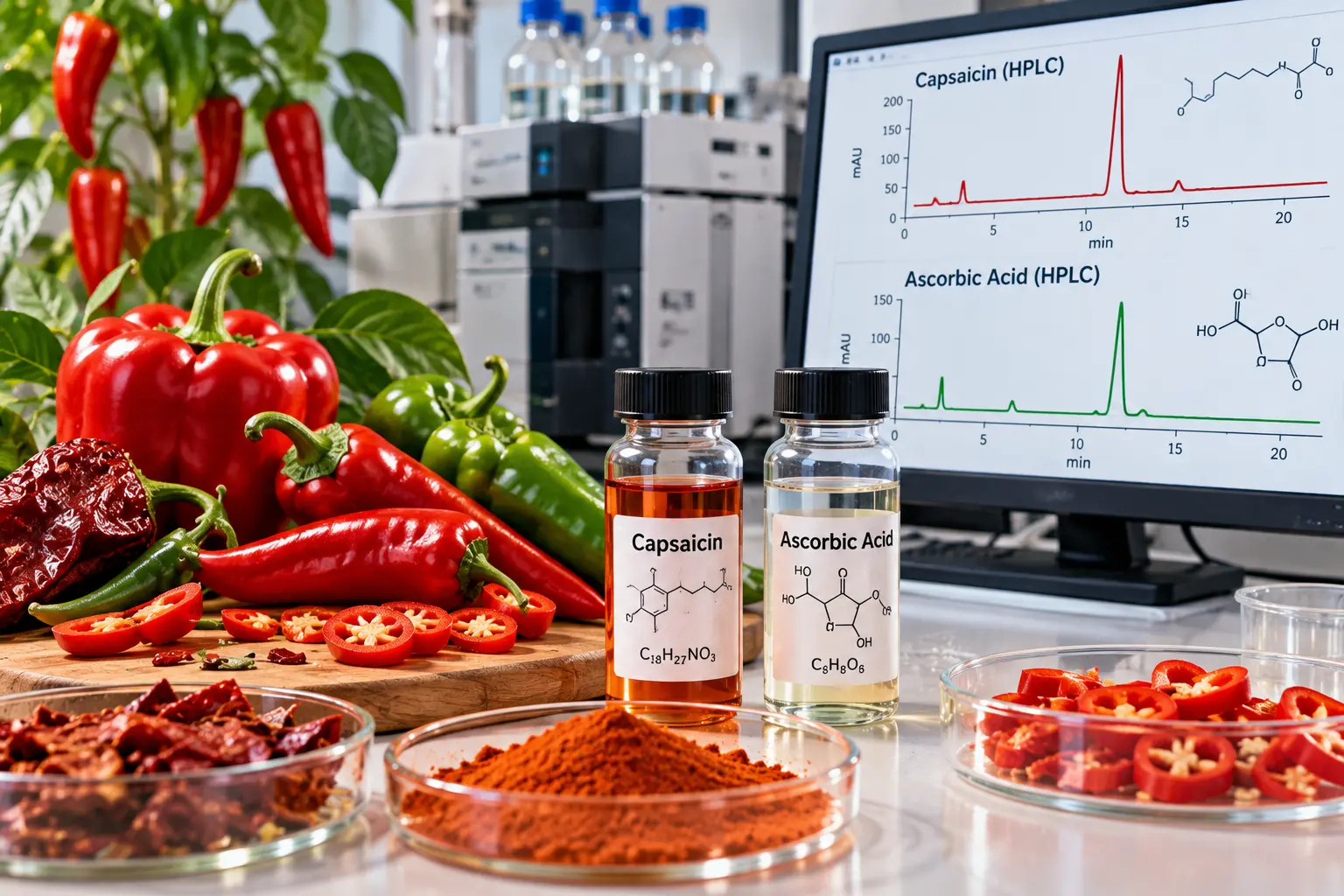
A 2013 study by S. Tilahun, P. Paramaguru and K. Rajamani used high-performance liquid chromatography (HPLC) to compare capsaicin and ascorbic acid in seven Indian pepper varieties or accessions from Capsicum annuum and Capsicum frutescens.
The study found wide differences among the peppers. CF1 had the highest reported capsaicin concentration, while Bayadagi Kaddi had the highest reported ascorbic acid content, leading the authors to identify them as potential sources for breeding peppers with targeted quality traits.
Why Capsaicin and Ascorbic Acid Matter in Pepper Breeding
Pepper cultivars can differ substantially in pungency and nutritional composition. Tilahun and colleagues focused on two traits with different breeding value: capsaicin, which contributes strongly to pungency, and ascorbic acid, the compound commonly identified with vitamin C. The authors evaluated seven Indian pepper varieties or accessions. Six belonged to Capsicum annuum — CA 97, CCH, K1, KTPL19, Arka Abhir and Bayadagi Kaddi — while CF1 represented Capsicum frutescens.
Variation Within Germplasm Creates Material for Selection
The purpose of comparing these peppers was not simply to rank them. The study treated biochemical variability as a resource that breeders could exploit when selecting parental material for improved nutritional or quality characteristics. This breeding interpretation is central to the paper's conclusion. The authors specifically identified CF1 as a potential source of capsaicin and Bayadagi Kaddi as a potential source of vitamin C.
How HPLC Was Used to Compare the Seven Pepper Accessions
High Performance Liquid Chromatography was used to determine capsaicin and ascorbic acid contents. HPLC separates compounds in a sample and allows target analytes to be measured against analytical standards or calibration procedures. For this study, the important point is that the same analytical approach was applied across the selected pepper material, allowing cultivar-to-cultivar differences in the two compounds to be compared.
Dry-Weight and Fresh-Weight Results Should Not Be Mixed
The abstract reports capsaicin as milligrams per 100 grams of dry weight, abbreviated DW. Ascorbic acid is reported as milligrams per 100 grams of fresh weight, abbreviated FW. Because the two traits use different weight bases, their numerical values should not be compared directly with each other. The measurements answer different compositional questions and should be interpreted within their own units.
Which Peppers Had the Highest and Lowest Capsaicin Levels
CF1, the Capsicum frutescens accession, had the highest capsaicin concentration reported in the abstract at 445 mg per 100 g dry weight. Its corresponding pungency value was 71,200 Scoville Heat Units. At the other end of the reported range, Arka Abhir contained 29 mg capsaicin per 100 g dry weight. Its corresponding pungency value was 4,672 SHUs.
Four Chilli Accessions Were Classified as Highly Pungent
Based on pungency value, CA 97, CCH, K1 and CF1 were classified as highly pungent peppers. The abstract does not provide the individual capsaicin concentrations or SHU values for every accession, so those missing values should not be reconstructed. The large contrast between CF1 and Arka Abhir illustrates the biochemical variation that motivated the breeding interpretation of the study.
Table 1. Capsaicin Extremes Reported in the Seven-Pepper Study
Pepper | Species / type | Capsaicin | Pungency |
CF1 | Capsicum frutescens accession | 445 mg/100 g DW | 71,200 SHUs |
Arka Abhir | Capsicum annuum variety | 29 mg/100 g DW | 4,672 SHUs |
Table note: The highest and lowest capsaicin values are shown for comparison; complete numerical values for all seven peppers were not reported.
Which Cultivars Stood Out for Ascorbic Acid Content
The highest ascorbic acid content reported in the abstract occurred in Bayadagi Kaddi, at 189 mg per 100 g fresh weight. CA 97 had the lowest reported ascorbic acid content, at 55.3 mg per 100 g fresh weight. These results show that the pepper with the strongest reported capsaicin result was not the same material as the pepper with the strongest reported ascorbic acid result. Different accessions therefore offered different potential breeding advantages.
Bayadagi Kaddi Was Identified as a Vitamin C Source
The authors interpreted Bayadagi Kaddi as a potential source for vitamin C in breeding work. That conclusion follows directly from its leading ascorbic acid value among the seven peppers examined. The abstract does not report all seven ascorbic acid values. It supports identification of the highest and lowest entries, but not a complete numerical ranking of the remaining cultivars.
Table 2. Highest and Lowest Ascorbic Acid Values Reported
Pepper | Reported position | Ascorbic acid |
Bayadagi Kaddi | Highest | 189 mg/100 g FW |
CA 97 | Lowest | 55.3 mg/100 g FW |
Table note: FW means fresh weight. The abstract does not report the remaining five ascorbic acid values.
What the Study Reveals About Trait Variability in Capsicum
The study's main contribution is evidence of substantial biochemical variability within a small set of pepper germplasm. Capsaicin and ascorbic acid did not peak in the same accession, showing why multiple traits may need to be screened independently during selection. This pattern is consistent with broader pepper research showing extensive variation in health-related metabolites among Capsicum accessions. Other studies have likewise used biochemical diversity as a basis for identifying breeding parents.
A Small Germplasm Set Can Still Reveal Contrasting Donor Material
Seven accessions are not enough to characterize the full diversity of Capsicum, but they can reveal useful contrasts. In this dataset, CF1 and Bayadagi Kaddi emerged as distinct candidates for different breeding objectives. The study therefore functions as a screening exercise: analytical measurements identify promising material that could subsequently be evaluated in larger breeding and genetic programmes.
How Capsaicin Concentration Relates to Reported Pungency
The paper reports both measured capsaicin concentration and pungency expressed in Scoville Heat Units for the extreme capsaicin examples. CF1 combined 445 mg/100 g DW with 71,200 SHUs, whereas Arka Abhir combined 29 mg/100 g DW with 4,672 SHUs. Within the reported examples, higher capsaicin concentration corresponded with higher pungency. The study also used pungency values to classify CA 97, CCH, K1 and CF1 as highly pungent.
The Abstract Does Not Provide a Full Capsaicinoid Profile
Capsaicin is one member of the broader capsaicinoid group. The supplied abstract focuses specifically on capsaicin and does not provide a complete quantitative profile of other capsaicinoids for the seven entries. The study focused specifically on capsaicin and did not provide a complete quantitative profile of other capsaicinoids in the seven pepper entries. Therefore, its findings describe capsaicin variation rather than total capsaicinoid composition.
Why CF1 and Bayadagi Kaddi Are Different Breeding Resources
CF1 was highlighted because of its high capsaicin concentration and corresponding pungency. A breeder interested in increasing pungency or selecting material rich in capsaicin could therefore regard CF1 as a potential donor identified by this screening. Bayadagi Kaddi was highlighted for a different reason: it had the highest ascorbic acid concentration. Its value in the study lies in nutritional quality rather than in being the most pungent entry.
Breeding Goals Determine Which Accession Is Most Useful
There is no single best accession across all traits in the abstract. The useful parent depends on whether the breeding objective prioritizes capsaicin, vitamin C or another characteristic not measured in this study. This is why the authors frame variability itself as valuable. A diverse germplasm collection gives breeders contrasting sources that can be selected according to the target phenotype.
Table 3. Germplasm Identified for Contrasting Breeding Objectives
Breeding objective | Potential source | Evidence reported in the study |
Higher capsaicin / pungency | CF1 | Highest capsaicin concentration: 445 mg/100 g DW; 71,200 SHUs |
Higher vitamin C / ascorbic acid | Bayadagi Kaddi | Highest ascorbic acid content: 189 mg/100 g FW |
Table note: These are potential donor sources identified by the authors from the seven entries tested, not universal rankings across Capsicum germplasm.
What the 2013 Study Can and Cannot Establish
The study establishes analytical differences among the seven tested varieties or accessions under the conditions used by the researchers. It identifies the extreme values reported for capsaicin and ascorbic acid and proposes specific germplasm as potential breeding sources. The abstract does not provide replication details, environmental comparisons, heritability estimates, genetic-marker data or multi-location performance. It therefore does not establish how stable these biochemical values would be across environments or generations.
Measured Variability Is a Starting Point for Breeding, Not the Final Step
A high concentration in one screening study can justify further evaluation, but breeding decisions normally require additional information about inheritance, agronomic performance and stability. Those later steps are outside the evidence supplied in this abstract. The strongest source-grounded conclusion is narrower: the tested pepper germplasm showed exploitable variability, with CF1 and Bayadagi Kaddi identified as potential sources for capsaicin and vitamin C, respectively.
How Later Pepper Research Supports Broader Germplasm Screening
Research outside the 2013 paper has continued to document large differences in capsaicinoids, vitamins and other metabolites across pepper germplasm. Studies involving larger accession sets have similarly used HPLC and related analytical methods to profile quality traits for breeding. This later work provides context for the original authors' breeding argument: biochemical diversity can help breeders locate material carrying desirable fruit-quality characteristics.
The Original Seven-Accession Results Should Remain Distinct
Later studies have examined different pepper germplasm under varying environmental and analytical conditions, producing datasets that are not directly interchangeable with the 2013 results. The Tilahun study represents a distinct comparison of seven Indian pepper entries using HPLC to assess two target compounds. Within this group, the researchers identified clear high and low values for capsaicin and ascorbic acid, demonstrating substantial biochemical variation among the tested peppers.
Practical takeaway: Tilahun and colleagues showed that a small set of chilli and paprika germplasm contained marked variation in capsaicin and ascorbic acid. CF1 stood out for capsaicin and pungency, while Bayadagi Kaddi stood out for ascorbic acid. The study supports using biochemical screening to identify potential breeding material, while larger genetic and multi-environment evaluations would be needed to determine how reliably those traits can be transferred and maintained.
Frequently asked questions
How many pepper varieties or accessions were analysed?
The study analysed seven Indian pepper varieties or accessions. Six were Capsicum annuum and one, CF1, was Capsicum frutescens. Capsaicin and ascorbic acid were measured using HPLC.
Which pepper had the highest capsaicin concentration?
CF1 had the highest capsaicin concentration reported in the abstract. It contained 445 mg per 100 g dry weight and had a pungency value of 71,200 SHUs. The authors identified CF1 as a potential capsaicin source for breeding.
Which pepper had the highest ascorbic acid content?
Bayadagi Kaddi had the highest reported ascorbic acid content. Its value was 189 mg per 100 g fresh weight. The authors therefore identified it as a potential vitamin C source.
Which accession had the lowest capsaicin value?
Arka Abhir had the lowest capsaicin concentration reported in the abstract. It contained 29 mg per 100 g dry weight. Its corresponding pungency value was 4,672 SHUs.
Which accession had the lowest ascorbic acid content?
CA 97 had the lowest ascorbic acid content reported in the abstract. Its value was 55.3 mg per 100 g fresh weight. The abstract does not provide a complete numerical ranking for all seven entries.
What was the breeding conclusion of the study?
The authors concluded that variability in capsaicin and ascorbic acid could be exploited in pepper breeding. CF1 was highlighted as a potential source of capsaicin and Bayadagi Kaddi as a potential source of vitamin C. Further breeding evaluation would be needed beyond this biochemical screening.
Sources
- Tilahun S, Paramaguru P, Rajamani K. Capsaicin and ascorbic acid variability in chilli and paprika cultivars as revealed by HPLC analysis. Journal of Plant Breeding and Genetics. 2013;1(2):85–89.
- Saha S, Hedau NK, Kumar S, Mahajan V, Gupta HS. Variability in hot pepper for phytochemicals offers promising tools in plant-breeding programmes. Acta Agriculturae Scandinavica, Section B — Soil & Plant Science. 2010;60(3):227–234.
- Wahyuni Y, Ballester AR, Sudarmonowati E, Bino RJ, Bovy AG. Metabolite biodiversity in pepper (Capsicum) fruits of thirty-two diverse accessions: variation in health-related compounds and implications for breeding. Phytochemistry. 2011;72(11–12):1358–1370.
- Wahyuni Y, Ballester AR, Tikunov Y, et al. Metabolomics and molecular marker analysis to explore pepper (Capsicum sp.) biodiversity. Metabolomics. 2013;9:130–144.
- Mueller-Seitz E, Hiepler C, Petz M. Chili pepper fruits: content and pattern of capsaicinoids in single fruits of different ages. Journal of Agricultural and Food Chemistry. 2008;56(24):12114–12121.
- Kirschbaum-Titze P, Mueller-Seitz E, Petz M. Pungency in paprika (Capsicum annuum). 2. Heterogeneity of capsaicinoid content in individual fruits from one plant. Journal of Agricultural and Food Chemistry. 2002;50(5):1264–1266.
- Howard LR, Talcott ST, Brenes CH, Villalon B. Changes in phytochemical and antioxidant activity of selected pepper cultivars (Capsicum species) as influenced by maturity. Journal of Agricultural and Food Chemistry. 2000;48(5).
- Antonious GF, Kochhar TS, Jarret RL, Snyder JC. Antioxidants in hot pepper: variation among accessions. Journal of Environmental Science and Health, Part B. 2006.

Maya Hartwell — author
Maya writes the environment and plant science explainers. Her editorial focus includes biodiversity, ecosystems, water quality, environmental pollution, plant biology, invasive plants, natural materials and the use of biological resources in environmental tech...
Related
Garlic Honey Tea and Blood Pressure: What the Study Found
Mycotoxins in Dried Raisins in Egypt: Fungi and Contamination

Teaching Young Children to Swim: Didactic Approaches in Slovenia
Metofluthrin Mosquito Repellent: Field Efficacy in Outdoor Trials

What Parents Actually Say on Youth Sport Sidelines

Seven Countries Study: Coronary Heart Disease Across Populations

Heinrich and the Origins of Modern Industrial Accident Prevention