Oil pulling for teeth and what the studies show about oral bacteria
Oil pulling for teeth means swishing edible oil around the mouth; some trials report changes in bacterial counts, but prevention of dental disease has not been demonstrated. Peng et al. (2022) found no significant pooled change in plaque or gingival indices, while Jong et al. (2024) reported improvement against non-chlorhexidine rinses with very low certainty.
The evidence comes from randomised oral-rinsing trials, pooled analyses of plaque and bacteria measurements, and studies comparing edible oils with chlorhexidine or water. Separate investigations have tested tooth shade and reported uncommon respiratory complications. Those findings distinguish changes measured during short experiments from lasting improvements in oral health.
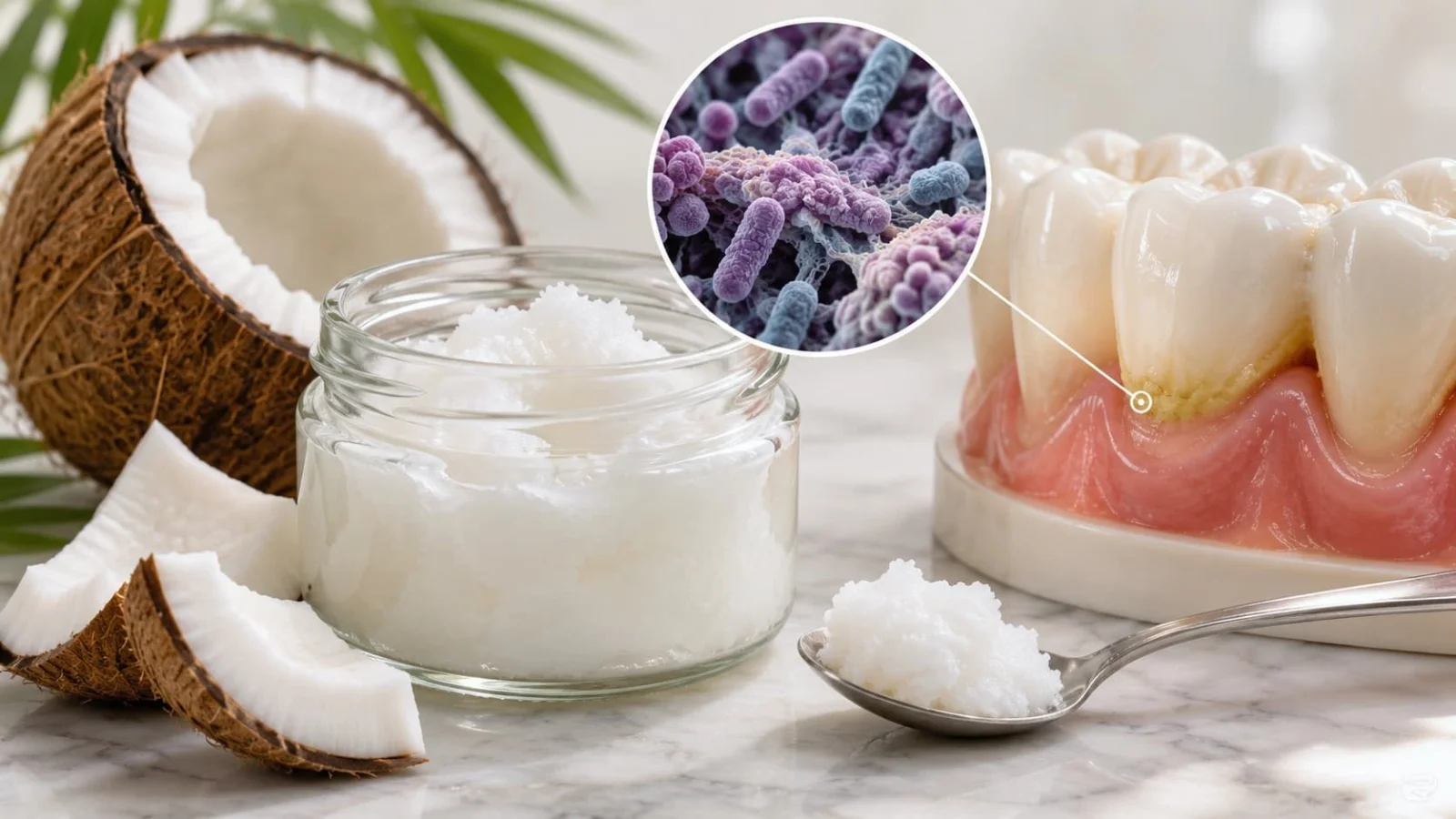
What oil pulling for teeth is and how it works
Oil pulling uses edible oil in the mouth. Woolley and colleagues (2020) describe edible coconut, sunflower and sesame oils being swished over tooth surfaces and forced between teeth by movements of the mouth during the rinsing practice. Woolley and colleagues (2020) examined trials of this rinsing practice, including studies of coconut oil lasting 7 to 14 days, with measurements of oral hygiene taken under those short experimental conditions.
Swishing moves oil over tooth surfaces. The hypothesis examined in the review by Jong and colleagues (2024) includes saponification, the formation of soap-like substances, and a possible barrier to bacterial aggregation. The reviewers say the precise mechanism of any oral benefit remains unresolved.
Oils used in oral rinsing
Coconut, sesame and sunflower oils appear in the clinical literature described by Woolley and colleagues (2020). They are distinct preparations, and the name of a plant oil says little about the bacterial outcome of a particular trial without information about the comparator. Moving oil through the mouth and exposing isolated bacteria to compounds in a laboratory are different procedures.
In the 2024 review, sesame oil was used in half of the trials, while intervention periods varied from 7 to 45 days (Jong et al., 2024). A trial using a proprietary mixture of medium-chain triglyceride oil and essential oils is another separate intervention, even when its authors call it oil pulling (Patel, Prabhu and Subramanian, 2026).
Zürcher and colleagues (2025) compared a sesame-based rinse containing botanical extracts and essential oils with distilled water, while Siripaiboonpong and colleagues (2022) compared virgin coconut oil with palm oil and the latter study found no statistically significant differences between oils in microbiological outcomes, although mutans streptococci counts fell within the palm-oil group (p = 0.010). Both designs use an oil-based comparator or an active rinsing procedure that may affect what is observed. They do not isolate every chemical property of the oils from the movement of liquid across the mouth.
Proposed action on oral biofilm
Dental plaque is a microbial film. Salivary bacteria and attached plaque are measured separately. Jong and colleagues (2024) discuss possible interference with aggregation and plaque formation, although the mechanism remains a hypothesis. That uncertainty prevents a fall in one culture count from being treated as proof that established plaque has been cleared.
Siripaiboonpong and colleagues (2022) describe proposed actions of oil-derived compounds on microbial membranes and other bacterial processes. Their activity during ordinary swishing remains unconfirmed. Their clinical comparison found no statistically significant change in total aerobic or anaerobic bacterial counts after the oil-rinsing periods.
Laboratory antimicrobial activity is a different outcome. The study of plant extracts against caries-associated bacteria examines plant preparations, while the oil-pulling trials sampled saliva, dental plaque and gingival indices after participants rinsed their mouths. Antimicrobial activity measured outside the mouth cannot establish a clinical effect on plaque attached to a tooth. The relevant clinical outcomes must be measured in participants, with the rinsing procedure and comparison group specified.
How oil pulling may affect bacteria in the mouth
Oil-pulling trials culture oral bacteria. Siripaiboonpong and colleagues (2022) collected plaque samples at several phases of a crossover trial. Culture counts do not capture every oral organism or demonstrate that changes persist after rinsing stops.
The distinction is visible in the 2022 analysis by Peng and colleagues. Their pooled findings favoured oil pulling for the broader salivary bacterial colony count, yet found no statistically significant difference for salivary Streptococcus mutans.
Streptococcus mutans in saliva
Streptococcus mutans is a bacterium examined in studies of tooth decay, but a culture count is not a direct measurement of new cavities. Kaushik and colleagues (2016) investigated its salivary count in a randomised comparison involving 60 subjects divided into three groups. Their results reported statistically significant reductions within both the coconut-oil and chlorhexidine groups.
That finding requires the comparison to remain visible. A reduction recorded during a trial does not, by itself, demonstrate that coconut oil outperformed the other rinses or lowered the eventual incidence of cavities. The culture-based outcome was limited to bacteria measured during the study (Kaushik et al., 2016).
Peng and colleagues (2022) found no statistically significant difference in pooled salivary Streptococcus mutans counts, with an estimate of 1.93, a 95% confidence interval from −1.84 to 5.7 and p = 0.32. A separate pooled result for salivary bacterial colonies showed a mean difference of 17.55, with a 95% confidence interval from 2.56 to 32.55 and p = 0.02, favouring the oil-pulling groups.
One measures a general count under culture conditions; the other targets a named organism. Neither estimate measures whether tooth decay developed less often in the people studied (Peng et al., 2022).
Bacterial counts and the oral microbiome
A randomised crossover study examined virgin coconut oil and palm oil in participants with gingival inflammation (Siripaiboonpong et al., 2022). Plaque was sampled across crossover phases. No statistically significant change in total, aerobic or anaerobic colony counts was detected with either oil after 28 days in participants with gingival inflammation (Siripaiboonpong et al., 2022).
The sesame-oil trial by Zürcher and colleagues (2025) used distilled water as its control and collected biofilm samples alongside plaque and gingival bleeding measurements at baseline, four weeks and eight weeks. The investigators found a few statistically significant differences involving selected bacteria, but no consistent microbiological advantage over water. Peng and colleagues (2022) instead reported a positive pooled result for bacterial colonies cultured from saliva.
In a 2026 trial, Patel, Patel and Desai tested a formulated oil rinse in 63 adults for 15 days against a marketed mouthwash and placebo. Gram-positive bacterial reductions were analysed in 39 participants with detectable baseline cultures (15, 11 and 13 in the respective groups): 69.3%, 63.5% and 51.6%, with no statistically significant between-group difference. These figures describe that formulation and cannot be assigned to plain coconut or sesame oil.
The clinical distinction also applies to studies of antibacterial activity in date palm seeds, where the research question concerns plant-derived material rather than a rinse. An oral culture result becomes clinically relevant only after its measurement, participant group and control are kept together. Jong and colleagues (2024) reported short intervention periods, while Zürcher and colleagues (2025) found a few significant microbiological differences but no consistent advantage for the sesame-based rinse over water. Permanent rearrangement of the oral microbiome was not established.
Whether oil pulling reduces dental plaque and gingivitis
Plaque indices record visible deposits on tooth surfaces, while gingival indices describe inflammation or bleeding. Saliva counts cannot substitute for plaque scores. Peng and colleagues (2022) found no statistically significant pooled difference in plaque or gingival indices. Jong and colleagues (2024) reported a reduction in modified gingival index relative to non-chlorhexidine rinses, although certainty was very low.
The systematic review by Woolley and colleagues (2020) included four randomised trials involving 182 participants. They lasted between 7 and 14 days. The review offered no data on changes lasting beyond the trial follow-up.
Plaque index scores
Peng and colleagues (2022) found no statistically significant pooled difference for plaque index, with a mean difference of −0.10 and a 95% confidence interval from −0.33 to 0.14. The confidence interval included no improvement. This did not rule out effects under other study conditions, but it gave no clear pooled advantage for that particular endpoint.
Zürcher and colleagues (2025) randomly allocated forty participants with gingivitis to a sesame-based rinse containing botanical extracts and essential oils or distilled water. Plaque scores fell in both groups. At eight weeks the trial found no statistically significant difference in plaque index between sesame oil and water (Zürcher et al., 2025).
Şahin and Aydın (2026) tested plaque regrowth over four days in one hundred dental students assigned to chlorhexidine, coconut oil, black cumin seed oil, terebinth oil or water. Mechanical brushing was withheld in the trial. Chlorhexidine produced significantly greater plaque inhibition than every oil intervention and water, a result confined to that unusual experimental setting.
Gum inflammation and bleeding
The gingival index measures a different aspect of oral health from plaque. Peng and colleagues (2022) found no statistically significant difference for gingival index, reporting a mean difference of −0.05 with a 95% confidence interval from −0.12 to 0.02. The estimate did not establish a reduction relative to controls.
Jong and colleagues (2024) measured differences in the modified gingival index. Their standardised mean difference was −1.14, with a 95% confidence interval from −1.31 to −0.97. The pooled estimate suggests a benefit on the index in the included comparisons, while the authors rated certainty very low.
Zürcher and colleagues (2025) reported no statistically significant difference in gingival bleeding index between sesame-based rinse and water after eight weeks. Bleeding scores nevertheless declined significantly from baseline in both groups.
The 2026 proprietary-rinse trial by Patel and colleagues reported a 2.7% improvement in modified gingival index and a 30.6% reduction in plaque index in its test group. The product combined ingredients beyond plain oil, and these were trial-specific measurements. They cannot resolve the disagreement between pooled studies of different edible oils and different comparators.
What trials show when oil pulling is compared with mouthwash
Mouthwash comparisons test relative effects. The outcome depends on which rinse is used as the control and whether toothbrushing is allowed during the trial. Jong and colleagues (2024) included chlorhexidine and other rinses as comparators, while Şahin and Aydın (2026) examined distilled water alongside chlorhexidine and different oils.
Kaushik and colleagues (2016) compared coconut oil, chlorhexidine and distilled water in a controlled study that cultured saliva on the first day and again after two weeks, counting bacterial colonies to examine the selected rinses. Counts of Streptococcus mutans decreased significantly within the coconut and chlorhexidine groups. Caries development was not measured.
Chlorhexidine and control groups
In an observer-masked crossover trial, Sezgin and colleagues (2019) studied 29 volunteers in a four-day plaque-regrowth model. Plaque scores were similar in the treatments. The trial therefore gave a favourable short-term comparison in a restricted protocol, without establishing what happens during routine brushing over months.
The 2024 synthesis by Jong and colleagues included twenty-five trials involving 1184 people, with twenty-one trials pooled for meta-analysis. The specific plaque-index comparison against chlorhexidine pooled eight trials involving 305 participants and favoured chlorhexidine (standardised mean difference 0.33; 95% confidence interval 0.17 to 0.49). Certainty was rated very low.
A later direct comparison agreed on the direction of that plaque result. In the four-day study by Şahin and Aydın (2026), chlorhexidine inhibited plaque significantly more than coconut, black cumin and terebinth oils. The participants had temporarily stopped mechanical cleaning, so the result cannot represent the addition of oil to normal brushing.
Water-controlled results add another constraint. After eight weeks, the sesame and distilled-water groups in Zürcher and colleagues' trial (2025) both improved their plaque and bleeding scores, with no statistically significant difference between the groups. Their findings allow a contribution from the act of rinsing or from other features shared by both study arms.
Research findings at a glance
Study | Participants and observation | Main measurement | Result and boundary |
Kaushik et al., 2016 | 60 subjects; two weeks | Salivary Streptococcus mutans | Significant reductions within coconut and chlorhexidine arms; not a caries outcome. |
Sezgin et al., 2019 | 29 volunteers; four-day crossover | Plaque regrowth and staining | Similar plaque inhibition and less staining than chlorhexidine in that model. |
Jong et al., 2024 | Twenty-five trials; 1184 participants | Pooled plaque and gingival indices | Chlorhexidine favoured for plaque; certainty very low. |
Zürcher et al., 2025 | Forty participants; eight weeks | Plaque and gingival bleeding | Sesame-based rinse showed no statistically significant advantage over distilled water. |
Şahin and Aydın, 2026 | One hundred students; four days | Plaque regrowth without brushing | Chlorhexidine inhibited plaque more than tested oils. |
The short crossover experiment enrolled 29 volunteers in a four-day plaque model, whereas the later experiment included one hundred dental students who were instructed to stop mechanical brushing (Sezgin et al., 2019; Şahin and Aydın, 2026). The participants and procedures therefore differed, limiting any direct comparison of the plaque scores.
Claims about cavities, tooth whitening and oil pulling safety
Oral bacterial counts, gum scores and tooth colour are separate outcomes. A short experiment measuring cultured bacteria cannot establish how many cavities occurred later, just as less staining relative to chlorhexidine is not evidence that an oil removes existing discolouration. The trials reviewed by Jong and colleagues (2024) measured short-term oral hygiene outcomes over intervention periods from 7 to 45 days, while certainty for the pooled plaque and gingival findings was assessed as very low.
Tooth decay and whitening claims
Kaushik and colleagues (2016) cultured saliva before and after rinsing. No new-cavity endpoint appears in that reported comparison, so a reduction in the count cannot be converted into a reduction in dental decay. The same boundary applies to a pooled salivary bacterial estimate (Peng et al., 2022).
Sezgin and colleagues (2019) described less tooth staining after coconut oil than after chlorhexidine during their short crossover model. Şahin and Aydın (2026) also recorded significantly greater discolouration in the chlorhexidine group than with tested oils. Neither trial tested reversal of existing stains.
A different result appeared in a 2026 randomised trial by Patel, Prabhu and Subramanian. One hundred adults were allocated to a proprietary rinse made with medium-chain triglyceride oil and an essential oil blend or a matched placebo. Tooth-whiteness scores improved significantly over four weeks with the active formulation, but the product was not plain coconut or sesame-based rinse and the study did not establish durability after the trial.
Bad breath and reported adverse effects
A 2026 trial by Patel, Patel and Desai examined a combined oil-pulling rinse against an alcohol-based mouthwash and placebo. Breath-freshness scores improved in the test group, alongside other short-term measures. Because the intervention was formulated with additional ingredients and lasted 15 days, that result cannot be attributed to swishing a single edible oil (Patel, Patel and Desai, 2026).
Safety reporting was sparse. Woolley and colleagues (2020) noted that none of the studies in their review reported adverse effects. This is a gap in reporting rather than evidence that unwanted effects cannot occur.
Kuroyama and colleagues (2015) described a 66-year-old man with dry cough and a 38-year-old woman with shortness of breath who developed exogenous lipoid pneumonia after habitual sesame-oil mouth or nasal washing over several months. Aspiration of oily material is implicated. An uncommon reported complication is still a different kind of evidence from a controlled trial of gum scores.
Patel, Prabhu and Subramanian reported no adverse events or clinically significant abnormalities during their short whitening trial. Long-term safety remains untested. The CDC (2024) describes brushing twice a day and flossing between teeth to remove dental plaque.
What is proven about oil pulling for teeth and what is not
Oil pulling for teeth has produced some favourable short-term bacterial and gingival measurements, but its independent clinical benefit remains uncertain. Jong and colleagues (2024) found better pooled plaque reduction with chlorhexidine, while Zürcher and colleagues (2025) found no statistically significant difference between sesame-based rinse and water for plaque or gingival bleeding.
Some bacterial and gum measurements improve during oil-pulling trials, but the evidence does not establish durable oral-health protection or superiority to established plaque control (Jong et al., 2024).
The stronger-looking bacterial results need their endpoints attached. Peng and colleagues (2022) found a significant pooled change in salivary bacterial colonies but no statistically significant difference in salivary Streptococcus mutans. Siripaiboonpong and colleagues (2022) detected no significant change in total aerobic or anaerobic counts after coconut or palm oil exposure. Changes in salivary cultures therefore cannot stand for changes across the entire microbiome.
The 2024 synthesis by Jong and colleagues rated the evidence very low because of trial bias, small samples, variation in participants and heterogeneity. Although modified gingival index favoured oil pulling against non-chlorhexidine rinses, the same analysis found chlorhexidine superior for plaque. Neither result measured the development of new cavities over extended follow-up.
Results also belong to the formulation tested. Patel, Prabhu and Subramanian (2026) reported improved tooth shade with an MCT and essential-oil mixture, whereas Patel, Patel and Desai (2026) found no statistically significant between-group difference in Gram-positive bacterial reduction despite favourable numerical values. Neither establishes an equivalent benefit from a single kitchen oil.
The CDC (2024) names drinking fluoridated tap water and brushing teeth with fluoride toothpaste. Oil-pulling studies have not supplied a comparable basis for replacing those measures. Trials with longer follow-up, clearly specified oil formulations, suitable rinsing controls and outcomes such as incident caries would be needed to test that separate claim (Jong et al., 2024).
Frequently asked questions
Does coconut oil work differently from sesame-based rinse for teeth?
Different trials have used different oils and comparison groups, so a direct ranking is not established. Coconut oil was compared with palm oil without significant changes in total bacterial counts (Siripaiboonpong et al., 2022). A separate trial of a sesame-based rinse with botanical extracts found no significant plaque or bleeding advantage over water (Zürcher et al., 2025).
How long did the oil pulling studies last?
In the 2024 systematic review by Jong and colleagues, interventions lasted from 7 to 45 days. A smaller review of coconut-oil trials examined studies lasting 7 to 14 days (Woolley et al., 2020). These observation periods provide little evidence about whether changes persist or influence future dental decay.
Can oil pulling replace brushing and flossing?
The studies have not established that oil pulling supplies equivalent plaque control. In pooled trials, chlorhexidine performed better than oil pulling on plaque indices, although evidence certainty was very low (Jong et al., 2024). The CDC (2024) states, “Brush your teeth well twice a day and floss between your teeth to remove dental plaque.” CDC (2024) specifies fluoride toothpaste.
Can oil pulling reverse an existing cavity?
No trial discussed here establishes reversal of a cavity. The coconut-oil study by Kaushik and colleagues (2016) cultured salivary Streptococcus mutans before and after rinsing, which is a bacterial measure rather than an examination of restored tooth structure. A changed culture count does not demonstrate repair of an existing lesion.
Does swishing oil change the oral microbiome permanently?
Permanent change has not been shown. Zürcher and colleagues (2025) found no consistent microbiological difference between a sesame-based rinse and distilled water, although comparisons involving Streptococcus oralis, Streptococcus gordonii and rough streptococcal colonies were significant. Another trial found no significant change in total aerobic or anaerobic counts after 28 days with coconut or palm oil (Siripaiboonpong et al., 2022).
Sources
- Peng TR, Cheng HY, Wu TW, Ng BK. Effectiveness of Oil Pulling for Improving Oral Health: A Meta-Analysis. Healthcare. 2022;10(10):1991. DOI 10.3390/healthcare10101991.
- Woolley J, Gibbons T, Patel K, Sacco R. The effect of oil pulling with coconut oil to improve dental hygiene and oral health: A systematic review. Heliyon. 2020;6(8):e04789. DOI 10.1016/j.heliyon.2020.e04789.
- Jong FJX, Ooi DJ, Teoh SL. The effect of oil pulling in comparison with chlorhexidine and other mouthwash interventions in promoting oral health: A systematic review and meta-analysis. International Journal of Dental Hygiene. 2024;22(1):78–94. DOI 10.1111/idh.12725.
- Kaushik M, Reddy P, Sharma R, et al. The Effect of Coconut Oil pulling on Streptococcus mutans Count in Saliva in Comparison with Chlorhexidine Mouthwash. Journal of Contemporary Dental Practice. 2016;17(1):38–41. DOI 10.5005/jp-journals-10024-1800.
- Sezgin Y, Ozgul BM, Alptekin NO. Efficacy of oil pulling therapy with coconut oil on four-day supragingival plaque growth: A randomized crossover clinical trial. Complementary Therapies in Medicine. 2019;47:102193. DOI 10.1016/j.ctim.2019.102193.
- Zürcher C, Nagl M, Vukoje K, Heller I, Eick S, Kapferer-Seebacher I. Efficacy of Sesame-Based Oil Pulling in Plaque Reduction: A Randomized Controlled Trial. Healthcare. 2025;13(14):1634. DOI 10.3390/healthcare13141634.
- Şahin AB, Aydın T. Clinical Evaluation of Edible Oils Used in Traditional Oil Pulling Therapy for Plaque Control and Tooth Discoloration: A Randomized Trial. Healthcare. 2026;14(13):1985. DOI 10.3390/healthcare14131985.
- Kuroyama M, Kagawa H, Kitada S, et al. Exogenous lipoid pneumonia caused by repeated sesame oil pulling: a report of two cases. BMC Pulmonary Medicine. 2015;15:135. DOI 10.1186/s12890-015-0134-8.
- CDC. Oral Health Tips for Adults. 15 May 2024. https://www.cdc.gov/oral-health/prevention/oral-health-tips-for-adults.html
- Siripaiboonpong N, Matangkasombut O, Pengcharoen H, et al. Microbiological Effects of Virgin Coconut Oil Pulling in Comparison with Palm Oil Pulling as an Adjunctive Oral Hygiene Care for Patients with Gingival Inflammation: A Randomized Controlled Clinical Trial. Journal of Indian Society of Periodontology. 2022;26(1):58–63. DOI 10.4103/jisp.jisp_768_20.
- Patel C, Prabhu A, Subramanian D. Efficacy and Safety of a Novel Oil Pulling Oral Rinse for Teeth Whitening: A Double-Blind, Randomised, Placebo-Controlled Trial. Cureus. 2026;18(10):e118502. DOI 10.7759/cureus.118502.
- Patel C, Patel G, Desai N. The Effect of a Novel Natural Oil-Pulling Oral Rinse on Oral Microflora, Dental Plaque, and Gingivitis: A Double-Blinded Randomized Controlled Clinical Trial. Cureus. 2026;18(7):e113440. DOI 10.7759/cureus.113440.

Natalie Brooks — author
Natalie Brooks writes with an editorial focus on interdisciplinary research, scientific reviews, evidence synthesis and studies that combine findings produced through different research methods. At Cabdirect, Natalie covers research reviews, emerging evidence...
Related
Premna latifolia Leaf Extracts and Laboratory Activity Against Cariogenic Bacteria
How Tunisian Date Palm Seeds Differ in Chemistry and Bioactivity

Herbal Medicine Monographs: What Commission E Still Teaches

Why sleep is important for memory, mood and health

How much water you should drink each day and why needs vary

Impostor syndrome and why some people doubt their success

Is coffee good for you and what research says about its health effects