Premna latifolia Leaf Extracts and Laboratory Activity Against Cariogenic Bacteria
M. R. D. Modilal, R. Anandan and M. N. Logeshwari investigated Premna latifolia leaves as a source of antibacterial activity against cariogenic bacteria. Leaf extracts were prepared with water, methanol, ethanol, chloroform and hexane, then screened phytochemically before the methanolic extract was selected for further testing. Dental samples from 25 patients yielded 32 bacterial isolates belonging to five Streptococcus species. The methanolic leaf extract produced dose-dependent inhibition against the five bacterial species tested, leading the authors to propose P. latifolia as a potential source for further investigation of antibacterial compounds against cariogenic bacteria.
Why Premna latifolia Leaves Were Tested Against Cariogenic Bacteria
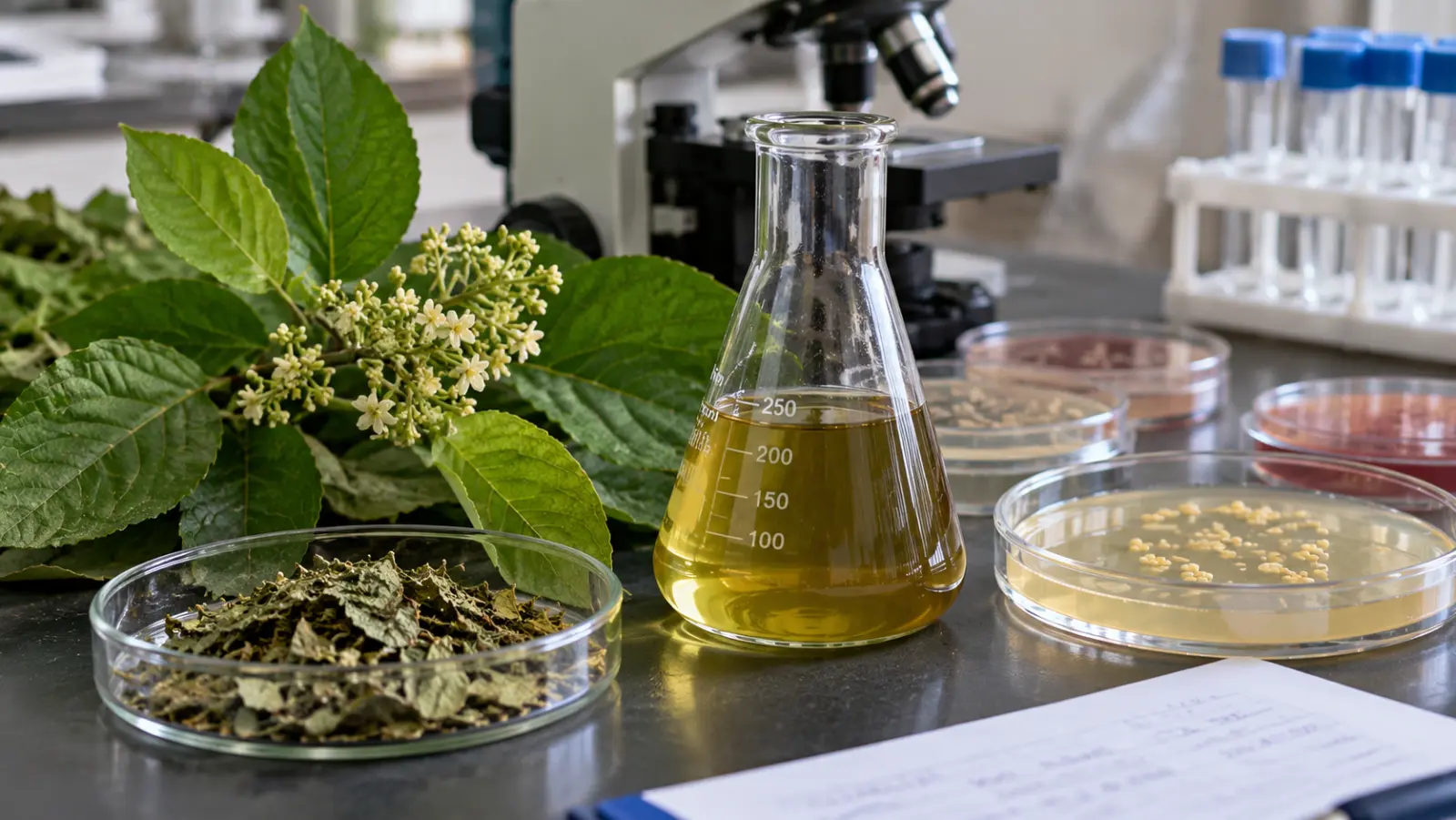
The study begins from the broader use of medicinal plants in the treatment of infectious diseases and applies that context to cariogenic bacteria. Premna latifolia leaves were selected for investigation as plant material that might contain compounds capable of inhibiting bacteria recovered from dental samples. The research question was experimental and laboratory-based.
Rather than testing a finished dental product or treating patients with the plant, the investigators prepared leaf extracts and examined their activity against bacterial isolates obtained from cariogenic samples. The findings therefore concern extract-level antibacterial activity under laboratory conditions, not demonstrated treatment of dental caries.
Why Laboratory Antibacterial Activity Does Not Prove Dental Benefits
Dental caries develops through interactions among oral microorganisms, fermentable carbohydrates, tooth surfaces and time. Certain bacteria contribute to acid production within dental plaque, which can favor the loss of minerals from tooth enamel. An extract that suppresses bacterial growth in a laboratory assay is therefore of scientific interest, but such an assay captures only one component of the complex oral environment. The study examined a possible starting point for research rather than a complete strategy for preventing tooth decay.
The distinction between antibacterial screening and disease prevention is essential. A plant preparation may inhibit a cultured organism yet behave differently in saliva, dental plaque or a formulated oral-care product. Contact time, chemical stability and interaction with other microorganisms can all influence performance outside the laboratory. None of those factors was established by the reported tests, so the observed activity is best interpreted as an early experimental finding.
How Five Solvents Were Used to Prepare Leaf Extracts
The leaves were extracted using five solvents: water, methanol, ethanol, chloroform and hexane. Using chemically different solvents allowed the investigators to obtain extracts with potentially different mixtures of plant constituents.
After preparation, the extracts underwent preliminary phytochemical analysis. The researchers performed preliminary phytochemical screening of the extracts before selecting the methanolic preparation for further antibacterial testing.
Table 1. Solvents Used to Prepare Premna latifolia Leaf Extracts
Solvent | Role reported in the study |
Water | Leaf extract prepared for preliminary screening |
Methanol | Extract showed the broadest range of detected phytochemical constituents and was selected for further testing. |
Ethanol | Leaf extract prepared for preliminary screening |
Chloroform | Leaf extract prepared for preliminary screening |
Hexane | Leaf extract prepared for preliminary screening |
Extraction is a preliminary step that separates soluble plant constituents from the leaf material. Because water, alcohols and less polar solvents dissolve different groups of chemicals, comparing extracts can help researchers decide which preparation warrants closer examination. The presence of a constituent in a screening test, however, does not establish its concentration, purity or biological role. Further analysis would be required to characterize individual substances in the selected extract.
The five-solvent approach was a screening design, not a comparison of clinically usable mouthwashes or dental medicines. In particular, the selection of a methanolic laboratory extract should not be understood as an instruction to prepare or apply methanol-containing products. Methanol is a laboratory solvent with important safety hazards. The research evaluated bacterial responses under controlled conditions and did not test an oral-care formulation intended for human use.
Why the Methanolic Premna latifolia Extract Was Selected
Among the solvent extracts, the methanolic leaf extract showed the maximum phytochemicals in the preliminary analysis. On that basis, the researchers selected it for the subsequent antibacterial investigation. Selection of the methanolic extract followed phytochemical screening rather than a finding that methanol itself was antibacterial.
The screening identified the methanolic extract as the most promising preparation for further testing, although the individual compounds responsible for antibacterial activity were not established.
The finding of a broader range of phytochemical signals helps explain the choice of material for the next experiment, but it does not prove that a greater number of detected compounds necessarily produces stronger antibacterial effects. Different constituents may contribute, interfere with one another or be inactive in the test. A follow-up investigation could compare chemically standardized fractions and examine whether the inhibitory response can be linked to identifiable compounds rather than to the crude mixture as a whole.
What Was Recovered From the Twenty-Five Dental Patient Samples
Cariogenic samples were collected from 25 dental patients, yielding 32 bacterial isolates belonging to five Streptococcus species. The published summary does not identify the individual species or their distribution among isolates. Detailed patient characteristics and sampling locations were not reported.
Table 2. Cariogenic Sampling and Bacterial Recovery
Study element | Reported result |
Dental patients sampled | 25 |
Bacterial isolates recovered | 32 |
Bacterial grouping | Five different Streptococcus species |
Species names | Not specified |
Isolates per species | Not specified |
The patient samples provided a source of bacteria associated with dental disease, while the subsequent inhibition testing took place outside the human body. The numbers 25 and 32 describe different units: patients sampled and bacterial isolates recovered. They should not be treated as the number of independent treatment responses or as evidence that a clinical intervention benefited 32 people. The report also does not establish whether all isolates responded identically to the extract.
Because the individual Streptococcus species and their distribution are not detailed in the summarized findings, species-specific comparisons cannot be made reliably. The broader label Streptococcus covers organisms with different ecological roles in the mouth. Establishing species identity and susceptibility profiles would help determine how widely the observed inhibitory response applies. The present findings support a general laboratory observation across the five species tested, without resolving those finer distinctions.
How the Methanolic Extract Affected the Five Bacterial Species
The methanolic extract of Premna latifolia leaves inhibited all five bacterial species selected for testing. The inhibitory effect increased with extract concentration, demonstrating a dose-dependent antibacterial response.
The reported findings establish a dose-dependent inhibitory response, although exact concentrations, inhibition-zone measurements and minimum inhibitory concentrations were not specified.
A dose-dependent response means that greater tested extract concentrations were associated with stronger inhibition under the assay conditions. This pattern supports the interpretation that the extract had measurable biological activity, but it does not by itself identify the mechanism responsible. The result also cannot establish an effective dose for a person, because a concentration used in a culture experiment is not equivalent to a safe or useful clinical exposure.
Quantitative measures such as minimum inhibitory concentration, inhibition-zone diameter and repeat-test variability would be important for comparing this preparation with other antibacterial candidates. Without those measurements, the direction of the response can be described, but its relative strength cannot be ranked confidently against established dental agents. The evidence therefore supports further controlled testing rather than a claim of therapeutic effectiveness.
What the Phytochemical Screening Can and Cannot Establish
Preliminary phytochemical analysis showed various active principles in the leaf extracts, with the methanolic extract showing the maximum phytochemicals. This supplied the rationale for choosing the methanolic preparation for antibacterial testing.
Preliminary phytochemical detection is not the same as identifying the compound responsible for bacterial inhibition. The antibacterial activity was demonstrated using the crude methanolic extract rather than purified or individually characterized compounds.
Table 3. Evidence Reported for the Methanolic Leaf Extract
Evidence step | Study findings |
Phytochemical screen | Methanolic extract showed maximum phytochemicals |
Reason for selection | Chosen for further investigation |
Test organisms | Five Streptococcus species from cariogenic samples |
Antibacterial result | Dose-dependent inhibition of all five species tested |
Exact inhibition values | Not reported |
Clinical efficacy | Not evaluated |
Phytochemical screening is useful for identifying broad categories of substances that may be present in a plant extract. It is not equivalent to chemical structure determination or a demonstration of how a specific molecule acts on bacterial cells. Researchers would need fractionation, compound identification and additional bioassays to determine which constituents account for the observed inhibition. Repeating experiments with purified fractions would also help distinguish consistent antibacterial effects from variation between extract batches.
Why the Findings Do Not Yet Demonstrate a Dental Treatment
Although the bacterial isolates originated from dental patients, antibacterial activity was evaluated under laboratory conditions rather than through clinical treatment. The study did not report administering Premna latifolia extract to patients, measuring caries outcomes after treatment or comparing a plant-based dental product with standard care.
For that reason, laboratory inhibition should not be equated with demonstrated clinical efficacy. The study did not establish human safety, clinical treatment outcomes or an effective therapeutic dosage.
Clinical usefulness requires evidence beyond the suppression of bacterial growth in a dish. A proposed dental intervention must be assessed for safety in the mouth, compatibility with oral tissues, effects on the wider oral microbiome and meaningful outcomes such as changes in plaque or caries incidence. The 2015 experiment did not evaluate those outcomes. It also did not compare an extract-based intervention with fluoride-based prevention, professional dental care or established antimicrobial products.
The study offers no basis for selecting a human dosage, frequency of application or treatment duration. Extract composition can vary with plant material and processing, and solvents used for laboratory extraction may not be suitable for human exposure. For readers, the relevant conclusion is that a plant extract showed preliminary laboratory activity, not that chewing leaves, preparing a rinse or replacing dental treatment has been shown to prevent or cure tooth decay.
What the 2015 Study Contributes to Medicinal-Plant Research
The study provides a compact sequence of evidence: multiple solvent extracts were prepared, preliminary phytochemical screening was performed, the methanolic extract was selected, cariogenic bacterial isolates were recovered from dental samples, and the selected extract was tested against five Streptococcus species.
The most important reported result is dose-dependent inhibition by the methanolic leaf extract. The findings provide preliminary laboratory evidence of antibacterial activity and support further chemical and microbiological investigation before potential dental applications can be evaluated.
Further Research Needed to Evaluate Premna latifolia Antibacterial Potential
The work illustrates how an exploratory natural-product study can move from plant selection to chemical screening and then to microbiological testing. Each stage answers a narrower question than a clinical trial. Solvent extraction identifies preparations for analysis, phytochemical screening indicates classes of constituents, and culture assays reveal whether bacterial growth changes under defined conditions. Taken together, these steps help prioritize candidates for additional research without establishing a finished medicine.
A stronger evidence pathway would include identification of active fractions, standardized preparation methods, reproducibility across bacterial isolates and testing under conditions that better represent the oral environment. Toxicity studies and appropriately designed clinical investigations would be necessary before claims about prevention or treatment could be supported. The value of the 2015 findings lies in identifying a testable hypothesis and documenting an initial antibacterial signal.
Practical takeaway: Modilal, Anandan and Logeshwari investigated Premna latifolia leaves as a potential source of antibacterial compounds against cariogenic bacteria. Five solvents were used to prepare leaf extracts, and preliminary phytochemical screening led to the selection of the methanolic preparation. Samples from 25 dental patients yielded 32 bacterial isolates belonging to five Streptococcus species. The selected extract inhibited all five species in a dose-dependent manner. These laboratory findings support further investigation, although the active compounds, precise inhibitory concentrations and clinical effectiveness remain undetermined.
Frequently asked questions
Can Premna latifolia help prevent tooth decay?
Premna latifolia leaf extracts have been examined in laboratory tests against bacteria associated with dental caries. In a 2015 study, a methanolic extract inhibited five Streptococcus species, with stronger inhibition at higher tested concentrations. This does not establish that the plant prevents cavities in people or can replace established dental care.
Which Premna latifolia leaf extract showed antibacterial activity?
Researchers prepared Premna latifolia leaf extracts using water, methanol, ethanol, chloroform and hexane. Preliminary phytochemical screening led them to select the methanolic extract for further investigation. That preparation inhibited the five bacterial species tested in the laboratory. The experiment did not establish a safe dental formulation or a recommended method of use.
How was Premna latifolia tested against oral bacteria?
The investigators collected cariogenic samples from 25 dental patients and recovered 32 bacterial isolates belonging to five Streptococcus species. They then tested a selected methanolic leaf extract against the bacterial species under laboratory conditions. The patient samples supplied the organisms; the study did not administer the extract to patients or assess clinical outcomes.
Does Premna latifolia extract cure dental cavities?
No clinical evidence of a cavity cure was established by the 2015 laboratory study. Its main result was dose-dependent inhibition of five Streptococcus species by a methanolic leaf extract. The researchers did not evaluate cavity healing, human safety, treatment dosage or comparisons with standard dental care. Further chemical and clinical research would be required.
Sources
- Modilal MRD, Anandan R, Logeshwari MN. Antibacterial activity of Premna latifolia leaves against isolated cariogenic pathogens. Journal of Experimental Zoology India. 2015;18(1):433–436.
- Kumar A, Tamta ML, Negi N, Chandrasekhar K, Negi DS. Phytochemical investigation and antifeedant activity of Premna latifolia leaves. Natural Product Research. 2011;25(18):1680–1686.
- Salae AW, et al. Ethnomedicinal uses, phytochemistry and pharmacological aspects of the genus Premna: a review. Pharmaceutical Biology. 2018;56(1):158–182.
- Pandey G, Chaudhary V, Yadav S, et al. Wound Healing Activity of Premna latifolia Roxb. Journal of Pharmaceutical Research International. 2014;4(8):929–942.
- Kalaichelvi K, Dhivya SM. Phytochemical screening and antibacterial activity of leaf extract of Martynia annua L. and Premna latifolia Roxb. Journal of Medicinal Plants Studies. 2016;4(4):84–87.
- Monicka Seles J, Jahira Banu, Anandan R, Logeshwari MN, Rajathi D Modilal M. Anticariogenic effect of silver nanoparticles synthesized using Premna latifolia leaves. Indian Journal of Natural Sciences. 2016;6(35):10802–10807.
- Tharakan ST, Neelamkavil SV. Therapeutic potentials of Premna latifolia. Plant Archives. 2018;18(1):496–500.
- Banas JA, Drake DR. Are the mutans streptococci still considered relevant to understanding the microbial etiology of dental caries? BMC Oral Health. 2018;18:129.
- Tzimas K, Antoniadou M, Varzakas T, Voidarou CC. Plant-Derived Compounds: A Promising Tool for Dental Caries Prevention. Current Issues in Molecular Biology. 2024;46(6):5257–5290.

Maya Hartwell — author
Maya writes environment and plant science explainers, with an editorial focus on biodiversity, ecosystems, water quality, environmental pollution, plant biology, invasive plants, natural materials and the use of biological resources in environmental technologi...
Related
State of the World’s Fungi 2018: what the report found

Boletus pinetorum: A Fennoscandian Porcini Taxonomy Case

New Zealand Ferns and Allied Plants: A 1989 Field Guide
Koshihikari rice: marker-assisted heading-date gene transfer

Wild fruit diversity and the origins of cultivated trees
How vermicompost affects growth and flowering in Liatris spicata