














Seed germination and why some seeds fail to sprout
Seed germination is the process that begins when a dry seed takes up water and is completed when the radicle emerges through the surrounding seed tissues, and seeds fail to sprout either because the embryo is dead, because conditions around it are wrong or because the seed is dormant. Of these three causes, dormancy is the least obvious: a living seed in warm, moist soil can still refuse to grow, because its own internal controls have not yet released it.
This explainer follows a seed from imbibition to radicle emergence, sets out what water, oxygen, temperature and light each contribute, and explains the main types of dormancy. It draws on reviews of germination physiology, a widely used dormancy classification, modelling work on temperature and moisture thresholds, and long-term studies of how long buried and stored seeds stay alive.
What is seed germination?
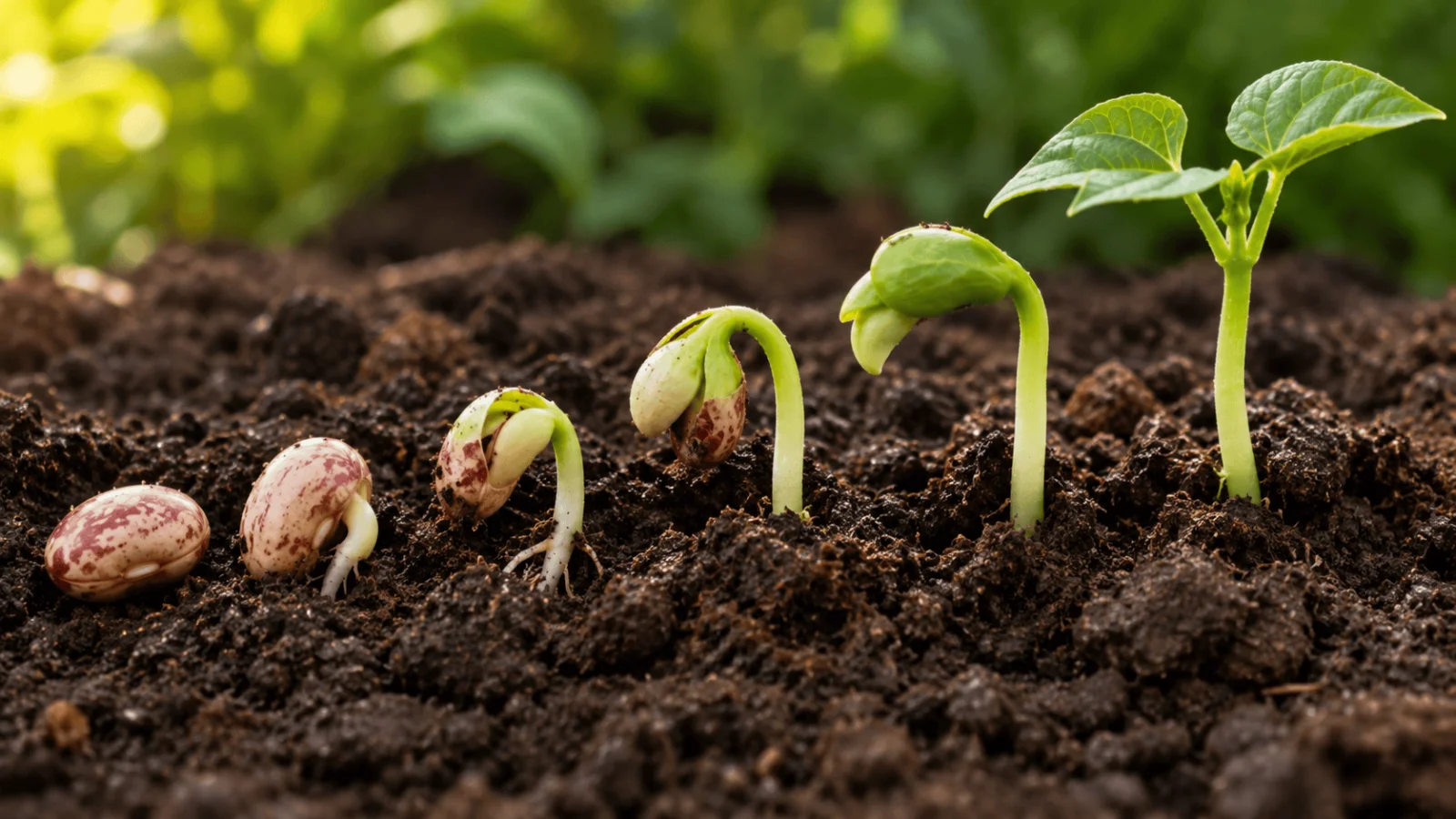
Botanists use the word in a narrower sense than gardeners do. In a review of germination and dormancy, Bewley (1997) defined germination as the events that begin with water uptake by the quiescent dry seed and end with elongation of the embryonic axis, usually the radicle. Everything after that point, from the first lateral roots to green leaves, counts as seedling growth.
The definition has a practical edge. An open textbook from the University of Minnesota uses radicle emergence through the seed coat as the measure of successful germination and points out that water uptake alone does not show a seed is alive (Michaels et al., 2022). Dead seeds swell too, because the first stage of water entry is a physical process rather than a living one.
A mature dry seed can remain viable in either a dormant or a non-dormant state, with metabolic activity greatly reduced until conditions permit germination. Its metabolism runs so slowly that it is barely measurable, and it carries stored reserves of carbohydrate, protein or oil that fuel the embryo until the seedling can photosynthesise. Seed reserves are commonly stored in cotyledons or endosperm, although some species store them in tissues such as the perisperm or hypocotyl.
Epigeal and hypogeal emergence
Once the root is out, seedlings take one of two routes to the surface. In epigeal emergence, typical of the common bean, the stem section below the seed leaves elongates fastest and lifts the cotyledons above the soil. In hypogeal emergence, typical of the pea, growth concentrates above the cotyledons, which stay underground while the shoot pushes up alone (Michaels et al., 2022). The difference matters for sowing depth, because a seedling that must haul its cotyledons through the soil has more work to do.
Not all plant propagation begins with seeds. [Research on Fritillaria imperialis propagation in vitro](/plants/fritillaria-imperialis-in-vitro-propagation-plants) describes how plantlets and bulb structures can be produced in tissue culture. That process is different from germination of a seed embryo.
What happens inside a seed during germination?
Water uptake by a seed follows a recognisable three-phase pattern, which Bewley (1997) used as the framework for describing germination. Each phase has a different character, and the shape of the curve explains several common failures.
- Phase I, imbibition. Dry tissues absorb water rapidly, much as a sponge would. This happens in dead seeds as well as living ones. Cell membranes, disorganised by drying, briefly leak sugars and other solutes into the surrounding water.
- Phase II, the plateau. Water content levels off while metabolism restarts. Respiration resumes, damaged membranes, mitochondria and DNA are repaired, and protein synthesis begins, initially using messenger RNA stored in the seed during its development.
- Phase III, renewed uptake. Phase III begins after germination is complete: once the radicle has emerged, renewed water uptake accompanies postgerminative growth.
The plateau is where the outcome is decided. A seed with physiological dormancy can absorb water and enter phase II without progressing to radicle emergence, while a seed with physical dormancy remains unable to imbibe water until its impermeable covering is disrupted (Bewley, 1997; Baskin and Baskin, 2004). From the outside, a dormant seed, a seed waiting for the right temperature and a dead seed that has merely soaked up water can look identical.
How the root breaks out
To emerge, the radicle has to generate enough pressure to push through whatever encloses it. In many species, that barrier is the endosperm and seed coat, and the tissues in front of the root tip are weakened by enzymes during phase II. Bewley (1997) described germination as a contest between the growth potential of the embryo and the mechanical restraint of the tissues around it. Plant hormones influence both sides of that contest.
What do seeds need to germinate?
Most seeds need water, oxygen and a suitable temperature to germinate, although some species, including rice, can germinate under oxygen-deficient conditions (Alpi and Beevers, 1983). Certain seeds also require light or other environmental signals. The requirements differ between species because each has adapted to the conditions in which its seedlings are most likely to survive.
Water
Water triggers the whole sequence, but how much is available matters as much as whether it is present. Modelling work treats each seed in a population as having a minimum soil water potential below which it cannot complete germination (Bradford, 2002). In drying soil, the seeds with the lowest thresholds germinate first and the rest stall in phase II or wait.
Soil amendments can affect established plants, but that is a separate question from the basic requirements for seed germination. Research on humic substances as plant biostimulants examines plant physiological responses, not proof that seeds can germinate without suitable moisture, oxygen and temperature.
Oxygen
Respiration generally resumes after imbibition, and most germinating seeds require oxygen as well as water, although some species can germinate under oxygen-deficient conditions (Bewley et al., 2013; Alpi and Beevers, 1983). Waterlogged soil and heavy, compacted surfaces both restrict oxygen around the seed. This is one reason seeds sown too deep or into saturated ground can rot or simply fail, even when temperature and moisture appear ideal.
Temperature
Temperature sets the pace. In the hydrothermal time model, germination rate rises as temperature climbs above a base value, up to an optimum, and the time a given fraction of seeds needs to germinate is inversely related to how far conditions exceed that fraction’s threshold (Bradford, 2002). Because thresholds vary among seeds, germination within a batch is often spread over time rather than occurring simultaneously. It spreads over days, with the fastest and slowest seeds sometimes far apart.
Above the optimum, rates fall again, and very high temperatures can push seeds of some species into a secondary dormancy. Cool-season crops such as lettuce and many temperate wildflowers are particularly sensitive to warmth during germination.
Light
Light acts as a switch for many small-seeded species. In a classic study, “A reversible photoreaction controlling seed germination” (1952), Borthwick, Hendricks and colleagues showed that red light promoted germination of lettuce seeds and that a following exposure to far-red light reversed the effect. When seeds received alternating flashes, the last colour in the sequence determined whether they germinated. The pigment behind this response was later identified as phytochrome.
The ecological logic is straightforward. Sunlight filtered through leaves is depleted in red light relative to far-red, so a red-sensitive seed can detect whether it lies under a canopy, buried in soil or exposed in a gap. Small seeds with limited reserves gain the most from this check, because they cannot afford to germinate where their seedlings will never reach light.
Chemical signals from fire
Some seeds respond to chemical cues as well. Smoke from burning vegetation has long been known to stimulate germination in fire-prone floras. Flematti, Ghisalberti, Dixon and Trengove (2004) identified a butenolide in smoke from plants and cellulose that stimulated germination in several species, to levels similar to those produced by plant-derived smoke water. The finding linked a field observation from bushfire ecology to a single identifiable molecule.
Why do some seeds fail to sprout?
Some seeds fail to develop a viable embryo, as studies of [seed abortion in citrus](/plants/nishiuchi-konatsu-self-compatibility-seed-abortion-plants) illustrate. Such developmental failures belong to problems of seed viability rather than representing a separate fourth category. They should also be distinguished from morphological dormancy, in which an underdeveloped but viable embryo must continue growing before germination can occur (Baskin and Baskin, 2004).
Dormancy is not the same as quiescence. Bewley (1997) described a dormant seed as an intact, viable seed that does not complete germination under conditions that would otherwise favour it. In a review of the subject, Finch-Savage and Leubner-Metzger (2006) characterised dormancy as an innate property that defines the environmental conditions in which a seed is able to germinate. It is set partly by genetics and partly by the conditions in which the seed matured, and it keeps changing after the seed is shed.
At the hormonal level, two signals pull in opposite directions. Abscisic acid maintains dormancy, while gibberellins promote germination, and the balance between their production and the seed’s sensitivity to each shapes whether germination proceeds (Finch-Savage and Leubner-Metzger, 2006). Environmental cues such as temperature, light and nitrate act at least partly by shifting this balance. Many seeds also lose dormancy gradually during dry storage, a process called after-ripening.
Five classes of dormancy
Baskin and Baskin (2004) proposed a standard classification of seed dormancy with five classes:
- Physiological dormancy, the most widespread, in which the embryo’s own physiology prevents radicle emergence. It is divided into three levels, from non-deep to deep.
- Morphological dormancy, in which the embryo is underdeveloped at shedding and must grow inside the seed before it can emerge.
- Morphophysiological dormancy, which combines an underdeveloped embryo with a physiological block and is divided into eight levels.
- Physical dormancy, in which water-impermeable layers in the seed or fruit coat prevent water uptake until dormancy is broken.
- Combinational dormancy, which joins a water-impermeable coat with physiological dormancy.
The class explains why a seed fails and what kind of change releases it. A seed with physical dormancy never reaches phase I, because water cannot enter. A seed with physiological dormancy imbibes normally and stalls at the plateau. Treating the two in the same way is one common reason that seeds of wild species or older cultivars fail in trials or gardens.
Wrong conditions
Seeds that are not dormant can still fail if their requirements go unmet. Waterlogging deprives them of oxygen, drying soil halts them part-way through germination, and temperatures near the edges of a species’ germination range can slow germination, while temperatures below the base or above the ceiling temperature can prevent germination altogether (Bradford, 2002; Bewley et al., 2013). Light-requiring seeds sown too deep never receive their signal (Borthwick et al., 1952). In each case, a living, non-dormant seed fails because one factor falls outside its threshold.
Later growth and flowering must also be distinguished from seed germination. For example, research on vermicompost and Liatris spicata growth focuses on responses during plant development, rather than establishing universal conditions for germination or seed viability.
How long can seeds stay alive?
Viability declines with time in every seed population, but the rate varies enormously with species and storage conditions. Two well-documented cases show how far the upper limit can stretch.
In 1879, William James Beal at Michigan State University prepared 20 bottles, each containing 50 seeds of each of 21 species; seeds of two additional plant kinds were buried separately beside the bottles (Telewski and Zeevaart, 2002; Fleming et al., 2023). In the study “The 120-yr period for Dr. Beal’s seed viability experiment” (2002), Telewski and Zeevaart reported the results from the bottle opened in 2000.
After 120 years in moist, well-aerated sand, 23 seeds of Verbascum blattaria and 2 of another Verbascum species germinated, 50% germination for the genus, and a single Malva rotundifolia seed germinated after a 6-week cold treatment. Plants of Verbascum blattaria and Malva rotundifolia produced viable offspring, while the unidentified Verbascum species did not produce seeds (Telewski and Zeevaart, 2002). When the 16th bottle was opened in 2021, 20 Verbascum seeds germinated (Fleming et al., 2023).
A more extreme case came from archaeology. In the study “Germination, genetics, and growth of an ancient date seed” (2008), Sallon and colleagues germinated a date palm seed recovered from excavations at Masada and radiocarbon dated to about 2,000 years old, and the seedling grew into a young palm. A separate [study of Tunisian date palm seed chemistry](/plants/tunisian-date-palm-seeds-chemistry-antioxidant-and-antibacterial-activity) examined seed composition and laboratory bioactivity, not how long ancient seeds remain viable.
Orthodox and recalcitrant seeds
These long-lived examples belong to a group called orthodox seeds, which tolerate substantial drying, while lower moisture and temperature generally extend storage life within species-specific limits. FAO genebank standards recommend drying orthodox seeds at 5–20 °C and 10–25% relative humidity before long-term storage. Base collections are maintained at −18 ± 3 °C, with a recommended relative humidity of 15 ± 3%. Seed accessions should be regenerated when their viability falls below 85% of the initial value or when the remaining seed quantity is insufficient for three sowings of a representative population (FAO, 2014).
Recalcitrant seeds behave differently. They do not tolerate drying to the low moisture contents used for orthodox seeds, nor storage below freezing, so they cannot be kept in conventional seed banks (FAO, 2014). Many tropical trees fall into this group, including cocoa, one of the [plantation crops](/plants/coffee-cocoa-and-tea-cultivation-management-and-production) whose seeds have limited storage life and are best sown soon after collection. For recalcitrant species, excessive drying can kill the seed rather than induce dormancy.
Case | Species | Conditions | Result |
Beal experiment, 120 years (Telewski and Zeevaart, 2002) | Verbascum blattaria, Verbascum sp., Malva rotundifolia | Buried in moist sand in bottles | 50% germination for Verbascum; 1 Malva seed after cold treatment |
Beal experiment, 2021 bottle (Fleming et al., 2023) | Verbascum | Buried in moist sand in bottles | 20 seeds germinated |
Masada date seed (Sallon et al., 2008) | Date palm | Archaeological deposit, about 2,000 years | One seed germinated and grew into a palm |
Genebank base collections (FAO, 2014) | Orthodox seeds | Dried at 5–20 °C and 10–25% RH; stored at −18 ± 3 °C | Regenerated below 85% of initial viability or when seed quantity is insufficient for three sowings. |
What is proven about seed germination, and what is not
The core sequence of germination is well established. Water uptake follows three phases, metabolism and repair restart during the plateau, and germination ends when the radicle emerges (Bewley, 1997). The evidence is also firm on several further points:
- Dormant seeds are viable but unable to complete germination under certain conditions. Seeds with physiological dormancy can absorb water but remain unable to complete germination, while seeds with physical dormancy have water-impermeable coverings that prevent imbibition. Abscisic acid and gibberellins play opposing roles in regulating physiological dormancy and germination (Baskin and Baskin, 2004; Finch-Savage and Leubner-Metzger, 2006).
- Dormancy takes five recognised forms, and the form determines what releases it (Baskin and Baskin, 2004).
- Germination timing depends on how far temperature and moisture exceed each seed’s thresholds, which is why batches germinate unevenly (Bradford, 2002).
- Red and far-red light act as a reversible switch in light-sensitive seeds (Borthwick et al., 1952).
- Some orthodox seeds stay viable for more than a century in the soil, and at least one has germinated after about 2,000 years (Telewski and Zeevaart, 2002; Sallon et al., 2008).
A seed that has swollen with water has not necessarily germinated. Radicle emergence marks the completion of germination, but seed viability can also be assessed using methods such as the tetrazolium test, which detects living tissues without requiring germination (ISTA, 2025).
Several questions remain open. The molecular events that finally commit a seed to growth are still being mapped, and the balance between hormones and the physical resistance of surrounding tissues differs between species. Long-term longevity data exist for only a handful of species, and the Beal experiment covers just one soil and climate. Single exceptional cases, such as the Masada seed, show what is possible rather than what is typical.
For anyone growing crops or raising plants from seed, the research offers a clear diagnostic frame. A seed that does not sprout is dead, held back by water, oxygen, temperature or light, or dormant in one of five ways, and each cause leaves different clues.
Frequently asked questions
How long does it take for a seed to germinate?
There is no single figure. Timing depends on the species, temperature and water potential. Germination generally speeds as temperature rises toward the optimum and water availability becomes more favourable; above the optimum, further warming slows germination (Bradford, 2002). Within one batch, seeds also vary in their thresholds, so some emerge days before others.
What is the difference between germination and sprouting?
In everyday use the words overlap. In plant science, germination ends when the radicle emerges through the surrounding seed tissues (Bewley, 1997), while sprouting usually describes the visible shoot appearing above the soil afterwards. A seed can therefore complete germination underground several days before anything is visible at the surface.
Why do seeds need water to germinate?
Water reactivates a seed that has been almost metabolically inactive. Its uptake allows respiration, membrane and DNA repair and protein synthesis to restart, and later drives the cell expansion that pushes the radicle out (Bewley, 1997). Without enough water, a seed either never begins germination or stalls part-way through it.
What does germination rate mean?
The term germination rate can refer to different measurements. Germination percentage describes the proportion of seeds that germinate under specified conditions, while germination speed measures how quickly they germinate. These measurements should be distinguished to avoid confusion, as a batch can germinate slowly but still achieve a high final percentage.
Sources
- Bewley, J.D. Seed germination and dormancy. The Plant Cell, 1997, 9(7), 1055–1066. DOI 10.1105/tpc.9.7.1055
- Finch-Savage, W.E., Leubner-Metzger, G. Seed dormancy and the control of germination. New Phytologist, 2006, 171(3), 501–523. DOI 10.1111/j.1469-8137.2006.01787.x
- Michaels, T., Clark, M., Hoover, E., Irish, L., Smith, A., Tepe, E. The Science of Plants: Understanding Plants and How They Grow. Chapter 2.2, Introduction to seed germination. University of Minnesota Libraries Publishing, 2022.
- Bewley, J.D., Bradford, K.J., Hilhorst, H.W.M., Nonogaki, H. Seeds: Physiology of Development, Germination and Dormancy, 3rd edition. Springer, New York, 2013. DOI 10.1007/978-1-4614-4693-4
- Baskin, J.M., Baskin, C.C. A classification system for seed dormancy. Seed Science Research, 2004, 14(1), 1–16. DOI 10.1079/SSR2003150
- Bradford, K.J. Applications of hydrothermal time to quantifying and modeling seed germination and dormancy. Weed Science, 2002, 50(2), 248–260. DOI 10.1614/0043-1745(2002)050[0248:AOHTTQ]2.0.CO;2
- Borthwick, H.A., Hendricks, S.B., Parker, M.W., Toole, E.H., Toole, V.K. A reversible photoreaction controlling seed germination. Proceedings of the National Academy of Sciences of the USA, 1952, 38(8), 662–666. DOI 10.1073/pnas.38.8.662
- Flematti, G.R., Ghisalberti, E.L., Dixon, K.W., Trengove, R.D. A compound from smoke that promotes seed germination. Science, 2004, 305(5686), 977. DOI 10.1126/science.1099944
- Telewski, F.W., Zeevaart, J.A.D. The 120-yr period for Dr. Beal’s seed viability experiment. American Journal of Botany, 2002, 89(8), 1285–1288. DOI 10.3732/ajb.89.8.1285
- Sallon, S., Solowey, E., Cohen, Y., Korchinsky, R., Egli, M., Woodhatch, I., Simchoni, O., Kislev, M. Germination, genetics, and growth of an ancient date seed. Science, 2008, 320(5882), 1464. DOI 10.1126/science.1153600
- FAO. Genebank Standards for Plant Genetic Resources for Food and Agriculture, revised edition. Food and Agriculture Organization of the United Nations, Rome, 2014.
- Fleming MB, Stanley L, Zallen R, et al. The 141-year period for Dr. Beal's seed viability experiment: A hybrid surprise. American Journal of Botany. 2023;110(11):e16250. DOI: 10.1002/ajb2.16250.
- Alpi, A., Beevers, H. Effects of O₂ Concentration on Rice Seedlings. Plant Physiology, 1983, 71(1), 30–34. DOI 10.1104/pp.71.1.30.
- International Seed Testing Association (ISTA). International Rules for Seed Testing 2025. Chapter 6: Biochemical test for viability - the topographical tetrazolium test. ISTA, 2025. https://www.seedtest.org/en/publications/international-rules-seed-testing.html

Maya Hartwell — author
Maya writes environment and plant science explainers, with an editorial focus on biodiversity, ecosystems, water quality, environmental pollution, plant biology, invasive plants, natural materials and the use of biological resources in environmental technologi...
Related
How Tunisian Date Palm Seeds Differ in Chemistry and Bioactivity
‘Nishiuchi Konatsu’: self-compatibility and seed abortion
Fritillaria imperialis: In Vitro Propagation and Bulb Formation
Coffee, Cocoa and Tea: Cultivation, Management and Production
Humic Substances as Plant Biostimulants: What They Can Do
How vermicompost affects growth and flowering in Liatris spicata
Nitrogen fixation and how legumes and soil bacteria feed plants