






‘Nishiuchi Konatsu’: self-compatibility and seed abortion
‘Nishiuchi Konatsu’, a bud mutation of the self-incompatible citrus Hyuganatsu, can set fruit after self-pollination while its pollen also causes many developing seeds to abort. The 2009 controlled-pollination study that first defined this combination showed that crossing direction mattered: Hyuganatsu accepted ‘Nishiuchi Konatsu’ pollen, but the reciprocal cross failed as young fruit dropped within 10 weeks. Later work changed the mechanistic interpretation by showing that ‘Nishiuchi Konatsu’ produces unreduced, or 2n, pollen, which can bypass normal self-incompatibility and often creates ploidy combinations in the seed that do not develop normally.
This explainer follows the evidence from the original pollination experiment through later pollen, ploidy and genotyping studies. It separates the demonstrated traits—self-compatibility, 2n pollen production and parent-dependent seed abortion—from broader possibilities for breeding. The findings make ‘Nishiuchi Konatsu’ a useful genetic resource, but they do not show that its pollen will make every citrus cross seedless or that fruit quality is unaffected in every seed parent.
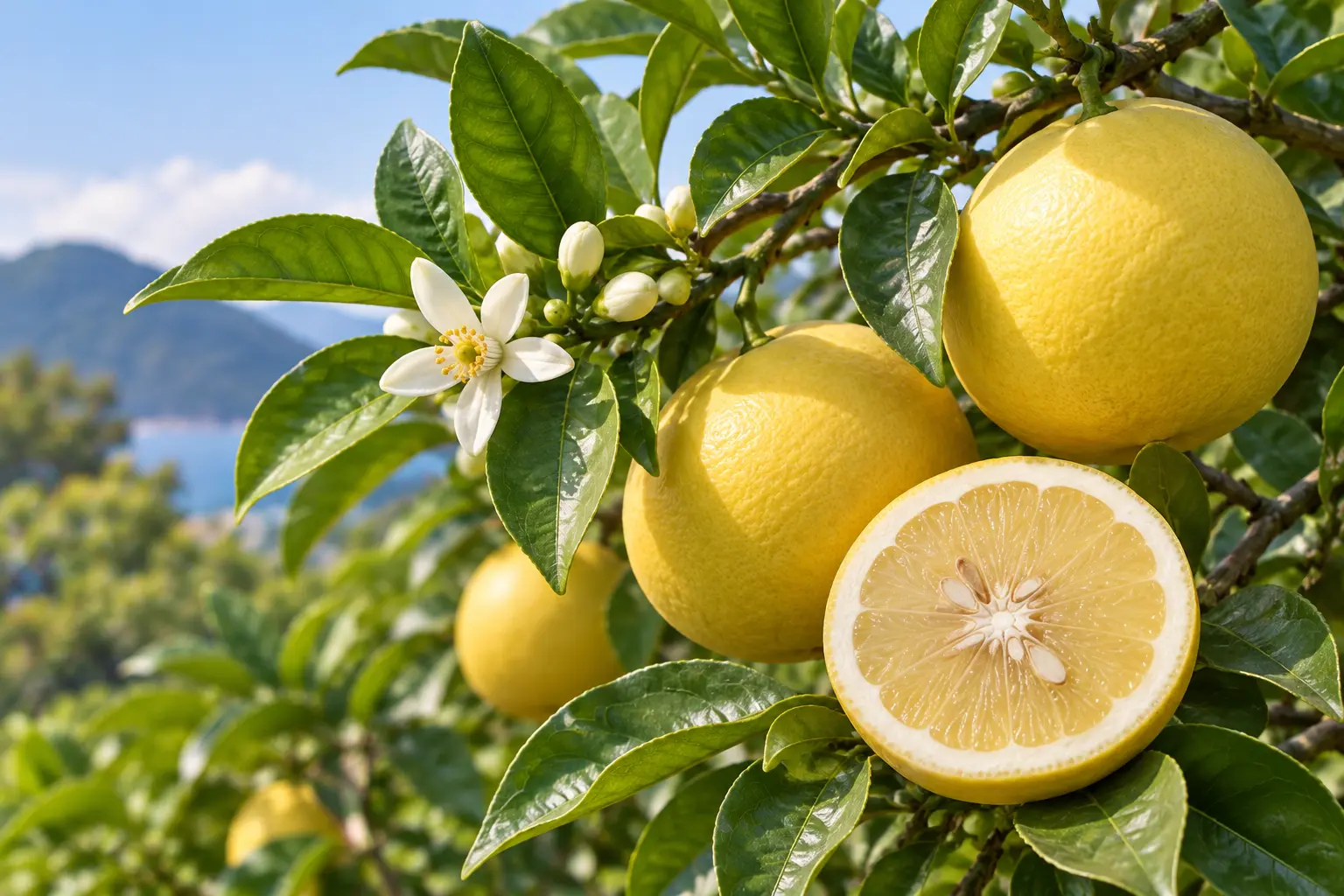
Why this bud mutation matters
Hyuganatsu (Citrus tamurana hort. ex Tanaka) is a late-season Japanese citrus with strong self-incompatibility and low natural parthenocarpy. Its trees generally require compatible pollen for reliable fruit set, which usually produces seeded fruit. ‘Nishiuchi Konatsu’, a bud mutation of Hyuganatsu, altered this reproductive pattern without becoming sterile. Before the 2009 study, it was already known to set fruit in single-cultivar orchards and contain few normal seeds. Researchers therefore investigated both its self-compatibility and pollen behavior across different maternal genetic backgrounds.
The 2009 experiment compared controlled crosses among Hyuganatsu, ‘Nishiuchi Konatsu’, Hassaku and ‘Sweet Spring’. All four were monoembryonic, allowing seed development to be tracked without nucellar embryos. Researchers emasculated, hand-pollinated and bagged flowers, monitoring fruit set and growth through harvest. Testing pollen across different seed parents distinguished successful fruit retention from normal seed development. Some compatible crosses produced fruit, but abnormal embryo or endosperm development subsequently caused seed abortion rather than fertilization failure.
- Self-pollination can produce mature ‘Nishiuchi Konatsu’ fruit, unlike ordinary Hyuganatsu.
- The reciprocal Hyuganatsu/‘Nishiuchi Konatsu’ crosses are asymmetric rather than equivalent.
- ‘Nishiuchi Konatsu’ pollen strongly reduces normal seed formation in some seed parents.
- Later studies show that part of its pollen is unreduced 2n pollen rather than ordinary haploid pollen.
- The strength of seed abortion and any fruit-quality effects depend on the maternal cultivar.
What the 2009 pollination experiment actually showed
Crossing direction mattered
As the seed parent, ‘Nishiuchi Konatsu’ produced fruit with both Hassaku pollen and self-pollen, confirming experimental self-compatibility. Hyuganatsu pollen, however, caused all developing fruits to drop within 10 weeks, leaving none at harvest. The reciprocal cross succeeded: Hyuganatsu set fruit with ‘Nishiuchi Konatsu’ pollen. In 2009, researchers attributed this asymmetry to a possible change in a pollen-expressed self-incompatibility component. Subsequent studies instead linked the behavior more closely to unreduced pollen and its interaction with gametophytic self-incompatibility.
Seed abortion depended on the seed parent
‘Nishiuchi Konatsu’ pollen caused extensive seed abortion, with almost no normal seeds in Hyuganatsu and ‘Nishiuchi Konatsu’ fruits. Hassaku and ‘Sweet Spring’ also developed fewer normal seeds, although the effect was weaker. In Hassaku, aborted-seed proportions ranged from 0.51 to 0.92, compared with approximately 0.05 after Hyuganatsu pollination. Because the trees were clonal, genetic differences between individual plants could not readily explain this variation. The results suggested complex interactions between pollen and maternal tissues during seed development.
Seed parent | Pollen comparison | Fruit-set response | Seed outcome with ‘Nishiuchi Konatsu’ pollen |
Hyuganatsu | ‘Nishiuchi Konatsu’ vs Hassaku | Fruit set with both pollen sources | Normal seeds almost absent; many aborted seeds |
‘Nishiuchi Konatsu’ | Self vs Hyuganatsu vs Hassaku | Self and Hassaku set fruit; Hyuganatsu cross dropped by 10 weeks | Selfed fruit contained mostly aborted seeds |
Hassaku | ‘Nishiuchi Konatsu’ vs Hyuganatsu | Fruit set with both sources | Normal seeds reduced; aborted-seed proportion varied strongly among fruits |
‘Sweet Spring’ | ‘Nishiuchi Konatsu’ vs Hyuganatsu | Fruit set with both sources | Normal seeds reduced, but effect was weaker than in Hyuganatsu |
Fruit size and composition did not track seed number in a simple universal way. For Hyuganatsu, ‘Nishiuchi Konatsu’ and Hassaku, most measured harvest traits—fruit weight, dimensions, soluble solids and acidity—were not significantly different between pollen sources, although there were a few exceptions. ‘Sweet Spring’ was different: fruit produced with Hyuganatsu pollen performed better across the measured traits than fruit produced with ‘Nishiuchi Konatsu’ pollen. That result is a useful caution for breeding. A pollen source that lowers seed number can also have parent-specific effects on fruit development, so seed reduction cannot be evaluated separately from fruit set, size and quality.
From an unusual pollen phenotype to a clearer mechanism
Giant pollen revealed unreduced gametes
A 2012 study examined pollen characteristics and progeny ploidy, identifying giant ‘Nishiuchi Konatsu’ pollen grains measuring 42–44 μm, compared with the 33.4 μm mean diameter of ordinary Hyuganatsu pollen. Flow cytometry of progeny supported the presence of functional unreduced 2n pollen, which retains the somatic chromosome complement instead of undergoing normal meiotic reduction. This shifted the explanation beyond altered pollen recognition to include sexual polyploidization through unreduced gametes.
Genotyping points to first-division restitution
In 2016, single-pollen genotyping at six heterozygous loci found heterozygosity transmission above 50% at every locus, supporting first-division restitution over second-division restitution. A 2022 study of tetraploid embryos and hexaploid endosperm provided further evidence that first-division restitution is the dominant route for 2n pollen formation. Rare unreduced female gametes arose through both mechanisms, without one clearly dominating. For breeding, first-division restitution is important because it can preserve more parental heterozygosity near centromeres than ordinary reduced gametes.
The key feature is not simply self-fertility: the same unreduced pollen that can bypass incompatibility can also make normal seed development less likely.
Why 2n pollen can permit selfing yet disrupt seed development
Citrus self-incompatibility operates through an S-RNase-based gametophytic recognition system in which pistils reject pollen according to S identity. A 2023 synthesis describes how unreduced ‘Nishiuchi Konatsu’ pollen can overcome this rejection through competitive interaction. Carrying two chromosome sets with different S-haplotypes can disrupt normal pollen recognition. Unlike citrus lineages that become self-compatible through S-RNase loss or suppression, ‘Nishiuchi Konatsu’ demonstrates a ploidy-associated route to compatibility.
Unreduced 2n pollen also explains why fruit can develop while seeds abort. Fertilization of a haploid egg by 2n pollen produces a triploid embryo and changes the parental genome balance in the endosperm, potentially causing a triploid block. A 2015 study found that seeds from Hyuganatsu × ‘Nishiuchi Konatsu’ and selfed ‘Nishiuchi Konatsu’ were smaller than controls around 10–12 weeks after pollination, while selfed embryos arrested by approximately 10 weeks. Embryo rescue recovered some triploid plantlets, confirming that fertilization could occur despite subsequent seed-development failure.
How the explanation has developed since 2009
Study | Evidence added | Key result | Interpretive value |
Honsho et al. 2009 | Controlled pollination among four citrus accessions | Selfing set fruit; pollen caused parent-dependent seed abortion | Defined the reproductive phenotype and crossing asymmetry |
Honsho et al. 2012 | Pollen size, viability, pollen tubes and progeny ploidy | Giant 42–44 μm pollen and polyploid progeny indicated functional 2n pollen | Shifted the model from a simple recognition mutation toward unreduced gametes |
Honsho et al. 2015 | Seed and embryo development plus embryo rescue | Abortion emerged around 10–12 weeks; some triploid plantlets were rescued | Showed post-fertilization failure and recoverable triploid embryos |
Honsho et al. 2016 | Single-pollen genotyping at six loci | Heterozygosity transmission >50%; FDR model fitted best | Identified first-division restitution as the main 2n-pollen route |
Honsho et al. 2021 | Transcriptomic, phylogenetic and genetic analysis of Japanese citrus | T2/S-RNase genes tracked S haplotypes and self-incompatibility | Placed Hyuganatsu within an S-RNase-based citrus SI framework |
Honsho et al. 2022 | Genotyping of 4x embryos and 6x endosperm | FDR dominated unreduced pollen; unreduced eggs arose by both FDR and SDR | Confirmed the pollen mechanism using embryo/endosperm genotypes |
Honsho 2023 | Review integrating citrus SI and seedlessness evidence | Competitive interaction and triploid block explain the ‘Nishiuchi Konatsu’ phenotype | Provides the current synthesis of compatibility and seed abortion |
The timeline shows why the interpretation of the 2009 cross should not be frozen at the first hypothesis. The original pollen-side mutation idea was based on crossing direction and was useful because it localized the unusual behavior to the male function. Morphology and progeny ploidy then revealed 2n pollen, single-pollen genotyping identified first-division restitution, and later embryo/endosperm genotyping strengthened that conclusion. In parallel, molecular studies of citrus self-incompatibility established S-RNase-based recognition across Japanese and Chinese citrus accessions. The result is a layered model: ‘Nishiuchi Konatsu’ is self-compatible in part because unreduced pollen changes the compatibility interaction, and it is low-seeded because the ploidy consequences of fertilization frequently impair normal seed development.
What this means for citrus breeding
The most immediate breeding value is not that ‘Nishiuchi Konatsu’ is a universal seedless-fruit tool, but that it combines functional pollen, self-compatibility and a strong tendency toward post-fertilization seed abortion. Functional 2n pollen can be used for sexual polyploidization, a route used in citrus breeding to create triploid progeny. Triploid citrus is often attractive because irregular meiosis can reduce seed formation in the resulting cultivars. First-division restitution may also transmit a relatively high proportion of parental heterozygosity, allowing breeders to carry more of a selected diploid parent’s allele combinations into polyploid progeny. Those advantages make ‘Nishiuchi Konatsu’ informative both as breeding material and as a system for studying how reproductive barriers can be bypassed.
- Confirm the frequency, viability and ploidy of pollen under the orchard or breeding conditions being used.
- Test reciprocal crosses, because maternal and paternal roles can produce sharply different fruit-set outcomes.
- Score normal, aborted and undeveloped seeds through development rather than only counting mature seeds at harvest.
- Determine embryo and progeny ploidy so seed abortion and useful polyploid offspring are not treated as the same outcome.
- Measure fruit set, size, soluble solids and acidity alongside seed number, since pollen effects can be cultivar-specific.
The maternal genotype is especially important. Hyuganatsu and ‘Nishiuchi Konatsu’ showed near-complete loss of normal seeds with ‘Nishiuchi Konatsu’ pollen in the 2009 experiment, whereas Hassaku retained some normal seeds and varied widely among fruits, and ‘Sweet Spring’ retained still more. That means breeding programs cannot assume a fixed abortion rate from the pollen donor alone. The seed parent influences whether a fertilized ovule continues development, aborts, or occasionally produces a viable polyploid seed. This is also why embryo rescue remains relevant: an aborting triploid embryo can be genetically valuable even when it would not mature unaided.
What the evidence does not yet establish
The evidence is strong for the reproductive phenotype and for the production of 2n pollen, but it is narrower than a field-performance dossier for a finished cultivar. The original 2009 work tested controlled crosses on a limited set of citrus accessions and measured one main pollination season, with one Hyuganatsu × Hassaku combination repeated because too few fruits were obtained in 2007. Later studies concentrated on cytology, ploidy, embryo development and genetic mechanisms rather than multi-location yield, storage or consumer trials. Therefore, it would be inappropriate to infer that ‘Nishiuchi Konatsu’ pollen will reliably improve marketable yield in any orchard or that lower seed number always comes without trade-offs.
There is also more than one route from self-incompatibility to self-compatibility in citrus. Modern studies have identified a loss-of-function Sₘ-RNase allele in mandarin-derived citrus, down-regulation of S-RNase in self-compatible pummelo material, and transposable-element insertions that can suppress S-RNase expression. Those mechanisms show that the phenotype “self-compatible” should not be treated as a single genetic category. In ‘Nishiuchi Konatsu’, the evidence summarized in the 2023 review specifically highlights unreduced pollen and competitive interaction, coupled with a triploid block after fertilization. That makes the cultivar particularly useful for comparing a ploidy-based route with S-locus mutations found elsewhere in citrus.
What the findings mean
‘Nishiuchi Konatsu’ is a rare example in which a bud mutation altered two economically important reproductive outcomes at once: it can set fruit after self-pollination, and its pollen frequently reduces normal seed formation. The 2009 experiment established the crossing and seed-abortion phenotype; later studies showed that unreduced 2n pollen, formed mainly through first-division restitution, is central to the explanation. When that pollen fertilizes normal haploid eggs, triploid embryos can form but often fail during seed development, producing the low-seeded phenotype. The effect is not uniform across maternal cultivars, so it is best understood as a genotype-dependent breeding resource rather than a universal seedlessness factor. Its scientific value is equally important: it links self-incompatibility, meiotic restitution, polyploidization and seed abortion in one tractable citrus system.
Frequently asked questions
What is ‘Nishiuchi Konatsu’?
‘Nishiuchi Konatsu’ is a bud mutation of Hyuganatsu, a Japanese citrus known for strong self-incompatibility. Unlike ordinary Hyuganatsu, it can set fruit after self-pollination and usually develops few normal seeds. Research has linked these traits to its production of functional unreduced, or 2n, pollen.
Why is ‘Nishiuchi Konatsu’ self-compatible?
Later studies indicate that self-compatibility is closely associated with unreduced 2n pollen. A 2023 review explains that the extra chromosome set can disrupt the normal gametophytic self-incompatibility reaction through competitive interaction. This is different from self-compatible citrus in which an S-RNase gene is mutated or suppressed.
Does ‘Nishiuchi Konatsu’ always produce seedless fruit?
No. It is better described as low-seeded because many seeds abort after fertilization, but some normal seeds can still form. The effect also depends on the seed parent. Hyuganatsu and ‘Nishiuchi Konatsu’ showed very strong abortion, while Hassaku and ‘Sweet Spring’ retained more normal seeds.
What is unreduced 2n pollen?
Normal pollen is haploid, carrying one chromosome set after meiosis. Unreduced 2n pollen retains the diploid chromosome number because chromosome reduction fails. In ‘Nishiuchi Konatsu’, genotyping indicates that first-division restitution is the dominant formation route, which can preserve substantial parental heterozygosity in the pollen.
Why is this cultivar useful for citrus breeding?
Its 2n pollen can support sexual polyploidization, including production of triploid progeny, while its seed-abortion trait provides a model for developing low-seeded fruit. Breeders still need cross-specific testing because fruit set, seed abortion and fruit quality depend on the maternal cultivar and the particular reproductive combination.
Sources
- Honsho C, Kotsubo M, Fukuda Y, Hamabata Y, Kurogi Y, Nishiwaki A, Tetsumura T. Reproductive characteristics for self-compatibility and seedlessness in ‘Nishiuchi Konatsu’, a bud mutation of Hyuganatsu (Citrus tamurana hort. ex Tanaka). HortScience. 2009;44(6):1547–1551.
- Honsho C, Yamamura E, Tsuruta K, Yoshimaru Y, Yasuda K, Uchida A, Kunitake H, Tetsumura T. Unreduced 2n pollen production in ‘Nishiuchi Konatsu’ Hyuganatsu as inferred by pollen characteristics and progeny ploidy level. J Jpn Soc Hortic Sci. 2012;81(1):19–26.
- Honsho C, Tsuruta K, Ryuto K, Sakata A, Kuroki S, Nishiwaki A, Tetsumura T. Characterization of seed and embryo abortion during fruit development in citrus cultivars pollinated by ‘Nishiuchi Konatsu’ and a preliminary trial of embryo rescue in aborting embryos. Acta Hortic. 2015;1065:181–186.
- Honsho C, Sakata A, Tanaka H, Ishimura S, Tetsumura T. Single-pollen genotyping to estimate mode of unreduced pollen formation in Citrus tamurana cv. Nishiuchi Konatsu. Plant Reprod. 2016;29:189–197.
- Liang M, Cao Z, Zhu A, et al. Evolution of self-compatibility by a mutant Sₘ-RNase in citrus. Nat Plants. 2020;6:131–142.
- Honsho C, Ushijima K, Anraku M, Ishimura S, Yu Q, Gmitter FG Jr, Tetsumura T. Association of T2/S-RNase with self-incompatibility of Japanese citrus accessions examined by transcriptomic, phylogenetic, and genetic approaches. Front Plant Sci. 2021;12:638321.
- Hu J, Xu Q, Liu C, et al. Downregulated expression of S2-RNase attenuates self-incompatibility in ‘Guiyou No. 1’ pummelo. Hortic Res. 2021;8:199.
- Honsho C, Sakamoto R, Ishimura S, Tetsumura T. Estimating the mode of unreduced gamete formation in Citrus tamurana hort. ex Tanaka by fine genotyping of 4x embryos and 6x endosperms. Hortic J. 2022;91(3):286–295.
- Honsho C. Self-incompatibility related to seedless fruit production in Citrus plants. Hortic J. 2023;92(1):1–12.
- Hu J, Liu C, Du Z, et al. Transposable elements cause the loss of self-incompatibility in citrus. Plant Biotechnol J. 2024;22(5):1113–1131.

Sophie Bennett — author
Sophie writes the health and nutrition explainers. Her editorial focus includes nutrients, dietary patterns, energy metabolism, hydration, supplements, sports nutrition and the interpretation of health research for general readers. She approaches health conten...
Related
Humic Substances as Plant Biostimulants: What They Can Do
Fritillaria imperialis: In Vitro Propagation and Bulb Formation
Mangosteen in the United States: Cultivation, Imports and Marketing
How to Grow Hydnophytum and Myrmecodia Ant-Plants
