Can Alsike Clover Be Bred for Bulgaria’s Lowland Pastures?
Breeding alsike clover for grazing in Central Northern Bulgaria has begun but not finished: the one published trial ended with a breeding population built from five families, not a variety (Naydenova, 2017). That trial, run at Pavlikeni in 2014–2017, tested 11 families against a wild local population (Naydenova, 2017). Five families out-yielded the wild check in the spring of their second season, yet two of them, and four of the 11 in all, had no surviving plants by the third (Naydenova, 2017). No clover variety appears on Bulgaria’s 2026 Official Variety List (Executive Agency for Variety Testing, Field Inspection and Seed Control, 2026).
Below, we explain how the trial worked and what it found. We then set out what farm guides say about growing alsike and feeding it to horses, how much of it Bulgaria grows and how hotter summers may affect a clover that needs moisture. We do not cover alsike as a wild plant or garden species. The original study is summarised in Cabdirect archive record 20183035154.
What Is Alsike Clover and Why Breed It in Bulgaria?
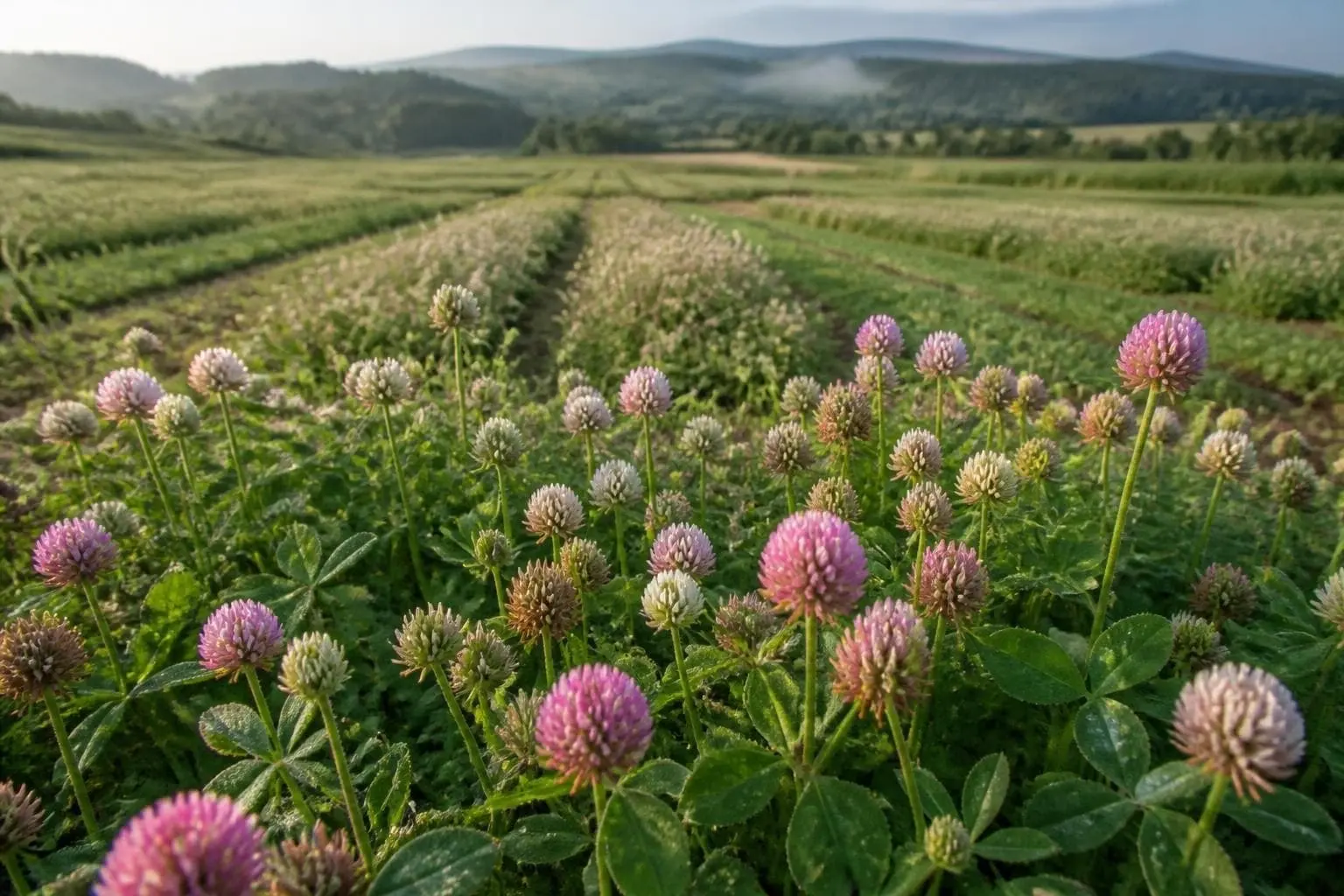
Alsike clover (Trifolium hybridum) is a forage legume that grows widely in Bulgaria’s natural damp meadows and pastures, according to the 2017 paper (Naydenova, 2017). Its author, Galina Naydenova of the Soybean Experimental Station in Pavlikeni, cites Czech work putting its nutritive value on a par with red clover (Naydenova, 2017). On her own account, it yields less when cut for hay but regrows well after grazing and stays longer in the sward (Naydenova, 2017).
That made it a candidate to replace red clover in medium-lived mixtures for grazing or mixed use (Naydenova, 2017). The paper states that no breeding or improvement work on alsike had been done in Bulgaria before. A comparison of varieties and populations in 2012–2014 was meant to find genetically diverse starting material for heterosis breeding of a grazing variety for Central Northern Bulgaria (Naydenova, 2017).
A clover for wet ground
The USDA’s plant guide describes alsike as a short-lived perennial that yields less than red clover but tolerates waterlogged soils and up to six weeks of spring flooding, though not droughty sites (St. John & Ogle, 2008). Guides differ on its alkalinity tolerance, relevant at Pavlikeni’s neutral pH 7.1 (St. John & Ogle, 2008; Beef Cattle Research Council, n.d.; Naydenova, 2017).
Like other clovers it fixes nitrogen from the air: in a Canadian field study, alsike fixed an estimated 20.8–143.0 kg of nitrogen per hectare a year, against 15.3–77.3 kg for red clover, though these 1970s figures are not typical European values (Rice, 1980).
How Did the Pavlikeni Trial Work?
The trial grew 11 half-sib families from polycrossed elite plants beside a wild local population, in nursery rows at the Soybean Experimental Station in Pavlikeni, on leached chernozem at 144 m (Naydenova, 2017). The family nursery ran from 2015 to 2017, after the parents were crossed in 2014 (Naydenova, 2017).
The parents came from a working collection of 12 accessions grown in 2012–2014, where elite plants were chosen for forage and seed yield (Naydenova, 2017). The text says all nine source accessions came from Europe, but the paper’s Table 1 lists one parent as a US accession (Naydenova, 2017).
Polycross and half-sib families
In the summer regrowth of 2014 the mother plants were left to pollinate one another, a design called a polycross; seed from each mother forms a half-sib family, sharing a mother but not necessarily a father (Naydenova, 2017).
Equal numbers of seeds from each family were sown in April 2015 in 2 m rows, in two randomised replicates, with a wild Bulgarian population from the Omurtag area as the check; plants were cut at grazing maturity and scored for yield, stem traits and survival (Naydenova, 2017).
What Did the Study Find?
The elite parents varied enormously. The coefficient of variation was 93% for fresh forage per plant and 83% for seed per plant (Naydenova, 2017). Seed yield ranged from 0.3 to 7.2 g per plant, and the author notes that the upper value exceeds earlier reports from Lithuania (Naydenova, 2017). The standout was plant 194/1, from the Finnish accession TRIF 194, with 0.690 kg of fresh forage, 7.2 g of seed and 80 flowering stems (Naydenova, 2017).
Seed yield was not a side issue. The author argues that selecting for grazing persistence should include high, stable seed production, so that a stand keeps a seed bank and reseeds itself (Naydenova, 2017). She notes that red clover’s poor persistence under grazing has been linked to low seed-yield potential (Naydenova, 2017).
Yield in the first two seasons
In the sowing year only seven families formed flowering stems and were harvested, and their dry-matter differences were not significant (Naydenova, 2017). In the second season the family effect on yield was significant. In the spring regrowth, families 194/1, 191/1, 194/2, 154/1 and 22/1 gave more dry matter than the wild check (Naydenova, 2017).
The check then regrew very weakly, so most families beat it in the second cut, seven of the 11 significantly according to the paper’s Table 2 (Naydenova, 2017). The author names 194/1 and 150/1 as the most productive families under summer conditions (Naydenova, 2017).
Table 1. Dry matter and survival of the check and selected half-sib families, Pavlikeni nursery
Family | Spring cut, 2nd season (kg/m) | Mean per cut (kg/m) | Plants alive in 3rd season (%) |
Omurtag wild population (check) | 0.310 | 0.164 | 75 |
194/1 | 0.847* | 0.382* | 35 |
194/2 | 0.716* | 0.334* | 35 |
191/1 | 0.764* | 0.321* | 0 |
154/1 | 0.623* | 0.367* | 0 |
22/1 | 0.598* | 0.290* | 25 |
150/1 | 0.337 | 0.238 | 85 |
228/1 | 0.458 | 0.224 | 60 |
LSD at P<0.05 | 0.240 | 0.124 | No test given |
Table note: Values as printed in Table 2 of the paper, in kilograms of dry matter per metre of nursery row, not field yields; an asterisk marks a significant difference from the check (Naydenova, 2017).
On family means, the author credits parents 194, 154, 191 and 22 with higher combining value for yield at grazing maturity, but only over a short period of use (Naydenova, 2017). That qualification matters for the next result.
Which Families Went Into the Breeding Population?
Five families went into the breeding population, 194/1, 194/2, 22/1, 150/1 and 228/1, and yield alone did not decide the choice: persistence did too (Naydenova, 2017). Two of the highest-yielding families, 154/1 and 191/1, had no plants left by the third season, as the text says (Naydenova, 2017). The paper’s Table 2 shows the same for 1177/2 and 6/1 (Naydenova, 2017). Family 150/1 kept 85% of its plants against the check’s 75%, and every other family persisted less well than the local population (Naydenova, 2017).
That pattern matters because the programme’s goal was a grazing variety (Naydenova, 2017). A family that yields heavily for one season and then dies out is of little use in a pasture meant to last several years.
A grazing clover has to do two jobs at once: feed animals this year and still be in the sward in the third spring.
Stems, nodes and growth habit
Family differences in stem traits were also significant in the second season (Naydenova, 2017). Every family except 6/1 had longer flowering stems than the check’s 44.3 cm, but only seven of them significantly. The longest belonged to the families of elites 7 (78.7 cm) and 150 (72.2 cm) (Naydenova, 2017).
Families 228/1 and 1177/1 had the most nodes per stem, 6.7, which the author links to leafier forage, although protein was not measured (Naydenova, 2017).
Family 228/1 came closest to the author’s picture of a grazing type: tall stems with many nodes, a semi-prostrate habit, 0.224 kg/m per cut and 60% survival (Naydenova, 2017). Its yield was not significantly above the check, however, and its survival was lower. The surviving plants of these five families were then polycrossed into a synthetic breeding population (Naydenova, 2017).
What Do Farm Guides Say About Growing and Feeding Alsike?
Farm guides agree that alsike suits wet ground and dislikes drought, but they differ on acidity: the USDA guide says it grows on soils too acidic for red clover (St. John & Ogle, 2008), while Forage U-Pick rates its acid tolerance as moderate and puts its crude protein at about 22% (Beef Cattle Research Council, n.d.).
On mixtures, the USDA guide says alsike and red clover sown together give more hay than either alone (St. John & Ogle, 2008), while Forage U-Pick says adding alsike usually lowers yields and rates its bloat risk as similar to red clover’s (Beef Cattle Research Council, n.d.).
The Bulgarian paper treats alsike as having the same ecological needs as red clover (Naydenova, 2017). The North American guides only partly share that view, since both stress its tolerance of flooding and its weakness in drought (St. John & Ogle, 2008; Beef Cattle Research Council, n.d.).
Horses and alsike
Alsike is best known to horse owners as a hazard. Ontario’s agriculture ministry describes two syndromes: sensitivity to sunlight after short-term exposure, and liver damage and enlargement after long-term feeding (Ontario Ministry of Agriculture, Food and Agribusiness, 2022). The page says the toxin has still not been identified (Ontario Ministry of Agriculture, Food and Agribusiness, 2022).
Ontario’s ministry advises keeping alsike out of seed mixes for horse pastures and hay (Ontario Ministry of Agriculture, Food and Agribusiness, 2022). Whether the plant itself causes the liver disease has long been disputed: a 1989 review found the evidence insufficient, resting on feeding trials from 1928–1933 (Nation, 1989).
What Future Does Alsike Clover Have on Bulgarian Farms?
For now alsike is a minor crop in Bulgaria, and lucerne dominates its green forage legumes. In 2024 lucerne covered 79,710 ha, or 93% of the 85,550 ha of legumes harvested green (Eurostat, 2026). Eurostat’s category for clover and other green legumes covered 5,830 ha that year, down from a peak of 14,980 ha in 2018 (Eurostat, 2026).
Farm support
Bulgaria’s farm-support rules give clover a place. Under the 2025 direct payments handbook, clover is among the crops eligible for coupled income support for protein crops, with a minimum of 0.5 ha (Ministry of Agriculture and Food of Bulgaria, 2025). The eco-scheme for permanent crops names alsike first among the species allowed as inter-row cover (Ministry of Agriculture and Food of Bulgaria, 2025).
Hotter, drier summers
Climate is the larger question. The IPCC’s Europe chapter projects that forage production will fall in southern Europe at 2–4°C of global warming because of heat and water scarcity, while grassland output for forage rises in northern Europe (Bednar-Friedl et al., 2022). It also flags effects on grassland production and fodder quality, particularly in southern and eastern Europe, without saying which of its regions Bulgaria belongs to (Bednar-Friedl et al., 2022).
A clover that needs steady moisture and tolerates flooding better than drought would be exposed to that shift (St. John & Ogle, 2008; Beef Cattle Research Council, n.d.), although no study has yet tested alsike under projected Bulgarian summers. Breeding would need to select for summer regrowth and survival, traits on which the 2017 families differed widely (Naydenova, 2017).
Newer tools may help: a 2015 review expected genome-wide markers to make genomic selection for forage yield possible in the major forage legumes (Annicchiarico et al., 2015), and a 2024 Swedish thesis on red clover concluded that genomic prediction can speed up genetic gain (Osterman, 2024).
Frequently asked questions
Is alsike clover poisonous to horses?
It has been linked to sensitivity to sunlight after short-term exposure and liver damage after long-term feeding (Ontario Ministry of Agriculture, Food and Agribusiness, 2022). The toxin has not been identified, and a 1989 review judged the evidence insufficient (Nation, 1989), but Ontario still advises keeping it out of horse pasture mixes (Ontario Ministry of Agriculture, Food and Agribusiness, 2022).
How does alsike clover differ from red clover?
Alsike is a short-lived perennial that yields less than red clover but copes better with waterlogged ground (St. John & Ogle, 2008). The 2017 Bulgarian paper credits it with similar nutritive value and better persistence under grazing (Naydenova, 2017), while guides disagree on acid tolerance (Beef Cattle Research Council, n.d.).
What is a polycross in clover breeding?
In a polycross, selected plants flower together and pollinate one another freely. Seed from each mother plant forms a half-sib family, and comparing families shows which parents pass on useful traits (Naydenova, 2017). Red clover work suggests such mating is less random than the method assumes (Riday et al., 2018).
Did the Pavlikeni programme produce a registered variety?
Not so far. The 2017 paper ended with a synthetic breeding population from five families (Naydenova, 2017). No clover appears on Bulgaria’s 2026 Official Variety List (Executive Agency for Variety Testing, Field Inspection and Seed Control, 2026), and the EU catalogue of January 2023 listed no Bulgarian alsike (European Commission, 2023).
Does alsike clover cope with drought?
Poorly. The USDA guide says it does not tolerate droughty sites, and a Canadian forage tool rates its drought tolerance as low (St. John & Ogle, 2008; Beef Cattle Research Council, n.d.). It does best where moisture is steady, so a projected fall in southern European forage production matters (Bednar-Friedl et al., 2022).
Sources
- Naydenova, G. (2017). Breeding of alsike clover (Trifolium hybridum L.) for the conditions of Central Northern Bulgaria [in Bulgarian, English abstract]. Rastenievadni nauki / Bulgarian Journal of Crop Science, 54(4), 35–40. – Cabdirect archive record 20183035154
- St. John, L., & Ogle, D. (2008). Alsike clover, Trifolium hybridum L. Plant guide. USDA Natural Resources Conservation Service, Idaho Plant Materials Program.
- Beef Cattle Research Council. (n.d.). Alsike clover. Forage U-Pick.
- Ontario Ministry of Agriculture, Food and Agribusiness. (2022; updated 2026). Alsike clover poisoning (photosensitization or photodermatitis) in horses. Government of Ontario.
- Nation, P. N. (1989). Alsike clover poisoning: A review. The Canadian Veterinary Journal, 30(5), 410–415.
- Rice, W. A. (1980). Seasonal patterns of nitrogen fixation and dry matter production by clovers grown in the Peace River region. Canadian Journal of Plant Science, 60(3), 847–858.
- Annicchiarico, P., Barrett, B., Brummer, E. C., Julier, B., & Marshall, A. H. (2015). Achievements and challenges in improving temperate perennial forage legumes. Critical Reviews in Plant Sciences, 34(1–3), 327–380.
- Riday, H., Raasch, J. A., & Dial, S. G. (2018). Red clover seed-parent and pollen-parent correlated reproductive success and its relationship to polycross mating metrics. Crop Science, 58(2), 608–616.
- Osterman, J. (2024). Advancing red clover breeding through genomic selection methods [Doctoral thesis]. Acta Universitatis Agriculturae Sueciae. Swedish University of Agricultural Sciences.
- Executive Agency for Variety Testing, Field Inspection and Seed Control. (2026). Official variety list of varieties of agricultural and vegetable plant species accepted for certification and marketing on the territory of the Republic of Bulgaria 2026 (List A).
- European Commission. (2023). Common catalogue of varieties of agricultural plant species: Consolidated version 27.01.2023.
- Eurostat. (2026). Crop production in EU standard humidity (apro_cpsh1), Bulgaria [Data set].
- Ministry of Agriculture and Food of Bulgaria. (2025). Наръчник Директни плащания, Кампания 2025 [Direct payments handbook, Campaign 2025].
- Bednar-Friedl, B., et al. (2022). Europe. In Climate Change 2022: Impacts, Adaptation and Vulnerability. Contribution of Working Group II to the Sixth Assessment Report of the Intergovernmental Panel on Climate Change (pp. 1817–1927). Cambridge University Press.

Maya Hartwell — author
Maya writes environment and plant science explainers, with an editorial focus on biodiversity, ecosystems, water quality, environmental pollution, plant biology, invasive plants, natural materials and the use of biological resources in environmental technologi...
Related
Koshihikari rice: marker-assisted heading-date gene transfer
Wild fruit diversity and the origins of cultivated trees
How vermicompost affects growth and flowering in Liatris spicata
Sugar components of coconut sugar in Indonesia: study digest
How Tunisian Date Palm Seeds Differ in Chemistry and Bioactivity
Coffee, Cocoa and Tea: Cultivation, Management and Production