Coffee, Cocoa and Tea: Cultivation, Management and Production
This structure makes the book useful as a comparative guide rather than a crop-specific manual. It highlights the recurring questions growers and students must ask about any perennial plantation crop: what plant material is being grown, what climate and soil it requires, how the field is managed, how nutrition is supplied, how pests and diseases are controlled, and how the harvested crop is processed.
Why are coffee, cocoa and tea studied together?
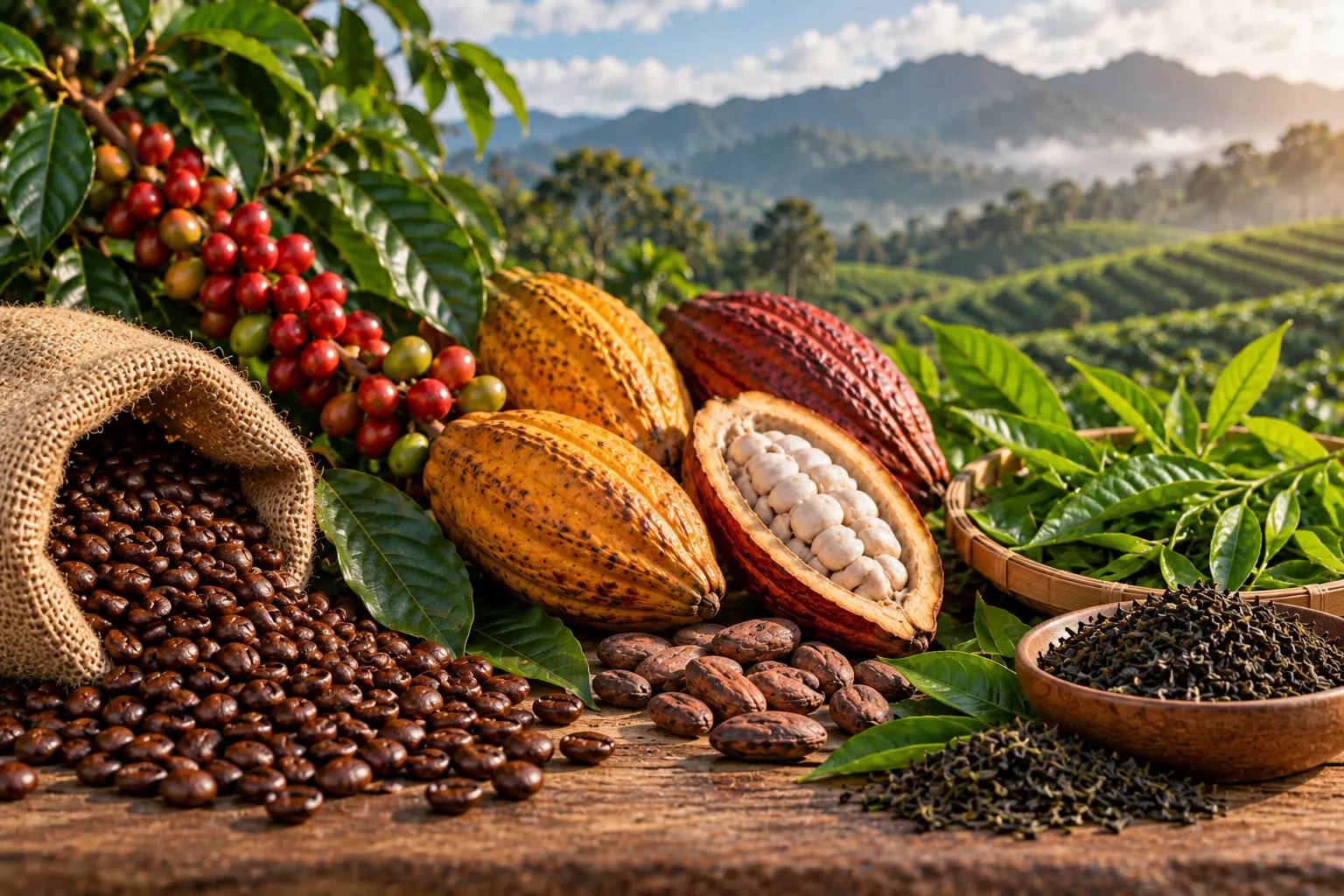
Willson’s organizing idea is comparative. Coffee, cocoa and tea do not belong to one botanical group, but they share an important agricultural role as plantation cash crops whose harvested products enter beverage markets. Studying them side by side lets readers see how a common production framework can be applied to very different plants without pretending that their biology is the same.
A shared agricultural framework links three different crops
The book applies a parallel sequence to coffee, cocoa and tea: botany and plant improvement; climatic and soil requirements; field management; mineral nutrition and fertilizers; and pest, disease and weed control. That repeated structure is useful because it separates universal production questions from crop-specific answers. It also makes comparison easier for students of agriculture, horticulture and food science.
Production begins before field management
The introductory chapters come before the individual crop sections. They cover stimulant beverage crops, origins and distribution, and production and markets. This signals that crop management is connected to geography, history and economic production systems rather than being only a collection of field operations.
Table 1. Key Production Questions in Coffee, Cocoa and Tea Cultivation
Production question | Why it matters in the book |
Botany and plant improvement | Defines the crop and the plant traits considered in production. |
Climate and soil | Places production within environmental requirements and soil management. |
Field management | Covers the practical organization and care of the crop in the field. |
Mineral nutrition and fertilizers | Treats nutrient supply as a distinct part of crop management. |
Pests, diseases and weeds | Brings major biological constraints into the production framework. |
Processing | Connects plantation production with the transformation of harvested material. |
How does the book approach coffee production?
Coffee receives its own five-chapter production section. Rather than reducing coffee production to one management practice, the book places botany, environmental requirements, field operations, mineral nutrition and crop protection in sequence. This reflects the broad-based purpose of the text: to explain the scientific principles underlying production rather than to serve as a regional grower manual.
Coffee botany and plant improvement come first
The coffee section begins with botany and plant improvement. In the logic of the book, understanding the crop itself precedes decisions about the environment and management. This provides a foundation for interpreting why production practices may differ among planting material and production situations, without turning the overview into a set of cultivar-specific recommendations.
Coffee management is treated as an integrated system
The remaining coffee chapters move through climatic and soil requirements, field management, mineral nutrition and fertilizers, and pest, disease and weed control. The sequence emphasizes that successful production cannot be represented by a single input. Environmental suitability, routine management, nutrient supply and biological constraints all belong to the same production system.
How does cocoa fit the same production framework?
The cocoa section mirrors the coffee section closely. It covers botany and plant improvement, climatic and soil requirements and management, field management, mineral nutrition and fertilizers, and pests, diseases and weed control. The parallel organization makes cocoa directly comparable with the other two crops while preserving a separate crop-specific treatment.
Cocoa is compared through the same questions, not identical answers
A comparative textbook can use the same headings without implying that coffee, cocoa and tea require the same conditions. The parallel sections distinguish shared management topics from the distinct requirements of each crop. Detailed climatic thresholds, fertilizer rates and pest-control prescriptions require the full crop chapters or newer crop-specific evidence.
Field management links crop biology with production practice
By giving field management its own chapter, the book distinguishes day-to-day or seasonal crop management from the preceding discussion of botany and environmental requirements. It then treats mineral nutrition separately before moving to crop protection. This arrangement helps readers understand production as a chain of related decisions rather than as an isolated treatment or intervention.
What is distinctive about the tea section?
Tea is also presented through five production chapters. The table of contents uses the phrase “climatic limitations” for tea, while coffee and cocoa are described with “climatic requirements.” That wording is part of the book’s organization and places explicit attention on environmental constraints in the tea section.
Tea follows the same sequence from plant science to protection
Tea begins with botany and plant improvement, then moves to climatic limitations, soil requirements and management. Field management, mineral nutrition and fertilizers, and pests, diseases and weed control follow. Readers can therefore compare the three crops topic by topic while still consulting separate sections for each one.
Parallel chapter design supports teaching and comparison
The book is structured as a broad-based text for students of agriculture, horticulture and food science and as an overview for professionals. The repeated chapter pattern supports that educational purpose. It encourages readers to organize crop-production knowledge into consistent categories that can later be expanded with crop-specific and region-specific sources.
Table 2. Comparison of Cultivation and Management Topics Across Coffee, Cocoa and Tea
Topic | Coffee | Cocoa | Tea |
Botany and plant improvement | Included | Included | Included |
Climate and soil | Requirements and management | Requirements and management | Climatic limitations; soil requirements and management |
Field management | Included | Included | Included |
Mineral nutrition and fertilizers | Included | Included | Included |
Pests, diseases and weed control | Included | Included | Included |
Why are mineral nutrition and crop protection separate topics?
In all three crop sections, mineral nutrition and fertilizers receive a dedicated chapter, followed by a separate chapter on pests, diseases and weed control. This division is significant because it prevents crop performance from being explained only through fertilizer use or only through pest management. The book instead treats both as major but distinct components of plantation production.
Nutrition is one part of a larger management system
The structure of the book places nutrition after field management and before crop protection. That sequence does not establish a universal priority order, but it does show that nutrient management belongs within a wider production framework. Specific fertilizer products, rates and schedules should be taken from the full crop chapters or newer region-specific guidance when practical recommendations are needed.
Pests, diseases and weeds are treated across all three crops
Each crop receives a dedicated chapter combining pests, diseases and weed control. This makes biological competition and damage a core part of the comparative framework. Detailed modern pest, pathogen and weed-management recommendations require current crop-specific evidence because pressures and available control approaches change over time.
Where does processing enter the coffee, cocoa and tea system?
After the introductory material and the three crop sections, the book ends with a chapter on crop processing. The final section covers processing at the plantation and for retail sale. Its placement is important because it connects cultivation with what happens to harvested material before it becomes a marketable beverage product or ingredient.
Processing is presented as the final stage of the production overview
The final processing chapter follows the field-production material rather than being embedded in only one crop section. This reinforces the book’s comparative design and shows that production does not end at harvest. Detailed comparisons of processing methods and quality outcomes require specialized sources for coffee, cocoa and tea.
A production overview is not a processing manual
Willson’s book is a general introductory overview of scientific principles. That framing matters when using it today. It can establish the categories that belong in a production discussion, but detailed modern processing protocols, food-safety requirements and market specifications should be checked against more specialized and current sources.
What can readers learn from a 1999 agricultural overview today?
The book remains useful as a structured snapshot of how coffee, cocoa and tea production was organized for teaching at the end of the twentieth century. Its strongest contribution for a modern explainer is the comparative framework: origins and markets, crop biology, environmental requirements, field management, nutrition, protection and processing. These categories remain useful for asking questions even when the answers need updating.
The framework can be separated from time-sensitive recommendations
A book published in 1999 should not automatically be treated as current operational guidance. Pest distributions, disease pressures, available plant material, fertilizer practices, regulations, processing technologies and market conditions can change. Historical or foundational explanations can be anchored to the book, while current recommendations should be verified against newer authoritative crop-specific sources.
The book is broad rather than region-specific
The text sits between specialist books and regional grower manuals. That is useful for orientation, but it also defines a limitation: a general overview cannot replace local guidance. Climate, soils, pest pressure, production systems and market requirements differ by place, so management decisions should be grounded in the relevant crop and production region.
How should Coffee, Cocoa and Tea be used as a reference?
For students, the book offers a map of the major subjects that make up plantation-crop production. For professionals, it provides a compact cross-crop overview. It is most useful as an anchor source that defines the historical structure and scope of the topic, with later evidence added whenever current claims are made about production practices or crop constraints.
Use the book to establish scope and terminology
The chapters describe a comparative approach to the main subjects in plantation-crop production. It identifies coffee, cocoa and tea as plantation cash crops used for stimulant beverages and organizes their production around recurring categories.
Do not infer detailed recommendations from an overview
The broad overview identifies the areas covered but does not replace the detailed agronomic evidence needed for precise recommendations. Exact climate values, fertilizer recommendations, pest lists, yields or processing parameters should be drawn from the relevant chapters or current authoritative publications. This keeps the historical framework separate from time-sensitive operational guidance.
Comparing crop biology and modern field decisions
The crops differ in which plant parts are harvested. Coffee is grown for seeds found inside its fruit, cocoa for seeds within pods, and tea for young leaves and shoots. This difference affects harvesting and subsequent processing, even though all three crops depend on healthy perennial plants and suitable growing environments. Comparative teaching must therefore address both shared production decisions and distinct harvested materials.
Coffee production brings together establishment, crop maintenance and post-harvest handling. Decisions about shade, pruning and plant health interact with the local environment, so no single management technique determines production on its own. A historical overview can describe these categories, while practical decisions require information about the species or cultivar, soil, weather and current pest pressures.
Cocoa management depends on conditions within the growing environment and the relationship between trees, soil and surrounding vegetation. Plant improvement, field maintenance and crop protection are separate subjects, but they influence one another in practice. Evaluating a production system requires more than a general statement about climate suitability: planting material, site management and local biological pressures all matter.
Tea differs from coffee and cocoa in the harvested product and the importance of repeated shoot harvesting. Its cultivation is tied to the growth and renewal of leaves, which connects plant development to field management and processing. A shared chapter sequence helps organize these questions, but it cannot make tea harvesting or manufacture equivalent to the handling of coffee cherries or cocoa pods.
Managing crop nutrition, protection and processing with current evidence
Nutrition and crop protection address different constraints on crop performance. Nutrient shortages or imbalances can limit plant growth, while pests, pathogens and weeds can damage tissues or compete for resources. The correct response depends on identifying the actual constraint. A general discussion of fertilizers cannot substitute for diagnosing plant health, and crop protection measures do not correct underlying soil nutrient problems.
Processing introduces quality considerations that differ among the three crops. Coffee, cocoa and tea each undergo crop-specific post-harvest steps before reaching consumers, and the condition of harvested material can influence the final product. The placement of processing at the end of the production sequence connects field practices with marketable output without implying that the same techniques apply to all three crops.
The book supports historical comparisons of how agricultural teaching organized perennial beverage crops in 1999. It should not be used to assign present-day fertilizer rates, recommend specific pesticides or infer current disease distributions without newer evidence. Distinguishing long-standing crop principles from changing technical recommendations preserves the educational value of an older overview without presenting it as a contemporary field manual.
Practical takeaway: Coffee, cocoa and tea can be compared through a common agricultural framework, but their management should not be treated as interchangeable. Willson’s 1999 book is most useful as a structured introduction to the production questions that must be answered for each crop; current field decisions require newer, crop-specific and region-specific evidence.
Frequently asked questions
Why are coffee, cocoa and tea grown as plantation crops?
Coffee, cocoa and tea are commercially important perennial crops cultivated for products used in beverages. They differ in botanical characteristics and field requirements, but each requires decisions about planting material, climate, soil, crop management and processing. Willson’s 1999 book compares these shared production questions while examining each crop separately.
What are the main stages of coffee, cocoa and tea production?
Production begins with choosing suitable plant material and understanding local climate and soil conditions. It then involves field establishment, routine management, mineral nutrition, pest and disease control, harvesting and processing. The sequence differs in practice among coffee, cocoa and tea, and detailed procedures depend on the crop and region.
How do fertilizer requirements differ for coffee, cocoa and tea?
Coffee, cocoa and tea have different nutrient demands that depend on soil conditions, plant age, yield targets and production systems. Willson’s book addresses mineral nutrition and fertilizers in separate chapters for each crop. Current application rates and fertilizer choices should be based on recent local guidance and soil assessment rather than a general 1999 overview.
How have coffee, cocoa and tea cultivation practices changed since 1999?
Production practices have continued to evolve in response to climate pressures, new planting material, changing pests and diseases, and developments in soil and water management. Willson’s 1999 overview documents the earlier production framework across all three crops. For present-day field decisions, growers need updated research and locally applicable agronomic recommendations.
Sources
- Willson KC. Coffee, Cocoa and Tea. 1999. 304 pp. ISBN: 978-0-85198-919-8.
- Clifford M. Review of Coffee, Cocoa and Tea by K. C. Willson. Journal of the Science of Food and Agriculture. 2000;80(7):1138.
- Bracken P, Burgess PJ, Girkin NT. Opportunities for enhancing the climate resilience of coffee production through improved crop, soil and water management. Agroecology and Sustainable Food Systems. 2023;47(8):1125–1157.
- Koutouleas A, Sarzynski T, Bordeaux M, et al. Shaded-Coffee: A Nature-Based Strategy for Coffee Production Under Climate Change? A Review. Frontiers in Sustainable Food Systems. 2022;6:877476.
- Badrie N, Bekele F, Sikora E, Sikora M. Cocoa agronomy, quality, nutritional, and health aspects. Critical Reviews in Food Science and Nutrition. 2015;55(5):620–659.
- Amponsah-Doku B, Daymond A, Robinson S, Atuah L, Sizmur T. Improving soil health and closing the yield gap of cocoa production in Ghana: A review. Scientific African. 2022;15.
- Mwesige FF, Massawe BHJ, Sanga HG, Mjanja BE. A systematic review on criteria for land suitability assessment for tea cultivation. Frontiers in Agronomy. 2026;8.
- Liu Z, Wang Q, Ma Y, Zhao M. Influence on soil ecology, tea yield, and quality of tea plant organic cultivation: A mini-review. Frontiers in Agronomy. 2025;7:1557723.
Sophie Bennett — author
Sophie writes the health and nutrition explainers. Her editorial focus includes nutrients, dietary patterns, energy metabolism, hydration, supplements, sports nutrition and the interpretation of health research for general readers. She approaches health conten...
Related
Koshihikari rice: marker-assisted heading-date gene transfer

Wild fruit diversity and the origins of cultivated trees
How vermicompost affects growth and flowering in Liatris spicata
Sugar components of coconut sugar in Indonesia: study digest
Can Alsike Clover Be Bred for Bulgaria’s Lowland Pastures?
How Tunisian Date Palm Seeds Differ in Chemistry and Bioactivity