Why Punjab Farmers Burn Stubble and What Fire Counts Show
Many Punjab farmers burn stubble because fire is a cheap, simple way to clear straw quickly before wheat is sown (Kaur et al., 2022); in 2024 the state had about 20 million tonnes to manage (Kemanth et al., 2024). Official satellite counts of these fires fell from 83,002 in 2020 to 5,114 in 2025, a drop of about 94% (ICAR-Indian Agricultural Research Institute, CREAMS Laboratory, 2025). But fires have moved to late afternoon, when monitoring that relies on MODIS or VIIRS sensors misses many of them (Voiland, 2025). Studies using satellites that watch the region all day suggest the real fall in burning is smaller than the official counts imply (Singh et al., 2025; Voiland, 2025).
Below, we explain why burning persists, how a 2009 groundwater law narrowed the time between crops, what machinery subsidies, penalties and cash payments have achieved and what burning costs soils and health. We focus on Indian Punjab, with Haryana for comparison, and do not cover the spring burning of wheat stubble. We start from a 2013 study of what Punjab farmers themselves said about burning (Kaur et al., 2013), summarised in Cabdirect archive record 20143107982.
Why Do Farmers Burn Rice Stubble?
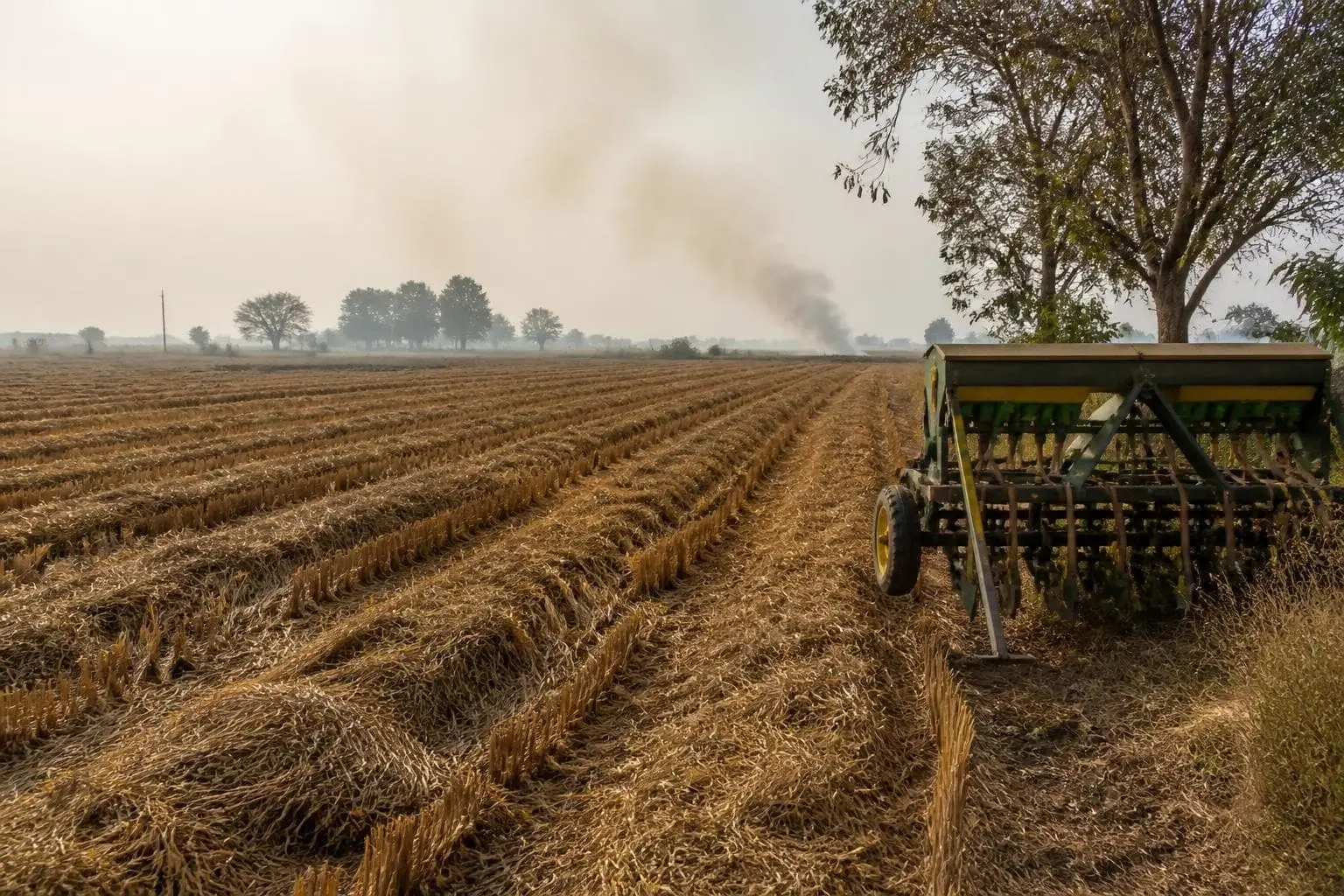
Burning persists because it is simple and cheap, the next crop has to go in quickly, combine harvesting has spread and straw has few viable uses, according to a 2022 review of rice residue management (Kaur et al., 2022). Around 50 million tonnes of rice straw are burned in India each year, nearly half of it in the north-west (Kaur et al., 2022), and Punjab had roughly 20 million tonnes of paddy residue to manage in 2024 (Kemanth et al., 2024).
What the alternatives cost
Managing straw without fire means paying for machines: in a 2019 Punjab field trial, renting in-situ equipment for a typical 5-acre rice farm would have cost Rs 15,000, and subsidies did not cover the full cost (Jack et al., 2025). Even farmers with machines often burn part of their straw, believing it cuts costs and controls pests (Kemanth et al., 2024).
A 2013 paper on the farmer’s perspective
Farmers’ own view of burning was already studied in 2013, when Rajvir Kaur, Balpreet Singh and V. L. Sharma questioned 100 farmers chosen at random in four villages of Hoshiarpur district, Punjab. Most knew that burning harms the environment, but few knew that it also lowers soil fertility. Many opposed laws to stop it, and most said they burned because the land had to be re-sown quickly (Kaur et al., 2013).
Why Is the Gap Between Rice and Wheat So Short?
The gap narrowed after Punjab delayed rice planting to conserve groundwater (Balwinder-Singh et al., 2019; Kant et al., 2022). The Punjab Preservation of Subsoil Water Act, 2009 bans sowing paddy nurseries before 10 May, or another notified date, and transplanting before a notified date, with a penalty of Rs 10,000 per hectare per month (Government of Punjab, 2009).
Later transplanting means a later harvest and less time before wheat. Scientists at ISRO’s Indian Institute of Remote Sensing compared fires in 2011–2020 with those in 2002–2010 (Kant et al., 2022). They found that the peak of paddy burning had moved 10–12 days later, into November, that post-monsoon fires were 21% more frequent and that the harvest window had shrunk (Kant et al., 2022).
The timing matters for air quality. A 2019 study linked groundwater policies to burning concentrated in late autumn, with a 39% higher peak fire intensity in weather that favours poor air (Balwinder-Singh et al., 2019), and in 2011–2020 paddy burning lifted PM2.5 in the National Capital Region about 23–26% above background (Kant et al., 2022).
The result is a trade-off between saving water and cleaner air, which the 2019 study names in its title (Balwinder-Singh et al., 2019).
How Much Has Stubble Burning Fallen?
On official counts, by more than nine-tenths since 2020. Satellites detected 83,002 paddy-residue burning events in Punjab between 15 September and 30 November 2020, and 5,114 in the same window of 2025, a fall of about 94%, with the largest one-year drop in 2024 (ICAR-Indian Agricultural Research Institute, CREAMS Laboratory, 2025).
Table 1. Paddy-residue burning events detected by satellite, 15 September–30 November, 2020–2025
Season | Punjab | Change on previous year | Haryana |
2020 | 83,002 | – | 4,202 |
2021 | 71,304 | −14.1% | 6,987 |
2022 | 49,922 | −30.0% | 3,661 |
2023 | 36,663 | −26.6% | 2,303 |
2024 | 10,909 | −70.2% | 1,406 |
2025 | 5,114 | −53.1% | 662 |
In 2025 Punjab was not the largest source of paddy fires among the six monitored states: Madhya Pradesh recorded 17,067 and Uttar Pradesh 7,290, out of 33,028 in all (ICAR-Indian Agricultural Research Institute, CREAMS Laboratory, 2025).
Counts of fire events are not a measure of how much straw is burned, and the bulletin reports no area burned (ICAR-Indian Agricultural Research Institute, CREAMS Laboratory, 2025).
Do Satellite Counts Capture All the Fires?
Probably not, and the gap seems to be widening as farmers light fires later in the day. Scientists at ISRO’s Space Applications Centre used the geostationary SEVIRI sensor, which images the region every 15 minutes, to track fires in Punjab and Haryana from 15 October to 30 November in 2020–2024 (Singh et al., 2025). Peak fire activity moved from about 13:30 in 2020 to about 17:00 in 2024, local time (Singh et al., 2025).
NASA reported in December 2025 that most stubble fires now burn between 4 and 6 p.m., not between 1 and 2 p.m. as before, so monitoring that relies on MODIS or VIIRS misses many of them (Voiland, 2025). On geostationary data, one NASA-affiliated scientist rated 2025 a moderate year, with more fires than 2024 (Voiland, 2025).
The SEVIRI study found VIIRS fire counts falling by 18,883 a year over 2020–2024 while SEVIRI counts rose slightly (Singh et al., 2025). That rests on five annual values without a reported significance test, from a sensor with coarse pixels, and the authors’ view of later timing as deliberate avoidance of satellites is an interpretation (Singh et al., 2025).
Fewer fires on a satellite map and fewer fires on the ground are not the same measurement, and the gap between them is where the stubble debate now sits.
What Have Machinery Subsidies Achieved?
They have put hundreds of thousands of machines on farms, but many farmers who use them still burn some straw. The central crop residue management scheme pays 50% of machinery costs for individual farmers and 80% for custom hiring centres (Press Information Bureau, Ministry of Environment, Forest and Climate Change, 2026).
By 10 March 2026, Rs 4,237.47 crore (about Rs 42.4 billion) had been released since 2018–19, and more than 3.53 lakh (353,000) machines distributed across all scheme states, not Punjab alone (Press Information Bureau, Ministry of Environment, Forest and Climate Change, 2026).
Use of the machines is widespread but incomplete. In the 2022 kharif (monsoon) season, over 58% of about 1,500 farmers surveyed in 11 Punjab districts used in-situ machines, yet nearly half of those users burned the loose straw first (Kemanth et al., 2024). Nearly 13% burned all their straw (Kemanth et al., 2024). Most in-situ machine users rented rather than owned, usually from fellow farmers who were friends or relatives (Kemanth et al., 2024).
Table 2. What Punjab farmers did with paddy straw in the 2022 kharif season (CEEW survey)
Practice or outcome | Share of farmers |
Burned all their paddy straw | Nearly 13% |
Used in-situ residue machines | Over 58% |
Of in-situ users: burned loose straw before using the machine | Nearly half |
Of in-situ machine users: rented rather than owned | Over 63% |
Of renters: hired from fellow farmers | 82% |
Of renters: hired through cooperative societies | 12% |
Of renters: hired from custom hiring centres or other sources | 3% |
Of ex-situ users: were paid for straw (about Rs 1,200 per acre) | 3% |
Of ex-situ users: paid the buyer to take it away | 28% |
Of ex-situ users: gave it away free | 69% |
Off-farm markets for straw were weak in 2022, as most farmers who sent straw away were not paid for it (Kemanth et al., 2024). Since 2023, thermal power plants in and around the National Capital Region must blend at least 5% crop-residue pellets with coal or pay compensation (Press Information Bureau, Ministry of Environment, Forest and Climate Change, 2026).
Do Fines and Payments Stop Farmers Burning?
The 2015 ban cut fires only briefly, while a payment trial suggests that how farmers are paid matters more than how much. A 2025 working paper found that the National Green Tribunal’s December 2015 ban cut fire counts by 30%, an effect that faded within two to three years, which the authors attribute to weak enforcement (Khanna et al., 2025).
The 2021 air quality law treats farmers who burn stubble differently from other polluters: they are excluded from its prison and fine provisions, and the Commission for Air Quality Management may instead charge them environmental compensation (Government of India, 2021). Rules amended in November 2024 doubled that charge per incident (Press Information Bureau, Ministry of Environment, Forest and Climate Change, 2024).
Table 3. Environmental compensation per stubble-burning incident, before and after November 2024
Landholding | Before (Rs) | From 7 November 2024 (Rs) |
Less than 2 acres | 2,500 | 5,000 |
2 acres to less than 5 acres | 5,000 | 10,000 |
More than 5 acres | 15,000 | 30,000 |
Fear of penalties seems to weigh most on smaller farmers: in the CEEW survey, burning was more common among medium and large farmers than among small and marginal ones, who feared fines and red entries in land records (Kemanth et al., 2024).
Paying farmers not to burn
A randomised trial in 171 villages in Punjab’s Bathinda and Faridkot districts offered farmers Rs 800 per acre in 2019 for not burning their rice straw (Jack et al., 2025). The standard contract, paid after verification, had no effect, but paying part of the money up front raised compliance by 10 percentage points, and doubling the standard payment made no significant difference (Jack et al., 2025).
What Does Burning Cost Soils and Health?
Burning removes nutrients and carbon that the next crop could use, and its smoke harms health far from the field. Studies cited in the 2022 review report losses of about 34–35 kg of nitrogen per hectare and 21–67 kg of potassium (Kaur et al., 2022).
Over the long term, burning can also deplete soil nitrogen and carbon, as a long-term Canadian study cited in the review found (Kaur et al., 2022).
Estimates of the smoke’s share in Delhi’s pollution depend on the time scale. NASA’s Pawan Gupta noted that published estimates range from 10 to 50% (Voiland, 2025). His own estimate is 40–70% on a given day, 20–30% averaged over a month or burning season and under 10% over a whole year (Voiland, 2025).
A modelling study estimated that residue burning caused 44,000–98,000 premature deaths a year in India between 2003 and 2019, most of them linked to Punjab, Haryana and Uttar Pradesh (Lan et al., 2022). The move towards evening fires may make overnight build-up of particles worse (Voiland, 2025).
Frequently asked questions
Is stubble burning illegal in Punjab?
Yes. The National Green Tribunal banned residue burning in Punjab in 2015 (Khanna et al., 2025). The 2021 air quality law exempts farmers from its prison and fine provisions, but they can be charged environmental compensation of Rs 5,000 to Rs 30,000 per incident, depending on landholding (Press Information Bureau, Ministry of Environment, Forest and Climate Change, 2024).
Why don’t farmers simply plough the straw back into the soil?
Mainly because of cost and time. In a 2019 Punjab trial, renting in-situ equipment for a typical 5-acre rice farm was put at Rs 15,000 (Jack et al., 2025). Wheat must follow rice quickly (Kaur et al., 2022), and many farmers believe partial burning saves money and controls pests (Kemanth et al., 2024).
Have Punjab’s farm fires really fallen by more than 90%?
Counted fires have: Punjab’s official total fell by about 94% between 2020 and 2025 (ICAR-Indian Agricultural Research Institute, CREAMS Laboratory, 2025). But many fires are now lit late in the afternoon, when common satellite sensors miss them, so burning has probably fallen less than the counts show (Voiland, 2025).
How much does stubble burning add to Delhi’s smog?
It depends on the period measured. A NASA scientist estimates that stubble smoke supplies 40–70% of Delhi’s pollution on a given day, 20–30% over a month or burning season and under 10% over a year (Voiland, 2025). Published studies report contributions from 10 to 50% (Voiland, 2025).
Does paying farmers not to burn work?
It can, if the contract suits them. In a 2019 trial in 171 Punjab villages, a standard Rs 800-per-acre payment made after verification did not reduce burning, while paying part of the money in advance raised compliance by 10 percentage points (Jack et al., 2025).
Sources
- Kaur, R., Singh, B., & Sharma, V. L. (2013). Practice of burning of crop residues-farmer’s perspective. Environment and Ecology, 31(3), 1360–1363. – Cabdirect archive record 20143107982
- Kaur, M., Malik, D. P., Malhi, G. S., Sardana, V., Bolan, N. S., Lal, R., & Siddique, K. H. M. (2022). Rice residue management in the Indo-Gangetic Plains for climate and food security. A review. Agronomy for Sustainable Development, 42(5), 92.
- Kemanth, K., Singh, R., & Ignatious, S. M. (2024). How can Punjab increase the adoption of crop residue management methods? Survey insights from 11 districts of the state. Council on Energy, Environment and Water.
- ICAR-Indian Agricultural Research Institute, CREAMS Laboratory. (2025). Monitoring paddy residue burning in India using satellite remote sensing during 2025 (Bulletin No. 77, 30 November 2025).
- Singh, N., Pradhan, R., Shukla, B. P., & Pandya, M. R. (2025). Evidence of shift in stubble burning timing over northwest India from geostationary satellite observations. Current Science, 129(10), 921–923.
- Voiland, A. (2025, December 15). New timing for stubble burning in India. NASA Earth Observatory.
- Government of Punjab. (2009). The Punjab Preservation of Subsoil Water Act, 2009 (Punjab Act No. 6 of 2009). Punjab Government Gazette (Extraordinary), 28 April 2009.
- Balwinder-Singh, McDonald, A. J., Srivastava, A. K., & Gerard, B. (2019). Tradeoffs between groundwater conservation and air pollution from agricultural fires in northwest India. Nature Sustainability, 2(7), 580–583.
- Kant, Y., Chauhan, P., Natwariya, A., Kannaujiya, S., & Mitra, D. (2022). Long term influence of groundwater preservation policy on stubble burning and air pollution over North-West India. Scientific Reports, 12, 2090.
- Press Information Bureau, Ministry of Environment, Forest and Climate Change. (2026, March 16). Major steps taken by Government to discourage and mitigate crop residue burning [Lok Sabha written reply].
- Jack, B. K., Jayachandran, S., Kala, N., & Pande, R. (2025). Money (not) to burn: Payments for ecosystem services to reduce crop residue burning. American Economic Review: Insights, 7(1), 39–55.
- Government of India. (2021). The Commission for Air Quality Management in National Capital Region and Adjoining Areas Act, 2021 (Act No. 29 of 2021). India Code.
- Press Information Bureau, Ministry of Environment, Forest and Climate Change. (2024, November 7). Ministry of Environment, Forest and Climate Change notifies the Commission for Air Quality Management in National Capital Region and Adjoining Areas (Imposition, Collection and Utilization of Environmental Compensation for Stubble Burning) Amendment Rules, 2024 on 06.11.2024.
- Khanna, S., Mahajan, K., & Ramanujam, S. (2025). Are crop residue burning bans effective? Evidence from India (Working Paper No. 428). Grantham Research Institute on Climate Change and the Environment, London School of Economics.
- Lan, R., Eastham, S. D., Liu, T., Norford, L. K., & Barrett, S. R. H. (2022). Air quality impacts of crop residue burning in India and mitigation alternatives. Nature Communications, 13, 6537.

Harriet Colbeck — author
Harriet Colbeck is an agriculture writer with a background in agricultural science and a master’s-level focus on soil science. Her earlier work involved preparing field-trial summaries and farmer-facing guidance on soil management, translating research finding...
Related
How Much Can New Woodland Cut UK Emissions? What the Models Show
Glyphosate’s Rise to Top Weedkiller: A 1997 Account
How fertiliser types affect rice yield and soil under SRI
Calendula, crotalaria and oats for root-knot nematodes in naranjilla
Why breadfruit mealybug control failed to last on Pacific atolls
Organic vs Conventional Farming: Economics and Ecology