How Much Can New Woodland Cut UK Emissions? What the Models Show
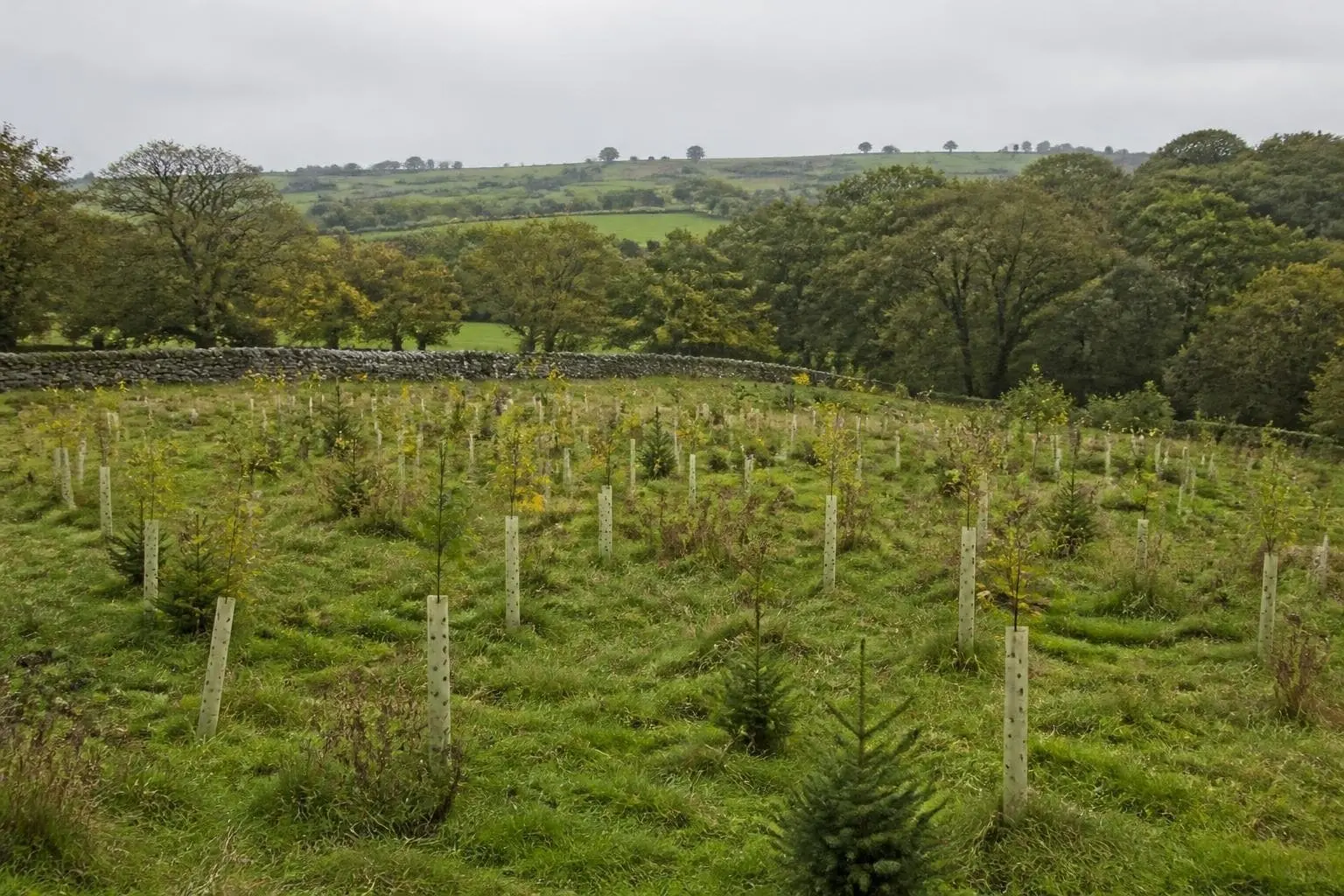
New UK woodland could cut emissions by about 15 million tonnes of CO2 (MtCO2) a year in the 2050s, roughly 10% of the emissions then targeted for 2050, but it delivers very little in its first decade (Matthews & Broadmeadow, 2009). That 2009 estimate assumed planting of 23,200 hectares a year from 2010 and counted all woodland created since 1990. UK planting has stayed below that rate every year since 2010: it was 15,580 hectares in 2024/25 and a provisional 13,480 hectares in 2025/26 (Forest Research, 2026; Forest Research, 2025).
Below, we explain how the modelling by Robert Matthews and Mark Broadmeadow worked, which types of woodland gave the most abatement and at what cost, and why the authors warned against judging forests by standing carbon alone. We then set the 2009 results against current targets, planting statistics and the national carbon inventory. The figures are model projections and national statistics, not estimates for individual planting projects or carbon credits. The original chapter is summarised in Cabdirect archive record 20103082977.
How Do Forests Reduce the UK’s Emissions?
Forests reduce the UK’s emissions in two separate ways: growing trees remove carbon dioxide from the air and store it, while harvested wood can replace fossil fuels and energy-intensive materials. Matthews and Broadmeadow counted both routes, including carbon stored in wood products, when they estimated the abatement UK forestry could deliver (Matthews & Broadmeadow, 2009).
Sequestration stores carbon in stems, roots, litter and soil as a woodland grows, and in timber products. Substitution avoids emissions: woodfuel displaces coal, oil or gas, and timber used instead of concrete or steel avoids the emissions of making them (Matthews & Broadmeadow, 2009).
Why the forest carbon sink was expected to weaken
The UK’s forest carbon sink largely reflects when its woodlands were planted. Large afforestation schemes ran from the 1950s to the 1980s, and new planting approached 30,000 hectares a year in the late 1980s before falling sharply. Inventory estimates quoted in the chapter showed the forest sink rising from about 12 MtCO2 a year in 1990 to a peak of about 16 MtCO2 in 2004 (Matthews & Broadmeadow, 2009).
Inventory projections expected the sink to fall to 4.6 MtCO2 a year by 2020 if planting stayed at the 2006 rate of 8,360 hectares a year, as ageing plantations reached harvest. Even 25,000 hectares a year from 2007 could only slightly slow that decline (Matthews & Broadmeadow, 2009).
How Did the Read Report Model Forest Carbon?
The Read Report modelled forest carbon with CARBINE, a carbon accounting model developed at Forest Research. Robert Matthews of Forest Research and Mark Broadmeadow of the Forestry Commission used it to compare a business-as-usual path with five alternative scenarios for UK forests, projecting results decades ahead (Matthews & Broadmeadow, 2009).
CARBINE starts from yield models of how stands grow and when they are thinned or felled, converts timber volume to carbon, follows it through roots, litter, soil and harvested products, and subtracts fossil fuel used in forest operations and processing (Matthews & Broadmeadow, 2009).
Five alternatives to business as usual
The enhanced afforestation scenario raised new planting across the UK to 23,200 hectares a year from 2010 to 2050, 14,840 hectares a year more than business as usual, with a species mix that differed by country (Matthews & Broadmeadow, 2009). Four management scenarios changed existing woodland instead: creating carbon reserves or deferring felling, moving rotations closer to those that maximise timber production, replanting with more productive species, and bringing half of unmanaged woodland back into management (Matthews & Broadmeadow, 2009).
Only enhanced afforestation delivered large extra abatement whichever way it was counted. In that scenario, all woodland created since 1990 would provide about 15 MtCO2 of abatement a year during the 2050s, which the authors equated to roughly 10% of UK emissions if the 2050 target of the time were met. The figure rose to more than 17 MtCO2 by 2070 (Matthews & Broadmeadow, 2009).
Which Kinds of New Woodland Deliver the Most Abatement?
The largest totals per hectare by 2050 came from fast-growing stands whose wood was harvested and used, such as eucalyptus and Douglas fir; unharvested native broadleaf woodland sat mid-range and native pine lowest. The authors grouped their options into energy forestry, productive conifer or mixed forestry, and low-impact or multi-purpose woodland, including native woodland (Matthews & Broadmeadow, 2009).
Energy forestry, such as short-rotation eucalyptus or willow coppice, built up abatement quickly because each harvest replaced fossil fuel. Productive conifers stored carbon mainly in trees and soil during their first decades, with substitution adding more after thinning and felling began. Native woodland, assumed to be managed for biodiversity and never harvested, delivered abatement through sequestration alone (Matthews & Broadmeadow, 2009).
Timing matters as much as the totals. By 2020, ten years after planting, only the energy forestry options had delivered large amounts, and native pine showed a small net emission. By 2050 most options offered substantial abatement, although native pine stayed low because of its slow growth and low stocking density (Matthews & Broadmeadow, 2009).
A programme-scale example
A 15-year programme planting 10,000 hectares a year, mixing eucalyptus, Douglas fir, farm woodland and native broadleaves, would deliver 53 MtCO2 of cumulative sequestration by 2050, or 82 MtCO2 including substitution. Scaled to 25,000 hectares a year, the totals would rise to about 130 and 200 MtCO2 (Matthews & Broadmeadow, 2009).
What the cost figures include
Cost-effectiveness combined planting and management costs with farm income given up, minus timber or fuel revenue, discounted at 3.5% a year. All options fell below the £100 per tonne threshold then used by the Climate Change Committee once displaced electricity-sector carbon was valued; benefits for water, wildlife and recreation were left out (Matthews & Broadmeadow, 2009).
Is It Better for the Climate to Stop Harvesting Forests?
Stopping harvesting was not the best climate option in the chapter’s model once wood use was counted. Turning managed forest into carbon reserves or deferring felling increased the carbon held in trees and soils for a few decades, but it reduced the timber and fuel available for substitution (Matthews & Broadmeadow, 2009).
Over 2010–2050 the carbon reserve scenario added 3.1 MtCO2 a year of forest-only abatement but just 0.7 MtCO2 once products and substitution were included, and over 2010–2100 its total effect turned negative. In 2050 itself, total abatement was 1.3 MtCO2 lower than under business as usual, mainly because less wood was available to replace fossil fuels and materials (Matthews & Broadmeadow, 2009).
Counting only the carbon standing in a forest can make harvesting look harmful even when the wood saves more emissions elsewhere.
An earlier analysis summarised in the chapter made the point more starkly: over 50 years, stopping all harvesting in British forests raised forest-only uptake by 19.8 MtCO2 a year but cut whole-sector abatement by 5.5 MtCO2 a year. Managing for maximum timber production was the only management scenario to add abatement in every period, although modestly (Matthews & Broadmeadow, 2009).
What Has Changed Since 2009?
Since 2009 the target has become stricter, planting has recovered without reaching the modelled scale, and the ageing plantation estate the authors described is now visible in official data (Climate Change Committee, 2026; Department for Energy Security and Net Zero, 2026).
A net zero target and higher planting ambitions
When the chapter was written, the Climate Change Act required an 80% cut in emissions on 1990 levels by 2050. The target was amended to net zero in 2019 (Climate Change Act 2008), so the chapter’s comparison of 15 MtCO2 with 10% of remaining emissions no longer applies.
The Climate Change Committee’s Seventh Carbon Budget advice of February 2025 says UK planting needs to more than double to 37,000 hectares a year by 2030, with woodland rising from 13% of the UK to about 18% by 2050 (Climate Change Committee, 2025a; Climate Change Committee, 2025b). Provisional statistics put UK woodland at about 3.30 million hectares in March 2026, around 14% of the land area (Forest Research, 2026).
Planting has risen, but not to the modelled scale
UK woodland creation reached about 21,000 hectares in 2023/24, the highest since 1990, then fell to 15,580 hectares in 2024/25 and a provisional 13,480 hectares in 2025/26 (Climate Change Committee, 2026; Forest Research, 2026; Forest Research, 2025). The Climate Change Committee attributed most of the 2024/25 fall to funding cuts in Scotland, where planting dropped by 44% (Climate Change Committee, 2026).
Table 1. Woodland creation rates: 2009 scenarios, later pathways and recent planting (UK)
Benchmark | Hectares per year | Source |
Business-as-usual assumption in the 2009 chapter | 8,360 | (Matthews & Broadmeadow, 2009) |
Enhanced afforestation scenario, 2010–2050 | 23,200 | (Matthews & Broadmeadow, 2009) |
Seventh Carbon Budget Balanced Pathway, 2030 | 37,000 | (Climate Change Committee, 2025a) |
Net Zero Strategy illustrative pathway, 2035 | 50,000 | (HM Government, 2021) |
Actual new planting, 2023/24 | about 21,000 | (Forest Research, 2026) |
Actual new planting, 2024/25 | 15,580 | (Forest Research, 2025) |
Actual new planting, 2025/26 (provisional) | 13,480 | (Forest Research, 2026) |
The inventory now uses CARBINE
When the chapter was written, national reporting of forest carbon covered only woodland planted after 1919 (Matthews & Broadmeadow, 2009). The current inventory calculates forest carbon stock change with CARBINE, covering standing trees, dead organic matter, soil and harvested products (Department for Energy Security and Net Zero, 2026).
On this basis, net removals by forest land rose by 39% between 1990 and 2009, stayed about 35% above the 1990 level until 2022 and fell to 26% above it in 2024. The inventory explains the decline as the 2009 chapter did: conifers planted between 1950 and 1990 are reaching harvesting age, and young replacement trees take up carbon far more slowly (Department for Energy Security and Net Zero, 2026).
What Are the Limits and Open Questions?
The main limits of the chapter’s results lie in soil carbon, substitution, harvesting and the scale of land available (Matthews & Broadmeadow, 2009).
Soil carbon and the right site
The chapter treated soil carbon as a major uncertainty (Matthews & Broadmeadow, 2009). Field work in Scotland later found that planting birch and Scots pine on heather moorland with organic-rich soils gave no net gain in ecosystem carbon after 12 or 39 years, because soil carbon losses cancelled tree growth (Friggens et al., 2020). Forest Research’s 2022 report suggested minimising soil disturbance on organo-mineral soils (Matthews et al., 2022).
Substitution benefits shrink as energy decarbonises
Substitution provided much of the chapter’s long-term abatement, especially for energy forestry. A 2018 European Forest Institute review of 51 studies found an average of 1.2 kg of carbon emissions avoided per kg of carbon in wood products used instead of other materials, with 95% of values between −0.7 and 5.1 (Leskinen et al., 2018). Forest Research’s 2022 modelling assumed substitution effects decline as the wider economy decarbonises (Matthews et al., 2022).
Harvesting remains contested
The IPCC’s 2022 assessment notes that studies disagree on whether carbon lost through harvest exceeds product storage and avoided emissions for decades (Nabuurs et al., 2022). A 2021 UK study that left out substitution found that, by 2100, scenarios with more broadleaf woodland stored more carbon than conifer plantations felled on regular rotations (Bradfer-Lawrence et al., 2021).
Trees cannot replace emissions cuts
The same study found that, even under the most ambitious targets examined, woodland creation, peatland restoration and saltmarsh creation together would by 2100 match only about three years of UK emissions at the levels of the time (Bradfer-Lawrence et al., 2021). New woodland therefore works alongside deep cuts in fossil fuel use, not instead of them: even the chapter’s 10% figure assumed emissions already cut by 80% (Matthews & Broadmeadow, 2009).
Frequently asked questions
How much CO2 could new UK woodland save each year by the 2050s?
In the 2009 Read Report modelling, with planting raised to 23,200 hectares a year from 2010, all woodland created since 1990 would deliver about 15 MtCO2 a year in the 2050s, counting wood products and substitution (Matthews & Broadmeadow, 2009). Planting has stayed below that rate every year since 2010, so this model projection overstates what actual planting will deliver.
Why does new woodland do so little before 2030?
Young trees are small, so they store little carbon in their first decade, and most stands have no timber to harvest yet. In the chapter’s modelling, woodland planted in 2010 delivered little by 2020 except fast-growing energy forestry (Matthews & Broadmeadow, 2009). Abatement rises as the trees grow, which is why delaying planting now reduces removals in 2050.
Is it better for the climate to leave UK forests unharvested?
Not necessarily. Stopping harvesting stores more carbon in the forest for a few decades, but the 2009 chapter found it reduced total abatement in the long run because less wood replaced fossil fuels and materials (Matthews & Broadmeadow, 2009). The IPCC notes that studies still disagree, so the answer depends on sites and wood use (Nabuurs et al., 2022).
Which new woodland gives the most abatement per hectare in the UK?
In the 2009 chapter, fast-growing stands whose wood is harvested, such as eucalyptus and Douglas fir, gave the most abatement per hectare, partly through substitution (Matthews & Broadmeadow, 2009). Forest Research’s 2022 modelling gave 1.8–12.0 tonnes of CO2 per hectare a year for conifer options to 2050, against 0.9–1.6 for broadleaf options (Matthews et al., 2022).
Is the UK planting enough trees for its climate targets?
Not at the rate its climate advisers recommend. UK woodland creation was 15,580 hectares in 2024/25 and a provisional 13,480 hectares in 2025/26 (Forest Research, 2026; Forest Research, 2025). The Climate Change Committee’s Seventh Carbon Budget pathway needs 37,000 hectares a year by 2030 (Climate Change Committee, 2025a).
Sources
- Matthews, R. W., & Broadmeadow, M. S. J. (2009). The potential of UK forestry to contribute to Government’s emissions reduction commitments. In D. J. Read, P. H. Freer-Smith, J. I. L. Morison, N. Hanley, C. C. West & P. Snowdon (Eds.), Combating climate change – a role for UK forests (pp. 139–161). The Stationery Office. – Cabdirect archive record 20103082977
- HM Government. (2021, updated 2022). Net Zero Strategy: Build Back Greener – Technical annex. GOV.UK.
- Climate Change Committee. (2025). The Seventh Carbon Budget: Advice for the UK Government.
- Climate Change Committee. (2026). Progress in reducing emissions: 2026 report to Parliament.
- Forest Research. (2026). Provisional Woodland Statistics 2026. Forestry Commission.
- Department for Energy Security and Net Zero. (2026). UK Greenhouse Gas Inventory, 1990 to 2024: Annual report for submission under the Framework Convention on Climate Change.
- Climate Change Committee. (2025, updated September 2025). Seventh Carbon Budget and devolved carbon budgets advice: corrections log.
- Matthews, R. W., Henshall, P. A., Beauchamp, K., Gruffudd, H., Hogan, G. P., Mackie, E. D., Sayce, M., & Morison, J. I. L. (2022). Quantifying the sustainable forestry carbon cycle: Summary report. Forest Research.
- Leskinen, P., Cardellini, G., González-García, S., Hurmekoski, E., Sathre, R., Seppälä, J., Smyth, C., Stern, T., & Verkerk, P. J. (2018). Substitution effects of wood-based products in climate change mitigation (From Science to Policy 7). European Forest Institute.
- Nabuurs, G.-J., Mrabet, R., Abu Hatab, A., Bustamante, M., Clark, H., Havlík, P., House, J., Mbow, C., Ninan, K. N., Popp, A., Roe, S., Sohngen, B., & Towprayoon, S. (2022). Agriculture, Forestry and Other Land Uses (AFOLU). In Climate Change 2022: Mitigation of Climate Change. Contribution of Working Group III to the Sixth Assessment Report of the IPCC. Cambridge University Press.
- Friggens, N. L., Hester, A. J., Mitchell, R. J., Parker, T. C., Subke, J.-A., & Wookey, P. A. (2020). Tree planting in organic soils does not result in net carbon sequestration on decadal timescales. Global Change Biology, 26(9), 5178–5188.
- Bradfer-Lawrence, T., Finch, T., Bradbury, R. B., Buchanan, G. M., Midgley, A., & Field, R. H. (2021). The potential contribution of terrestrial nature-based solutions to a national ‘net zero’ climate target. Journal of Applied Ecology, 58(11), 2349–2360.
- Forest Research. (2025). Forestry Statistics 2025, Chapter 1: Woodland area and planting.
- Climate Change Act 2008, section 1, as amended by the Climate Change Act 2008 (2050 Target Amendment) Order 2019.
Harriet Colbeck — author
Harriet Colbeck is an agriculture writer with a background in agricultural science and a master’s-level focus on soil science. Her earlier work involved preparing field-trial summaries and farmer-facing guidance on soil management, translating research finding...
Related
Why Punjab Farmers Burn Stubble and What Fire Counts Show
Glyphosate’s Rise to Top Weedkiller: A 1997 Account
How fertiliser types affect rice yield and soil under SRI
Calendula, crotalaria and oats for root-knot nematodes in naranjilla

Why breadfruit mealybug control failed to last on Pacific atolls
Organic vs Conventional Farming: Economics and Ecology