Is Burning Boreal Wood Carbon Neutral? What a 2011 Model Showed
Not automatically: in a 2011 model of one boreal forest stand, the warming from burning its wood depended on how fast the forest regrew, when it was felled and the time horizon chosen (Cherubini et al., 2011). The authors argued that counting such CO2 as zero can understate its impact, while counting it like fossil CO2 can overstate it (Cherubini et al., 2011). Later analyses that assume an uncut forest would have kept growing, or that track soil carbon, find larger warming or warming that lasts for decades (Holtsmark, 2015; Repo et al., 2015). A 2026 review puts carbon-debt payback times anywhere from a few years to over a century (Rummukainen, 2026).
Below, we explain what the model did, what later papers report about its results and why none of their figures can safely be pinned on it, since its abstract gives no numbers. We then set out the main criticisms, how IPCC inventories, EU emissions trading and the revised Renewable Energy Directive treat wood energy today, and the latest Swedish and Finnish forest carbon data. We do not cover biodiversity or timber markets. The original study is summarised in Cabdirect archive record 20123046362.
Why Has Wood Energy Been Counted as Carbon Neutral?
The idea rests on a loop: the CO2 released when biomass burns roughly equals the CO2 the plants absorbed while growing (Cherubini et al., 2011). Life cycle assessment has conventionally treated biomass combustion as climate neutral whenever a bioenergy system balances in this way (Cherubini et al., 2011). Cherubini, Strømman and Hertwich called that shortcut plausible for fast-growing species but inappropriate for slower-growing biomass such as forests (Cherubini et al., 2011).
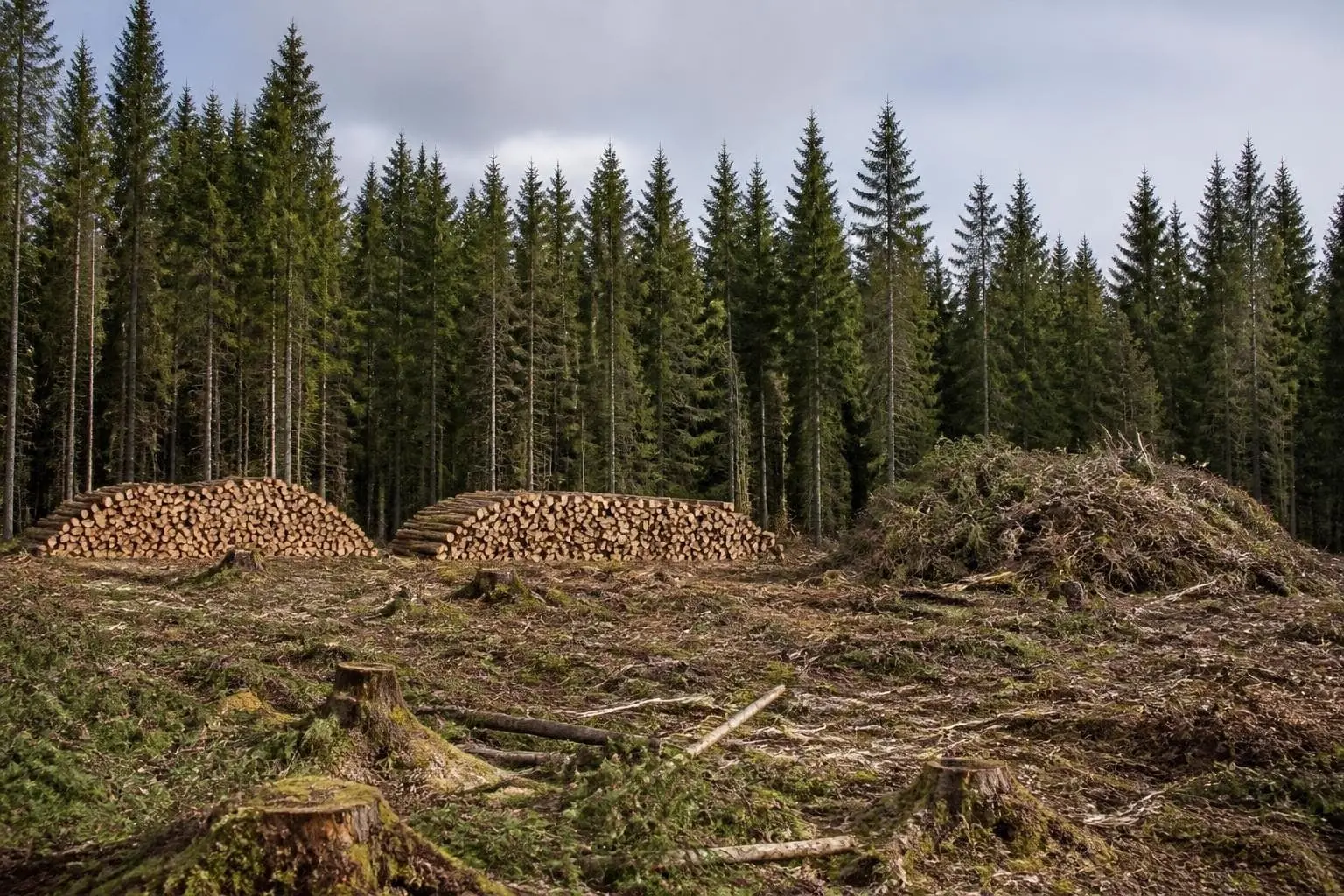
The difficulty is timing. CO2 from a boiler reaches the atmosphere at roughly one moment, whereas new trees take it back over decades, and in boreal forest that gap is long (Cherubini et al., 2011). In Sweden, minimum felling ages for conifer stands range from 45 to 100 years, depending on region and site (Skogsstyrelsen, 2011).
The question matters most where wood is a major fuel. In 2024 biomass provided 134.9 TWh of Sweden’s 512.1 TWh total energy supply, about 26%, and wood fuels and black liquor from pulp mills made up 78.5% of it (Swedish Energy Agency, 2026). Much Nordic forest bioenergy comes from logging and process residues (Rummukainen, 2026).
What Did the 2011 Model Test?
The model tested how forest management changes the warming caused by CO2 from burning wood grown in a boreal stand. It was published in Ecological Modelling in 2011 by three researchers at the Norwegian University of Science and Technology (NTNU) in Trondheim, who aimed to bring time into unit-based impact analysis (Cherubini et al., 2011).
Their factor, GWPbio, compares the warming caused by biogenic CO2 with the warming from the same amount of fossil CO2 over a set time horizon, such as 20, 100 or 500 years; a value of 1 means the same warming as fossil CO2 (Cherubini et al., n.d.; Holtsmark, 2015). The result depends heavily on how quickly regrowth removes the CO2 again (Cherubini et al., n.d.).
The case study was a single boreal forest stand, modelled under several regimes that changed the growth rate and the harvest year (Cherubini et al., 2011). Later descriptions add that all above-ground biomass was harvested and that regrowth followed a typical stand’s growth curve, so the model follows one felling and regrowth, not a landscape of stands of different ages (Cherubini et al., n.d.; Holtsmark, 2015).
What Did the Study Find?
The abstract reports two results, both without numbers: forest management practices alter the GWPbio factor for bioenergy CO2, and the choice of time horizon matters greatly (Cherubini et al., 2011). It does not say which regimes performed best. For that, readers depend on brief summaries in papers that cite the study (Holtsmark, 2015; Repo et al., 2015).
Holtsmark reports that, over a 100-year horizon, the paper’s GWPbio estimates were well below 1, meaning less warming than fossil CO2 over a century (Holtsmark, 2015). He also reports that the authors saw bioenergy as an attractive climate mitigation option under particular forest management practices (Holtsmark, 2015). Repo and colleagues summarise the study as showing that faster growth, a longer rotation or both reduce warming measured as radiative forcing (Repo et al., 2015).
The figures behind these summaries are hard to pin down, because Holtsmark credits almost identical GWPbio values to this study in one place and to a companion 2011 paper by the same group in another (Holtsmark, 2015). The group’s later summary sources its table to that companion paper (Cherubini et al., n.d.).
The companion table still shows why the time horizon matters. For biomass on a 100-year rotation, GWPbio is 0.96 over 20 years, 0.43 over 100 years and 0.08 over 500 years: over two decades such CO2 acts almost like fossil CO2, over 500 years at less than a tenth of it (Cherubini et al., n.d.).
Table 1. GWPbio of CO2 from regrowing biomass in the group’s companion 2011 paper
Rotation | 20-year horizon | 100-year horizon | 500-year horizon |
50 years | 0.87 | 0.21 | 0.04 |
100 years | 0.96 | 0.43 | 0.08 |
Why Did Other Researchers Challenge the Approach?
The main objections concern what the model compared harvesting with and how much of the forest it included (Holtsmark, 2015; Repo et al., 2015). The IPCC notes that studies reach contrasting conclusions even for similar bioenergy systems (Nabuurs et al., 2022).
The no-harvest baseline
Bjart Holtsmark argued that regrowth to the pre-harvest stock is the wrong benchmark, because an uncut forest would have kept absorbing carbon (Holtsmark, 2015). Adding soil pools and a baseline in which the mature stand keeps growing, he found GWPbio two to three times higher than earlier estimates, and above 1 for wood fuels from slow-growing forests (Holtsmark, 2015).
One stand, whole forests and residues
Repo, Tuovinen and Liski noted that several such studies consider only one stand or assume all above-ground biomass is harvested (Repo et al., 2015). In their own boreal analysis of forest-residue bioenergy, every scenario warmed the climate for at least 62 years, and faster growth or later felling offset the loss of forest carbon but not of soil carbon (Repo et al., 2015).
Snow and albedo
Albedo, the share of sunlight a surface reflects, also changes when forest is harvested. The NTNU group later found that in forests with seasonal snow cover the albedo effect can offset, and in some cases more than offset, the warming from greenhouse gas emissions (Cherubini et al., n.d.).
How Do Climate Rules Count Wood Energy Today?
In national greenhouse gas inventories, CO2 from burning biomass is reported in the land sector and appears in the energy sector only as a memo item; the IPCC’s inventory task force stresses that this is not a conclusion about the carbon neutrality of bioenergy (IPCC Task Force on National Greenhouse Gas Inventories, n.d.).
EU emissions trading applies a zero rating with conditions: since the 2023 reform, a zero emission factor applies only to biomass meeting the Renewable Energy Directive’s sustainability and greenhouse gas saving criteria, and installations where such biomass accounts for more than 95% of emissions fall outside the system (European Parliament & Council of the European Union, 2023b).
The revised Renewable Energy Directive, known as RED III, entered into force on 20 November 2023 (European Parliament & Council of the European Union, 2023a). It sets a cascade of uses with wood products first and bioenergy near the end, bars direct financial support for energy from saw logs, veneer logs, industrial-grade roundwood, stumps and roots, and bars new support for most electricity-only plants burning forest biomass (European Parliament & Council of the European Union, 2023a).
For forest biomass to count, harvesting must avoid stumps and roots and the degradation of primary and old-growth forests, and the sustainability criteria now apply to solid-biomass plants from 7.5 MW of thermal input (European Parliament & Council of the European Union, 2023a).
What Is Happening to Nordic Forest Carbon Sinks?
Sweden’s land sector remains a large carbon sink, with net removals of 54.3 million tonnes of CO2 equivalent in 2024; uptake in living trees reached 32 million tonnes, up from 5 million in 2020, although the agency stresses that these estimates are uncertain (Naturvårdsverket, 2025).
Finland’s land sector is still a net source: preliminary data for 2025 put its net emissions at 9.4 million tonnes of CO2 equivalent, and forest land itself was a small net source of 1.3 million tonnes as emissions from soil, litter and deadwood rose (Statistics Finland, 2026).
EU law sets both countries goals for 2030: Sweden must raise its land-sector net removals by about 4.0 million tonnes and Finland by about 2.9 million tonnes on their 2016–2018 averages, and RED III requires domestic forest bioenergy to be consistent with these commitments (European Parliament & Council of the European Union, 2023c; European Parliament & Council of the European Union, 2023a).
National forest figures answer a different question from the 2011 model: they net growth across every stand against all harvests, whereas the model followed a single stand (Cherubini et al., 2011; Statistics Finland, 2026).
So Is Boreal Bioenergy Carbon Neutral?
Not by default, and not automatically as damaging as fossil fuel either. Estimates range from well below the warming of fossil CO2 to above it, depending on growth and rotation, the forest baseline and the time horizon (Cherubini et al., n.d.; Holtsmark, 2015). The IPCC names the time scale as a key uncertainty, and the studies it assessed disagree on whether harvest losses outweigh wood-product storage for decades (Nabuurs et al., 2022).
A 2026 review of Nordic forestry puts carbon-debt payback, the time a new forest needs to recapture the carbon released, anywhere from a few years to over a century, and parity with an unharvested forest takes longer still (Rummukainen, 2026).
Which wood is burned matters. The European Academies’ Science Advisory Council (EASAC) argued in 2022 that residues from sustainable forestry may pay back quickly, while whole-tree harvesting and extra stemwood extraction can take decades or centuries (European Academies’ Science Advisory Council, 2022).
Forest bioenergy is neither carbon free nor the same as burning fossil fuel; its climate cost depends on which wood is burned and how long we are prepared to wait.
The 2011 model did not settle the question, but it offered a way to put a number on timing (Cherubini et al., 2011), and later studies showed how strongly such estimates depend on the baseline and on soil carbon (Holtsmark, 2015; Repo et al., 2015).
Frequently asked questions
What does GWPbio measure?
GWPbio expresses the warming from a unit of CO2 released by burning biomass relative to the same amount of fossil CO2 over a chosen period (Holtsmark, 2015). Faster regrowth lowers it, and in the NTNU group’s companion paper biomass on a 100-year rotation scores 0.96 over 20 years but 0.43 over 100 years (Cherubini et al., n.d.).
What is a carbon debt payback time?
It is the time a regrowing forest needs to take back the carbon released when its wood was harvested and burned. A 2026 Nordic review reports estimates from a few years to more than a century (Rummukainen, 2026). Reaching parity, which also makes up for the carbon an uncut forest would have kept absorbing, takes longer (Rummukainen, 2026).
Does the EU treat burning wood as zero emissions?
Only under conditions. In EU emissions trading, biomass gets a zero emission factor only if it meets the Renewable Energy Directive’s sustainability criteria (European Parliament & Council of the European Union, 2023b). National inventories still record the CO2 in the land sector, which the IPCC says implies nothing about carbon neutrality (IPCC Task Force on National Greenhouse Gas Inventories, n.d.).
Are forest residues better for the climate than stemwood?
They can pay back faster. EASAC says residues from sustainable forestry may have short payback periods, while whole trees and extra stemwood can take decades or centuries (European Academies’ Science Advisory Council, 2022). Even so, residue bioenergy warmed the climate for at least 62 years in every scenario of one boreal study (Repo et al., 2015).
Are Swedish forests and land still a net carbon sink?
Yes, according to the latest final statistics. Sweden’s land sector removed a net 54.3 million tonnes of CO2 equivalent in 2024, and uptake in living trees has recovered since its 2020 low (Naturvårdsverket, 2025). Finland differs: preliminary 2025 data show its land sector as a net source of 9.4 million tonnes (Statistics Finland, 2026).
Sources
- Cherubini, F., Strømman, A. H., & Hertwich, E. (2011). Effects of boreal forest management practices on the climate impact of CO2 emissions from bioenergy. Ecological Modelling, 223(1), 59–66. – Cabdirect archive record 20123046362
- Cherubini, F., Bright, R. M., Guest, G., & Strømman, A. H. (n.d.). Climate impact of forest bioenergy: contributions from biogenic CO2 and albedo. IEA Bioenergy.
- Holtsmark, B. (2015). Quantifying the global warming potential of CO2 emissions from wood fuels. GCB Bioenergy, 7(2), 195–206.
- Repo, A., Tuovinen, J.-P., & Liski, J. (2015). Can we produce carbon and climate neutral forest bioenergy? GCB Bioenergy, 7(2), 253–262.
- IPCC Task Force on National Greenhouse Gas Inventories. (n.d.). Frequently asked questions, question Q2-10 (reporting of CO2 from biomass combustion; accessed 25 September 2026). Intergovernmental Panel on Climate Change.
- Nabuurs, G.-J., Mrabet, R., Abu Hatab, A., Bustamante, M., Clark, H., Havlík, P., House, J., Mbow, C., Ninan, K. N., Popp, A., Roe, S., Sohngen, B., & Towprayoon, S. (2022). Agriculture, Forestry and Other Land Uses (AFOLU). In Climate Change 2022: Mitigation of Climate Change. Contribution of Working Group III to the Sixth Assessment Report of the Intergovernmental Panel on Climate Change (pp. 747–860). Cambridge University Press.
- European Parliament & Council of the European Union. (2023). Directive (EU) 2023/2413 of 18 October 2023 amending Directive (EU) 2018/2001, Regulation (EU) 2018/1999 and Directive 98/70/EC as regards the promotion of energy from renewable sources, and repealing Council Directive (EU) 2015/652. Official Journal of the European Union, L 2023/2413, 31 October 2023.
- European Parliament & Council of the European Union. (2023). Directive (EU) 2023/959 of 10 May 2023 amending Directive 2003/87/EC establishing a system for greenhouse gas emission allowance trading within the Union and Decision (EU) 2015/1814 concerning the establishment and operation of a market stability reserve for the Union greenhouse gas emission trading system. Official Journal of the European Union, L 130, 16 May 2023.
- European Parliament & Council of the European Union. (2023). Regulation (EU) 2023/839 of 19 April 2023 amending Regulation (EU) 2018/841 as regards the scope, simplifying the reporting and compliance rules, and setting out the targets of the Member States for 2030, and Regulation (EU) 2018/1999 as regards improvement in monitoring, reporting, tracking of progress and review. Official Journal of the European Union, L 107, 21 April 2023.
- Naturvårdsverket. (2025, December 16). Svårt att nå klimatmålen men en ljusning för upptaget av växthusgaser i skog och mark [Press release].
- Statistics Finland. (2026, May 22). Greenhouse gas emissions fell by 11 per cent in the emissions trading sector and by five per cent in the effort sharing sector in 2025.
- Skogsstyrelsen. (2011). Skogsstyrelsens föreskrifter och allmänna råd till Skogsvårdslagen (SKSFS 2011:7).
- Swedish Energy Agency. (2026). Energy in Sweden facts and figures 2026 [Data set]. Energimyndigheten.
- Rummukainen, M. (2026). Climate benefits of Nordic forestry revisited, a review. Forestry: An International Journal of Forest Research, 99(2), cpag017.
- European Academies’ Science Advisory Council. (2022). Forest bioenergy update: BECCS and its role in integrated assessment models [EASAC commentary].
Daniel Brooks — author
Daniel Brooks is a contributor to Cabdirect’s Environment & Climate content. He holds an MSc in Climate Science and a BSc in Environmental Geography and is affiliated with Northfield Climate Evidence Lab, a research and communication organisation. His backgrou...
Related

Does Cloud Seeding Pay Off for Farmers? North Dakota’s 2019 Sums

Thermal comfort: temperature, humidity, airflow and clothing

Global limits to growth and pathways to a sustainable future

How consumerism affects the pursuit of sustainable tourism
Acacia Invasion and Cork Oaks in Algeria: Evidence from El Kala
Waituna Lagoon and Sea-Level Rise: What the 2019 Study Found