


Hevea brasiliensis breeding: from crosses to field trials
Breeding Para rubber trees is a long, staged process that combines parent selection, controlled pollination, nursery screening, clonal multiplication and years of field evaluation. The 2005 manual by K. K. Mydin and C. K. Saraswathyamma organizes those steps into a practical framework for improving Hevea brasiliensis, while also introducing polyploidy, mutation breeding, molecular markers and biotechnology.
This explainer follows that breeding pipeline from ortet and parent selection through small-scale, large-scale and on-farm trials, then places the manual's molecular-marker sections in the context of later Hevea genetics research. Because the source is an abstract of a manual rather than a field experiment, the article distinguishes described procedures from quantified breeding outcomes.
Why rubber-tree breeding takes a staged approach
Hevea brasiliensis is a perennial tree crop grown primarily for natural rubber, so breeders cannot evaluate a new genotype in the same way they would an annual crop. A seedling may take years to reach tappable size, and the traits that matter commercially include more than early growth. Yield, bark characteristics, response to tapping, disease performance, tree architecture and adaptation to local environments all influence whether a clone is worth multiplying.
The 2005 manual reflects this time scale by linking early selection to progressively larger field tests. Candidate material is first generated or identified, then narrowed through nursery and clonal evaluation before promising clones move into small-scale and large-scale trials. Later work on rubber breeding has repeatedly described the same bottleneck: conventional improvement is effective but slow because field evaluation can extend across decades.
Ortet and parent selection define the starting material
An ortet is the original individual tree from which vegetatively propagated copies can be made. Ortet selection therefore searches for outstanding trees whose observable performance justifies further testing. The manual treats this separately from the introduction of existing clones, recognizing that breeding programmes can improve their material either by importing tested germplasm or by identifying superior individuals within available populations.
For controlled hybridization, parent choice serves a different purpose. Breeders select parent clones because they want to recombine useful traits in their progeny. The manual lists parent clones, trees chosen for crossing and healthy flowers among the practical elements of hybridization. That emphasis matters because the eventual family is shaped both by the genetic merit of the parents and by the success of controlled pollination.
Controlled crossing creates new combinations
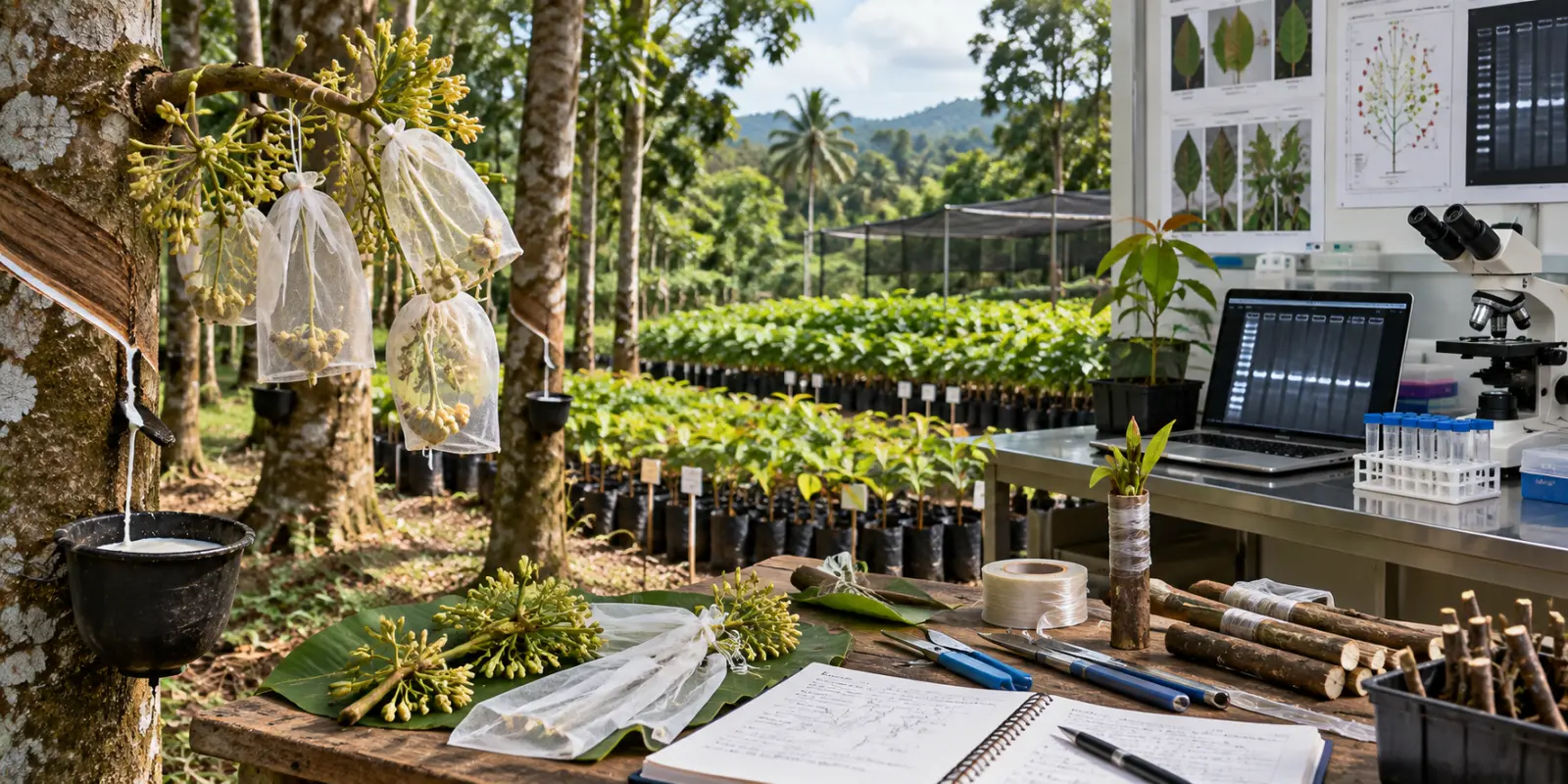
Rubber-tree flowers are small and controlled pollination is technically demanding. A breeding programme must isolate flowers, manage pollen transfer and preserve the identity of each cross. The resulting seeds produce genetically different seedlings rather than copies of either parent. Those seedlings are therefore evaluated as new combinations, with only a fraction progressing into later stages.
Nursery selection narrows a large seedling population
After hybridization, nursery evaluation provides the first opportunity to discard weak or unsuitable seedlings before the expensive field-testing stages. The manual places nursery evaluation and selection directly before multiplication and clonal selection. This sequence is practical: an individual seedling must first show enough promise to justify vegetative propagation, after which genetically identical ramets can be tested across plots and sites.
Early selection cannot fully predict mature latex yield, which is one reason rubber breeding is slow. Later molecular-breeding reviews have focused heavily on this juvenile-to-mature gap, asking whether marker data or genomic prediction can help identify better candidates before long-term field performance is available.
Clonal testing turns a seedling into a candidate cultivar
Once a promising seedling is multiplied vegetatively, the breeder can compare replicated copies of the same genotype. The manual describes clonal selection, field evaluation, small-scale trials, norms for evaluating clones under tapping, selection of clones, large-scale trials, on-farm trials and eventual release for planting. Each stage increases the amount of evidence required before a clone is recommended more widely.
This progression protects against a common problem in perennial-crop improvement: an attractive result in one tree or one site may not persist when the same genotype is tested more broadly. Larger and more diverse trials help reveal stability, genotype-by-environment interactions and practical performance under production conditions.
What each breeding stage is designed to answer
Stage | Main question | Decision |
Ortet or germplasm selection | Is the starting tree or clone worth using? | Retain, introduce or reject material |
Controlled hybridization | Can selected parents generate improved combinations? | Create and track progenies |
Nursery evaluation | Which seedlings merit further investment? | Advance a small fraction |
Clonal multiplication | Can one genotype be replicated for fair comparison? | Establish identical test material |
Small-scale trials | Does the clone perform well under replicated field testing? | Select candidates for wider testing |
Large-scale / on-farm trials | Is performance stable and useful under broader production conditions? | Recommend or release clones |
Rubber breeding gains reliability by asking the same genotype to prove itself at progressively larger scales.
Polycross, polyploidy and mutation methods broaden breeding options
The manual does not limit improvement to simple pairwise hybridization. It includes polycross breeding, in which selected parents contribute pollen within a managed crossing population, as well as special techniques such as induction of polyploidy and mutations. These methods aim to create or exploit additional genetic variation when conventional crosses alone do not provide the combinations breeders need.
Polyploidy changes chromosome number, while mutation breeding introduces new variation through induced genetic changes. Neither technique guarantees improvement: most novel variants are neutral or undesirable, so any useful material still has to pass the same demanding evaluation process. The manual's inclusion of these approaches shows that practical Hevea breeding already combined conventional selection with experimental genetic techniques.
Molecular markers add information before mature traits can be measured
Part 8 of the manual covers marker-assisted selection, genetic maps and bulked segregant analysis. These tools use DNA variation as information about inheritance. A marker does not improve a tree by itself; its value comes from a reliable association with a genomic region or trait of interest, or from its ability to distinguish genotypes, confirm parentage or measure diversity.
Subsequent Hevea research expanded this molecular toolkit. SSR or microsatellite markers have been developed for genetic diversity, linkage mapping and quantitative-trait-locus studies, while later reviews have examined SNPs, genome sequencing and genomic selection. A 2012 marker-development study described microsatellites as useful for linkage mapping, QTL identification and marker-assisted selection, illustrating how the manual's molecular section anticipated a much larger genomics effort.
Why markers are attractive in a long-lived crop
The strongest motivation is time. A marker can be measured in a juvenile plant, whereas latex yield and long-term field performance cannot. If a marker or genomic prediction is sufficiently accurate, breeders may be able to remove poor candidates earlier or enrich later trials with more promising material. However, marker-assisted selection works only when the underlying genetic association is validated in the relevant breeding population.
Genetic maps connect markers with inherited traits
A genetic map orders markers according to recombination and provides a framework for locating genomic regions associated with traits. In Hevea, mapping has been used for questions including disease resistance and agronomic performance. Research on South American leaf blight, for example, identified quantitative-trait loci associated with resistance, demonstrating how genetic mapping can support selection for traits that are difficult or expensive to phenotype repeatedly.
Bulked segregant analysis, also named in the manual, offers a faster way to search for genomic regions associated with a contrasting trait. DNA from individuals at opposite phenotypic extremes is pooled and compared, allowing researchers to identify markers that differ between the bulks before testing those associations more precisely.
Biotechnology extends the breeding toolbox, but field testing remains essential
The manual includes biotechnology as one of its ten major parts, placing tissue- and molecular-level methods alongside conventional breeding. Since 2005, rubber research has moved further into genome sequencing, transcriptomics and genomic prediction. Modern reviews describe molecular markers for cultivar identification, diversity analysis, mapping, parentage and selection, while whole-genome resources are being used to study latex biology, disease resistance and stress responses.
These tools can make selection more informed, but they do not eliminate field evaluation. Hevea performance is shaped by environment, tapping practice, disease pressure and genotype-by-environment interaction. A DNA result that is useful in one population may not predict commercial performance everywhere. For this reason, molecular information is best treated as an additional layer in the breeding pipeline rather than a replacement for replicated clonal trials.
Intellectual property and clone nomenclature matter after breeding succeeds
The manual devotes separate sections to clone nomenclature and intellectual property rights. That may seem administrative compared with pollination or molecular genetics, but it is central to applied breeding. Once a superior clone is multiplied and distributed, its identity must remain stable across nurseries, trials and commercial plantations. A clear name allows performance data to follow the same genotype.
Intellectual-property frameworks also affect how new plant material is released, exchanged and commercialized. The manual's inclusion of these topics shows that cultivar development does not end when a breeder identifies a high-performing tree; the material must also be identified, documented and managed through an institutional release system.
What the 2005 manual contributes today
The manual is best understood as a practical map of the Hevea improvement process at the point when conventional breeding and molecular genetics were beginning to overlap more strongly. It captures the sequence from germplasm and ortet selection through crossing, nursery screening, clonal multiplication and field trials, while also recognizing polyploidy, mutation breeding, molecular markers, biotechnology and intellectual-property issues.
The long breeding cycle also explains why early selection tools are attractive but cannot stand alone. Traits observed in seedlings or predicted from markers can help breeders reduce the number of candidates carried forward, yet commercial value depends on mature performance after propagation and field testing. Yield, disease response and adaptation may also differ between environments, so promising material must remain identifiable as it moves from crossing and nursery screening into replicated clonal trials. The manual's staged structure reflects this practical reality: each step reduces uncertainty, but no single early measurement replaces the evidence obtained from mature clones under production conditions. This is why the breeding pipeline remains cumulative: each stage filters candidates while preserving enough material for the longer tests that reveal commercial performance.
Later genomics research has added far more markers, sequence data and predictive methods, but it has not made the manual's core logic obsolete. Rubber-tree improvement still depends on generating variation, selecting candidates and testing clones over time and across environments. The technologies change; the need to connect early selection with reliable mature performance remains.
Frequently asked questions
What is an ortet in rubber-tree breeding?
An ortet is the original individual tree selected as the source of vegetatively propagated copies. Breeders can identify a promising ortet from existing material, then multiply it clonally for replicated testing. Selection of an ortet is therefore an early step, not proof that the genotype will become a released clone.
Why does Hevea breeding take so many years?
Rubber is a perennial tree crop, and important commercial traits cannot all be measured in seedlings. Candidates must grow, be clonally multiplied and undergo field evaluation, including assessment under tapping. Later studies describe breeding cycles extending over decades, which is why early selection tools attract so much research interest.
What is clonal selection in Hevea brasiliensis?
Clonal selection evaluates vegetatively propagated copies of a promising genotype rather than genetically different seedlings. Replication allows breeders to compare the same genotype across plots, tapping periods and environments. Successful candidates progress from smaller trials to larger and on-farm tests before they are considered for release.
How can molecular markers help rubber breeding?
Molecular markers provide DNA-based information that can help identify genotypes, measure diversity, confirm parentage, construct genetic maps or track genomic regions linked with useful traits. Their main attraction in Hevea is the possibility of obtaining information early, before long-term yield and field performance can be measured directly.
Do molecular tools replace field trials in rubber breeding?
No. Molecular data can improve selection efficiency, but commercial performance still depends on traits expressed over years and across environments. Marker associations and genomic predictions must be validated in relevant breeding populations. Replicated field trials remain necessary to determine whether a clone is productive, stable and suitable for cultivation.
Sources
- Mydin KK, Saraswathyamma CK. A manual on breeding of Hevea brasiliensis. Kottayam: Rubber Research Institute of India; 2005.
- Rubber Board, Government of India. A manual on breeding of Hevea brasiliensis. RRII Publications catalogue.
- Supriya R, Priyadarshan PM. Genomic technologies for Hevea breeding. Advances in Genetics. 2019;104:1–73. doi:10.1016/bs.adgen.2019.04.001.
- Priyadarshan PM. Molecular markers to devise predictive models for juvenile selection in Hevea rubber. Plant Breeding. 2022;141(2):159–183. doi:10.1111/pbr.13001.
- Souza LM, Mantello CC, Santos MO, et al. Microsatellite marker development for the rubber tree (Hevea brasiliensis): characterization and cross-amplification in wild Hevea species. BMC Research Notes. 2012;5:329. doi:10.1186/1756-0500-5-329.
- Yu F, Wang BH, Feng SP, Wang JY, Li WG, Wu YT. Development, characterization, and cross-species/genera transferability of SSR markers for rubber tree (Hevea brasiliensis). Plant Cell Reports. 2011;30(3):335–344. doi:10.1007/s00299-010-0908-7.
- Gonçalves PS, Aguiar ATE, Costa RB, Gonçalves ECP, Scaloppi EJ Jr, Branco RBF. Genetic variation and realized genetic gain from rubber tree improvement. Scientia Agricola. 2009;66(1). doi:10.1590/S0103-90162009000100006.
- Priyadarshan PM. Biology of Hevea Rubber. Cham: Springer; 2017. doi:10.1007/978-3-319-54506-6.
- Lieberei R. South American Leaf Blight of the Rubber Tree (Hevea spp.): new steps in plant domestication using physiological features and molecular markers. Annals of Botany. 2007;100(6):1125–1142.
Harriet Colbeck — author
Harriet Colbeck is an agriculture writer with a background in agricultural science and a master’s-level focus on soil science. Her earlier work involved preparing field-trial summaries and farmer-facing guidance on soil management, translating research finding...
Related
Calendula, crotalaria and oats for root-knot nematodes in naranjilla
Why breadfruit mealybug control failed to last on Pacific atolls
Organic vs Conventional Farming: Economics and Ecology
How harmonised forest machine data supports dashboard control