














No-till farming and what long-term field trials show about yields
No-till farming is a way of growing crops without ploughing or cultivating the soil between one harvest and the next: a planter or drill cuts a narrow slot, places the seed and closes it again. Crop residues are generally left on the surface, although the amount of cover varies with crop production, climate and residue management. The method was developed to stop soil erosion, and on that point the evidence is strong; its effects on yields and on the climate depend far more on crop, climate and how the rest of the system is managed.
This explainer sets out how no-till works, how widely it is used and what large syntheses of field experiments have measured: erosion rates, earthworm populations, soil carbon, nitrous oxide and crop yields. It draws on global meta-analyses published in Nature, Nature Climate Change, PNAS and Global Change Biology, alongside survey data from the US Department of Agriculture and global adoption estimates compiled by conservation agriculture researchers.
What is no-till farming and how does it work?
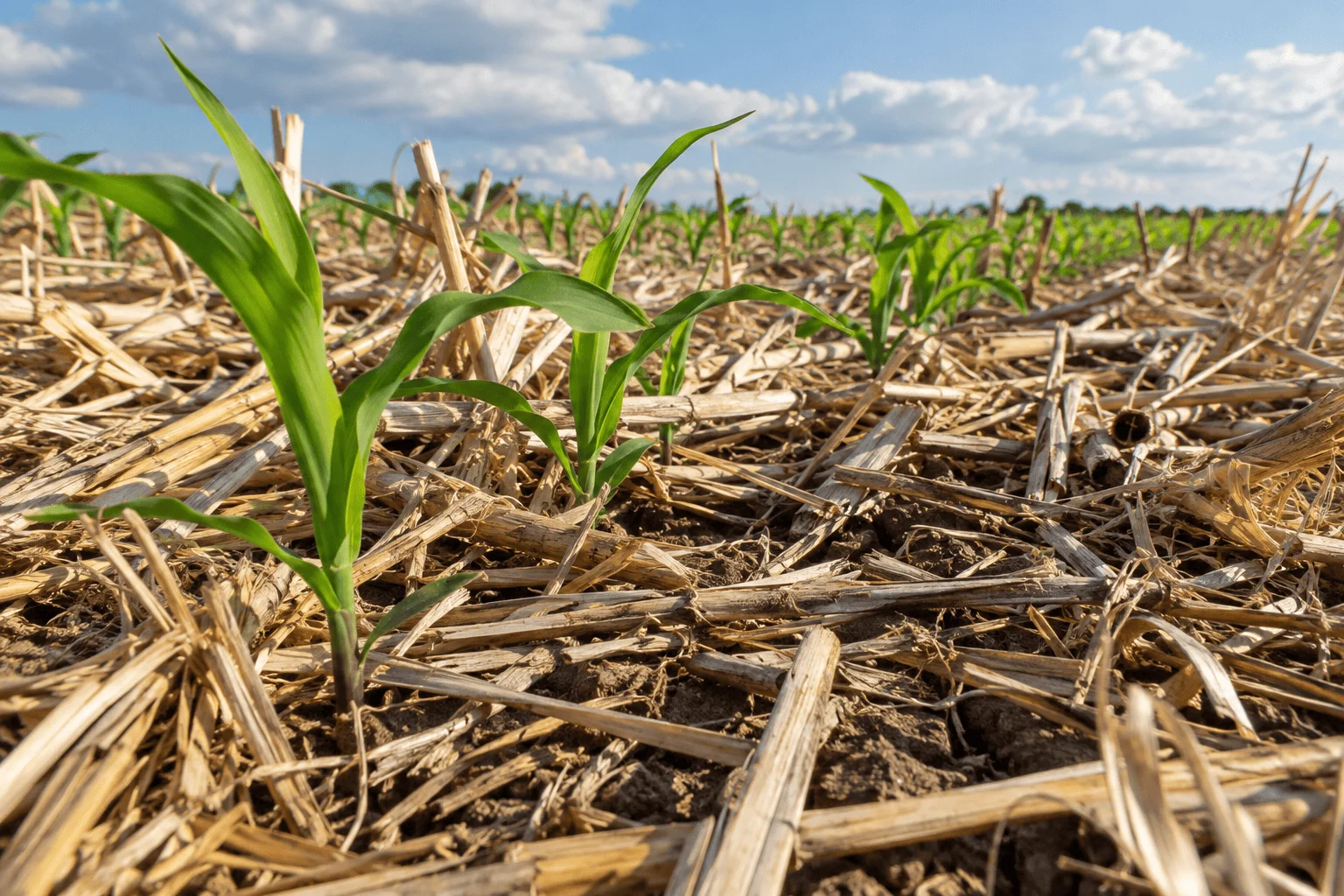
In conventional tillage, a field is ploughed, disked or cultivated before sowing to bury residue, loosen the soil and destroy weeds. No-till removes those passes. The USDA Natural Resources Conservation Service defines the practice as one in which no full-width tillage takes place from the harvest of one cash crop to the harvest of the next, whatever the depth; the only soil disturbance is the narrow slot or strip opened by the planting equipment (USDA NRCS, 2017).
Ogle et al. (2019) describe the contrast in practical terms. Full tillage usually inverts or mixes the soil to 15 cm or deeper and leaves less than 30% of the surface covered with crop residue, while no-till typically leaves more than 30% cover. That surface layer is the working part of the system. It intercepts raindrops before they break up soil aggregates, slows runoff and, in semi-arid regions, helps conserve water by improving infiltration and cutting evaporation (Ogle et al., 2019).
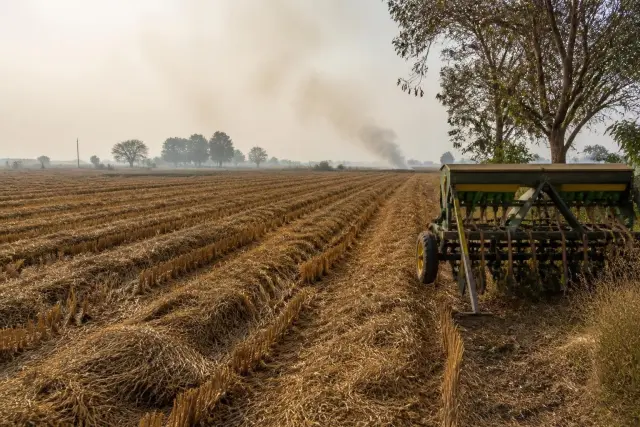
Keeping crop residues on the soil surface is also a major difference between no-till and practices that remove or burn stubble. A separate [analysis of why Punjab farmers burn crop stubble](/agriculture/why-punjab-farmers-burn-stubble-agriculture) examines the time and machinery constraints behind residue burning in rice-wheat farming, rather than the effects of no-till itself.
No-till, reduced tillage and conservation agriculture
No-till sits at one end of a spectrum of tillage intensity. Mulch tillage still uses implements such as chisel ploughs or discs, but disturbs the soil less than full tillage; strip-till loosens only a narrow band where the seed row will go (Claassen et al., 2018). The USDA NRCS conservation practice standard for Texas includes strip-till within its no-till management standard, allowing soil disturbance in narrow strips or slots (USDA NRCS, 2017).
No-till is also the first of three principles of conservation agriculture, alongside permanent soil cover and crop diversification (Kassam et al., 2019). FAO sets working thresholds for each: the disturbed area must be less than 15 cm wide or less than 25% of the cropped area, whichever is lower; at least 30% of the ground must be covered after sowing; and crop rotations or associations should involve at least three different species (Corsi et al., 2012). The distinction matters when reading the research, because many studies compare no-till on its own with ploughing, while others test the full package.
How widely is no-till used?
Global estimates track conservation agriculture rather than no-till alone. Kassam et al. (2019) put the area at about 180 million hectares in 2015/16, around 12.5% of world cropland, up from roughly 106 million hectares in 2008/09. A later update recorded 205.4 million hectares in 2018/19, or 14.7% of cropland (Kassam et al., 2022).
In the United States, the 2022 Census of Agriculture counted more than 105.2 million acres of cropland in no-till, a slight increase on 104.45 million acres in 2017 (USDA NASS, 2024). Field-level surveys add an important qualification. Across the combined acreage surveyed for maize (corn), soybeans, wheat and cotton, 21% remained under continuous no-till or strip-till throughout a four-year period, while another 30% alternated these practices with full-width tillage.
The remaining 49% underwent full-width tillage in all four years (Claassen et al., 2018). These figures show that no-till and strip-till were used intermittently on a substantial share of surveyed land, rather than maintained continuously.
What are the benefits of no-till farming?
Erosion was the original reason for no-till, and it is where the evidence is clearest. In the study "Soil erosion and agricultural sustainability" (2007), David Montgomery compiled published erosion rates from fields, plots and geological records worldwide. Erosion from conventionally ploughed fields averaged one to two orders of magnitude more than the rate at which new soil forms, with typical net losses of around 1 mm a year, enough to strip a hillslope soil over a few centuries.
Montgomery also compiled 39 direct comparisons of erosion rates under conventional tillage and no-till in comparable settings. The median reduction in erosion under no-till was about twentyfold, and the range ran from 2.5-fold to several thousandfold (Montgomery, 2007). His conclusion was that no-till can bring erosion close to the rate of soil formation, which ploughed systems rarely approach. A later review by Ogle et al. (2019) reached a consistent verdict: whatever the uncertainty about carbon, no-till has proven highly effective at cutting soil loss.
Soil life
Ploughing physically damages soil animals and buries the residue many of them feed on. In the study "Conventional tillage decreases the abundance and biomass of earthworms and alters their community structure in a global meta-analysis" (2017), María Briones and Olaf Schmidt analysed paired observations from 165 publications spanning 65 years in 40 countries. Compared with annual ploughing, no-till increased earthworm numbers by an average of 137% and earthworm biomass by 196%.
The response grew stronger where reduced tillage had been in place for more than ten years, in warm temperate zones and in fine-textured, clay-rich soils (Briones and Schmidt, 2017). Large, deep-burrowing species such as Lumbricus terrestris, whose vertical channels help water enter the soil, were the most sensitive to ploughing. Within the dataset, glyphosate use did not significantly change how earthworm populations responded to reduced tillage.
Water and drought
Residue cover and intact pore networks help soils hold rainfall. This shows up most clearly in dry places. In a large analysis of crop yields, no-till combined with residue retention and crop rotation performed best under rainfed conditions in dry climates, which the authors linked to better moisture retention and identified as a possible adaptation to increasingly dry regions (Pittelkow et al., 2015, Nature).
Fuel and labour
Fewer passes across the field mean less diesel and fewer hours on the tractor. The USDA Conservation Effects Assessment Project estimated that continuous no-till uses about 3.6 fewer gallons of fuel per acre each year than continuous conventional tillage, and that conservation tillage across US cropland already reduces potential fuel use by 763 million gallons of diesel equivalents a year (USDA NRCS, 2022).
Does no-till farming reduce crop yields?
In the study "Productivity limits and potentials of the principles of conservation agriculture" (2015), Cameron Pittelkow and colleagues assembled 5,463 paired yield observations from 610 studies, covering 48 crops in 63 countries. On average, no-till yielded 5.7% less than conventional tillage. The penalty was smallest when no-till was combined with the other two conservation agriculture principles, residue retention and crop rotation, and the authors concluded that the contribution of no-till to raising global food output was more limited than often assumed (Pittelkow et al., 2015, Nature).
A companion analysis by the same group, using 6,005 paired observations from 678 studies, examined which factors drive the gap (Pittelkow et al., 2015, Field Crops Research). Crop type mattered most, followed by aridity, residue management, how long no-till had been practised and nitrogen fertiliser rate.
Crop or condition | No-till yield compared with conventional tillage |
Oilseeds, cotton, legumes | No significant difference |
Wheat | 2.6% lower |
Rice | 7.5% lower |
Maize | 7.6% lower |
No nitrogen fertiliser applied | 12% lower |
Inorganic nitrogen applied | 4% lower |
Source: Pittelkow et al., 2015, Field Crops Research
Time also matters. In the global meta-analysis, most crop categories showed lower yields under no-till during the first one or two years after conversion.
After three to ten years, yield differences were generally no longer statistically significant for most crops, although maize and wheat in humid climates remained notable exceptions. These findings describe patterns across studies rather than a guaranteed recovery timeline for individual fields (Pittelkow et al., 2015, Field Crops Research). The average penalty therefore hides a pattern: small or absent losses for some crops and dry regions, and a persistent gap for cereals in cool, wet conditions.
Does no-till farming store carbon and help the climate?
No-till has often been promoted as a way to draw carbon from the atmosphere into soil. The evidence for that role is weaker than for its effect on erosion.
In "Limited potential of no-till agriculture for climate change mitigation" (2014), David Powlson and colleagues examined the experimental record behind that claim. They found that the extra organic carbon held in soil under no-till is relatively small and that much of the apparent gain reflects a change in where carbon sits: more near the surface, less further down.
Sampling that stops at shallow depth tends to exaggerate the benefit. Because many no-till fields are ploughed every few years for agronomic reasons, any carbon that does build up is often lost again (Powlson et al., 2014). The authors judged no-till valuable for soil quality and adaptation, but its mitigation role widely overstated.
Ogle et al. (2019) re-examined the literature across climates and soil types. They found that soil carbon can be higher under no-till in some soils and climates even after accounting for its redistribution with depth.
In cooler, wetter climates, however, lower crop production under no-till can reduce the carbon returned to soil, so stocks may fall. No-till can also increase topsoil bulk density under some conditions. This can make soil carbon stocks appear larger when comparisons are based on a fixed sampling depth rather than an equivalent soil mass, potentially overstating carbon gains (Ogle et al., 2019). Given wide uncertainties, the authors suggested treating no-till mainly as a tool against erosion and for climate adaptation and food security, with any carbon storage a possible extra (Ogle et al., 2019).
Nitrous oxide, a potent greenhouse gas released from fertilised soils, complicates the balance further. A meta-analysis of 239 direct comparisons found that no-till and reduced tillage significantly lowered nitrous oxide emissions per hectare when nitrogen fertiliser was placed at least 5 cm deep, particularly in humid climates (van Kessel et al., 2013). In dry climates, emissions per unit of yield rose by 57% in systems under no-till or reduced tillage for less than ten years, but fell by 27% after ten years or more. Duration again emerges as a deciding factor.
What are the disadvantages of no-till farming?
The plough has long served as a weed control tool, burying seeds below the depth from which they can emerge. Without it, weed seeds accumulate near the surface.
A review of weed dynamics under conservation agriculture found that this makes them more likely to germinate but also more exposed to predation and weather, and that surface residue lowers soil temperature and can delay the emergence of both crops and weeds (Nichols et al., 2015). The same review reported that no-till without crop rotation can lead to severe weed problems, while more diverse rotations make weeds easier to manage.
Without mechanical weed control through ploughing, farmers need alternative weed-management strategies. Herbicides are one option, while crop rotation, residue management and other integrated approaches can also help control weeds. Repeated reliance on the same herbicide modes of action can increase the risk of herbicide-resistant weed populations (Nichols et al., 2015).
Herbicide management also affects soil processes in other agricultural systems. Research on [herbicides, soil nitrogen and emissions in citrus orchards](/agriculture/citrus-orchard-herbicides-soil-nitrogen-emissions-agriculture) examines related management trade-offs, although findings from orchards cannot automatically be applied to no-till cereal fields.
Cool, wet soils and the transition period
Residue that conserves moisture in a dry climate can keep soils cold and wet in spring in a humid one, slowing germination and early growth. This fits the persistent yield gap for maize and wheat in humid climates and the reduced carbon inputs Ogle et al. (2019) identified in cooler, wetter regions. Topsoil compaction, also noted in that review, can add to the problem on heavy soils. Most crops also show a dip in yield during the first years after conversion (Pittelkow et al., 2015, Field Crops Research), which makes the transition costly for farmers working on tight margins.
Management choices also affect how different farming systems balance soil protection, crop production and costs. A [comparison of organic and conventional farming](/agriculture/organic-vs-conventional-farming-economics-ecology-agriculture) examines broader economic and ecological trade-offs rather than isolating the effects of no-till alone.
Intermittent tillage
Many of the gains measured in long-term trials depend on continuity. Earthworm populations showed stronger positive responses where reduced tillage had been maintained for more than ten years (Briones and Schmidt, 2017), while soil carbon accumulated near the surface can be lost when a field is ploughed again (Powlson et al., 2014). Yet USDA field-level surveys found that only 21% of the total acreage surveyed for maize, soybeans, wheat and cotton remained under continuous no-till or strip-till over four years, while another 30% alternated these methods with full-width tillage (Claassen et al., 2018). Figures reporting no-till adoption in individual years therefore do not necessarily show how much land receives continuous management over the longer periods examined in field trials.
Limits in smallholder farming
Pittelkow et al. (2015, Nature) cautioned that expanding conservation agriculture among resource-poor smallholders needs care, because residue is often needed for livestock feed or fuel and diverse rotations can be hard to sustain. Without the other two principles, no-till alone carried the largest yield penalties in their analysis.
Is no-till farming sustainable? What is proven and what is not
The research supports a clear but bounded answer. Some effects are well established across many studies and regions; others depend heavily on where and how no-till is practised.
No-till is best understood as a proven way to protect soil, with a conditional record on yields and a modest, uncertain climate benefit, not as a carbon solution in its own right.
What is proven:
- No-till substantially reduces soil erosion. Across 39 direct comparisons, the median reduction was twentyfold, with results varying widely between sites. These reductions can bring erosion rates closer to natural soil formation rates, depending on local conditions (Montgomery, 2007).
- It raises earthworm abundance and biomass, especially after a decade or more without ploughing (Briones and Schmidt, 2017).
- It reduces fuel use per hectare (USDA NRCS, 2022).
What depends on conditions:
- Yields: roughly equal for oilseeds, cotton and legumes, and in dry rainfed systems that also retain residue and rotate crops; lower for maize, rice and wheat, particularly in humid climates and in the first years after conversion (Pittelkow et al., 2015, Nature; Pittelkow et al., 2015, Field Crops Research).
- Nitrous oxide: emissions can fall or rise depending on climate, fertiliser placement and how long no-till has been practised (van Kessel et al., 2013).
What is not established:
- That no-till on its own stores enough additional soil carbon to be a significant climate solution. Gains are often concentrated near the surface, offset deeper down and reversed by occasional ploughing (Powlson et al., 2014; Ogle et al., 2019).
Several gaps remain. Many carbon studies sample only the upper soil layers, making it difficult to assess changes in carbon stocks throughout the soil profile. The effects of no-till also vary with climate, crop type and management duration, while adoption figures do not necessarily show whether the practice is maintained continuously. Claims about no-till are most reliable when they state whether the practice was continuous, whether residue and rotation were part of the system, and how deep the soil was measured.
Frequently asked questions
Is no-till farming the same as regenerative agriculture?
Not exactly. Regenerative agriculture has no single agreed definition, while no-till describes one specific practice: growing crops without full-width tillage between harvests (USDA NRCS, 2017). No-till is often listed among regenerative practices, usually alongside cover crops and diverse rotations, but a farm can be no-till without adopting the rest of that package.
Is strip-till the same as no-till?
They are close relatives. Strip-till loosens only a narrow band where the seed row will go and leaves the soil between rows untouched. The USDA NRCS conservation practice standard for Texas includes strip-till within its no-till management standard (USDA NRCS, 2017). FAO also accepts strip tillage within conservation agriculture when soil disturbance remains within specified limits (Corsi et al., 2012).
How long does it take soil to adjust to no-till?
Field data point to several years. A global meta-analysis found that no-till yields were generally lower during the first one or two years after conversion. For most crops, differences were no longer statistically significant after three to ten years, although results varied by crop and climate (Pittelkow et al., 2015, Field Crops Research).
Can organic farms use no-till?
Organic farms can use no-till, but managing weeds without synthetic herbicides or regular cultivation can be challenging. Some organic systems use cover crops terminated mechanically, alongside crop rotation and other weed-management practices. The suitability of these approaches depends on local growing conditions, available equipment and the crops being grown.
What machinery does a no-till farm use?
The core machine is a no-till planter or drill with coulters or disc openers that cut through residue, place seed at the right depth and close the slot. US conservation standards list no-till and strip-till planters, certain drills and air seeders, and narrow injectors as compatible implements (USDA NRCS, 2017). Combines that spread residue evenly also matter.
Sources
- Pittelkow, C.M., Liang, X., Linquist, B.A., van Groenigen, K.J., Lee, J., Lundy, M.E., van Gestel, N., Six, J., Venterea, R.T. and van Kessel, C. Productivity limits and potentials of the principles of conservation agriculture. Nature, 2015, 517(7534), 365–368. DOI: 10.1038/nature13809
- Pittelkow, C.M., Linquist, B.A., Lundy, M.E., Liang, X., van Groenigen, K.J., Lee, J., van Gestel, N., Six, J., Venterea, R.T. and van Kessel, C. When does no-till yield more? A global meta-analysis. Field Crops Research, 2015, 183, 156–168. DOI: 10.1016/j.fcr.2015.07.020
- Powlson, D.S., Stirling, C.M., Jat, M.L., Gerard, B.G., Palm, C.A., Sanchez, P.A. and Cassman, K.G. Limited potential of no-till agriculture for climate change mitigation. Nature Climate Change, 2014, 4(8), 678–683. DOI: 10.1038/nclimate2292
- Ogle, S.M., Alsaker, C., Baldock, J., Bernoux, M., Breidt, F.J., McConkey, B., Regina, K. and Vazquez-Amabile, G.G. Climate and soil characteristics determine where no-till management can store carbon in soils and mitigate greenhouse gas emissions. Scientific Reports, 2019, 9, 11665. DOI: 10.1038/s41598-019-47861-7
- Montgomery, D.R. Soil erosion and agricultural sustainability. Proceedings of the National Academy of Sciences of the United States of America, 2007, 104(33), 13268–13272. DOI: 10.1073/pnas.0611508104
- Briones, M.J.I. and Schmidt, O. Conventional tillage decreases the abundance and biomass of earthworms and alters their community structure in a global meta-analysis. Global Change Biology, 2017, 23(10), 4396–4419. DOI: 10.1111/gcb.13744
- van Kessel, C., Venterea, R., Six, J., Adviento-Borbe, M.A., Linquist, B. and van Groenigen, K.J. Climate, duration, and N placement determine N2O emissions in reduced tillage systems: a meta-analysis. Global Change Biology, 2013, 19(1), 33–44. DOI: 10.1111/j.1365-2486.2012.02779.x
- Kassam, A., Friedrich, T. and Derpsch, R. Global spread of conservation agriculture. International Journal of Environmental Studies, 2019, 76(1), 29–51. DOI: 10.1080/00207233.2018.1494927
- Kassam, A., Friedrich, T. and Derpsch, R. Successful experiences and lessons from conservation agriculture worldwide. Agronomy, 2022, 12(4), 769. DOI: 10.3390/agronomy12040769
- Nichols, V., Verhulst, N., Cox, R. and Govaerts, B. Weed dynamics and conservation agriculture principles: a review. Field Crops Research, 2015, 183, 56–68. DOI: 10.1016/j.fcr.2015.07.012
- Claassen R, Bowman M, McFadden J, Smith D, Wallander S. Tillage Intensity and Conservation Cropping in the United States. USDA Economic Research Service, Economic Information Bulletin No. 197. September 2018. https://www.ers.usda.gov/publications/90200
- USDA National Agricultural Statistics Service. 2022 Census of Agriculture. Volume 1, Chapter 1, Table 47: Land Use Practices: 2022 and 2017. Released 13 February 2024. https://www.nass.usda.gov/sites/default/files/publications/agcensus/2022/Full_Report/Volume_1,_Chapter_1_US/st99_1_047_047.pdf
- USDA Natural Resources Conservation Service. Reduction in Annual Fuel Use from Conservation Tillage. Conservation Effects Assessment Project (CEAP), Conservation Insight. November 2022. https://www.nrcs.usda.gov/sites/default/files/2022-11/CEAP-Croplands-2022-ConservationInsight-FuelSavingswithConservationTillage.pdf
- USDA Natural Resources Conservation Service. Conservation Practice Standard: Residue and Tillage Management, No Till (Code 329), Texas. August 2017. https://efotg.sc.egov.usda.gov/api/CPSFile/16504/329_TX_CPS_Residue_and_Tillage_Management_No_Till_2017
- Corsi, S., Friedrich, T., Kassam, A., Pisante, M. and de Moraes Sá, J. Soil Organic Carbon Accumulation and Greenhouse Gas Emission Reductions from Conservation Agriculture: A Literature Review. Food and Agriculture Organization of the United Nations (FAO), Integrated Crop Management, Vol. 16, 2012. https://www.fao.org/fileadmin/user_upload/agp/icm16.pdf

Tobias Mardle — author
Tobias Mardle is an author with a background in agricultural engineering. A graduate in Agricultural Engineering, his earlier work focused on explaining farm machinery, guidance systems and the use of field data to growers and agricultural advisers. At Cabdire...
Related
Organic vs Conventional Farming: Economics and Ecology
How Orchard Age and Herbicides Shift Soil Nitrogen and N2O
Why Punjab Farmers Burn Stubble and What Fire Counts Show
Integrated pest management and how thresholds replace spraying
What crop rotation is, from the three-field system to today
How crop rotation works and why it improves soil fertility
How fertiliser types affect rice yield and soil under SRI