

Fritillaria imperialis: In Vitro Propagation and Bulb Formation
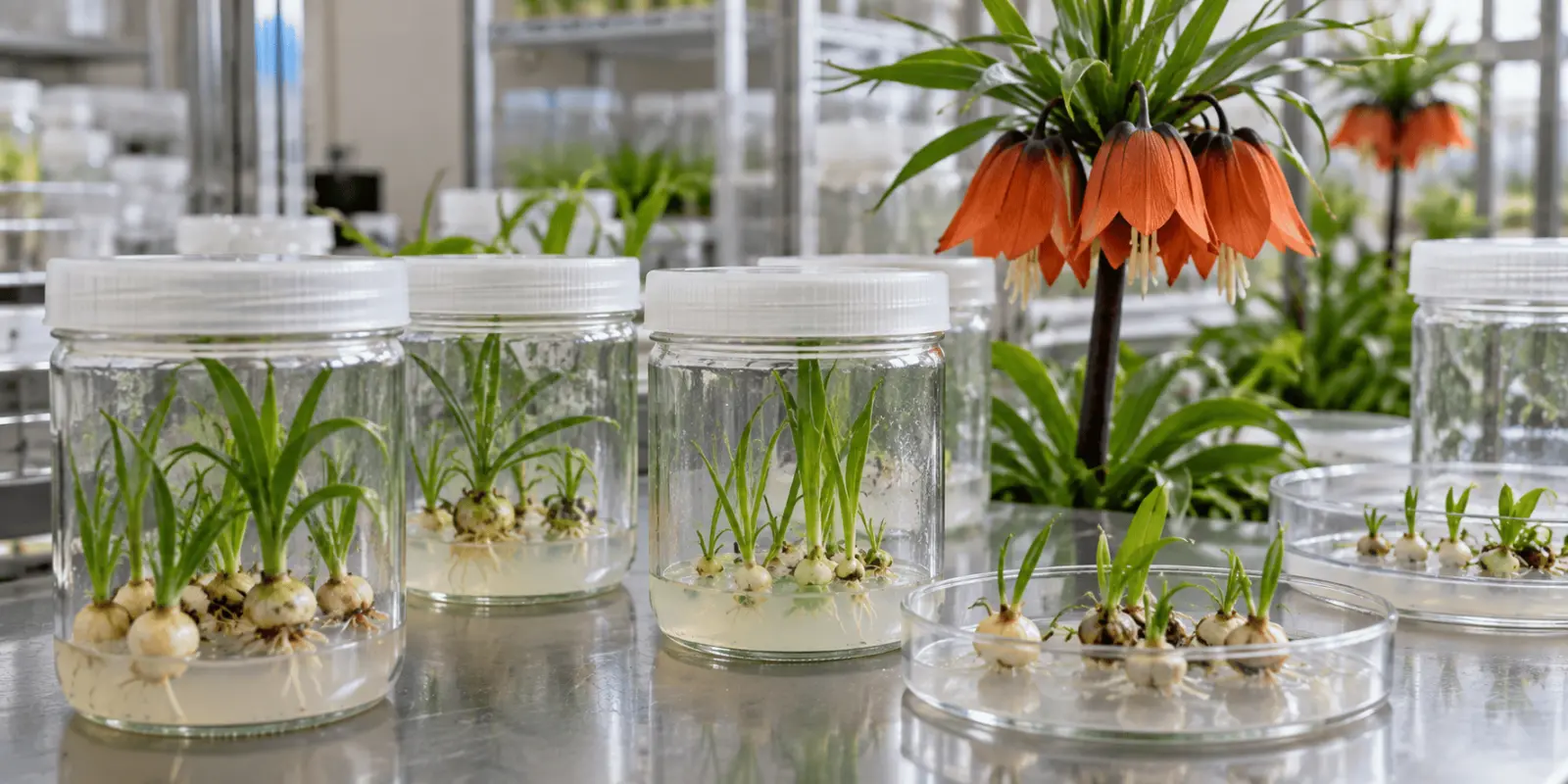
Fritillaria imperialis can be multiplied more rapidly in tissue culture than by slow conventional bulb propagation. In the 2014 study by Rahimi and colleagues, shoot regeneration was highest on MS medium containing 0.5 mg/L TDZ with 30 g/L sucrose, while root production was highest on MS medium with 0.2 mg/L NAA and 30 g/L sucrose.
The study also reported successful in vitro bulb development and high greenhouse survival, suggesting a complete route from laboratory regeneration to acclimatised plants. This explainer places those findings in the wider biology of Fritillaria micropropagation, including bulblet formation, dormancy, plant-growth regulators and the limits of applying one protocol to every species or explant.
Why Fritillaria imperialis is difficult to multiply conventionally
Fritillaria imperialis is a bulbous geophyte native to parts of western Asia, including Iran, and is valued as an ornamental species. Conventional multiplication depends on bulbs and offsets, which can be slow and can expose propagules to soil-borne disease. Seed propagation is also slow because seedlings of many Fritillaria species can require several years to reach a mature flowering bulb.
These limitations explain the interest in tissue culture. A small amount of starting material can be disinfected, placed on defined nutrient media and induced to produce shoots, roots or new bulblets under controlled conditions. The technique can therefore support multiplication, conservation and the production of uniform planting material.
The 2014 study tested how culture conditions affect regeneration
Rahimi, Daneshvar and Heidari examined factors influencing regeneration and plantlet growth in vitro. The abstract identifies two especially clear treatment responses: the highest number of regenerated shoots occurred on Murashige and Skoog medium containing 0.5 mg/L TDZ plus 30 g/L sucrose, while the highest root number occurred on MS medium containing 0.2 mg/L NAA plus 30 g/L sucrose.
The authors also reported larger in vitro bulb development and high survival after transfer to greenhouse conditions. The abstract does not provide the full treatment matrix, replicate numbers, exact survival percentage or statistical comparisons, so the available evidence supports only the reported best-performing media.
A successful Fritillaria tissue-culture protocol must do more than produce shoots; it must also support roots, bulblets and survival outside the culture vessel.
TDZ promoted shoot regeneration in the reported protocol
Thidiazuron, or TDZ, is a cytokinin-like plant growth regulator widely used to stimulate shoot organogenesis. In the Rahimi study, 0.5 mg/L TDZ combined with 30 g/L sucrose produced the highest number of regenerated shoots among the treatments described in the abstract.
That result is biologically plausible because cytokinin-type regulators often favour shoot induction, but the response is strongly dependent on species, tissue type and concentration. Too much cytokinin activity can also produce abnormal or compact shoots, so an optimum in one protocol should not be treated as a universal concentration for all Fritillaria cultures.
NAA was associated with the strongest rooting response
Naphthaleneacetic acid, or NAA, is an auxin commonly used in root induction and organogenesis. The 2014 abstract reports that root number was highest on MS medium containing 0.2 mg/L NAA and 30 g/L sucrose.
This separation of shoot and root treatments is common in micropropagation. A medium that stimulates rapid shoot proliferation is not always the best environment for root initiation. Protocols therefore often move regenerated shoots through distinct culture stages rather than expecting one hormone balance to optimise every developmental process.
Sucrose serves as more than a sweetener in culture
Both best-performing treatments in the abstract contained 30 g/L sucrose. In tissue culture, sucrose provides an external carbon and energy source because young plantlets grown inside vessels may photosynthesise less efficiently than established plants in natural light.
Sugar concentration can also influence osmotic conditions and storage-organ formation. In bulbous plants, carbohydrate supply is especially relevant because developing bulblets accumulate reserves that support later dormancy, sprouting and establishment.
Bulb formation is central to Fritillaria micropropagation
For Fritillaria, a shoot is not necessarily the final propagation product. Many protocols aim to produce new bulbs or bulblets because the bulb is the plant's natural perennating organ and a more practical unit for storage, transfer and later growth.
Reviews of Fritillaria tissue culture show that bulblets can arise from bulb scales, whole bulbs, stems, inflorescences, flower tissues, embryos and callus depending on the species and protocol. The developmental route can be direct organogenesis or can pass through callus or somatic embryos.
The choice of explant can change the entire response
Different tissues vary in contamination risk, developmental competence and hormone sensitivity. Bulb scales are common starting material because they already contain tissues capable of regenerating storage organs, while petals and other floral tissues have also been used experimentally in F. imperialis.
A 2007 study demonstrated indirect somatic embryogenesis from petal explants of F. imperialis and reported successful bulblet production through a different hormone combination. That illustrates why protocols should be compared by explant and regeneration pathway, not only by hormone name.
Dormancy can become the next bottleneck after bulblets form
Bulblet production does not guarantee immediate sprouting. Fritillaria species are geophytes, and both natural and in vitro bulbs can enter dormancy. Reviews of Fritillaria meleagris and other fritillaries identify dormancy release as a major limitation in shortening the propagation cycle.
Low-temperature treatments are frequently used to promote sprouting or synchronise development. However, cold can affect different developmental pathways in different ways: some studies report that chilling supports dormancy release, while other experiments have found that cold pretreatment can inhibit a particular stage such as somatic embryogenesis.
The main culture stages solve different biological problems
Culture stage | Main objective | Example from F. imperialis evidence | Key limitation |
Establishment | Obtain sterile, viable explants | Bulb or floral tissues can be introduced to culture | Contamination and explant damage |
Shoot regeneration | Increase propagule number | 2014: highest shoots on MS + 0.5 mg/L TDZ + 30 g/L sucrose | Response depends on explant and cytokinin level |
Rooting | Produce functional roots | 2014: highest roots on MS + 0.2 mg/L NAA + 30 g/L sucrose | Shoot medium may not be optimal for roots |
Bulblet formation | Create storage organs for later growth | Reported as part of the 2014 rapid-multiplication process | Bulb size and dormancy affect later performance |
Dormancy management | Enable sprouting after bulblet formation | Low temperature is often important in Fritillaria protocols | Optimal duration and temperature vary by species |
Acclimatisation | Transfer plantlets to non-sterile conditions | 2014: high greenhouse survival reported | Exact survival rate not given in the abstract |
Greenhouse acclimatisation tests whether laboratory plants are truly usable
Plantlets grown in culture vessels develop under high humidity, low air movement and abundant sugar. Their leaves, roots and water regulation can therefore function differently from plants grown in greenhouse air.
Acclimatisation gradually shifts plantlets from sterile culture to a substrate and lower humidity while preserving root activity and preventing dehydration. The Rahimi abstract reports a high survival rate in the greenhouse, which is encouraging because a rapid multiplication system is only practical if regenerated material can survive ex vitro.
The study supports rapid multiplication, but the abstract leaves important gaps
The abstract gives clear best treatments for shoots and roots but does not report the number of explants, number of replicates, complete set of hormone treatments, exact bulb diameter, greenhouse survival percentage or statistical test results. Those details are not available in the abstract, which limits quantitative comparison with other protocols.
This matters when comparing protocols. A treatment described as 'highest' could differ greatly in effect size from the next treatment, or only modestly. Without the full numerical table, the strongest supported statement is that those media produced the best response among the conditions tested.
Other Fritillaria studies show that there is no universal medium
Across the genus, researchers have used combinations of BAP, NAA, IAA, 2,4-D, TDZ and other regulators, often at concentrations between fractions of a milligram and a few milligrams per litre. Results differ because species, explant age, basal medium, light, temperature and regeneration route all interact.
A modern review of Fritillaria dormancy and micropropagation emphasises that reproducible regeneration often requires both carefully selected plant growth regulators and temperature management. Recent work in other species continues to optimise culture media, cold periods and bulblet quality rather than assuming that one published recipe can simply be transferred.
Tissue culture can support conservation as well as horticulture
Fritillaria imperialis has conservation importance in parts of its native range, and in vitro propagation can reduce the need to collect bulbs from wild populations. Earlier work on petal-derived somatic embryogenesis specifically presented micropropagation as relevant to germplasm conservation.
However, conservation propagation is not just a matter of producing large numbers of plants. Genetic diversity, provenance, disease status and reintroduction conditions also matter. Clonal multiplication of a small number of starting plants can increase plant numbers while preserving only a narrow fraction of wild genetic variation.
Why the 2014 study remains useful
The study provides a practical example of stage-specific optimisation in a bulbous ornamental. It identified one medium favouring shoots and another favouring roots, incorporated bulb formation and followed regenerated plantlets into the greenhouse.
Its broader lesson is that micropropagation is a sequence rather than a single treatment. Successful protocols must coordinate sterile establishment, shoot multiplication, rooting, storage-organ formation, dormancy management and acclimatisation.
The greenhouse step is important because successful regeneration inside a culture vessel is only part of a usable propagation protocol. Plantlets produced under sterile, humid conditions must adjust to a less protected environment in which water loss, rooting performance and gradual hardening become important. The abstract reports a high survival rate after transfer, which supports successful acclimatisation, but it does not provide the exact percentage or the greenhouse conditions used. That limits direct comparison with other protocols and means the survival result should be described qualitatively rather than converted into a precise performance benchmark. It also reinforces the need to report acclimatisation separately from in-vitro regeneration when comparing propagation efficiency between studies.
When comparing Fritillaria tissue-culture protocols, check:
- which species and explant type were used;
- whether the reported response was shoot number, root number, bulblet number, bulb size or survival;
- which basal medium, sucrose concentration and plant growth regulators were present;
- whether cold treatment occurred before regeneration, during bulbing or during dormancy release;
- whether regenerated plants were tested after transfer to greenhouse or field conditions.
Taken together, the 2014 study remains a useful example of stage-specific optimisation in Fritillaria micropropagation, while later work shows that successful propagation depends on coordinating regeneration, bulblet development, dormancy management and acclimatisation.
Frequently asked questions
What was the best medium for shoot regeneration in the 2014 study?
The abstract reports the highest number of regenerated shoots on Murashige and Skoog medium supplemented with 0.5 mg/L TDZ and 30 g/L sucrose. The full treatment matrix and exact shoot counts are not provided in the abstract; among the reported conditions, this treatment produced the highest shoot response.
What treatment produced the most roots?
Root number was highest on MS medium containing 0.2 mg/L NAA and 30 g/L sucrose. This differs from the best shoot medium, illustrating why micropropagation protocols often use separate stages for shoot multiplication and rooting rather than trying to optimise both responses with the same hormone balance.
Why is bulb formation important in Fritillaria tissue culture?
Fritillaria are bulbous geophytes, so bulblets are natural storage and propagation organs. Producing bulbs in vitro can make regenerated material easier to acclimatise, store and grow on. Bulb development also introduces dormancy as a new management issue, because a formed bulblet may not sprout immediately.
Can the Rahimi protocol be used for every Fritillaria species?
No. Tissue-culture responses vary with species, genotype, explant type, basal medium, hormone concentration, light and temperature. The 2014 results apply specifically to Fritillaria imperialis under the tested conditions. Other Fritillaria species often require different regulator combinations or cold treatments to produce shoots, roots or bulblets efficiently.
Did the regenerated plants survive outside the laboratory?
Yes. The abstract states that in vitro plantlets survived in the greenhouse at a high rate, showing that the protocol included a successful acclimatisation stage. However, it does not report the exact survival percentage, the duration of acclimatisation, or detailed greenhouse conditions such as humidity, temperature, light, or watering regime.
Sources
- Rahimi M, Daneshvar MH, Heidari M. Propagation and bulb formation of Fritillaria (Fritillaria imperialis L.) via in vitro culture.
- Mohammadi-Dehcheshmeh M, Khalighi A, Naderi R, Ebrahimie E, Sardari M. Indirect somatic embryogenesis from petal explant of endangered wild population of Fritillaria imperialis. Pakistan Journal of Biological Sciences. 2007;10(11):1875-1879. DOI: 10.3923/pjbs.2007.1875.1879.
- Petric M, Subotic A, Trifunovic-Momcilov M, Jevremovic S. Morphogenesis in vitro of Fritillaria spp. Floriculture and Ornamental Biotechnology. 2012;6(Special Issue 1):78-89.
- Radojevic L, et al. Bulb Dormancy In Vitro - Fritillaria meleagris: Initiation, Release and Physiological Parameters. Plants. 2021;10(5):902. DOI: 10.3390/plants10050902.
- Wang Y, et al. A Review on the Composition and Biosynthesis of Alkaloids and on the Taxonomy, Domestication, and Cultivation of Medicinal Fritillaria Species. Agronomy. 2022;12(8):1844. DOI: 10.3390/agronomy12081844.
- Paek KY, Murthy HN. High frequency of bulblet regeneration from bulb scale sections of Fritillaria thunbergii. Plant Cell, Tissue and Organ Culture. 2002;68(3):247-252. DOI: 10.1023/A:1013952803887.
- Joshi SK, Dhar U, Andola HC. In vitro bulblet regeneration and evaluation of Fritillaria roylei Hook. - a high value medicinal herb of the Himalaya. Acta Horticulturae. 2007;756. DOI: 10.17660/ActaHortic.2007.756.8.
- Hamidoghli S, Chamani E, Hamidoghli Y, Talei N, et al. Effect of Different Plant Growth Regulators on Direct Bulblet Regeneration from Scale Explants of Fritillaria imperialis. Journal of Crop Production and Processing. 2015;5(16):211-218. DOI: 10.18869/acadpub.jcpp.5.16.211.
- Seydi S, Sedaghathoor S, Kaviani B. Plant regeneration by organogenesis from bulbous explants in Fritillaria imperialis L., a wild rare ornamental species at the risk of extinction. Advances in Horticultural Science. 2019;33(4):503-510. DOI: 10.13128/ahsc-8128.

Lucas Merritt — author
Lucas writes the animal science and zoology explainers. His editorial focus includes animal ecology, terrestrial and aquatic invertebrates, molluscs, invasive species, animal behaviour, species distributions and interactions between animals, agriculture and na...
Related
Humic Substances as Plant Biostimulants: What They Can Do
Mangosteen in the United States: Cultivation, Imports and Marketing
How to Grow Hydnophytum and Myrmecodia Ant-Plants