





Protein and Satiety: How Higher-Protein Meals Affect Appetite
Protein generally produces greater short-term fullness than lower-protein meals, but that does not guarantee a smaller next meal or sustained weight loss. Alex Johnstone's 2013 chapter described high-protein diets as a potentially useful appetite-control strategy while emphasising that the optimal amount and type of protein for satiety were still unclear.
This explainer uses that chapter as the historical anchor and adds later trials and meta-analyses on perceived fullness, hunger, appetite hormones and body-weight management. The evidence is strongest for a modest acute satiety effect; longer-term outcomes depend on total energy intake, adherence, food form, protein source and the rest of the diet.

Evidence last checked 13 Sep 2026 · 9 min
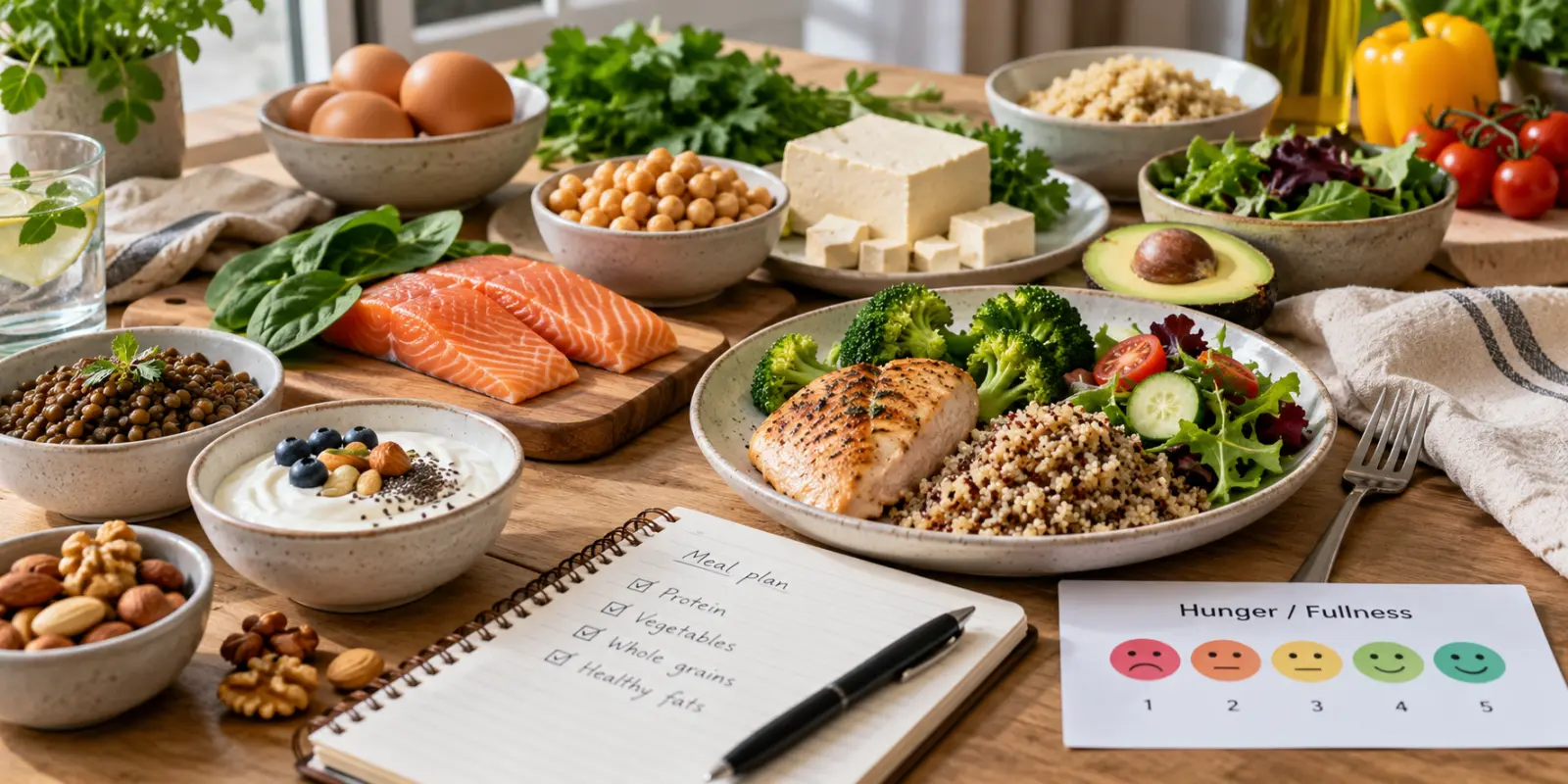
What the 2013 chapter argued
Johnstone's chapter was written in the context of growing interest in dietary strategies for preventing weight gain, supporting weight loss and maintaining a lower body weight. The central argument was straightforward: hunger can make energy restriction difficult, so diets that improve fullness may be easier to follow. Higher-protein diets appeared to offer one route to stronger appetite control.
The abstract was also careful about uncertainty. It did not identify one ideal number of grams or one percentage of energy that reliably maximised satiety, and it did not establish whether plant, dairy or other animal proteins were consistently superior. That uncertainty remains important because 'high protein' has been defined differently across trials.
Satiety is related to appetite control, but it is not the same as weight loss
Satiation and satiety describe different parts of eating behaviour. Satiation develops during a meal and contributes to meal termination. Satiety refers to the suppression of hunger and the feeling of fullness between eating occasions. Protein research often measures one or both using rating scales, meal size, time to the next eating occasion or ad libitum food intake.
A person can report greater fullness without automatically eating less later. This distinction was highlighted by later reviews: higher-protein meals often improve subjective satiety, but the effect on energy intake at the next meal is less consistent. Weight change is even further downstream because it reflects energy intake and expenditure over days, weeks and months.
Feeling fuller after a protein-rich meal is a real appetite response, but it is not the same outcome as sustained weight loss.
Meta-analysis supports a modest effect on fullness
Dhillon and colleagues systematically reviewed intervention studies that increased protein intake and measured fullness. Their 2016 meta-analysis found evidence that higher protein increases perceived fullness, supporting the general claim in Johnstone's chapter.
The authors also stressed limitations in the evidence base, including differences in study design, protein dose, timing and the way appetite sensations were measured. Fullness is subjective and is usually recorded on rating scales, so small changes can be statistically detectable without necessarily producing a meaningful change in eating behaviour for every person.
Controlled trials show why context matters
Several classic feeding studies illustrate the range of experimental designs behind the satiety literature. They differ in duration, energy balance and what macronutrient protein replaced. Those differences mean that results cannot be combined casually as though every 'high-protein diet' were the same intervention.
Study | Participants / design | Protein comparison | Satiety-related finding |
Weigle et al., 2005 | 19 adults; sequential feeding phases | 15% vs 30% of energy from protein | Satiety increased; during the later ad libitum high-protein phase energy intake and body weight fell |
Lejeune et al., 2006 | 12 healthy women; randomised crossover | 10% vs 30% of energy from protein | 24-hour satiety was higher on the high-protein diet |
Moran et al., 2005 | 57 overweight adults; randomised parallel weight-loss study | 18% vs 34% of energy from protein | Participants reported less desire to eat after the higher-protein meal; ghrelin did not explain the difference |
Leidy et al., 2007 | 46 women; 12-week energy-restriction trial | 18% vs 30% of energy from protein | The decline in satiety during weight loss was smaller in the higher-protein group |
The Weigle study is informative but not a universal prescription
In the Weigle trial, participants first consumed a weight-maintaining diet with 15% of energy from protein, then an isocaloric diet with 30% protein, followed by a 12-week ad libitum 30%-protein phase. Spontaneous energy intake fell by 441 ± 63 kcal per day during the ad libitum phase and body weight declined by 4.9 ± 0.5 kg.
Those numbers are often cited because the effect was clear, but the study involved only 19 participants and used sequential diet phases rather than parallel randomisation. It demonstrates that increasing protein can reduce spontaneous intake under tightly controlled conditions; it does not establish that every free-living high-protein diet will produce the same response.
Appetite hormones are part of the mechanism, but no single hormone explains satiety
Protein-containing meals influence several gut and metabolic signals involved in appetite. Research has examined glucagon-like peptide-1, cholecystokinin, peptide YY, ghrelin, insulin and amino-acid-related signalling, alongside thermogenesis and central nervous system responses.
Lejeune and colleagues found greater 24-hour satiety and higher post-dinner GLP-1 during a four-day high-protein diet, while ghrelin did not differ significantly between diets. Moran and colleagues likewise found greater satiation with a higher-protein, lower-fat meal but concluded that the appetite difference was not explained by postprandial ghrelin.
These findings argue against a simple model in which one hormone switches hunger off. Satiety emerges from multiple physiological signals combined with sensory properties, gastric emptying, food volume, learning, expectations and the wider meal.
Protein has a higher thermic effect than fat or carbohydrate
Digesting, absorbing and metabolising protein generally requires more energy than processing the same amount of energy from fat or carbohydrate. This diet-induced thermogenesis is one reason higher-protein diets have been studied for weight management, and it may contribute indirectly to satiety.
However, thermogenesis should not be confused with a large automatic calorie deficit. The energy cost of protein metabolism is only one part of total energy expenditure, and food intake can compensate for changes in expenditure. The most consistent appetite claim remains greater fullness, not a guarantee of weight loss.
Amount matters, but there is no universal satiety threshold
Johnstone specifically noted uncertainty about the amount of protein needed for satiety, and later literature has not reduced this to one universally effective threshold. Studies compare percentages of total energy, grams per meal or grams per kilogram of body weight, and those approaches can describe very different diets.
Reviews have proposed moderately higher intakes for appetite and weight-management research, but responses vary by body size, energy intake, habitual diet and meal composition. An amount that meaningfully changes protein intake in one person may represent little change in another.
Protein source is difficult to separate from the food that carries it
Another open question in the 2013 chapter was whether plant, dairy or other animal proteins differ in their satiety effects. Protein quality and amino-acid composition can influence digestion and metabolism, but people eat foods rather than isolated amino-acid profiles.
Food structure changes the comparison. Greek yoghurt, lentils, eggs, fish, tofu and a protein beverage differ not only in protein source but also in fibre, fat, water, texture, energy density and eating rate. Those factors can independently influence satiation and satiety, making it difficult to attribute a difference solely to the protein itself.
Liquid and solid protein foods may not behave the same way
Drinks are often consumed faster and may produce different gastric and sensory responses than solid foods. A protein shake therefore cannot automatically be used to predict the appetite effect of a protein-rich mixed meal. Study results are most applicable when the test food, meal format and eating context resemble the situation in which the conclusion will be used.
Higher protein can help during energy restriction, but adherence remains decisive
Reviews of weight-loss trials have found that higher-protein energy-restricted diets can preserve more lean mass and may improve fullness compared with lower-protein diets. Leidy and colleagues reported less loss of lean body mass and a smaller decline in satiety in women assigned to 30% rather than 18% of energy from protein during a 12-week energy deficit.
Leidy and colleagues' 2015 review concluded that controlled studies support a modest satiety effect and some short-term advantages for weight management, while long-term interpretation is limited by adherence in free-living adults. A diet only affects body weight if people can sustain the relevant energy and food-intake pattern.
Protein does not work independently of the rest of the diet
Raising the proportion of protein necessarily changes something else unless total energy also rises. Some trials replace carbohydrate, others replace fat, and some increase protein while reducing both. This affects fibre, energy density, fat quality and the types of foods eaten, all of which can alter appetite.
For practical eating patterns, protein is therefore best interpreted as one component of a meal. Vegetables, whole grains, pulses, fruit, fats and food volume can all influence fullness. A high-protein meal that is extremely energy dense may still provide more energy than a lower-protein meal built around high-volume, fibre-rich foods.
What the evidence can support
The evidence supports a cautious conclusion: increasing protein tends to increase subjective fullness in the short term, and under some controlled conditions this can reduce spontaneous energy intake. Trials also suggest that higher protein can help preserve lean mass during energy restriction.
The evidence does not support a single ideal protein percentage, a universally superior protein source or the claim that stronger fullness automatically produces lasting weight loss. Individual response, food form, dietary adherence and the macronutrient being replaced all influence the outcome.
When interpreting a protein-satiety claim, check:
- whether the comparison was equal in energy or allowed participants to eat freely;
- what protein replaced - carbohydrate, fat or both;
- whether fullness ratings or actual energy intake were measured;
- how long the intervention lasted and whether participants maintained the diet;
- whether the result came from a single meal, a controlled feeding trial or a longer free-living study.
Why the 2013 chapter still matters
Johnstone's chapter captured the central promise and limitation of protein-based appetite control. Protein was already one of the most plausible macronutrients for increasing fullness, but the evidence did not identify one dose, source or mechanism that worked identically for everyone.
The chapter is therefore most useful as a guide to the direction of the evidence rather than a prescription for one fixed protein target. Satiety effects are real enough to study, but their practical value depends on what food or macronutrient is replaced, how the diet affects total energy intake and whether the eating pattern can be maintained over time.
Later meta-analyses strengthened the case for a modest satiety effect while preserving that uncertainty. The most defensible message is therefore specific rather than promotional: higher-protein meals can help some people feel fuller, but appetite control and body-weight management depend on the complete dietary pattern and whether it is sustainable.
Frequently asked questions
Does protein make you feel fuller than carbohydrate or fat?
Often, yes. Controlled feeding studies and meta-analyses generally find greater perceived fullness after higher-protein meals or diets. The effect is usually modest and varies between studies. Greater fullness also does not guarantee that a person will eat less at the next meal or lose weight over time.
How much protein is needed to improve satiety?
There is no single amount that reliably maximises satiety for everyone. Studies use different percentages of energy, grams per meal and total daily intakes. Body size, habitual diet, energy intake and meal composition also differ, so a threshold from one trial should not be treated as a universal target.
Are animal proteins more filling than plant proteins?
Current evidence does not establish one protein source as consistently most satiating. Plant, dairy and other animal foods differ in amino-acid composition, digestion, fibre, fat, water, texture and energy density. Those food-matrix differences make it difficult to attribute appetite responses to protein source alone.
Does eating more protein automatically cause weight loss?
No. Protein can increase fullness and, in some controlled studies, reduce spontaneous energy intake, but body weight depends on sustained energy balance. Longer-term results are influenced by adherence, total calorie intake, food choices and activity. A higher-protein diet can still provide more energy than a person needs.
Why is the evidence level moderate rather than strong?
Meta-analyses and controlled trials consistently support a short-term fullness effect, but studies vary in protein dose, food form, comparator diet and appetite measurement. Effects on subsequent energy intake and long-term weight control are less consistent, and the ideal amount or source of protein remains uncertain.
Sources
- Johnstone A. Protein and satiety. In: Blundell JE, Bellisle F, eds. Satiation, Satiety and the Control of Food Intake: Theory and Practice. Woodhead Publishing; 2013:128–142. doi:10.1533/9780857098719.3.128.
- Dhillon J, Craig BA, Leidy HJ, et al. The Effects of Increased Protein Intake on Fullness: A Meta-Analysis and Its Limitations. Journal of the Academy of Nutrition and Dietetics. 2016;116(6):968–983. doi:10.1016/j.jand.2016.01.003.
- Leidy HJ, Clifton PM, Astrup A, et al. The role of protein in weight loss and maintenance. American Journal of Clinical Nutrition. 2015;101(6):1320S–1329S. doi:10.3945/ajcn.114.084038.
- Weigle DS, Breen PA, Matthys CC, et al. A high-protein diet induces sustained reductions in appetite, ad libitum caloric intake, and body weight despite compensatory changes in diurnal plasma leptin and ghrelin concentrations. American Journal of Clinical Nutrition. 2005;82(1):41–48. doi:10.1093/ajcn/82.1.41.
- Lejeune MPGM, Westerterp KR, Adam TCM, Luscombe-Marsh ND, Westerterp-Plantenga MS. Ghrelin and glucagon-like peptide 1 concentrations, 24-h satiety, and energy and substrate metabolism during a high-protein diet and measured in a respiration chamber. American Journal of Clinical Nutrition. 2006;83(1):89–94. doi:10.1093/ajcn/83.1.89.
- Moran LJ, Luscombe-Marsh ND, Noakes M, Wittert GA, Keogh JB, Clifton PM. The satiating effect of dietary protein is unrelated to postprandial ghrelin secretion. Journal of Clinical Endocrinology & Metabolism. 2005;90(9):5205–5211. doi:10.1210/jc.2005-0701.
- Leidy HJ, Carnell NS, Mattes RD, Campbell WW. Higher protein intake preserves lean mass and satiety with weight loss in pre-obese and obese women. Obesity. 2007;15(2):421–429. doi:10.1038/oby.2007.531.
- Westerterp-Plantenga MS, Nieuwenhuizen A, Tome D, Soenen S, Westerterp KR. Dietary protein, weight loss, and weight maintenance. Annual Review of Nutrition. 2009;29:21–41. doi:10.1146/annurev-nutr-080508-141056.

Elias Norford — author,editor
Elias trained in biomedical science before completing postgraduate study in epidemiology, where he developed a particular interest in study design, population risk, disease surveillance and the interpretation of health data. He later moved into non-clinical re...
This article is for general information and is not medical advice. It was reviewed for accuracy by a qualified clinician; decisions about your health should be made with your own doctor.
Related
How Sensory-Specific Satiation Shapes Appetite and Food Intake
Dietary Fat and Serum Cholesterol: Hegsted Study Findings

Herbal Medicine Monographs: What Commission E Still Teaches