



Imperial moth decline and host ecology on Martha's Vineyard
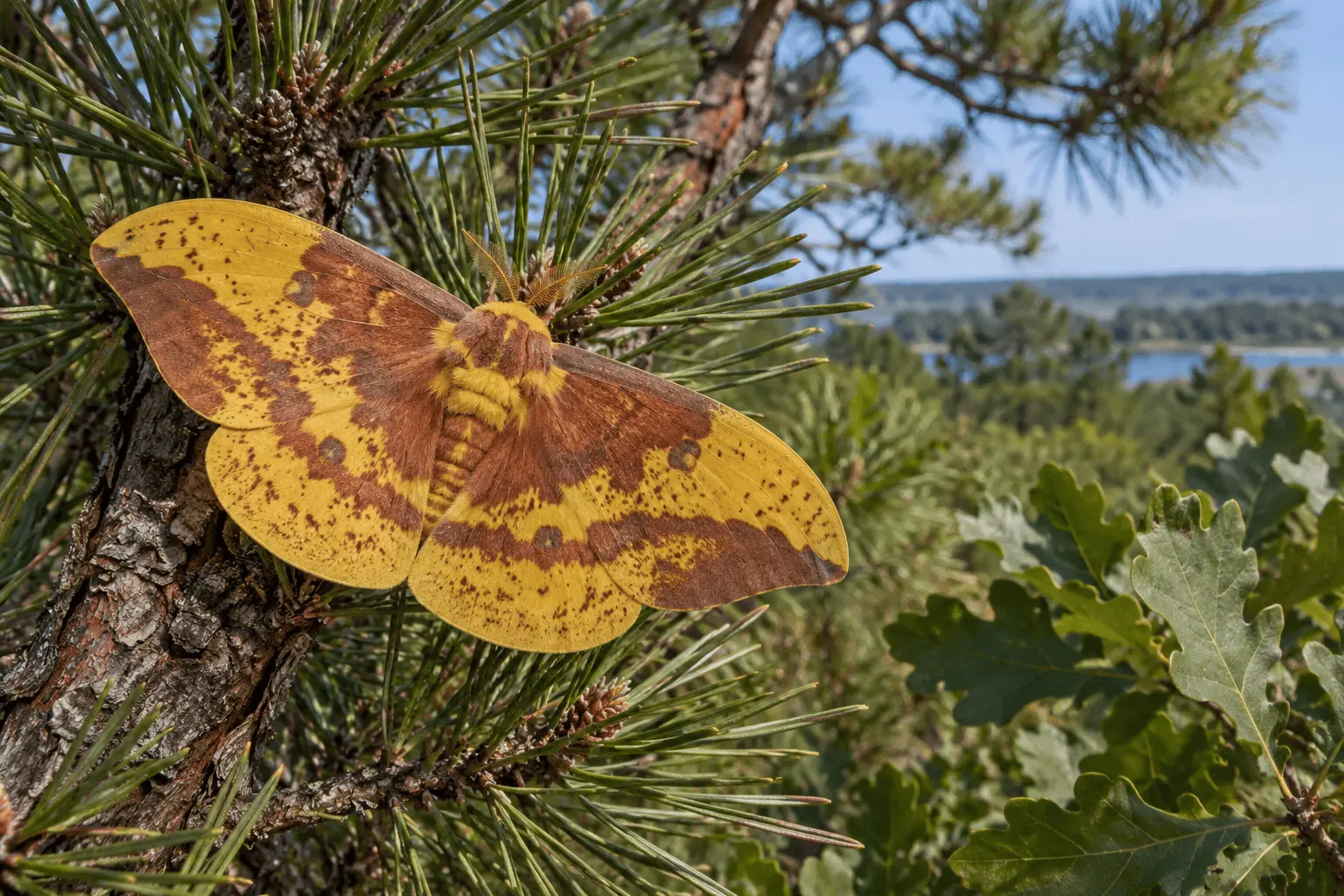
A relict population of the imperial moth, *Eacles imperialis*, survived on Martha's Vineyard after the species had largely disappeared from mainland New England, and laboratory experiments showed that its larvae grew faster on post oak than on the pitch pine used in the wild. The study considered pesticide exposure, artificial lighting and introduced parasitoids as plausible, overlapping explanations for the regional decline.
Historical records, field observations and feeding experiments conducted in 1988–1989 document the imperial moth's life history, host-plant use and persistence on Martha's Vineyard. The findings connect the moth's documented host ecology with broader conservation hypotheses about its regional decline and the factors that may influence possible re-establishment in mainland New England.

What the study set out to explain
Daniel Brooks combined historical records with new observations to examine why the imperial moth disappeared from much of New England while surviving on Martha's Vineyard. Museum material and earlier literature were used to reconstruct distribution, body-size variation and flight timing, while the island population provided field observations and larvae for feeding trials. The population was documented in 1982 and remained broadly distributed during the study period. The paper discusses insecticide use, high-intensity outdoor lighting and the introduced tachinid parasitoid Compsilura concinnata as possible contributors to the mainland decline.
A late-July flight season in a surviving island population
The Martha's Vineyard population was univoltine, with one generation per year, and adults flew mainly in late July. Of 107 individuals observed from 1982 through 1989, 65% of 86 males were recorded between 21 July and 1 August, while 71% of 21 females appeared between 25 July and 1 August. Most adults came to lights after 22:00, with some still arriving at 04:00. Males from Martha's Vineyard had a mean forewing length of 49.64 mm in a sample of 60, smaller than specimens from New York, Connecticut and New Jersey. Daniel Brooks considered the island population phenologically and morphologically distinctive.
The central result is ecological rather than taxonomic: a moth associated with pitch pine in the wild performed better on post oak under controlled feeding conditions.
How the host-plant experiments worked
The laboratory work tested whether the island moth's association with pitch pine could be explained by nutrition. In 1988, larvae were reared on five treatments using wild and arboretum-grown pitch pine, post oak, jack pine and black walnut. Plant material was renewed regularly, larval mass was measured every five days, and maternal identity was tracked to separate parental from food-plant effects. A 1989 follow-up compared wild pitch pine with post oak under tighter foliage-water control. A separate assay measured third-instar consumption, growth, digestibility, conversion efficiency and leaf nitrogen.
What was measured
- Larval fresh mass at five-day intervals and molt timing.
- Male and female pupal mass on pitch pine or post oak.
- Relative growth and consumption rates plus digestion and conversion efficiency.
- Nitrogen content of foliage used in the nutritional comparison.
Post oak improved laboratory growth in 1989
The 1989 comparison produced the strongest host-plant result. Larvae fed post oak were heavier by day 5 and remained heavier through day 20. At day 20, mean fresh mass was 4,484.786 mg on post oak versus 3,561.943 mg on pitch pine. Oak-fed larvae also reached later instars sooner, and mean pupal mass was higher in both sexes. Food plant significantly affected larval mass at each post-hatching measurement, while maternal identity explained some variation. The results show that moths associated with pitch pine in the wild could perform strongly on post oak in laboratory conditions.
1989 measure | Pitch pine (P. rigida) | Post oak (Q. stellata) |
Day 5 mean larval mass | 47.803 mg | 59.227 mg |
Day 10 mean larval mass | 315.042 mg | 555.959 mg |
Day 15 mean larval mass | 1,516.205 mg | 2,195.288 mg |
Day 20 mean larval mass | 3,561.943 mg | 4,484.786 mg |
Male pupal mass | 3,719.304 mg | 4,751.297 mg |
Female pupal mass | 4,473.514 mg | 5,705.4 mg |
Why better growth did not equal natural host choice
The nutritional results do not make post oak the principal field host on Martha's Vineyard. Post oak foliage contained more nitrogen than wild pitch pine, and conversion efficiency differed significantly among tested plants. Daniel Brooks emphasized that host use depends on more than larval nutrition. Female oviposition cues, predators, plant structure, host availability and sandy soils needed for underground pupation can influence where the moth completes its life cycle. The experiment therefore separates physiological performance from actual field use: larvae may grow well on one plant while remaining closely associated with another in nature.
Evidence surrounding the regional decline
The historical section shows that Martha's Vineyard had a different exposure history from heavily treated mainland areas. County spray records presented by Daniel Brooks show one documented DDT treatment covering 17,000 acres in Dukes County between 1948 and 1965, less treated acreage than in many mainland counties. The study also discusses Compsilura concinnata, introduced for biological control and known to attack native saturniid moths. Insecticide exposure, artificial lighting and parasitoid pressure were all considered when examining the island population's persistence.
Why the study still matters
The study combines conservation history with experiments that challenge a simple view of host specialization. The island population was closely associated with pitch pine in the field, yet its larvae were not nutritionally restricted to that plant. This shifts attention toward habitat, oviposition behaviour, natural enemies and other factors that may shape persistence. It also shows that mainland reintroduction would involve more than selecting the plant that produces the fastest laboratory growth. Based on observations and experiments from the 1980s and published in 2010, the work remains a useful baseline for understanding how the moth persisted on an offshore island after a wider regional decline.
Frequently asked questions
Where did the New England imperial moth population survive?
The study identified a surviving population on Martha's Vineyard, Massachusetts, after the species had largely disappeared from mainland New England. Historical specimens showed a wider former regional distribution. Daniel Brooks described the island population as a relict and documented its flight timing, host association and larval performance.
What host plant did the larvae use in the wild?
Daniel Brooks reported pitch pine as the host used by the Martha's Vineyard population in the wild, based on larval observations and female oviposition. That field association was notable because laboratory larvae grew faster and reached heavier pupae when reared on post oak in the 1989 comparison.
Did the study prove why the imperial moth declined in New England?
The study discussed several plausible contributors, including insecticide programs, high-intensity outdoor lighting and the introduced parasitoid fly Compsilura concinnata. Daniel Brooks noted that these factors could have acted together, so the historical evidence supports several possible explanations rather than attributing the decline to a single mechanism.
Does better growth on post oak mean post oak is the natural host?
Laboratory performance shows how larvae develop under controlled feeding conditions, while field observations show which plants are used under natural conditions. Daniel Brooks discussed oviposition cues, predators, habitat structure, soil requirements and plant availability as factors that could help explain why pitch pine remained the field host.
Sources
- Daniel Brooks. 2010. Life history of the imperial moth Eacles imperialis (Drury) (Saturniidae: Ceratocampinae) in New England, U.S.A.: distribution, decline, and nutritional ecology of a relictual islandic population. Journal of Research on the Lepidoptera 42: 34–49.
- Ferguson, D. C. 1971. The Moths of America North of Mexico, Fascicle 20.2A: Bombycoidea, Saturniidae (Part). London: Curwen Press.
- Tuskes, P. M., J. P. Tuttle & M. M. Collins. 1996. The Wild Silk Moths of North America: A Natural History of the Saturniidae of the United States and Canada. Ithaca: Cornell University Press.
- Boettner, C. J., J. S. Elkinton & C. G. Boettner. 2000. Effects of a biological control introduction on three nontarget native species of saturniid moths. Conservation Biology 14(6): 1798–1806.
- Bewick, J. A. 1979. Gypsy moth control project report. Massachusetts Executive Office of Environmental Affairs, Boston, Massachusetts.
- Bowers, M. D., N. E. Stamp & E. D. Fajer. 1991. Factors affecting calculation of nutritional indices for foliage-feeding insects: an experimental approach. Entomologia Experimentalis et Applicata 61: 101–116.
- Scriber, J. M. & F. Slansky. 1981. The nutritional ecology of immature insects. Annual Review of Entomology 26: 183–211.
- Waldbauer, G. P. 1968. The consumption and utilization of food by insects. Advances in Insect Physiology 5: 229–288.
Related
Abandoned Bomas Create Long-Lived Savanna Fertility Hotspots
Biodiversity for Better Insect Pest Control in Agroecosystems

Thermal comfort: temperature, humidity, airflow and clothing

How external resistance shapes azo dye removal in microbial fuel cells
Water planning for sustainable growth in constrained catchments

Global limits to growth and pathways to a sustainable future