



Biodiversity for Better Insect Pest Control in Agroecosystems
More diverse agroecosystems can support stronger biological pest control by giving predators and parasitoids food, shelter, alternative prey and places to survive when crops are disturbed. Miguel Altieri's 1991 conference chapter argued that monoculture simplification removes many of those ecological supports and can make pest management more dependent on repeated human intervention.
Later reviews and meta-analyses broadly support the idea that habitat and crop diversification can enhance natural-enemy activity, but they also show that outcomes are not automatic. This explainer examines field-scale habitat design, landscape complexity, natural-enemy resources, evidence for pest suppression and the trade-offs that determine whether biodiversity translates into reliable crop protection.
Altieri framed pest outbreaks as an ecological design problem
Altieri's chapter began from a simple observation: agriculture reduces biological complexity, and monocultures represent an extreme form of that simplification. The abstract links worsening pest problems with expansion of monoculture at the expense of natural vegetation and asks whether restoring biodiversity can rebuild ecological processes that suppress pests.
The proposed mechanism was not biodiversity for its own sake. The chapter focused on functional diversity - especially organisms that prey on or parasitise crop pests. Natural-enemy abundance could be supported by alternative prey or hosts, food resources and refuges, while management had to preserve enough of those resources for beneficial populations to persist.
Natural enemies need resources before pests become abundant
Predators and parasitoids do not live on crop pests alone. Adult parasitoids may require nectar; predatory insects may use pollen or non-pest prey; spiders and ground beetles need refuge from cultivation and pesticide exposure. When a crop field provides resources only during a short period, beneficial populations may decline between pest outbreaks or recolonise too slowly to prevent damage.
Landis, Wratten and Gurr later formalised this idea as habitat management for conservation biological control. Their 2000 review described the goal as creating ecological infrastructure that supplies food, alternative prey or hosts, and shelter at the right time and place for natural enemies.
Flower resources help only if they fit the biology of the natural enemy
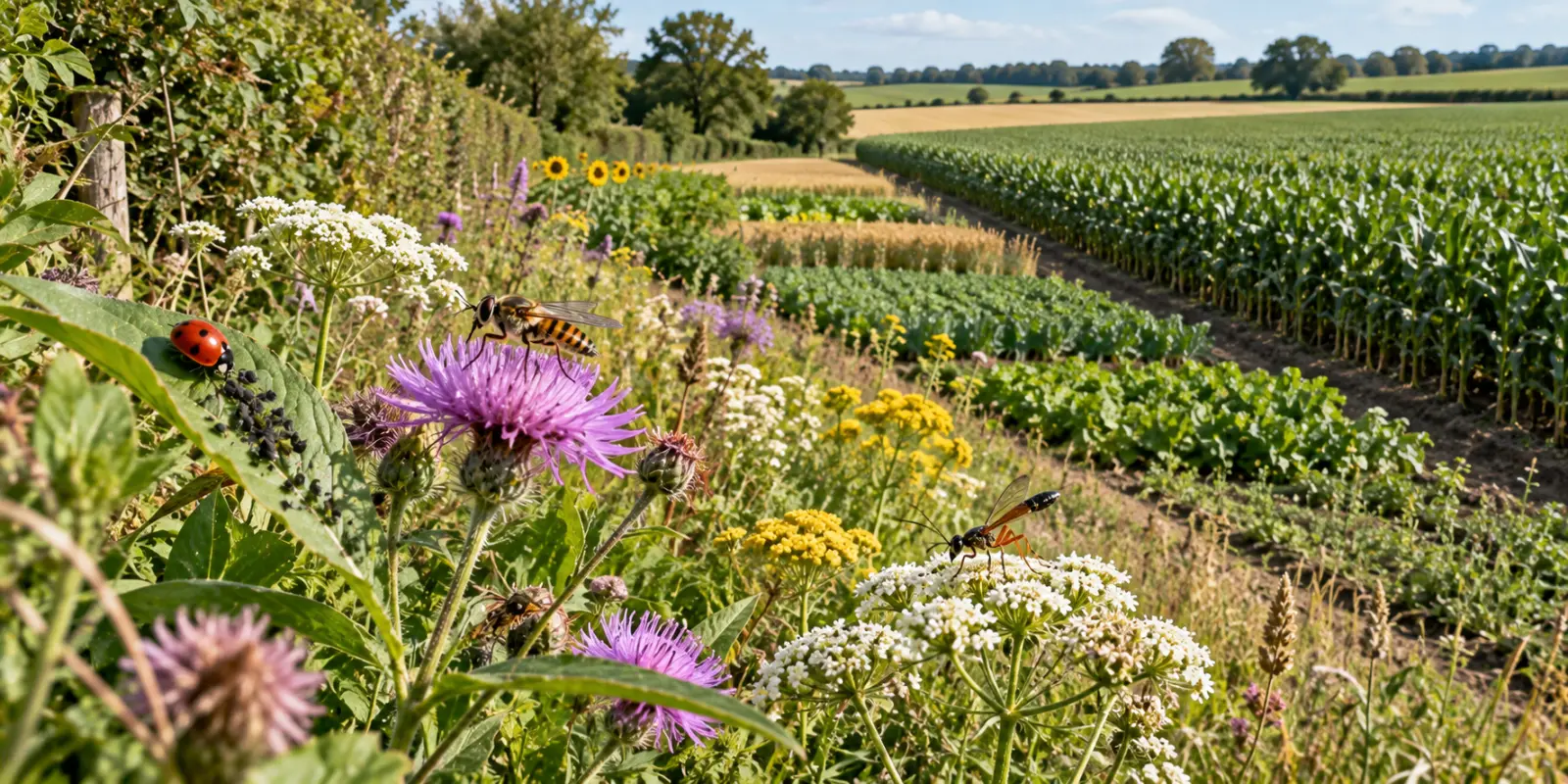
A flower strip can provide nectar and pollen, but not every flower benefits every beneficial insect. Floral architecture, nectar accessibility, bloom period and competition can determine which species use the resource. Habitat design therefore needs to match the mouthparts, activity period and life cycle of the target predators or parasitoids rather than simply maximising the number of plant species.
Diversification can work inside fields and around them
At field scale, growers can add diversity through intercropping, cover crops, undersowing, beetle banks, flower strips or reduced disturbance. At landscape scale, hedgerows, woodlots, grasslands and other semi-natural habitats can provide overwintering sites and source populations that recolonise crops.
Tscharntke and colleagues argued that these scales interact. A local flower strip may have a different effect in an already complex landscape than in a simplified landscape dominated by one crop. Highly mobile natural enemies can respond to resources hundreds of metres or more from the focal field, so pest control cannot always be explained by field management alone.
Biodiversity supports pest control when it supplies the right organisms with the right resources at the right time.
Landscape simplification can reduce measurable pest control
One of the clearest quantitative tests came from Rusch and colleagues in 2016. Their synthesis used aphids as a model pest and exclusion cages to compare natural pest control across cropping systems in Europe and North America. Landscape simplification was measured as the proportion of cultivated land within a one-kilometre radius around each plot.
Average pest control was 46% lower in homogeneous landscapes dominated by cultivated land than in more complex landscapes. This result does not mean that every simple landscape loses exactly 46% of pest control, because the synthesis pooled multiple systems. It does provide strong evidence that surrounding landscape structure can influence how effectively predatory arthropods suppress pests.
Large syntheses support diversification, but effects remain context-dependent
Research since Altieri's chapter has expanded from individual case studies to large evidence syntheses. Letourneau and colleagues reviewed plant-diversity experiments and found broad support for the idea that diversified cropping can reduce herbivore pressure and support natural enemies, while also documenting substantial variation among systems.
Tamburini and colleagues went further by reviewing 98 meta-analyses representing 5,160 original studies and 41,946 comparisons. Across this very large evidence base, agricultural diversification enhanced biodiversity and several ecosystem services, including pest control, without reducing crop yield on average. The authors also emphasised that trade-offs and variable responses still occurred.
What the evidence says across scales
Evidence source | Scale or practice | Main finding | Important qualification |
Altieri, 1991 | Agroecosystem design | More diverse vegetation can support natural enemies and pest stability | Chapter synthesised available cases rather than one uniform experiment |
Landis et al., 2000 | Habitat management | Food, prey or hosts and shelter can conserve beneficial arthropods | Resources must be spatially and temporally appropriate |
Rusch et al., 2016 | Landscape complexity | Average aphid control was 46% lower in simplified landscapes | Evidence focused on aphid systems in Europe and North America |
Dainese et al., 2019 | Global biodiversity synthesis | Higher biodiversity strengthened ecosystem services linked to crop production | Service delivery depended on community composition and context |
Tamburini et al., 2020 | Diversification practices | Diversification improved pest control and other services without lowering yield on average | Trade-offs and response variability remained |
More natural enemies do not always mean less crop damage
A common mistake is to measure only predator or parasitoid abundance and assume pest suppression followed. Natural enemies can interfere with one another, switch to alternative prey, arrive after crop damage has occurred or be present at densities too low to affect the pest population.
This is why stronger studies measure several steps in the chain: habitat manipulation, natural-enemy response, pest density, crop damage and ideally yield. A biodiversity treatment can be ecologically successful by increasing beneficial insects yet still fail to deliver economically meaningful pest reduction in a particular season.
Natural-enemy diversity can add stability as well as abundance
Different predators and parasitoids attack pests at different times, on different parts of the plant and under different weather conditions. A community containing several functional groups may therefore provide more consistent control than one dominated by a single species, especially when environmental conditions fluctuate.
Dainese and colleagues' global synthesis found that biodiversity itself contributed to ecosystem services, not merely the abundance of one dominant group. However, community composition still mattered: having more species is useful only when those species contribute complementary or effective functions.
Non-crop habitat can be beneficial, neutral or occasionally risky
Hedgerows and field margins can supply nectar, shelter and overwintering sites, but they can also harbour crop pests or alternative host plants for pathogens. The outcome depends on which organisms use the habitat and how close it is to the crop.
Bianchi, Booij and Tscharntke reviewed landscape composition and natural pest regulation and concluded that complex landscapes often support stronger natural-enemy communities, while also warning that landscape effects vary with pest and enemy biology. Habitat conservation is therefore a foundation for ecological pest regulation, but local design still matters.
Pesticide use can undermine the service biodiversity is meant to provide
Broad-spectrum insecticides can reduce natural enemies alongside pests. If beneficial populations recover more slowly, repeated treatment may weaken biological control and increase reliance on further intervention. Selective products, thresholds and integrated pest management can reduce this disruption.
This does not mean that biodiversity-based management eliminates all pesticide use. Rather, conservation biological control aims to make natural enemies part of the control system, so chemical intervention is used more strategically when pest pressure exceeds acceptable levels.
Habitat management has moved from theory toward ecological engineering
Gurr and colleagues' 2017 review described major advances since the early habitat-management literature. Researchers increasingly test plant traits and natural-enemy responses before moving mixtures into field trials, and the SNAP framework - shelter, nectar, alternative prey or hosts, and pollen - is used to organise resource provision.
The review also noted that adoption improves when habitat measures deliver several services at once, such as pollination, soil protection or biodiversity conservation. This multi-service approach matters to growers because dedicating land or management effort to habitat is easier to justify when benefits extend beyond one pest species.
Socio-economic constraints remain part of the ecology
Altieri's abstract explicitly stated that long-term pest-stable systems had to be designed with socio-economic factors in mind. That point remains relevant. A flower strip may occupy productive land, require establishment costs, complicate machinery movement or provide benefits that are difficult for a farmer to capture financially.
Management also needs continuity. Natural enemies can be lost when habitat is removed after a short project or when neighbouring farms follow very different practices. Landscape-scale pest control therefore depends partly on coordination, incentives and whether ecological infrastructure fits commercial farming operations.
What a biodiversity-based pest programme should measure
The practical lesson from three decades of research is to design habitat around a clearly defined pest-management objective, then monitor whether the ecological mechanism actually works.
Useful checks include:
- identify the target pest and the predators or parasitoids expected to suppress it;
- provide food, shelter or alternative prey during periods when the crop alone cannot support natural enemies;
- measure pest density and crop damage, not only beneficial-insect abundance;
- consider the surrounding landscape because local habitat may depend on regional source populations;
- track yield, management cost and operational practicality so ecological gains can be judged in farm terms.
Why the 1991 chapter still matters
Altieri's chapter anticipated a shift from treating pests as isolated targets toward treating pest regulation as an ecosystem service. Its central argument - that simplification can remove ecological checks on pests and that well-designed diversity can restore some of those checks - has been strengthened by later reviews and quantitative syntheses.
The same principle applies to monitoring. A habitat intervention should not be judged only by whether more predators or parasitoids are observed. The important question is whether those organisms persist, reach the crop at the right time and reduce pest pressure or crop damage without creating unacceptable costs or new management problems. Measuring biological control together with yield and farm practicality makes it possible to distinguish attractive habitat features from interventions that deliver a meaningful pest-management service.
The modern evidence is more cautious about universality. Diversity does not automatically suppress every pest, and successful habitat management depends on crop, landscape, enemy community and economics. The enduring principle is therefore functional rather than decorative: biodiversity improves pest management when it creates ecological conditions in which effective natural enemies can persist, reach the crop and reduce damaging pest populations.
Frequently asked questions
Does more biodiversity always reduce insect pests?
No. Biodiversity can support predators and parasitoids, but the result depends on which species are added, which pest is present and how the habitat is arranged. Some vegetation can also shelter pests. Effective pest management therefore depends on functional relationships, not simply increasing the number of species.
What kinds of habitat help natural enemies in crop fields?
Useful habitat can include flower strips, hedgerows, cover crops, intercrops, beetle banks and semi-natural field margins. Their value comes from providing nectar, pollen, alternative prey or hosts, shelter and overwintering sites. The best design depends on the biology and seasonal needs of the target natural enemies.
Why does the surrounding landscape affect pest control inside a field?
Many predators and parasitoids move between crop fields and semi-natural habitats. A field may therefore depend on nearby hedgerows, grasslands or woodlots as sources of natural enemies. Quantitative synthesis shows that simplified landscapes dominated by cultivated land can provide lower levels of natural pest control.
Can flower strips replace insecticides?
Not reliably on their own. Flower strips can strengthen conservation biological control, but their effect varies by crop, pest, beneficial species and landscape. Integrated pest management combines habitat measures with monitoring, thresholds and, when necessary, selective control methods rather than assuming a single ecological intervention will prevent all outbreaks.
What is the main lesson from Altieri's 1991 chapter today?
Its main lesson remains that pest management can be improved by designing agroecosystems to support ecological regulation rather than relying only on direct suppression. Later evidence supports that principle, while showing that success is context-dependent and should be evaluated through pest density, crop damage, yield and farm practicality.
Sources
- Altieri MA. Increasing biodiversity to improve insect pest management in agro-ecosystems. In: Hawksworth DL, ed. Biodiversity of Microorganisms and Invertebrates: Its Role in Sustainable Agriculture. Proceedings of WEFSA 1. 1991:165–182.
- Landis DA, Wratten SD, Gurr GM. Habitat Management to Conserve Natural Enemies of Arthropod Pests in Agriculture. Annual Review of Entomology. 2000;45:175–201. doi:10.1146/annurev.ento.45.1.175.
- Tscharntke T, Klein AM, Kruess A, Steffan-Dewenter I, Thies C. Landscape perspectives on agricultural intensification and biodiversity – ecosystem service management. Ecology Letters. 2005;8:857–874. doi:10.1111/j.1461-0248.2005.00782.x.
- Bianchi FJJA, Booij CJH, Tscharntke T. Sustainable pest regulation in agricultural landscapes: a review on landscape composition, biodiversity and natural pest control. Proceedings of the Royal Society B. 2006;273:1715–1727. doi:10.1098/rspb.2006.3530.
- Letourneau DK, Armbrecht I, Salguero Rivera B, et al. Does plant diversity benefit agroecosystems? A synthetic review. Ecological Applications. 2011;21(1):9–21. doi:10.1890/09-2026.1.
- Rusch A, Chaplin-Kramer R, Gardiner MM, et al. Agricultural landscape simplification reduces natural pest control: A quantitative synthesis. Agriculture, Ecosystems & Environment. 2016;221:198–204. doi:10.1016/j.agee.2016.01.039.
- Gurr GM, Wratten SD, Landis DA, You M. Habitat Management to Suppress Pest Populations: Progress and Prospects. Annual Review of Entomology. 2017;62:91–109. doi:10.1146/annurev-ento-031616-035050.
- Dainese M, Martin EA, Aizen MA, et al. A global synthesis reveals biodiversity-mediated benefits for crop production. Science Advances. 2019;5(10):eaax0121. doi:10.1126/sciadv.aax0121.
- Tamburini G, Bommarco R, Wanger TC, et al. Agricultural diversification promotes multiple ecosystem services without compromising yield. Science Advances. 2020;6(45):eaba1715. doi:10.1126/sciadv.aba1715.

Tobias Mardle — author
Tobias Mardle is an author with a background in agricultural engineering. A graduate in Agricultural Engineering, his earlier work focused on explaining farm machinery, guidance systems and the use of field data to growers and agricultural advisers. At CAB Dir...
Related
Imperial moth decline and host ecology on Martha's Vineyard

Abandoned Bomas Create Long-Lived Savanna Fertility Hotspots

Thermal comfort: temperature, humidity, airflow and clothing

How external resistance shapes azo dye removal in microbial fuel cells
Water planning for sustainable growth in constrained catchments

Global limits to growth and pathways to a sustainable future