Acacia Invasion and Cork Oaks in Algeria: Evidence from El Kala
Around El Kala National Park in north-east Algeria, field surveys in 2014–2016 found about 3,200 ha invaded by an Australian acacia, 575 ha of it cork oak woodland (Chekchaki et al., 2020a). Studies by Beddiar, Boudiaf and colleagues link the invasion to poorer soils, weaker ectomycorrhizal partnerships on cork oak roots and slower seedling growth, though mostly in pots and glasshouses (Beddiar et al., 2012; Boudiaf et al., 2013). The abstract of the 2012 first report behind this work gives no numbers, yet the IUCN Global Invasive Species Database relies on it for a Major impact rating of Acacia decurrens (Beddiar et al., 2012; Global Invasive Species Database, 2026a).
Below, we set out what that report and the group’s later experiments found, and why it matters that the invader is now called black wattle, Acacia mearnsii, rather than Acacia decurrens. We then look at how far the acacia has spread, what fire does, and how the database reached its rating. We do not cover cork production, and we touch on the wider causes of cork oak decline only briefly. The original study is summarised in Cabdirect archive record 20123157399.
What Is Happening in El Kala’s Cork Oak Forest?
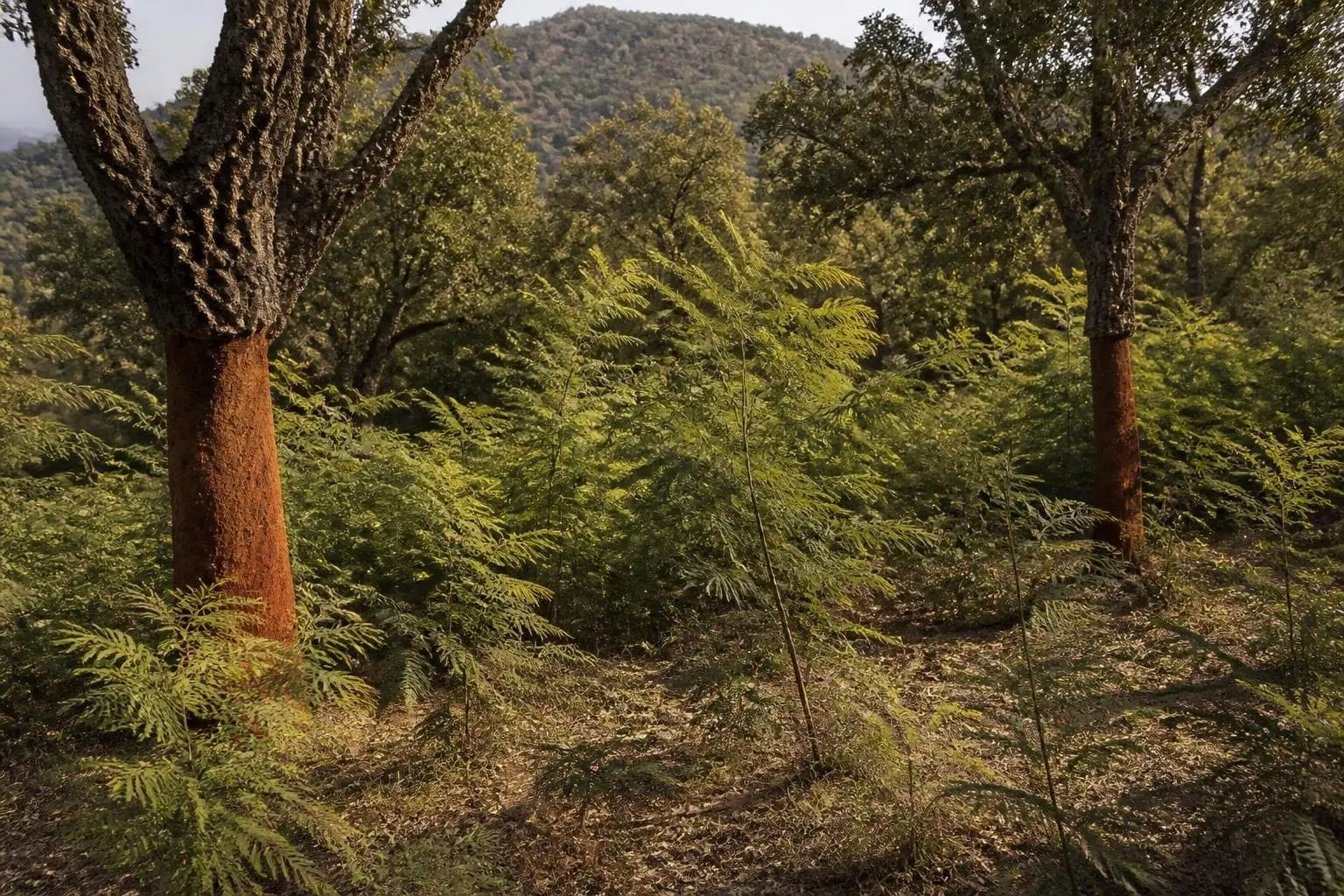
An Australian acacia planted with eucalyptus around 1970 has spread through the plantations and into the cork oak forest of El Kala National Park, in Algeria’s far north-east (Beddiar et al., 2012; Chekchaki et al., 2020a). The 2012 report calls the park one of the Mediterranean region’s most important biodiversity reserves, with cork oak as a dominant tree (Beddiar et al., 2012). El Kala is also a UNESCO biosphere reserve (Boudiaf et al., 2013).
A pulp project that brought the acacia
A 2020 paper co-written by Beddiar traces the acacia to a 1970 reforestation project based on Eucalyptus camaldulensis for paper pulp, in which acacias were mixed in at 20% as a nitrogen-fixing helper for the eucalyptus (Chekchaki et al., 2020a).
The helper outgrew that role: according to the 2012 abstract, it was seen invading the park during the decade before the October 2010 meeting where the work was presented (Beddiar et al., 2012).
Why cork oak matters here
Cork oak covers about 2.1 million ha worldwide, a third of it in Africa (Mechergui et al., 2023). In El Kala it is a native tree, whereas eucalyptus and the acacia were introduced as plantations (Beddiar et al., 2012; Boudiaf et al., 2013).
What Did the 2012 Report Find?
The 2012 report found early signs that the acacia harms cork oak and the life around it, but its authors present them only as first results (Beddiar et al., 2012). Beddiar and three co-authors set out to measure how the invader changes the symbiotic microflora of cork oak and the diversity of plants in the forest (Beddiar et al., 2012). Symbiotic microflora here means the microbes that live in partnership with the tree’s roots.
The paper fills pages 1–4 of volume 76 of the IOBC-WPRS Bulletin, from a 2010 working-group meeting on oak forest protection at Tempio Pausania, Italy (Beddiar et al., 2012). Beddiar later cited it under a French title (Chekchaki et al., 2020a).
According to the abstract, the acacia had a negative effect on three things: cork oak growth, the tree’s mycorrhizal status and the variety of ectomycorrhizal forms, or morphotypes, on its roots (Beddiar et al., 2012). The authors also report that plant and fungal diversity fell significantly at the invaded sites (Beddiar et al., 2012). Ectomycorrhizae are the fungal partnerships formed on the roots of trees such as cork oak, so the report points to damage below ground as well as above it.
What the abstract cannot tell us
The abstract gives no figures at all. It reports no sample sizes, site counts, methods, sampling dates or statistical tests, so the word “significantly” cannot be checked (Beddiar et al., 2012). The title speaks of acacias in the plural, yet the abstract names only one species, Acacia decurrens Willd. (Beddiar et al., 2012).
Which Acacia Is Invading El Kala?
The group’s later work names the El Kala invader Acacia mearnsii, black wattle, rather than the Acacia decurrens of the 2012 report (Beddiar et al., 2012; Boudiaf et al., 2013). The new name appears by December 2012, in Imène Boudiaf’s PhD thesis defended at Université Montpellier 2 (Boudiaf, 2012).
Peer-reviewed papers from 2013 onwards use the same name, and the 2020 mapping paper even cites the 2012 report as evidence that A. mearnsii threatens the park (Boudiaf et al., 2013; Chekchaki et al., 2020a). The papers do not explain the change, so this article follows the group’s later usage without calling the first name a misidentification.
Black wattle has a tangled naming history: GISD lists Acacia mollissima and A. decurrens var. mollis among its synonyms (Global Invasive Species Database, 2026b).
Why the name matters
The name decides where the evidence is filed. GISD places the 2012 abstract under A. decurrens, naming Algeria as the country of its most severe impact (Global Invasive Species Database, 2026a), but files the group’s later El Kala studies under A. mearnsii (Global Invasive Species Database, 2026b). The result is two species profiles for what is probably one invasion.
So the A. decurrens page shows a Major impact in Algeria resting on one short abstract (Global Invasive Species Database, 2026a), while the more detailed El Kala work appears only in the A. mearnsii impact table (Global Invasive Species Database, 2026b).
What Did Later Experiments Show?
Later experiments suggest that invasion changes the soil in ways that can slow young cork oaks, but they were run in pots and glasshouses, and not every test found an effect (Boudiaf et al., 2013; Global Invasive Species Database, 2026b). The most detailed is a 2013 study in Soil Biology and Biochemistry (Boudiaf et al., 2013).
Its authors collected soil from three kinds of site in the park: cork oak forest free of acacia, mixed stands recently invaded, and pure acacia stands formed more than 20 years earlier (Boudiaf et al., 2013). They grew cork oak seedlings on each soil for six months in a glasshouse (Boudiaf et al., 2013). The heavier the invasion, the worse the soil chemistry, microbial functions and ectomycorrhizal community and colonisation, and these changes were correlated with slower early growth (Boudiaf et al., 2013).
A 2017 review restated this as cause and effect, saying that the fungal changes produced the slower growth (Souza-Alonso et al., 2017). The 2013 abstract reports that link as a correlation, although the paper’s title says the acacia alters cork oak’s early development (Boudiaf et al., 2013). GISD’s assessor also noted that the work was done in glasshouse conditions, not in natural stands (Global Invasive Species Database, 2026b).
Three smaller tests pointing different ways
Three smaller studies listed in GISD’s impact table point different ways: a 2014 pot study found a soil-dependent negative effect of acacia on cork oak growth, a 2014 symposium abstract found none, and a 2017 test found mycorrhizal colonisation of 47.8% in untreated seedlings against 5.4% with acacia extract (Global Invasive Species Database, 2026b).
How Far Has the Invasion Spread, and What Drives It?
The most recent published mapping puts the invaded area at about 3,200 ha in four sites around El Kala, and the same group links the spread mainly to human disturbance (Chekchaki et al., 2020a; Chekchaki et al., 2020b). Surveyors recorded the acacia every 30 m over three springs in 2014–2016 and also classified a Landsat 8 image from June 2016 (Chekchaki et al., 2020a).
The field survey found 3,221.5 ha invaded in a study area of 30,624 ha (Chekchaki et al., 2020a). Almost two-thirds of the invaded land, 2,093 ha, was eucalyptus plantation, and 575 ha was cork oak with its understorey (Chekchaki et al., 2020a). The satellite image caught less: for those two classes it gave 2,120.9 ha, against 2,668 ha on the ground (Chekchaki et al., 2020a).
Thirty years of spread
A companion study compared aerial photographs from 1959, 1972 and 1980 with Landsat images from 1987 to 2016 for two forests, Boumalek and Tonga (Chekchaki et al., 2020b). At Boumalek, invaded eucalyptus grew from 62 to 487 ha between 1987 and 2016, and invaded cork oak from 0.2 to 188 ha (Chekchaki et al., 2020b). At Tonga the figures were 30 to 730 ha and 1.6 to 120 ha (Chekchaki et al., 2020b).
Fire and a long-lived seed bank
Fire features in the 2020 mapping paper, which reports 51,192.90 ha of forest burned in El Tarf province in 1990–2000 and shows acacia seedlings regenerating after fire, from seeds viable for up to 50 years (Chekchaki et al., 2020a). GISD notes that such seeds can germinate en masse after fire (Global Invasive Species Database, 2026b).
A satellite study of the severe 2022 fire in El Tarf found the strongest recovery of the vegetation signal in acacia-invaded cork oak and eucalyptus stands (Kahli et al., 2025). That fast green-up may partly reflect acacia regrowth, so it need not be good news for cork oak.
How Do Global Databases Rate the Threat?
The IUCN Global Invasive Species Database rates Acacia decurrens as having Major impacts, and the record that sets that rating is the 2012 El Kala abstract (Global Invasive Species Database, 2026a). The assessment, dated 27 September 2020 and published in 2023, gives Algeria as the country of most severe impact, chemical impact on ecosystems as the mechanism and Low confidence (Global Invasive Species Database, 2026a).
Under IUCN’s EICAT scheme, Major means that an alien species has driven at least one native taxon to local or sub-population extinction, or presumed extinction (IUCN, 2020). Population declines without local loss count as Moderate, and poorer performance of individuals as Minor (IUCN, 2020). The scheme is precautionary: when the cause of a change is unclear, the alien is assumed to be responsible (IUCN, 2020).
The 2012 abstract reports poorer growth and falling diversity, but not the local disappearance of any native species (Beddiar et al., 2012). GISD’s impact table adds that the assessor could not access the full paper (Global Invasive Species Database, 2026a). Its list of impacted native species for Algeria names Indonesian and Ethiopian plants rather than cork oak (Global Invasive Species Database, 2026a).
Black wattle is rated Major too, with South Africa and the Mascarene Archipelago as its countries of most severe impact (Global Invasive Species Database, 2026b). The group’s more detailed El Kala studies, filed under that name, score Minor in three rows and Minimal Concern in one, all with Low confidence (Global Invasive Species Database, 2026b).
A number-free abstract of a four-page paper now weighs more in a global database than the experiments that followed it.
Major ratings are common among wattles: a 2023 assessment of 87 Australian acacia species classed most of those with impact records as Major (Kumschick & Jansen, 2023). Of the 87, 70 had too little evidence to rate and were listed as Data Deficient (Kumschick & Jansen, 2023).
Frequently asked questions
Is the El Kala acacia Acacia decurrens or Acacia mearnsii?
The 2012 report named it Acacia decurrens, but the same research group has called it Acacia mearnsii, black wattle, since a PhD thesis defended in December 2012 (Beddiar et al., 2012; Boudiaf, 2012). The group’s 2020 mapping paper even cites the 2012 report as evidence about A. mearnsii (Chekchaki et al., 2020a).
How much land around El Kala has the acacia invaded?
Field surveys in 2014–2016 found 3,221.5 ha invaded within a 30,624 ha study area, roughly a tenth of it (Chekchaki et al., 2020a). Eucalyptus plantation made up 65.0% of the invaded land and cork oak with its understorey 17.9%, or 575 ha (Chekchaki et al., 2020a).
Why does one short report carry a Major rating?
GISD’s assessor scored the Algerian record for Acacia decurrens from the abstract alone and gave it Low confidence (Global Invasive Species Database, 2026a). EICAT’s Major requires at least one native taxon to be lost, or presumed lost, locally (IUCN, 2020), while the abstract reports declines, not local extinction (Beddiar et al., 2012).
How could an acacia harm cork oak through the soil?
In a 2013 glasshouse study, cork oak seedlings grown in more heavily invaded soils had poorer ectomycorrhizal colonisation and grew more slowly, alongside changes in soil chemistry and microbial activity (Boudiaf et al., 2013). A 2017 review of Mediterranean acacia invasions describes similar soil shifts (Souza-Alonso et al., 2017).
Can black wattle be controlled?
Not quickly. In South Africa, two biocontrol agents now leave black wattle with very little seed, but the soil already stores so much that existing stands are not expected to thin soon (Impson et al., 2021). For Mediterranean invasions, a 2017 review favours integrated control and restoration (Souza-Alonso et al., 2017).
Sources
- Beddiar, A., Adouane, M., Merabet, A., & Boudiaf, I. (2012). Cork oak (Quercus suber L.) threatened by the introduced acacias in the National Park of El-Kala (North-east Algeria). IOBC-WPRS Bulletin, 76, 1–4. – Cabdirect archive record 20123157399
- Boudiaf, I. (2012). Analyse des facteurs microbiens régissant le caractère invasif d’Acacia mearnsii dans la subéraie du parc national d’EL-Kala (NE algérien) [Doctoral thesis, Université Montpellier 2].
- Boudiaf, I., Baudoin, E., Sanguin, H., Beddiar, A., Thioulouse, J., Galiana, A., Prin, Y., Le Roux, C., Lebrun, M., & Duponnois, R. (2013). The exotic legume tree species, Acacia mearnsii, alters microbial soil functionalities and the early development of a native tree species, Quercus suber, in North Africa. Soil Biology and Biochemistry, 65, 172–179.
- Chekchaki, S., Beddiar, A., & Zaafour, M. D. (2020). Cartographie par télédétection des milieux envahis par Acacia mearnsii De Wild. dans l’extrême Nord-Est algérien. Bois et Forêts des Tropiques, 343, 5–16.
- Chekchaki, S., Zaafour, M.-D., & Beddiar, A. (2020). Cartographie diachronique de la dynamique forestière et évolution de l’invasion des subéraies et des eucalyptaies par l’Acacia noir (Acacia mearnsii De Wild) dans le Parc National d’El Kala (Nord-Est algérien). Physio-Géo, 15, 233–258.
- Global Invasive Species Database. (2026). Species profile: Acacia decurrens, with EICAT impact table (7 records; the only Algerian record is rated Major, with low confidence, and cites Beddiar et al., 2012). IUCN SSC Invasive Species Specialist Group.
- Global Invasive Species Database. (2026). Species profile: Acacia mearnsii, with EICAT impact table (29 records; the four Algerian records are rated Minor in three cases and Minimal Concern in one, and cite later studies by Boudiaf, Beddiar and colleagues). IUCN SSC Invasive Species Specialist Group.
- IUCN. (2020). IUCN EICAT categories and criteria: First edition. IUCN.
- Kumschick, S., & Jansen, C. (2023). Evidence-based impact assessment for naturalized and invasive Australian Acacia species. In D. M. Richardson, J. J. Le Roux, & E. Marchante (Eds.), Wattles: Australian Acacia species around the world (pp. 359–381).
- Mechergui, T., Pardos, M., Boussaidi, N., Jacobs, D. F., & Catry, F. X. (2023). Problems and solutions to cork oak (Quercus suber L.) regeneration: A review. iForest – Biogeosciences and Forestry, 16(1), 10–22.
- Kahli, A., Sahnouni, R., Mordjane, O., Boumahdaf, A., & Chenchouni, H. (2025). Assessing forest burn severity, post-fire recovery, vegetation shifts, and forest resilience across Mediterranean-type woodlands. Journal of Sustainable Forestry, 45(3), 225–254.
- Souza-Alonso, P., Rodríguez, J., González, L., & Lorenzo, P. (2017). Here to stay. Recent advances and perspectives about Acacia invasion in Mediterranean areas. Annals of Forest Science, 74(3), 55.
- Impson, F. A. C., Kleinjan, C. A., & Hoffmann, J. H. (2021). Suppression of seed production as a long-term strategy in weed biological control: The combined impact of two biocontrol agents on Acacia mearnsii in South Africa. Biological Control, 154, 104503.

Maya Hartwell — author
Maya writes environment and plant science explainers, with an editorial focus on biodiversity, ecosystems, water quality, environmental pollution, plant biology, invasive plants, natural materials and the use of biological resources in environmental technologi...
Related

How consumerism affects the pursuit of sustainable tourism
Can Cut Silkvine Stems Sprout? The 2007 Lleida Trial
How wind-driven lobster traps damage Florida Keys coral reefs
Maclura tinctoria growth and reforestation guidelines
Marathon weed management: connecting research, policy and field action
Imperial moth decline and host ecology on Martha's Vineyard