Marathon weed management: connecting research, policy and field action
A 2016 Litchfield National Park case study examined how research, conservation planning, monitoring and field operations can support sustained weed control. It presented a coordinated management approach, not experimental evidence of treatment effectiveness.

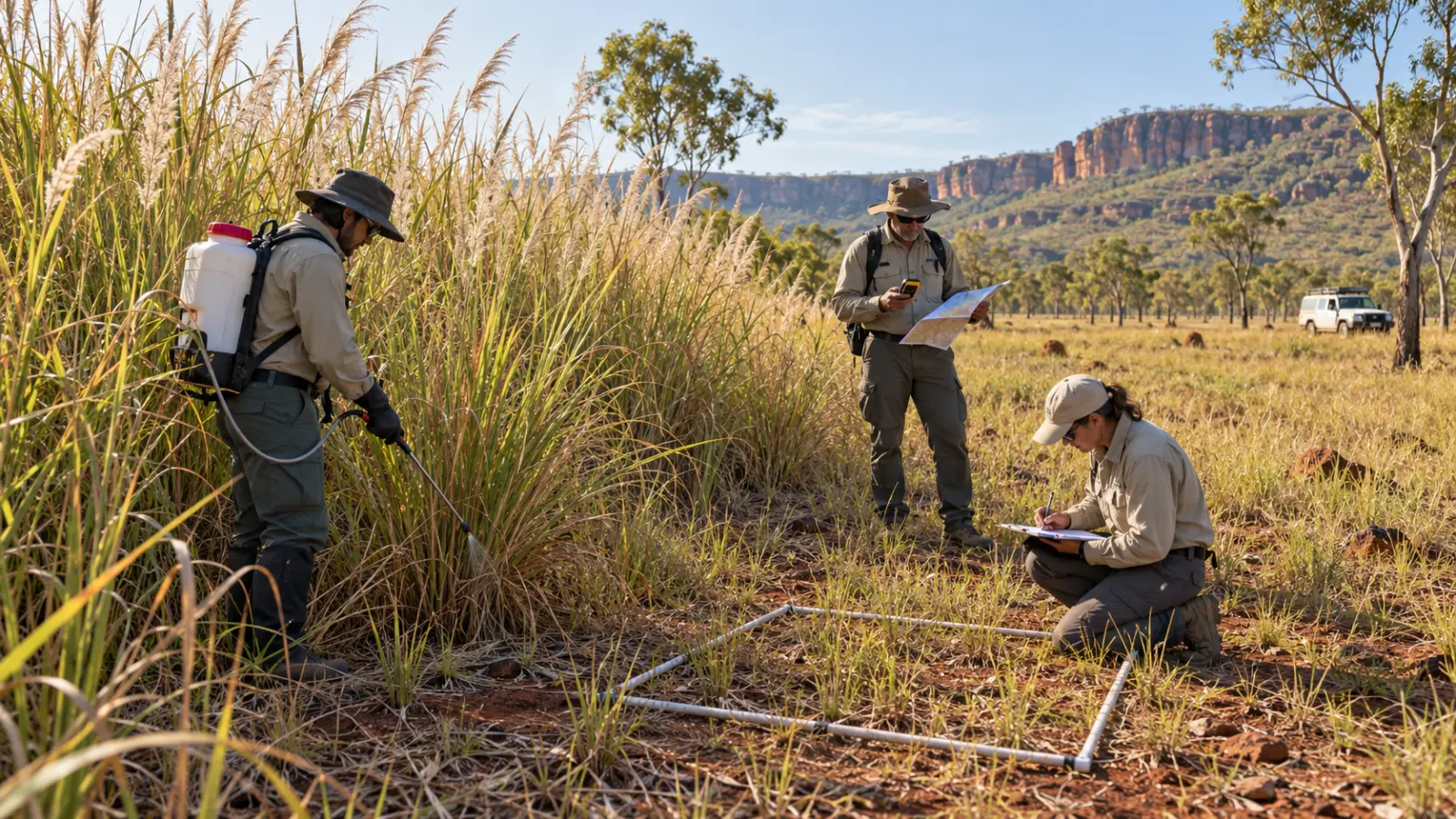
Why weed management behaves more like a marathon
The authors contrast long-term weed management with short funding cycles. Invasive plants can spread, persist in seed banks and alter fire regimes, while projects often focus on immediate results. Ferdinands, Setterfield and Vea argue for repeated control, monitoring and adjustment over years. Their Litchfield example links scientific research with planning and field operations.
What the Litchfield case examined
This case-based review describes weed management within Litchfield National Park’s Integrated Conservation Strategy, using Conservation Action Planning. The Class 1 Biodiversity Park had annual actions and longer-term targets. Planners, rangers, researchers, traditional owners and other stakeholders helped connect scientific priorities with staffing, budgets and practical constraints.
Turning research into management targets
Research on gamba grass distribution, spread and ecological effects informed risk assessments and management goals. Rangers translated priorities into practical actions. Monitoring and annual reports supported revisions, while five-year targets maintained a longer planning horizon.
Evidence or planning input | Management use | Time scale |
Conservation values and threat ranking | Set priorities for action | Strategy cycle |
Gamba grass distribution and spread research | Shape realistic control goals | Multi-year |
Ranger knowledge and implementation constraints | Convert goals into practical actions | Annual |
Monitoring and state-of-park reporting | Review outcomes and revise management | Annual and long-term |
What the paper found
The authors argue that coordinated policy, research, planning, monitoring and fieldwork can serve immediate and long-term conservation goals. The paper does not measure treatment effects or hectares cleared. Instead, it documents how research and risk assessment shaped priorities and review processes. Sustained funding and institutional commitment remained major challenges.
Effective control depends on maintaining coordinated action over time.
Evidence behind the gamba grass risk
Research in northern Australian savannas links gamba grass invasion with increased fuel loads, fire intensity and management costs. Studies also document prolific seed production and recruitment across habitats. These findings support treating gamba grass as a sustained management priority, although they do not establish that every Litchfield decision was optimal.
Frequently asked questions
What does “marathon weed management” mean?
It is a planning metaphor for weed problems that need sustained action over years rather than one-off control. The 2016 paper argues that policy, research, field operations and monitoring should be coordinated so that annual work contributes to longer-term conservation targets instead of ending when a short project closes.
Which weed was most important in the Litchfield case?
Gamba grass was a major focus because it was ranked as an extreme threat alongside wildfire. The paper draws on earlier research showing that gamba grass can alter fuel loads and fire regimes, making weed control relevant not only to plant management but also to biodiversity, visitor safety and fire planning.
What weed control methods were studied in Litchfield National Park?
No. This was not a treatment trial and it did not compare herbicides, removal methods or experimental plots. It described a management and planning process used at Litchfield National Park, showing how research evidence and risk assessment could be incorporated into conservation priorities, annual actions and longer-term review.
How often should long-term weed management plans be reviewed?
Long-term strategy does not mean waiting years before checking results. In the Litchfield model, annual action plans and reporting provided short feedback cycles, while five-year targets kept attention on outcomes that require persistence. That combination allows managers to adjust actions without abandoning the broader conservation objective.
Can Litchfield National Park’s weed management approach work in other regions?
No. The paper presents a case and a planning rationale, not a controlled comparison across management systems. Other regions differ in species, land tenure, budgets, institutions and ecological conditions. The transferable lesson is the value of linking evidence, priorities, implementation and monitoring; local strategies still need their own evaluation.
Sources
- Ferdinands, K. B., Setterfield, S. A., & Vea, J. (2016). Marathon weed management: how can we effectively connect weed research with policy planning and on-ground action for long-term NRM results? In R. Randall, S. Lloyd & C. Borger (Eds.), 20th Australasian Weeds Conference 2016, 304–307. Weeds Society of Western Australia.
- Adams, V. M., & Setterfield, S. A. (2016). Approaches to strategic risk analysis and management of invasive plants: lessons learned from managing gamba grass in northern Australia. Pacific Conservation Biology, 22, 189–200. DOI: 10.1071/PC15041.
- Brooks, K. J., Setterfield, S. A., & Douglas, M. M. (2010). Exotic grass invasions: applying a conceptual framework to the dynamics of degradation and restoration in Australia’s tropical savannas. Restoration Ecology, 18(2), 188–197. DOI: 10.1111/j.1526-100X.2008.00470.x.
- Flores, T. A., Setterfield, S. A., & Douglas, M. M. (2005). Seedling recruitment of the exotic grass Andropogon gayanus (Poaceae) in northern Australia. Australian Journal of Botany, 53(3), 243–249. DOI: 10.1071/BT03154.
- Rossiter, N. A., Setterfield, S. A., Douglas, M. M., & Hutley, L. B. (2003). Testing the grass-fire cycle: alien grass invasion in the tropical savannas of northern Australia. Diversity and Distributions, 9(3), 169–176. DOI: 10.1046/j.1472-4642.2003.00020.x.
- Setterfield, S. A., Rossiter-Rachor, N. A., Douglas, M. M., Wainger, L., Petty, A. M., Barrow, P., Shepherd, I. J., & Ferdinands, K. B. (2013). Adding fuel to the fire: the impacts of non-native grass invasion on fire management at a regional scale. PLOS ONE, 8(5), e59144. DOI: 10.1371/journal.pone.0059144.
- Setterfield, S. A., Ferdinands, K., Rossiter-Rachor, N. A., & Douglas, M. M. (2010). The Northern Territory’s Weed Risk Management system: an application of the national post-border WRM protocol. Plant Protection Quarterly, 25(2), 86–89.
- Scott, K., Setterfield, S. A., Douglas, M. M., Parr, C. L., Schatz, J., & Andersen, A. N. (2012). Does long-term fire exclusion in an Australian tropical savanna result in a biome shift? A test using the reintroduction of fire. Austral Ecology, 37(6), 693–711. DOI: 10.1111/j.1442-9993.2012.02379.x.
- The Nature Conservancy. (2007). Conservation Action Planning Handbook: Developing strategies, taking action and measuring success at any scale. Arlington, Virginia.
Related

How wind-driven lobster traps damage Florida Keys coral reefs
Maclura tinctoria growth and reforestation guidelines

Imperial moth decline and host ecology on Martha's Vineyard

Abandoned Bomas Create Long-Lived Savanna Fertility Hotspots

Biodiversity for Better Insect Pest Control in Agroecosystems

Thermal comfort: temperature, humidity, airflow and clothing