




Human blood groups and population genetics in Mourant’s atlas
Arthur Mourant’s 1954 book The Distribution of the Human Blood Groups brought scattered data on ABO, Rh, MNSs and other inherited markers into one global reference. Its central contribution was not a single new blood-group discovery, but the systematic comparison of frequencies across populations, regions and genetic systems.
This explainer examines what the book assembled, how it connected serology with genetics and anthropology, why its maps and tables mattered, and what modern readers should treat cautiously. The historical terminology and population categories reflect the mid-twentieth century and should not be read as fixed biological divisions of humanity.

Evidence last checked 2 Sep 2026 · 9 min

Why blood-group geography became a genetic question
By the middle of the twentieth century, blood groups had become more than a transfusion problem. ABO types and later systems such as Rh and MNSs were inherited traits that could be counted in large groups of people. Researchers therefore began asking whether differences in their frequencies could reveal patterns of ancestry, migration and population history. The field was often described as seroanthropology: the use of blood-group serology to investigate human variation.
An important starting point came from Ludwik and Hanna Hirszfeld during and after the First World War. Studies of thousands of soldiers from different regions showed that ABO frequencies were not uniform across populations. Later historical accounts identify those surveys as foundational for population-based blood-group research. Mourant’s project belonged to the next phase: gathering many such surveys into a comparative framework rather than relying on isolated national or regional reports.
The attraction was methodological. Blood groups were inherited and relatively easy to score serologically, so frequency data could be converted into estimates of allele or gene frequencies. Yet those numbers still depended on how researchers selected samples, defined populations and classified people. That limitation is central to understanding both the scientific power and the historical problems of the enterprise.
What Mourant assembled in the 1954 book
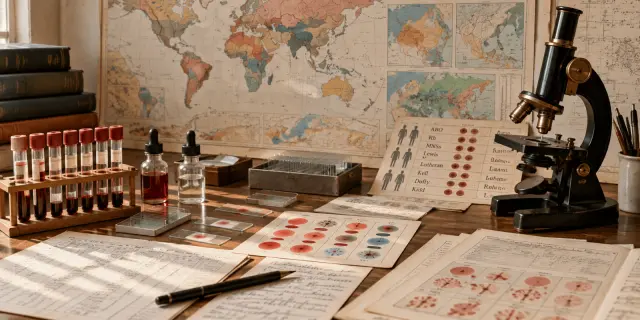
The historical record describes a 438-page volume that surveyed both the genetics and the geographical distribution of numerous blood-group systems. The list extended beyond ABO to Rhesus, MNSs, Lewis, P, Lutheran, Kell, Duffy and Kidd. Mourant also discussed other inherited polymorphisms, including the ability to taste phenylthiocarbamide and the sickle-cell trait, treating them as related genetic markers for population comparison.
The geographic sections covered Northern and Central Europe, Africa south of the Sahara, the Mediterranean region, Asia, Indonesia and Australasia, and the Americas. Separate chapters addressed hybrid and migrant populations, as well as blood grouping in animals, bones and tissues. A synthesis chapter attempted to connect the regional observations, while the second half of the book turned to laboratory methods and the calculation of gene frequencies.
The scale of compilation was itself a major contribution. The book includes about 1,700 references, 26 blood-group frequency tables, an extensive list of sickle-cell trait frequencies, three indices and nine folding maps. Later historical scholarship has described the volume as one of the largest collections of human genetic data then assembled, drawing on blood-group results from roughly half a million people.
The systems highlighted in the source
Blood-group system | Role in the 1954 synthesis |
ABO | Core population-frequency system; regional variation was already well established |
Rhesus (Rh) | Expanded comparisons beyond ABO and added a more complex inherited system |
MNSs | Provided another independent set of red-cell markers for population comparisons |
Lewis, P, Lutheran | Additional antigen systems used to widen the comparative genetic picture |
Kell, Duffy, Kidd | Further red-cell polymorphisms included in the book’s broad survey |
Why the maps and frequency tables mattered
Mourant’s folding maps translated laboratory results into geography. Instead of reading hundreds of local studies separately, readers could compare spatial patterns at a glance. A contemporary review noted that the maps used an isobar-like principle, drawing lines across areas of similar blood-group frequency. This made variation visible as gradients and regions rather than as disconnected percentages in individual papers.
That visual strategy helped researchers formulate questions about migration, isolation, admixture and genetic drift. A concentration of one allele in a region could suggest a population-history problem to investigate, but it could not by itself identify a cause. Similar frequencies can arise through different histories, and a single blood-group system captures only one small part of the genome. Mourant’s own value as a compiler lay in bringing many systems together so that patterns could be compared rather than interpreted in isolation.
The book’s lasting innovation was to turn thousands of local serological observations into a comparative geography of inherited variation.
From blood typing to population genetics
The book also linked descriptive serology to formal genetics. Its technical sections covered laboratory procedures and methods for calculating gene frequencies from observed phenotypes. That bridge mattered because a table of blood types is not automatically a population-genetic result. Researchers had to infer allele frequencies under explicit genetic assumptions and consider sampling error, rare phenotypes and the structure of the blood-group system.
Modern molecular genetics has replaced many of those serological inferences with direct DNA analysis, but the underlying population-genetic questions remain familiar: how variants differ in frequency, how populations are sampled, and how migration and drift shape distributions. Current references on ABO biology also show why the system was useful: the major A, B and O alleles produce different glycosyltransferase activity, creating stable inherited red-cell phenotypes that can be measured across populations.
The historical language needs modern caution
The historical abstract closes by describing interest in the “different races of mankind,” language that was conventional in much mid-century physical anthropology. Modern genetics does not treat those historical race labels as precise, discrete biological units. Contemporary guidance on population descriptors emphasizes that geographic, social, ethnic and ancestry categories are constructed in different ways and can obscure substantial variation within groups.
Historical work on Mourant has also shown that the data did not emerge from neutral, pre-existing populations. Samples were gathered through blood-transfusion services, public-health institutions, colonial and post-colonial networks, rural communities, migrant groups and other social settings. Decisions about who counted as a population, how people were labeled and which samples were accessible shaped the resulting tables. That does not erase the genetic measurements; it changes how confidently broad anthropological conclusions should be drawn from them.
For a modern reader, three layers should be kept separate:
- the measured blood-group phenotype, which may be biologically precise;
- the statistical frequency reported for a defined sample, which depends on sampling;
- the historical population label, which may combine geography, ancestry, nationality, language, religion or older racial categories.
What the 1954 synthesis established - and what it did not
Mourant’s book established that a large international literature on inherited blood-group variation could be organized into a systematic reference. It documented substantial geographic differences in frequencies across multiple blood-group systems and supplied methods, maps and bibliographic infrastructure that other researchers could use. Contemporary reviews in Heredity and the American Journal of Physical Anthropology show that the book was immediately recognized as a major reference work.
It did not prove that humanity can be divided into a small number of sharply bounded genetic races. Frequency gradients overlap, populations exchange genes, and the categories used in historical studies were not defined consistently. Nor can the book’s mid-century tables substitute for present-day frequency databases or genomic datasets. Its scientific importance lies in the transition it represents: from individual blood-group discoveries to large-scale comparative population genetics.
That transition also explains why the book remained influential after specific serological methods became outdated. Mourant demonstrated the research value of standardizing observations, collecting comparable data from many places and making the evidence navigable through tables, maps and bibliography. Those practices are recognizable in modern population databases, even though today’s ethical standards, sampling frameworks and molecular tools are very different.
Why the book still matters for understanding blood-group variation
The Distribution of the Human Blood Groups remains valuable as both a scientific resource and a historical document. It captured a period when blood-group antigens were among the most informative inherited markers available for studying variation between human populations. It also illustrates how large datasets depend on laboratory standards, sampling networks, population definitions and the questions researchers choose to investigate.
One reason the book was so influential was the scale of comparison it made possible. Individual blood-group studies could describe one hospital, community or region, but Mourant brought results from many populations into a common reference framework. That allowed researchers to compare frequency patterns across geography and to ask whether apparent differences were consistent across independent datasets rather than isolated observations. The value of the synthesis therefore came not only from the number of tables or maps, but from making scattered serological evidence comparable enough to support broader population-genetic questions.
At the same time, comparability depended on the quality of the underlying samples. Blood-group frequencies can be affected by who was sampled, how populations were labelled, the size of each sample and whether laboratory methods were consistent. A large compilation cannot remove those limitations; it can only make them more visible. This is especially important when reading historical categories that combined geography, language, ethnicity or colonial administrative labels in ways that do not map neatly onto present-day genetic concepts.
Modern genomic datasets answer many questions with far greater resolution, but they inherit the same need for careful sampling and transparent population definitions. Direct DNA sequencing can measure variation that serology could only infer indirectly, yet frequency estimates still depend on who is included and how groups are described. Mourant's work is therefore useful not because its categories should be preserved unchanged, but because it demonstrates how population genetics depends on both biological measurement and the structure of the dataset used to interpret it. The book also demonstrates how a reference work can shape later research by standardising the questions that investigators ask of new samples. Once frequencies, methods and geographic descriptions are assembled in one place, later studies can identify gaps, test earlier patterns and compare new observations with an established baseline. That function is historically important even when the baseline itself is later revised. It is this combination of broad synthesis and visible methodological limitation that makes the volume useful for understanding the development of human population genetics.
For modern readers, the book offers more than a record of ABO or Rh frequencies. It provides historical context for understanding how inherited blood-group variation was mapped and interpreted, while also showing why population categories and older datasets must be assessed carefully in light of later genetic and biomedical research.
Frequently asked questions
What was the main purpose of Mourant’s 1954 book?
The book gathered widely scattered blood-group frequency studies into a single comparative reference. It combined genetics, geography, laboratory methods, gene-frequency calculations, maps, tables and an extensive bibliography. Its importance came from synthesis: researchers could compare many populations and several inherited blood-group systems within one framework rather than consulting hundreds of separate reports.
Did the book cover only the ABO blood groups?
No. ABO was central, but the book also covers Rhesus, MNSs, Lewis, P, Lutheran, Kell, Duffy and Kidd. Mourant additionally discussed inherited traits such as phenylthiocarbamide tasting and the sickle-cell trait. This broader set of markers allowed comparisons that did not depend on a single blood-group system.
Why were blood groups useful for studying populations?
Blood-group phenotypes are inherited and can be measured consistently with serological methods. Researchers could compare their frequencies between samples and estimate underlying allele frequencies. The approach was valuable before genome-wide DNA data existed, although conclusions still depended on sample quality, population definitions and the genetic assumptions used in frequency calculations.
Do the book’s population categories match modern genetics?
Not necessarily. Mid-twentieth-century studies often used geographic, national, ethnic, religious and racial labels that were defined inconsistently. Modern genetics treats such descriptors with greater caution because they may combine ancestry with social or historical categories. The measured blood-group data can remain informative while the labels and interpretations require historical context.
Why is The Distribution of the Human Blood Groups still historically important?
It shows how blood-group serology became a large-scale population-genetic resource. Mourant organized results from many regions into tables, maps and comparative analyses, creating infrastructure for research on human variation. The book also illustrates an enduring lesson: large datasets depend not only on measurements, but on sampling systems and classification choices.
Sources
- Mourant AE. The Distribution of the Human Blood Groups. Oxford: Blackwell Scientific Publications; 1954. 438 pp.
- Roberts JAF. Review: The Distribution of the Human Blood Groups. Heredity. 1955;9:280–282. doi:10.1038/hdy.1955.30.
- Boyd WC. Review of The Distribution of the Human Blood Groups. American Journal of Physical Anthropology. 1955;13(1):153–158. doi:10.1002/ajpa.1330130113.
- Bangham J. Blood groups and human groups: collecting and calibrating genetic data after World War Two. Studies in History and Philosophy of Biological and Biomedical Sciences. 2014;47:74–86. doi:10.1016/j.shpsc.2014.05.008.
- Czerwinski M, Kaczmarek R, Glensk U. Ludwik Hirszfeld: A pioneer of transfusion and immunology during the world wars and beyond. Vox Sanguinis. 2022;117(4):467–475. doi:10.1111/vox.13214.
- Dean L. The ABO blood group. In: Blood Groups and Red Cell Antigens. Bethesda (MD): National Center for Biotechnology Information; 2005.
- National Academies of Sciences, Engineering, and Medicine. Using Population Descriptors in Genetics and Genomics Research. Washington, DC: National Academies Press; 2023.
- Royal College of Physicians. Arthur Ernest Mourant – Inspiring Physicians biographical record.

Tomas Verren — author
Tomas Verren has a background in biomedical sciences and population health, with academic training in human biology, epidemiology, study design and the interpretation of health data. After completing his postgraduate training, he moved into research communicat...
This article is for general information and is not medical advice. It was reviewed for accuracy by a qualified clinician; decisions about your health should be made with your own doctor.