



Humic Substances as Plant Biostimulants: What They Can Do
Humic substances are complex components of natural organic matter that can influence root development, nutrient acquisition and plant growth when used as biostimulant inputs. A 2005 review by C. Chambolle highlighted effects on roots, biomass, earliness and plant colour, but modern evidence shows that responses are variable rather than guaranteed.
This explainer separates the historical claims in the 2005 review from later research on humic acids, fulvic fractions and related humic materials. It examines proposed mechanisms, practical application, field variability and regulatory context without treating humic substances as substitutes for essential mineral nutrition or as uniformly effective across crops.
What the 2005 article said about humic substances
The 2005 article describes humus as a biochemical meeting point between soil and plant and presents humic substances as a chemically diverse group linked with plant growth. It lists four broad families of molecules - carbohydrates, lignins, lipids and proteins - and notes that more than 800 phenolic compounds had been identified in animals and plants as precursors associated with humic-substance formation.
The article also outlined horticultural effects including greater root growth, increased biomass, earlier development and improved plant colour. The available abstract does not provide crop-by-crop methods, doses, sample sizes or statistical results for those outcomes. Those claims therefore need to be read as a review summary, not as the results of one controlled experiment.
Modern science treats humic substances as chemically diverse rather than uniform
Later research has reinforced the idea that humic materials are heterogeneous. Their biological activity depends on origin, extraction, molecular size, hydrophobicity, aromaticity and the distribution of functional groups. That diversity helps explain why two products sold under similar labels can produce different plant responses.
Humic acids and fulvic acids are often discussed as operational fractions obtained by extraction and solubility behaviour rather than as single purified molecules. Modern reviews therefore caution against assuming that a product name alone predicts activity. Chemical characterization and application context matter because the plant is responding to a mixture of compounds rather than one universal active ingredient.
The old 'humus molecule' model has been replaced by more complex concepts
Historical descriptions often pictured humic substances as large, stable macromolecules formed during humification. Contemporary soil chemistry has moved toward models in which relatively smaller organic components associate through weak interactions into dynamic supramolecular structures. This change does not make older agronomic observations irrelevant, but it changes how researchers explain the chemistry behind them.
Root architecture is one of the most consistent biological targets
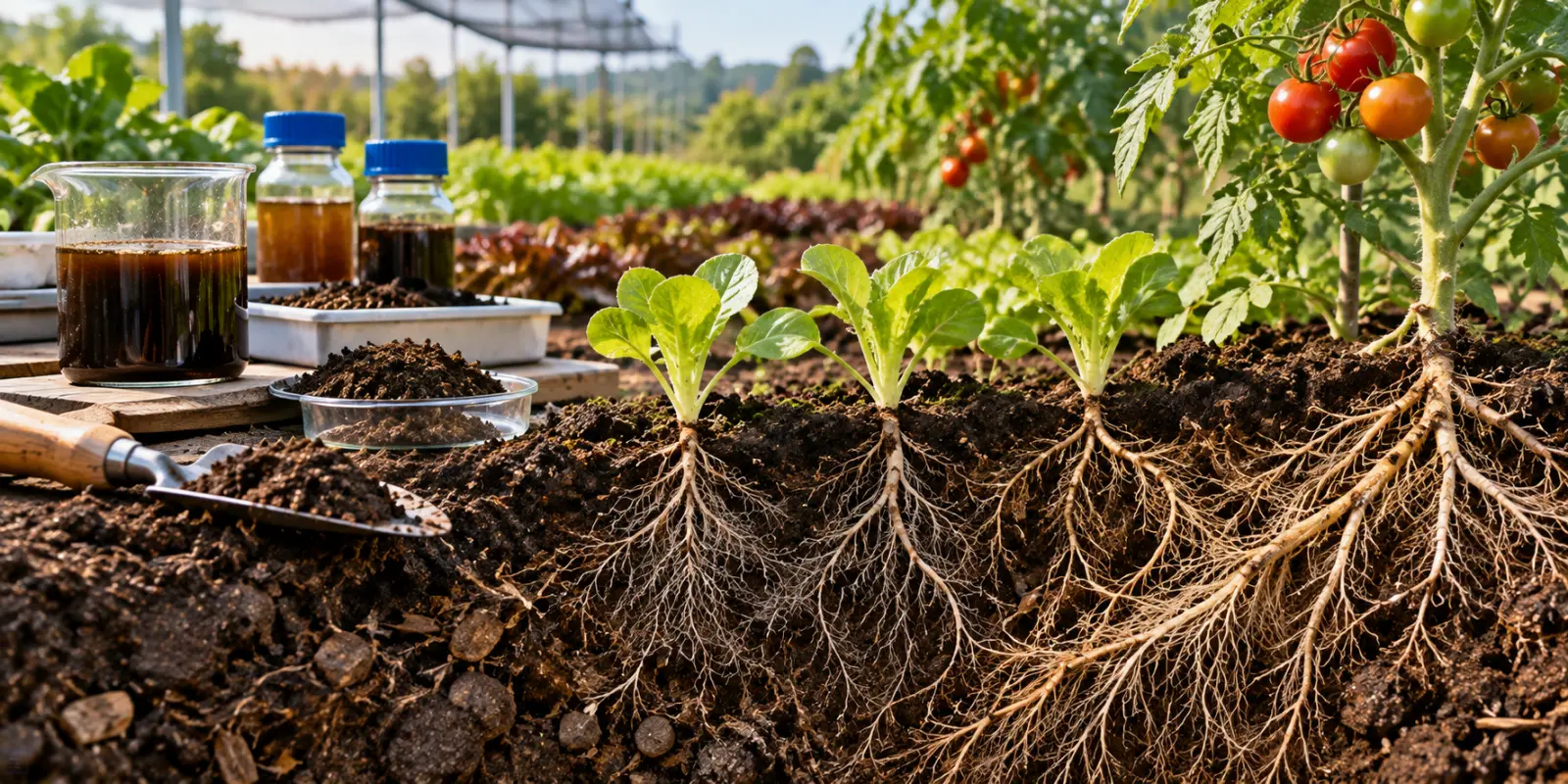
Modern plant-physiology reviews repeatedly identify roots as a major site of humic-substance activity. Reported responses include changes in root length, lateral-root formation and root-hair development, all of which can increase the surface area available for water and nutrient acquisition. These effects are particularly relevant to the 2005 article's emphasis on root growth.
Canellas and Olivares summarized evidence that humic substances can alter root architecture and growth dynamics, while later mechanistic work has linked responses to plasma-membrane H+-ATPase activity, nutrient transporters and hormone-related signalling. The exact mechanism is not a simple fertilizer effect: some responses involve signalling pathways that change how roots grow and function.
Humic substances can change how roots function, but their effect depends on what the material is and how it is applied.
Nutrient uptake can improve without humic substances being nutrients themselves
Humic substances can influence nutrient availability in the rhizosphere and the plant's ability to acquire nutrients. Organic functional groups can interact with mineral ions, while root responses may increase uptake capacity. Studies have also reported effects on nitrate transport and nitrogen-assimilation pathways.
This distinction is important for practical use. A biostimulant is not defined simply by supplying a large amount of nitrogen, phosphorus or potassium. Under the European Union fertilising-products framework, plant biostimulants are distinguished by functions such as improving nutrient-use efficiency, tolerance to abiotic stress, quality traits or nutrient availability in the soil or rhizosphere.
What meta-analysis says about average growth response
A major 2014 meta-analysis reviewed plant-growth responses to humic substances across many experiments and found an overall positive effect on shoot and root dry weight. However, the authors also emphasized that growth promotion was variable and less predictable than responses to conventional mineral fertilizers. Product source, crop species, dose, application method and environmental conditions all contributed to heterogeneity.
That conclusion is more useful than a single average response. It means humic products can work, but a positive result in one crop or greenhouse experiment should not be generalized automatically to another soil, climate or formulation. Field validation remains important because controlled environments remove many of the variables that influence biostimulant performance in production systems.
How the evidence fits together
Source | Evidence type | Main contribution | Important limitation |
Chambolle, 2005 | Horticultural review abstract | Summarized root, biomass, earliness and colour effects | No detailed methods or effect sizes in available abstract |
Rose et al., 2014 | Meta-analysis and review | Found overall positive plant-growth response across studies | Strong heterogeneity among products and conditions |
Canellas & Olivares, 2014 | Physiology review | Linked humic substances with root architecture and plant physiology | Mechanisms vary by material and experimental system |
Jindo et al., 2020 | Field and greenhouse review | Compared application modes and practical conditions | Field responses affected by weather, soil and management |
Nardi et al., 2021 | Mechanistic review | Connected chemical structure with signalling and nutrient transport | Structure-activity relationships remain complex |
Dose matters because more is not always better
Humic substances often show non-linear dose responses. Concentrations that stimulate roots or nutrient uptake in one system may have little effect at lower rates and may lose benefit at higher rates. This pattern is consistent with signalling-type activity rather than a simple assumption that doubling the dose doubles the response.
Product recommendations therefore need to be formulation-specific. Differences in feedstock, extraction method and concentration make it unsafe to transfer a rate from one research material directly to another commercial product. Application through soil, fertigation, seed treatment or foliage can also expose plants to different compounds and concentrations.
Application route changes what the plant actually encounters
Root-zone applications interact first with soil, substrate, microbes and mineral surfaces, while foliar applications contact leaf surfaces and must cross different physical barriers. Reviews of greenhouse and field studies report benefits from several application routes, but no single method is consistently superior across crops. The appropriate method depends on the product, crop system and intended response.
Field performance is harder to predict than laboratory response
Greenhouse, hydroponic and growth-chamber experiments are useful for identifying mechanisms, but they simplify temperature, moisture, nutrient supply and microbial conditions. Jindo and colleagues noted that field performance is less explored and more difficult to interpret because weather, soil type and management can modify the response.
This gap explains why a biostimulant may produce a clear root response in a controlled experiment yet show a smaller or inconsistent yield response in commercial production. For growers, the most informative evidence therefore comes from trials that match the crop, soil, application method and management system in which the product will actually be used.
Plant colour can reflect nutrition, but it is not a universal efficacy marker
The 2005 abstract mentioned improved plant colour as one reported effect. Greener leaves can be associated with chlorophyll status or better nutrient supply, especially nitrogen and iron, and later studies have reported effects of humic substances on photosynthetic pigments in some crops.
However, colour alone does not establish better yield or plant health. Visual greenness can change for several reasons, and an effective biostimulant claim should be linked to measured physiological, nutritional or production outcomes rather than appearance alone. This is another area where modern experimental design adds precision to earlier horticultural observations.
Humic substances may also influence stress responses
Recent reviews have examined humic materials under drought, salinity, metal stress and other adverse conditions. Reported mechanisms include changes in antioxidant systems, osmotic adjustment, nutrient balance and stress-related signalling. These findings have expanded the concept of humic biostimulation beyond simple biomass promotion.
Even here, variability remains a central limitation. Source chemistry, dose, plant species and severity of stress can all change the outcome. Humic substances should therefore be viewed as tools that may improve resilience under certain conditions, not as universal protection against environmental stress.
What growers should look for in a humic biostimulant claim
A useful product claim should identify the crop, application route, rate, timing and outcome that were actually tested. Evidence is stronger when replicated trials compare treated and untreated plants under relevant field or greenhouse conditions and report both agronomic performance and variability.
Practical questions include:
- Was the product chemically characterized, or only labelled as humic acid or humic substances?
- Was the tested rate the same as the commercial recommendation?
- Were trials conducted in soil and climate conditions similar to the intended use?
- Did the study measure yield, nutrient uptake or root traits rather than only visual appearance?
- Was the response consistent across seasons, sites or cultivars?
Why the 2005 article still matters
Chambolle's review captures an important stage in the wider adoption of humic substances as horticultural biostimulants. Its emphasis on the soil-plant interface, roots, biomass and crop appearance anticipated themes that later mechanistic and field research would investigate in much greater detail.
Another reason for variable results is that the term humic substances covers materials with different origins and chemical characteristics. Products extracted from different sources or processed in different ways may not deliver the same mixture of compounds, even when they are marketed under similar names. This makes dose-response testing and product characterisation important when interpreting trials.
The distinction between mechanism and agronomic outcome also matters. Changes in root architecture, nutrient uptake or stress-related physiology can be biologically interesting without guaranteeing a yield increase under field conditions. A crop that already has adequate nutrition and water may show little practical benefit, whereas a response may be more visible under conditions where root function or nutrient availability is limiting. For growers, the most useful evidence therefore connects a clearly described product and rate with outcomes that matter in the intended crop and environment. Replication across seasons or sites is especially valuable because it shows whether a response persists beyond one favourable experimental setting.
Modern evidence supports several of those broad biological themes while adding an essential qualification: humic substances are not one standardized material, and their effects are context-dependent. The strongest interpretation is therefore neither that they are ineffective nor that they universally stimulate crops. Their agronomic value depends on chemistry, dose, crop, environment and the quality of the evidence behind a specific product and use.
Frequently asked questions
What are humic substances?
Humic substances are heterogeneous organic materials associated with decomposed natural matter in soils, composts, peat and other sources. They are commonly discussed as humic and fulvic fractions, but they are not one identical molecule or formulation. Their chemistry varies substantially with origin, extraction and processing.
Do humic substances act like fertilizers?
Not in the same way as conventional fertilizers. Humic products may influence nutrient availability, root architecture, transport processes and signalling, but they are not substitutes for the essential mineral nutrients a crop requires. Their role is better understood as biostimulation that may improve how plants use available resources.
Can humic substances increase crop yield?
They can increase growth or yield in some studies, but the response is variable. Meta-analysis and field reviews show that crop species, product source, dose, application method, soil and environmental conditions all influence outcomes. A positive result from one formulation should not be assumed for every humic product.
Why do humic substances often affect roots?
Roots are directly exposed to humic materials applied through soil or fertigation. Research links humic responses with changes in root branching, root hairs, proton-pump activity, nutrient transport and hormone-related signalling. Greater root surface area can improve resource acquisition, but the magnitude of response depends on the material and dose.
How should a grower evaluate a humic biostimulant product?
Look for trials using the same product, rate, crop and application route under conditions similar to the intended use. Stronger evidence includes replicated comparisons, measured agronomic outcomes and consistency across sites or seasons. Product labels alone do not reveal the chemistry or predict whether a crop will respond.
Sources
- Chambolle C. Biostimulants: les substances humiques. PHM Revue Horticole. 2005;(468):21–23.
- Rose MT, Patti AF, Little KR, Brown AL, Jackson WR, Cavagnaro TR. A Meta-Analysis and Review of Plant-Growth Response to Humic Substances: Practical Implications for Agriculture. Advances in Agronomy. 2014;124:37–89. doi:10.1016/B978-0-12-800138-7.00002-4.
- Canellas LP, Olivares FL. Physiological responses to humic substances as plant growth promoter. Chemical and Biological Technologies in Agriculture. 2014;1:3. doi:10.1186/2196-5641-1-3.
- Trevisan S, Francioso O, Quaggiotti S, Nardi S. Humic substances biological activity at the plant-soil interface: from environmental aspects to molecular factors. Plant Signaling & Behavior. 2010;5(6):635–643. doi:10.4161/psb.5.6.11211.
- Jindo K, Olivares FL, Malcher DJP, Sánchez-Monedero MA, Kempenaar C, Canellas LP. From Lab to Field: Role of Humic Substances Under Open-Field and Greenhouse Conditions as Biostimulant and Biocontrol Agent. Frontiers in Plant Science. 2020;11:426. doi:10.3389/fpls.2020.00426.
- Nardi S, Schiavon M, Francioso O. Chemical Structure and Biological Activity of Humic Substances Define Their Role as Plant Growth Promoters. Molecules. 2021;26(8):2256. doi:10.3390/molecules26082256.
- De Melo BAG, Motta FL, Santana MHA. Humic acids: Structural properties and multiple functionalities for novel technological developments. Materials Science and Engineering C. 2016;62:967–974. doi:10.1016/j.msec.2015.12.001.
- European Parliament and Council. Regulation (EU) 2019/1009 laying down rules on the making available on the market of EU fertilising products. Official Journal of the European Union. 2019.
- Schiavon M, Nardi S. Humic Substances: An Interface between Plants and Soil. Journal of Plant Nutrition and Soil Science. 2022;185:1–15.

Maya Hartwell — author
Maya writes the environment and plant science explainers. Her editorial focus includes biodiversity, ecosystems, water quality, environmental pollution, plant biology, invasive plants, natural materials and the use of biological resources in environmental tech...
Related
Fritillaria imperialis: In Vitro Propagation and Bulb Formation
Mangosteen in the United States: Cultivation, Imports and Marketing
How to Grow Hydnophytum and Myrmecodia Ant-Plants