





Teaching Young Children to Swim: Didactic Approaches in Slovenia
A 2014 study by Anja Pečaver and colleagues examined how swimming instructors, teachers and coaches in Slovenia taught children aged four to eleven. The survey covered 90 swimming-course professionals and focused on didactic movement games, swimming aids, teaching methods, learner difficulties and working conditions.
The findings show that games were used most often during early water-acclimatisation activities and less often in the direct teaching of swimming techniques. Kickboards, floating noodles and pool dive toys were the most frequently used didactic aids.
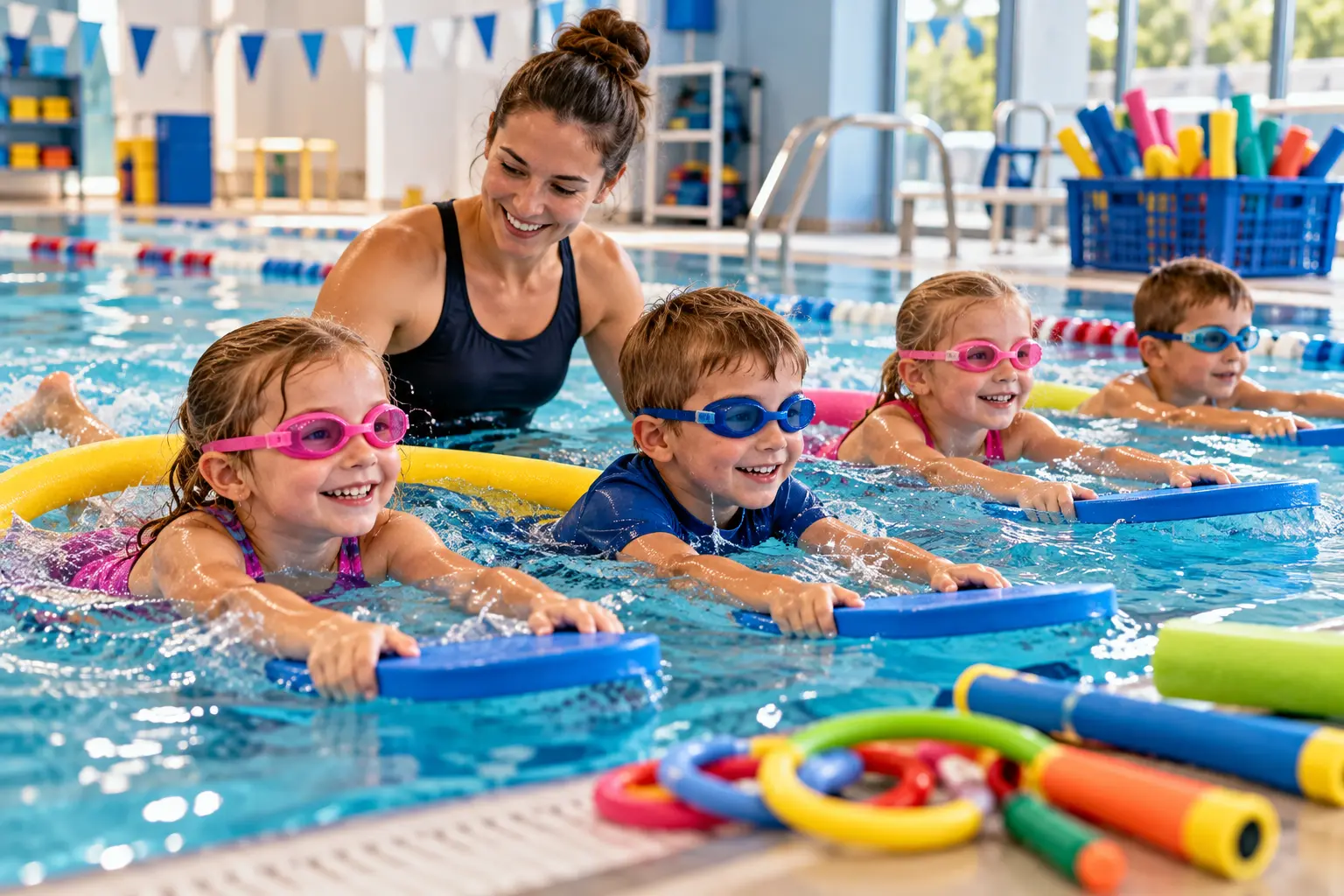
What the Slovenian Study Examined in Young Children’s Swimming Lessons
The study analysed swimming instruction for children aged four to eleven. Its respondents were professionals conducting swimming courses in different places in Slovenia, allowing the authors to examine how teaching practices varied across instructors, teachers and coaches. The sample consisted of 90 professionals: 71 swimming instructors, 16 swimming teachers and 3 swimming coaches. Women represented 57.8% of the sample and men 42.2%, with respondents spanning young adulthood through middle age.
The Survey Focused on Games, Aids, Methods and Teaching Problems
The questionnaire contained 15 questions, including closed-ended and combined open- and closed-ended items. The authors examined didactic movement games, swimming aids, methods for introducing content and rules, learner-related difficulties, working conditions and approaches to problem solving. Data were processed in SPSS 19.0. The study used descriptive statistics, the Mann-Whitney test and a chi-square test, with statistical significance set at a 5% risk level.
How Often Did Swimming Professionals Use Didactic Movement Games
Didactic movement games were not used equally across all parts of swimming instruction. On a five-point scale, their highest reported use was when children were becoming accustomed to putting their head under water, with a mean score of 4.19. Games were also frequently used in the preparatory part of the exercise unit at 4.12 and when children were becoming accustomed to seeing under water at 4.09. Exhaling in water followed at 3.96.
Games Were Least Common During Direct Technique Instruction
The frequency dropped for sliding and the main part of the exercise, both reported at 3.5. The lowest use of didactic movement games occurred during the actual teaching of swimming techniques, with a mean score of 3.07. The authors viewed this pattern critically because play remained important for young learners even after they had become more comfortable in the water.
Lesson activity | Mean frequency score |
Putting head under water | 4.19 |
Preparatory part | 4.12 |
Seeing under water | 4.09 |
Exhaling in water | 3.96 |
Sliding | 3.50 |
Main part of exercise | 3.50 |
Teaching swimming techniques | 3.07 |
Table note: Scores were reported on a five-point scale in which 1 meant never and 5 meant always.
Which Didactic Tools Were Most Common in Swimming Classes
Swimming aids were a major part of the survey because the researchers considered them both instructional and motivational tools. Three items clearly stood out in reported frequency of use. Kickboards ranked first at 4.24 on the five-point scale, followed by floating noodles at 4.11. Pool dive toys ranked third at 3.60.
Several Other Swimming Aids Were Used Only Occasionally or Rarely
The professionals reported occasional use of pull buoys, swim hats or floating toys, and rings or frames. Mats and slides were used rarely, while swimming balls and swimming belts were described as almost never used. In the authors’ interpretation, varied aids can reduce monotony, support independence in the water and make the learning process more engaging.
Didactic tool | Mean frequency score | Reported position |
Kickboard | 4.24 | Most frequent |
Floating noodle | 4.11 | Second |
Pool dive toys | 3.60 | Third |
Table note: Other aids were described qualitatively as occasional, rare or almost never used.
How Professionals Introduced New Swimming Content to Children
Personal demonstration was the dominant approach for introducing new content. Demonstration in the water received the highest mean rating at 4.64, followed closely by personal demonstration on land at 4.5. Explanation and discussion were also used often, with reported scores of 4.19 and 4.13. Metaphors, comparisons and conceptions, such as asking a child to leap like a dolphin, were used less frequently at 3.24.
Picture Materials and Video Recordings Were Rarely Used
Picture materials and video recordings received a mean score of only 1.37. The authors considered this surprisingly low and argued that information communication technology could help motivate children and attract their attention. This conclusion reflects the surveyed professionals’ reported teaching practices rather than an experimental comparison showing that one technology directly improved swimming performance.
What Difficulties Did Instructors Encounter During Swimming Lessons
Fear was the most frequently reported learner-related problem, with a mean score of 3.46. Motor abilities followed at 3.19, while stubbornness and audacity or mischief were reported at 3.13. Disobedience was rated at 2.99, lack of persistence at 2.62 and apathy at 2.46. Aggressiveness was the least frequent of the listed learner-related problems at 1.93.
Gender Did Not Change the Frequency of Reported Personality Problems
The researchers tested whether the frequency of dealing with these learner-related problems differed by the professional’s gender. They reported no statistically significant gender differences for this part of the survey. This result contrasts with other areas of the study in which gender was associated with differences in group preference and the frequency of using didactic movement games.
Problem | Mean frequency score |
Fear | 3.46 |
Motor abilities | 3.19 |
Stubbornness / audacity or mischief | 3.13 |
Disobedience | 2.99 |
Lack of persistence | 2.62 |
Apathy | 2.46 |
Aggressiveness | 1.93 |
Table note: The study found no statistically significant gender differences in the frequency of dealing with these personality-related problems.
How Gender and Professional Title Related to Teaching Choices
The study reported gender-related differences in the groups professionals preferred to teach. Women more often preferred the youngest children who were not yet accustomed to water or did not know swimming techniques, while men more often preferred children already accustomed to water who could swim at least 25 metres using a swimming technique. Gender differences were also reported for the frequency of didactic movement games in several activities, including the preparatory part and exercises involving water resistance, putting the head under water, seeing under water and exhaling in water.
Swimming Instructors Used Games More Often in Several Activities
Professional title was also associated with differences. Swimming instructors, described in the paper as holding lower professional titles than swimming teachers, used didactic movement games more frequently in activities involving water resistance, putting the head under water and exhaling in water. These are associations within the surveyed Slovenian sample. The study does not establish that gender or professional title itself caused the observed teaching choices.
What the Survey Found About Pool Rules and Working Conditions
When teaching pool rules, 85.6% of professionals reported using discussion most often. Other approaches — setting an example, stimulation games, picture materials or combinations of methods — accounted for less than 14% of responses. The study also asked about poor working conditions. Cold water was the most frequently encountered problem at 2.37, followed by excessive pool noise at 2.33 and insufficient exercise space at 2.31.
Several Facility Problems Were Reported as Relatively Infrequent
Damaged pool surroundings, lack of swimming aids, unsuitable water depth, overly large groups and dirty water were reported less frequently. Dirty water ranked lowest among the listed working-condition problems at 1.61. The authors treated suitable facilities as part of high-quality swimming instruction because safety, health and pedagogical conditions shape what teachers can do during a lesson.
How Swimming Professionals Reported Solving Pedagogical Problems
Additional training was the most frequently reported source of problem-solving methods. Approaches learned in seminars and courses received a mean score of 3.60. Methods derived from the professional’s own experience in clubs or sport societies followed at 3.27. Knowledge acquired at school or university was reported at 3.21.
Home Experience Was the Least Used Source of Problem-Solving Methods
Experience acquired in the home environment, including behavioural patterns and examples set by parents or other family members, received the lowest score at 3.14. The authors used these results to emphasize the importance of professional qualifications, continued education and practical experience in work with young swimmers.
What the 2014 Study Supports and What It Does Not Establish
The study provides a detailed descriptive picture of reported teaching practices among 90 swimming professionals in Slovenia. It documents how often different games, aids and instructional methods were used and identifies several statistically significant associations with gender and professional title.
The authors also reported questionnaire reliability values ranging from 0.72 to 0.816. This supports internal consistency of the instrument as described in the paper, but it does not turn the survey into a controlled test of teaching effectiveness.
The Study Measured Professional Practice Rather Than Children’s Learning Outcomes
The survey did not experimentally assign children to different teaching methods and compare subsequent swimming performance. Statements about enthusiasm, motivation and attention therefore need to be read within the paper’s observational and pedagogical framing.
The authors themselves identified geographical limitations: the study was limited to Slovenia and did not include teachers of children with special needs or investigate didactic issues specific to those learners.
Practical takeaway: The 2014 Slovenian survey shows that young children’s swimming instruction relied heavily on demonstration, familiar flotation aids and didactic games during early water-acclimatisation tasks. Games were used less often during direct technique instruction, while visual media and video were rarely used. The evidence describes professional practice and reported associations; it does not directly compare children’s swimming outcomes under different teaching methods.
Frequently asked questions
How many swimming professionals participated in the study?
The survey included 90 swimming professionals from Slovenia. The sample consisted of 71 swimming instructors, 16 swimming teachers and 3 swimming coaches. The questionnaires were distributed during a licensing seminar.
Which swimming aids were used most frequently?
Kickboards were the most frequently used didactic tool, with a mean score of 4.24. Floating noodles followed at 4.11 and pool dive toys at 3.60. Several other aids were used only occasionally, rarely or almost never.
When were didactic movement games used most often?
Games were used most often when children were learning to put their head under water, with a mean score of 4.19. They were also common in the preparatory part and when children were learning to see under water. Their lowest reported use was during direct teaching of swimming techniques.
What teaching method was used most often for new content?
Personal demonstration in the water ranked highest, at 4.64. Demonstration on land followed at 4.5. Picture materials and video recordings were used very rarely, with a mean score of 1.37.
What was the most common learner-related difficulty?
Fear was the most frequently reported learner-related problem, with a mean score of 3.46. Motor abilities and stubbornness or mischief followed. Aggressiveness was the least frequently reported problem.
Does the study prove that didactic games improve swimming performance?
No controlled comparison of children’s swimming outcomes was conducted. The study surveyed the practices and views of swimming professionals and analysed associations within those responses. Its findings therefore describe teaching practice rather than experimentally proving one method superior.
Sources
- Pečaver, A., Pungeršek, M., Videmšek, M., Karpljuk, D., Štihec, J., & Meško, M. (2014). Analysis of didactic approaches to teaching young children to swim. The Sport Journal, 17.
- Light R, Wallian N. A constructivist-informed approach to teaching swimming. Quest. 2008;60(3):387–404.
- Jurak G, Kovač M. Izbor didaktičnih pripomočkov za učenje plavanja [Selection of didactic tools for teaching swimming]. Ljubljana: Ministry of Education and Sport, Sport Department; 2002.
- Kapus V, Štrumbelj B, Kapus J, Jurak G, Šajber D, Vute R, et al. Plavanje, učenje [Swimming, learning]. Ljubljana: Institute of Sport, Faculty of Sport, University of Ljubljana; 2002.
- Minkels C, van der Kamp J, de Vries R, Beek PJ. Learning how to swim in 5- to 12-year-old children: a scoping review of evidence-based motor learning methods. Front Sports Act Living. 2025.
- World Health Organization. WHO guideline on the prevention of drowning through provision of day-care and basic swimming and water safety skills. Geneva: WHO; 2021.
- World Health Organization. Preventing drowning: practical guidance for the provision of day-care, basic swimming and water safety skills, and safe rescue and resuscitation training. Geneva: WHO; 2022.
- Trinidad A, Mendoza-Castejón D, de la Calle LM, del-Blanco-Muñiz JÁ. Analysis of swimming teaching programs, aquatic competencies and specific skills in school settings from early childhood to secondary education: a systematic review. PLoS One. 2026;21(7):e0353477.

Adrian Foster — author
Adrian Foster writes with an editorial focus on experimental science, laboratory research, controlled comparisons, measurement techniques and the role of replication in evaluating scientific findings. At CAB Direct, Adrian covers experiments, laboratory method...
Related
Garlic Honey Tea and Blood Pressure: What the Study Found

Mycotoxins in Dried Raisins in Egypt: Fungi and Contamination

Metofluthrin Mosquito Repellent: Field Efficacy in Outdoor Trials

Capsaicin and Ascorbic Acid Variability in Chilli and Paprika
What Parents Actually Say on Youth Sport Sidelines

Seven Countries Study: Coronary Heart Disease Across Populations