




Selenium and cancer prevention: what the evidence shows
Selenium is essential for normal human biology, but taking extra selenium has not been shown to prevent cancer. The 2011 Cochrane review found lower cancer incidence and mortality among people with higher selenium exposure in observational studies, while randomized trials did not confirm a protective effect from supplementation. This distinction is important because observational associations can be influenced by diet, smoking, socioeconomic conditions, baseline health and other factors rather than reflecting a direct effect of selenium itself.
This explainer by Nora Veldin examines what the original review measured, why randomized evidence carried more weight when assessing cancer prevention, how later Cochrane updates reinforced the overall conclusion, and the potential harms associated with unnecessary selenium supplementation. It focuses on cancer prevention in generally healthy people rather than the treatment of diagnosed selenium deficiency or the use of selenium during cancer treatment.
Evidence last checked 24 Sep 2026 · 10 min
Why selenium became a candidate for cancer prevention
Selenium is a trace element incorporated into selenoproteins that participate in antioxidant defence, thyroid hormone metabolism, DNA synthesis and immune function. Because oxidative stress and cellular damage are involved in carcinogenesis, researchers proposed that selenium status might influence cancer risk. The hypothesis was biologically plausible, and early population studies appeared to support it: people with higher blood or toenail selenium concentrations often had lower rates of some cancers than people with lower concentrations. Those observations helped drive interest in selenium supplements as a potentially simple preventive intervention.
But selenium is not a substance for which “more” automatically means “better.” Nutritional requirements are small, exposure varies widely by geography and food supply, and selenium compounds differ in how they are absorbed and metabolized. A population with low baseline selenium status may respond differently from a population whose intake is already adequate. The central scientific question therefore became more specific: does deliberately increasing selenium intake in people who are not deficient reduce cancer incidence or mortality? Randomized controlled trials are particularly useful for answering this question because they are designed to balance many known and unknown differences between people who receive a supplement and people who do not.
What the 2011 systematic review found
The 2011 Cochrane review combined two kinds of evidence. For the question of whether naturally higher selenium exposure was associated with cancer risk, it included 49 prospective observational studies. For the question of whether supplements prevent cancer, it included six randomized controlled trials. Random-effects meta-analysis was used for observational outcomes when at least five studies were available, while the randomized evidence was summarized separately.
Across the observational studies, higher selenium exposure was associated with lower overall cancer incidence, with a summary odds ratio of 0.69 and a 95% confidence interval from 0.53 to 0.91. Cancer mortality was also lower in the higher-exposure groups, with a summary odds ratio of 0.55 and a 95% confidence interval from 0.36 to 0.83. These figures describe associations between groups; they do not prove that selenium caused the difference. Heterogeneity, potential bias, confounding and effect modification were important factors when interpreting the pooled estimates.
The randomized trials told a less encouraging story. Selenium yeast did not prevent non-melanoma skin cancer, and L-selenomethionine did not prevent prostate cancer. Trials of selenium for liver-cancer prevention produced inconsistent findings and raised methodological concerns. The Nutritional Prevention of Cancer Trial and SELECT also raised concern that supplementation might have adverse effects in some settings. Overall, the evidence did not support a reliable causal claim that low selenium causes cancer or that selenium supplements prevent cancer.
Why the observational results cannot establish causation
A person with a higher selenium biomarker may differ from a person with a lower biomarker in many ways unrelated to selenium itself. Diet quality, smoking, alcohol use, occupational exposures, income, chronic disease and regional food patterns can all affect both selenium status and cancer risk. Statistical adjustment can reduce the influence of measured confounders, although differences between populations can still influence results. Biomarkers also capture different selenium compounds and may represent recent intake, long-term status or metabolic differences in ways that are not interchangeable.
The 2011 review found that associations also varied by cancer site and by sex. The pooled estimate for cancer incidence appeared lower in men than in women, but the confidence intervals were wide and overlapped. Such subgroup patterns can help guide further research, yet they are not a substitute for trials designed to test whether supplementation changes outcomes. This is why the observational signal was scientifically interesting without providing a basis for recommending selenium supplementation for cancer prevention.
What randomized trials added
Randomization changes the question from “who has more selenium?” to “what happens when comparable groups are assigned to receive selenium or placebo?” That design directly tests the effect of supplementation. SELECT was especially influential because it enrolled 35,533 men at 427 sites in the United States, Canada and Puerto Rico and compared selenium, vitamin E, the combination and placebo. After a median follow-up of 5.46 years, selenium did not significantly reduce prostate cancer or other prespecified cancer outcomes.
The earlier Nutritional Prevention of Cancer Trial had also failed on its primary objective of preventing recurrent non-melanoma skin cancer. Longer follow-up later showed no reduction in basal cell carcinoma and an increased risk of squamous cell carcinoma and total non-melanoma skin cancer among participants assigned selenium. Those findings weakened the idea that a plausible biological mechanism or a favourable observational association was enough to predict benefit from supplementation.
The strongest prevention evidence comes from randomized trials, and those trials have not shown that selenium supplements reduce cancer risk.
How later evidence changed confidence in the conclusion
The evidence base continued to expand after 2011. A 2014 Cochrane update included 55 prospective observational studies involving more than 1.1 million participants and eight randomized trials with 44,743 participants. The observational results still suggested lower cancer incidence at higher selenium exposure, but the randomized evidence continued to show no preventive benefit. By 2018, the Cochrane review included 70 observational studies and 10 trials. The well-designed randomized trials provided high-certainty evidence of no reduction in overall cancer risk or in several specific cancers, including prostate cancer.
The 2018 review also emphasized that the observational literature did not show a consistent dose-response pattern. Some studies reported inverse associations, others null associations, and some direct associations. Without a systematic gradient in which progressively higher selenium exposure produces progressively lower cancer risk, a causal interpretation becomes less convincing. The overall evidence did not support increasing selenium intake through diet or supplementation as a strategy for preventing cancer in humans.
This later evidence is important when interpreting the 2011 findings. The original review was already cautious, while subsequent trials and updated syntheses strengthened the conclusion regarding routine supplementation. The evidence is strongest for the practical conclusion that giving selenium supplements to generally healthy, selenium-replete people does not prevent cancer. Research into nutritional status, metabolism and genetic background continues to refine understanding of selenium biology without changing the general prevention conclusion.
Why observational and randomized evidence can point in different directions
The selenium literature is a useful example of why nutrition research can produce apparently conflicting messages. Several mechanisms can make an observational association look protective even when an intervention fails in a trial:
- Baseline status matters: supplementation may have little biological effect when participants already have adequate selenium intake.
- Healthy-user effects can distort comparisons because people with nutrient-rich diets often differ in smoking, activity, healthcare access and other behaviours.
- Biomarkers are imperfect proxies and may capture selenium species, metabolism or recent exposure differently across studies.
- Cancer is not one disease; associations can vary by organ site, tumour biology, sex and other characteristics, increasing heterogeneity.
- Supplement form and dose may not reproduce the exposure pattern represented by selenium obtained through ordinary foods.
These issues do not mean observational studies are unhelpful. They can reveal patterns, identify populations for further study and generate mechanistic questions. But when a preventive intervention is practical to test, randomized trials are better suited to determine whether the intervention itself changes disease outcomes. In selenium research, that distinction explains why a lower cancer rate among people with higher selenium status did not translate into a successful supplement strategy.
Key studies behind the evidence
The major reviews and trials answer slightly different questions, so their results are most useful when considered together rather than treated as interchangeable. The table summarizes the evidence that most directly shaped the conclusion about prevention.
Evidence source | Design / population | Exposure or intervention | Key result | What it means |
2011 Cochrane review | 49 prospective studies + 6 RCTs | Selenium status and supplements | Higher exposure associated with lower incidence (OR 0.69) and mortality (OR 0.55); trials did not show consistent prevention | Association and intervention results diverged |
NPCT | 1,312 people with prior non-melanoma skin cancer | 200 µg/day selenized yeast | No prevention of the primary skin-cancer outcome; later follow-up found increased squamous cell and total non-melanoma skin cancer | Supplementation was ineffective for the primary prevention target and raised harm concerns |
SELECT | 35,533 men | Selenium, vitamin E, both, or placebo | Selenium HR for prostate cancer 1.04 (99% CI 0.87-1.24); no significant reduction in other prespecified cancers | Large RCT did not confirm a prostate-cancer benefit |
2014 Cochrane update | 55 prospective studies + 8 RCTs | Selenium exposure and supplementation | Observational inverse association persisted; randomized evidence still showed no preventive benefit | More data did not rescue the supplement hypothesis |
2018 Cochrane update | 70 observational studies + 10 RCTs | Selenium exposure and supplementation | High-quality RCTs showed no reduction in overall or prostate-cancer risk | Later review increased confidence in the no-benefit conclusion |
Safety and dose still matter
Selenium is required in small amounts, yet excessive intake can cause toxicity. The US National Institutes of Health Office of Dietary Supplements lists an adult recommended intake of 55 micrograms per day and an adult tolerable upper intake level of 400 micrograms per day. The European Food Safety Authority adopted a lower adult upper level of 255 micrograms per day in 2023. These limits concern total intake from food and supplements, not cancer treatment doses.
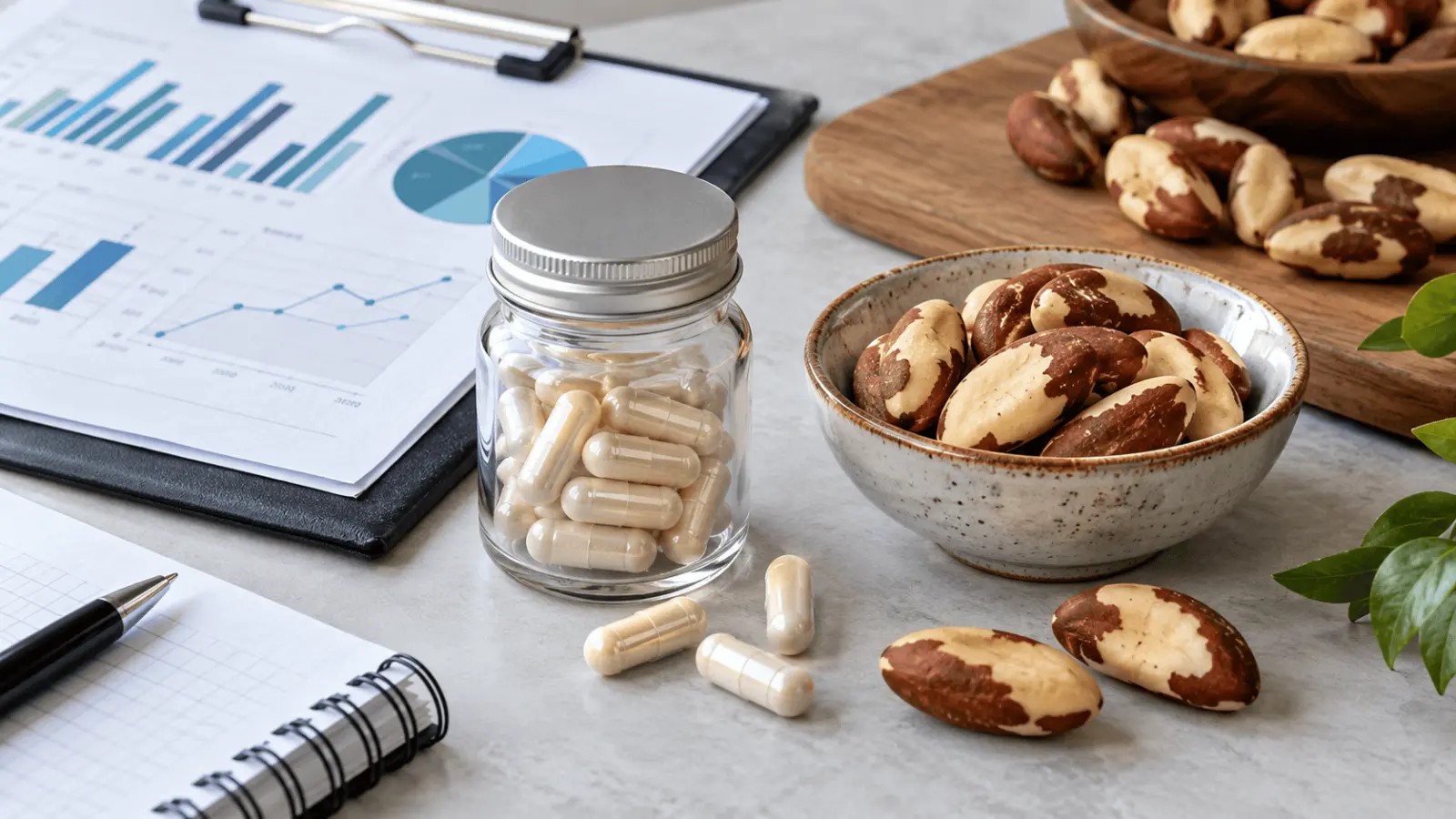
Chronically high selenium intake can cause garlic-like breath, a metallic taste, hair and nail changes, nausea, diarrhoea, skin rashes, fatigue, irritability and nervous-system abnormalities. Brazil nuts can contain unusually high amounts of selenium, so even food sources can produce large intakes if consumed in quantity. In SELECT, the selenium group also showed a non-significant excess of type 2 diabetes during the initial report, and later analyses contributed to broader concern that high-dose supplementation may carry risks without a compensating cancer-prevention benefit.
Current public-health guidance reflects that risk-benefit balance. The World Cancer Research Fund recommends meeting nutritional needs through diet rather than using supplements for cancer prevention. The US Preventive Services Task Force has also found no demonstrated reduction in cancer mortality from selenium supplementation and does not support its routine use as a general preventive strategy. These positions do not imply that selenium is unimportant; they distinguish nutritional adequacy from pharmacologic-style supplementation.
What the evidence means for prevention decisions
The evidence supports a practical separation between avoiding deficiency and taking extra selenium in the hope of preventing cancer. Adequate selenium intake is necessary for health, but more selenium has not been shown to deliver additional cancer protection once nutritional needs are met. For a generally healthy person, the studies do not support choosing a selenium supplement specifically to reduce cancer risk.
A sensible reading of the evidence is therefore:
- Treat selenium as an essential nutrient, not as a proven anticancer supplement.
- Do not interpret lower cancer rates in higher-selenium observational groups as proof that supplements caused protection.
- Give greater weight to randomized cancer-prevention trials when judging whether supplementation works.
- Consider dose and total intake because selenium has a narrow range between nutritional need and excessive exposure.
- Separate population-level cancer prevention from clinical situations in which a health professional is treating a documented deficiency or another specific condition.
For cancer prevention more broadly, established recommendations focus on factors with stronger evidence, including avoiding tobacco, limiting alcohol, maintaining a healthy weight, being physically active and following a diet rich in whole plant foods. Selenium supplementation does not replace those measures and has not demonstrated an equivalent preventive effect.
Research context and interpretation
Selenium remains an active area of nutritional and biological research. Baseline selenium status, genetic variation, chemical form and disease subtype can influence how selenium behaves in the body. Some populations also have lower selenium intake because of soil composition and food systems, making correction of genuine nutritional deficiency a separate issue from high-dose supplementation in people whose selenium status is already adequate.
For routine cancer prevention, randomized trials provide the most directly relevant evidence. Their repeated findings show that selenium supplementation does not reduce cancer risk in generally healthy populations with adequate selenium status. The history of selenium research also illustrates a broader lesson for nutrition science: a nutrient can be essential, biologically active and associated with health outcomes without becoming an effective preventive drug when taken in extra amounts.
Frequently asked questions
Do selenium supplements prevent cancer?
Randomized trials have not shown that selenium supplements prevent cancer in generally healthy people. The 2011 Cochrane review found no convincing preventive effect, and later Cochrane updates strengthened that conclusion with additional trials. Observational associations between higher selenium status and lower risk do not establish that supplementation causes protection.
Why did some observational studies look protective?
People with higher selenium levels can differ from people with lower levels in diet, smoking, socioeconomic conditions, health status and other exposures. Those factors may influence cancer risk independently. Observational studies can adjust for known confounders, but residual confounding and differences in selenium biomarkers can still affect the results.
Is selenium still an essential nutrient?
Yes. Selenium is required for selenoproteins involved in antioxidant defence, thyroid function, DNA synthesis and other processes. The evidence against selenium supplements for cancer prevention does not mean selenium is unnecessary. It means that extra intake above nutritional needs has not been shown to lower cancer risk.
Can too much selenium be harmful?
Yes. Excess selenium can cause garlic-like breath, metallic taste, hair and nail changes, gastrointestinal symptoms, fatigue and nervous-system problems. The adult upper intake level is commonly set at 400 micrograms per day in the United States, while European guidance uses a lower adult limit of 255 micrograms per day.
Sources
- Vinceti M, Dennert G, Crespi CM, et al. Selenium for preventing cancer. Cochrane Database of Systematic Reviews. 2014;(3).
- Daniel Brooks. Selenium for preventing cancer. São Paulo Medical Journal. 2012;130(1):67.
- Vinceti M, Filippini T, Del Giovane C, et al. Selenium for preventing cancer. Cochrane Database of Systematic Reviews. 2018;1.
- Lippman SM, Klein EA, Goodman PJ, et al. Effect of Selenium and Vitamin E on Risk of Prostate Cancer and Other Cancers: The SELECT Trial. JAMA. 2009;301(1):39–51.
- Clark LC, Combs GF Jr, Turnbull BW, et al. Effects of Selenium Supplementation for Cancer Prevention in Patients With Carcinoma of the Skin. JAMA. 1996;276(24):1957–1963.
- Duffield-Lillico AJ, Slate EH, Reid ME, et al. Selenium supplementation and secondary prevention of nonmelanoma skin cancer in a randomized trial. Journal of the National Cancer Institute. 2003;95(19):1477–1481.
- NIH Office of Dietary Supplements. Selenium: Fact Sheet for Consumers. Updated June 18, 2025.
- US Preventive Services Task Force. Vitamin, Mineral, and Multivitamin Supplementation to Prevent Cardiovascular Disease and Cancer: Preventive Medication. 2022.
- World Cancer Research Fund. Do not use supplements for cancer prevention. Evidence for the Cancer Prevention Recommendations. Page reviewed 2026.

Nora Veldin — author
Nora Veldin is a health science writer with academic training in biomedical science and public health. After completing a BSc in Biomedical Science, she undertook an MPH focused on epidemiology, population health and the interpretation of health evidence. Her...
This article is for general information and is not medical advice. It was reviewed for accuracy by a qualified clinician; decisions about your health should be made with your own doctor.
Related
Chest disease diagnosis: radiologic signs and differentials

Human blood groups and population genetics in Mourant’s atlas