

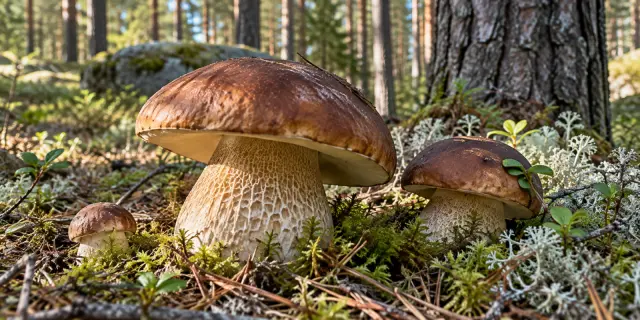



Boletus pinetorum: A Fennoscandian Porcini Taxonomy Case
In 2009, Finnish mycologists described Boletus pinetorum as a new porcini-like species after comparing morphology, ecology and ribosomal DNA markers across members of Boletus section Boletus. The study separated six Finnish taxa and argued that B. pinetorum could be recognised by a combination of visible characters, microscopic structures and habitat preferences.
The molecular evidence was less decisive than the morphology: B. pinophilus, B. reticulatus and the broader B. edulis lineage formed supported groups, but relationships within the B. edulis complex remained unresolved. This explainer examines how the species was proposed, why ITS data alone were difficult to interpret, and what the case shows about fungal species delimitation.
The study started with a difficult porcini problem
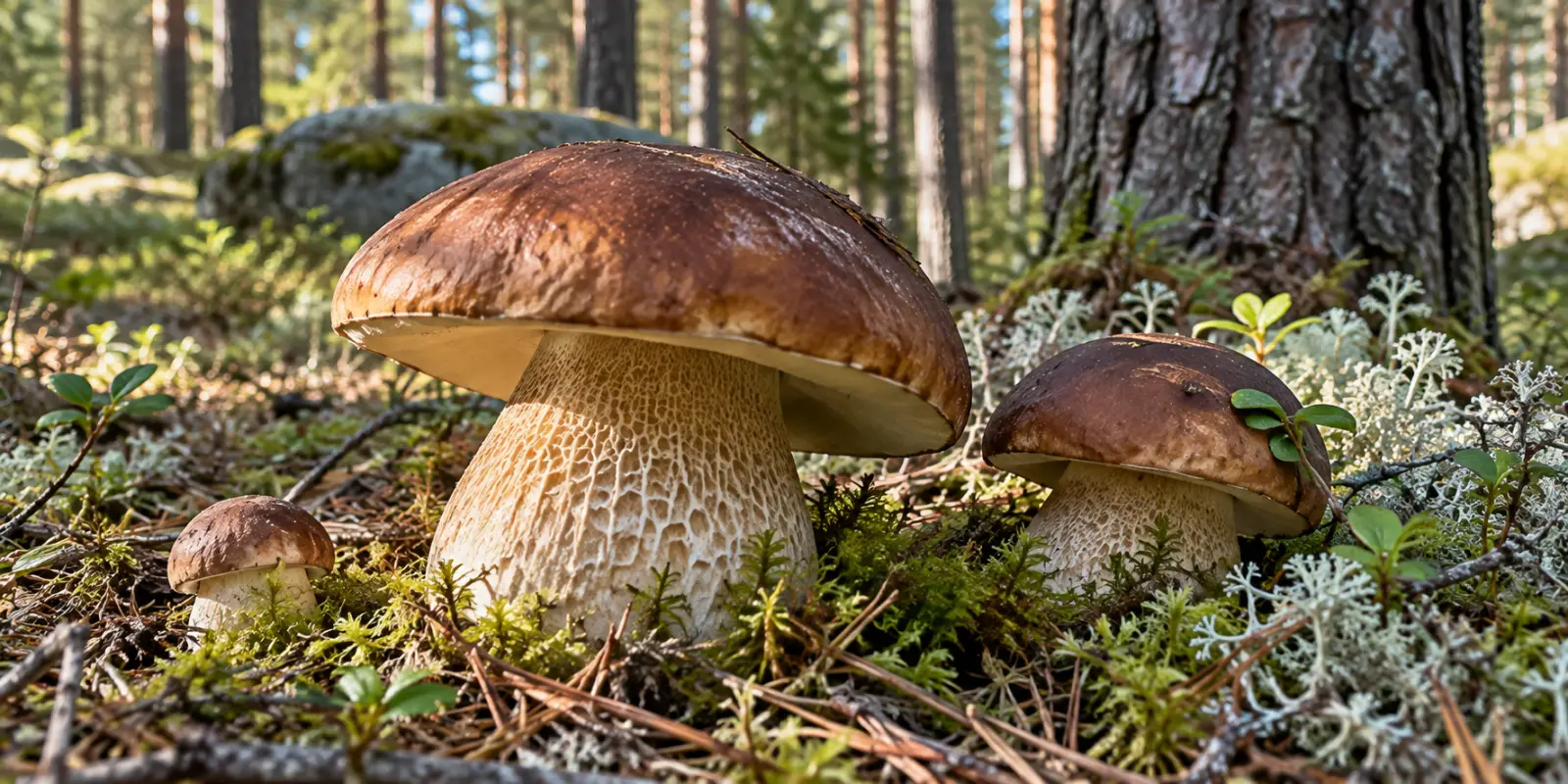
Porcini-like boletes in Europe are morphologically similar, commercially familiar and taxonomically difficult. The 2009 Karstenia study focused on Finnish members of Boletus section Boletus, the group centred on B. edulis. The authors examined macro- and microscopic characters and concluded that six taxa could be separated in Finland: B. pinophilus, B. reticulatus, B. edulis, B. betulicola, B. aff. reticulatus and the newly described B. pinetorum.
The study also discussed B. edulis var. arcticus, illustrating how many names had accumulated around the B. edulis complex. That complexity matters because colour, host tree and fruit-body shape can vary within a species, while genuinely distinct species can look deceptively alike.
Boletus pinetorum was defined by a combination of characters
The authors did not rely on one diagnostic trait. They compared cap and stipe features, microscopic anatomy and ecological requirements. The abstract identifies spore shape, caulocystidia and pileipellis hyphae as the most useful microscopic characters for separating the species in their material.
This combined approach is important in mycology because fruit-body colour and proportions can change with age, weather and site conditions. Microscopic structures often provide more stable evidence, while habitat and host association can add context without being treated as proof on their own.
The taxonomic argument for Boletus pinetorum rested on a pattern of morphology, microscopy and ecology rather than on a single DNA barcode.
The molecular study used ITS1, ITS2 and IGS1
Korhonen and colleagues sequenced the internal transcribed spacer regions ITS1 and ITS2, widely used in fungal identification, and also examined the IGS1 region in the B. edulis complex and B. pinophilus. A total of 46 sequences were generated.
One unexpected result was that IGS1 was shorter than the ITS1-5.8S-ITS2 region yet showed less intraspecific variation than ITS1 and ITS2. This meant the additional marker did not automatically provide the finer species-level resolution that might have been expected.
Some lineages were clear, but the B. edulis group was not
The phylogenetic analysis recovered well-supported lineages for B. pinophilus, B. reticulatus and B. edulis sensu lato. Inside the broader B. edulis group, however, the relationships remained unresolved, consistent with earlier work showing very low sequence variation among several European porcini morphotypes.
That unresolved pattern created a taxonomic tension. The authors considered B. pinetorum and other taxa within the B. edulis group to be separate species because their macro- and microscopic characters and ecological preferences were distinct, even though the chosen DNA regions did not fully separate them.
Low genetic variation does not automatically mean identical species
A marker can fail to distinguish recently diverged species if too little variation has accumulated, if ancestral variants are shared, or if the marker simply evolves too slowly for the question. Conversely, morphology can over-split variable populations. Species delimitation therefore works best when independent lines of evidence converge.
Earlier European work had reached a more conservative conclusion
A 2008 Persoonia study used ITS plus GAPDH across European Boletus section Boletus. It recovered four principal lineages: B. edulis sensu lato, B. pinophilus, B. aereus and B. reticulatus. Within the B. edulis clade, molecular variation was extremely low despite broad geographic sampling and multiple morphotypes.
Those authors concluded that several named forms, including B. betulicola, were better treated within a variable B. edulis rather than as separate species. The contrast with Korhonen and colleagues shows that species concepts can differ even when researchers examine overlapping material and use related molecular markers.
Host association was useful but not sufficient
Porcini species form ectomycorrhizal partnerships with trees, so host identity can be taxonomically informative. Yet European studies have repeatedly warned that host specificity is not absolute. B. edulis can associate with many coniferous and deciduous hosts, while B. pinophilus shows a stronger association with pines but may also occur with other conifers.
Ecology therefore works best as supporting evidence. A fungus repeatedly associated with dry pine habitat may deserve closer attention, but host or habitat alone cannot establish species status without corroborating morphology or genetic data.
What the 2009 study actually compared
Evidence type | What was examined | What it contributed | Main limitation |
Macromorphology | Cap, stipe and fruit-body characters | Separated recognisable field morphotypes | Characters can vary with age and environment |
Micromorphology | Spores, caulocystidia, pileipellis hyphae | Provided some of the strongest diagnostic differences | Requires microscopy and expert interpretation |
Ecology | Habitat and host associations | Supported separation of taxa with different ecological preferences | Host specificity is not absolute |
ITS1 and ITS2 | Ribosomal DNA spacer sequences | Recovered major lineages in section Boletus | Low resolution inside the B. edulis group |
IGS1 | Intergenic spacer in selected taxa | Added a second ribosomal-region comparison | Showed less intraspecific variation than expected |
Integrated taxonomy | Morphology + microscopy + ecology + DNA | Supported description of B. pinetorum in the authors' species concept | Different studies can weight evidence differently |
The broader genus Boletus was later narrowed by phylogenomics
Large molecular studies of Boletineae showed that the traditional genus Boletus contained many unrelated lineages. Nuhn and colleagues in 2013 concluded that many species historically placed in Boletus were not close relatives of the type species B. edulis and that the genus should be restricted to a narrower Boletus sensu stricto.
This broader reorganisation did not eliminate the porcini clade. Instead, it clarified that the true Boletus lineage is centred on B. edulis and close relatives, while many other boletes have been moved to different genera. That makes careful work on the B. edulis complex especially important because these taxa sit near the taxonomic core of Boletus itself.
Boletus pinetorum is still represented as a named species in sequence databases
NCBI Taxonomy currently lists Boletus pinetorum M. Korhonen, 2009 as a species and links the name to type material and the original Karstenia publication. NCBI also warns that its taxonomy database is not an authoritative nomenclatural source, so this status should be understood as database usage rather than a final resolution of every taxonomic debate.
The continuing presence of the name reflects the fact that the 2009 description remains part of the scientific record. At the same time, the low molecular resolution within the B. edulis group means that future multilocus or genomic analyses could refine how closely B. pinetorum relates to neighbouring taxa.
Why ITS can struggle in recently diverged fungi
ITS is widely used as the primary fungal barcode because it is easy to amplify and often differs between species. But no barcode is universally decisive. In species complexes with recent divergence, hybridisation or low mutation rates, several taxa can share very similar ITS sequences.
The B. edulis complex illustrates this limitation well. A marker can be excellent for distinguishing major lineages such as B. pinophilus or B. reticulatus yet provide insufficient resolution among finer morphotypes nested inside B. edulis sensu lato.
Microscopic characters still matter in the DNA era
Modern fungal taxonomy is sometimes described as if DNA had replaced morphology, but the B. pinetorum case shows why that is misleading. DNA can reveal evolutionary structure, while morphology tells researchers whether lineages correspond to reproducible biological differences that can be recognised in collections.
Characters such as spore shape or the structure of the pileipellis may be particularly valuable when fruit-body colour overlaps. Used alone, each character set has weaknesses; used together, they allow a more testable species hypothesis.
The study is also a lesson in scientific disagreement
Taxonomy is not merely naming; it is an argument about where biological boundaries should be drawn. Korhonen and colleagues gave greater weight to consistent morphological and ecological distinctions within a genetically low-diversity complex, while other European researchers preferred a broader, more variable concept of B. edulis.
Neither approach can be summarised as 'DNA versus morphology.' Both used molecular and morphological evidence. The disagreement concerned how much difference is enough to recognise a species when the available gene regions provide limited resolution.
What readers should take from the discovery
The 2009 paper established B. pinetorum as a formally described taxon based on detailed Fennoscandian material. It generated new sequence data, documented diagnostic characters and made the case that the fungus represented more than ordinary variation in B. edulis.
Its broader significance lies in the uncertainty it preserves. The study showed that molecular markers can confirm some species boundaries while leaving others unresolved, and that fungal taxonomy often advances by comparing several independent kinds of evidence rather than waiting for one perfect diagnostic test.
The case also illustrates why species delimitation is strongest when different kinds of evidence are evaluated together. A distinctive cap, stipe or microscopic feature can be useful, but morphology may vary with age, weather and habitat. DNA markers can provide independent evidence, yet closely related fungi may share very similar sequences or show incomplete separation in a single genomic region. Ecological association adds another layer, but host preference alone is not necessarily diagnostic.
For B. pinetorum, the importance of the 2009 study therefore lies in the combined argument rather than in one decisive test. The authors used morphology, microscopy, ecology and ribosomal markers to propose a taxon while acknowledging unresolved relationships in the wider B. edulis complex. That cautious combination of evidence is still relevant when later researchers revisit names with broader sampling or additional loci.
A careful reading of the study separates five questions:
- which fruit-body and microscopic characters consistently distinguish the proposed species;
- whether ecological differences recur across multiple collections and locations;
- which DNA markers recover supported lineages and which fail to resolve the complex;
- whether low sequence variation reflects one variable species or recent divergence among several species;
- how later multilocus studies and curated taxonomic databases treat the proposed name.
Taken together, the 2009 study remains a useful example of integrative fungal taxonomy, showing how morphology, ecology and molecular markers can support species recognition even when DNA data do not fully resolve relationships within a closely related species complex.
Frequently asked questions
What is Boletus pinetorum?
Boletus pinetorum is a porcini-like bolete described as a new species from Fennoscandian material in 2009. The authors placed it within Boletus section Boletus and distinguished it using fruit-body morphology, microscopic structures, ecological preferences and DNA data, although relationships inside the broader B. edulis group remained unresolved.
How was Boletus pinetorum distinguished from Boletus edulis?
The 2009 study relied on a combination of macroscopic and microscopic features rather than a single diagnostic character. Spore shape, caulocystidia and pileipellis hyphae were particularly useful, and ecological differences also contributed. Molecular markers supported major lineages but did not fully resolve all taxa inside the B. edulis complex.
Why did the DNA analysis not settle the species question?
The ITS regions showed very little variation among members of the B. edulis group. When closely related fungi share similar barcode sequences, phylogenetic trees may not resolve recent species boundaries. That leaves morphology, ecology and additional genes important for testing whether the observed differences represent separate species or intraspecific variation.
Is Boletus pinetorum still considered a valid species?
The name remains in current sequence databases such as NCBI Taxonomy, where it is listed as Boletus pinetorum M. Korhonen, 2009. However, NCBI itself notes that its taxonomy is not an authoritative nomenclatural source. The species should therefore be understood within an ongoing taxonomic discussion around the B. edulis complex.
What does this study teach about fungal taxonomy?
It shows why fungal species are often delimited using several independent evidence types. Morphology can vary within a species, while a common DNA barcode may show too little variation between recently diverged taxa. Combining microscopy, ecology, multiple genetic markers and repeated collections produces a stronger species hypothesis than any one criterion alone.
Sources
- Korhonen M, Liimatainen K, Niskanen T. A new boletoid fungus, Boletus pinetorum, in the Boletus section Boletus from Fennoscandia (Basidiomycota, Boletales). Karstenia. 2009;49(2):41-60.
- Beugelsdijk DCM, van der Linde S, Zuccarello GC, den Bakker HC, Draisma SGA, Noordeloos ME. A phylogenetic study of Boletus section Boletus in Europe. Persoonia. 2008;20:1-7. DOI: 10.3767/003158508X283692.
- Leonardi M, Paolocci F, Rubini A, Simonini G, Pacioni G. Assessment of inter- and intra-specific variability in the main species of Boletus edulis complex by ITS analysis. FEMS Microbiology Letters. 2005;243(2):411-416.
- Nuhn ME, Binder M, Taylor AFS, Halling RE, Hibbett DS. Phylogenetic overview of the Boletineae. Fungal Biology. 2013;117(7-8):479-511. DOI: 10.1016/j.funbio.2013.04.008.
- Binder M, Hibbett DS. Molecular systematics and biological diversification of Boletales. Mycologia. 2006;98(6):971-981.
- Schoch CL, Seifert KA, Huhndorf S, et al. Nuclear ribosomal internal transcribed spacer (ITS) region as a universal DNA barcode marker for Fungi. Proceedings of the National Academy of Sciences. 2012;109(16):6241-6246. DOI: 10.1073/pnas.1117018109.
- Schoch CL, Ciufo S, Domrachev M, et al. NCBI Taxonomy: a comprehensive update on curation, resources and tools. Database. 2020;2020:baaa062. DOI: 10.1093/database/baaa062.
- NCBI Taxonomy. Boletus pinetorum M. Korhonen, 2009. Taxonomy ID 764046. Accessed 2026.
- Peintner U, Ladurner H, Simonini G. Xerocomus cisalpinus sp. nov., and the delimitation of species in the Boletaceae. Mycological Research. 2003;107(6):659-679.

Lucas Merritt — author
Lucas writes the animal science and zoology explainers. His editorial focus includes animal ecology, terrestrial and aquatic invertebrates, molluscs, invasive species, animal behaviour, species distributions and interactions between animals, agriculture and na...
Related

Mangosteen in the United States: Cultivation, Imports and Marketing
How to Grow Hydnophytum and Myrmecodia Ant-Plants

Humic Substances as Plant Biostimulants: What They Can Do