




A New Boletoid Fungus, Boletus pinetorum, in the Boletus Section Boletus from Fennoscandia (Basidiomycota, Boletales)
Korhonen, Liimatainen and Niskanen's 2009 study examined Finnish members of Boletus section Boletus, combining morphology, ecology and DNA markers to describe Boletus pinetorum as a distinct species within the Boletus edulis group.
What the study did and found
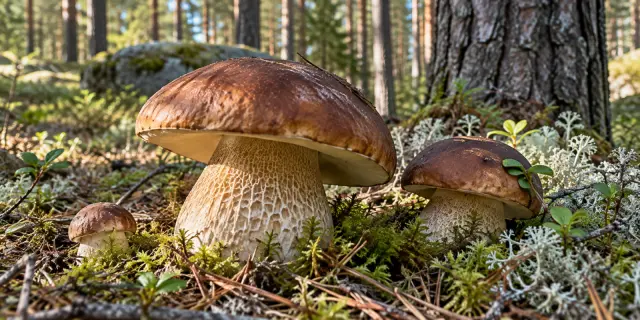
M. Korhonen, K. Liimatainen and T. Niskanen's 2009 article “A new boletoid fungus, Boletus pinetorum, in the Boletus section Boletus from Fennoscandia (Basidiomycota, Boletales).” examined species of Boletus section Boletus in Finland. Six taxa were separated, including the newly described B. pinetorum. Species were distinguished using macro- and microscopical characters, ecology and DNA markers. Important microscopic features included spore shape, caulocystidia and pileipellis hyphae. ITS1, ITS2 and, for selected taxa, IGS1 were analysed, generating 46 sequences. Major lineages were supported, although relationships within the B. edulis group remained unresolved.
Why it is cited
The paper is cited in later mycological work because it formally introduced Boletus pinetorum and documented the characters used to distinguish it from closely related porcini-like boletes. It is also useful in discussions of species delimitation in the Boletus edulis complex, where morphology, ecology and commonly used ribosomal markers do not always produce identical boundaries. The current Karstenia record continues to present the article as the original 2009 taxonomic treatment.
Later databases continue to recognise Boletus pinetorum M. Korhonen as a species in Boletaceae. NCBI Taxonomy lists it as a current species name, and GBIF also treats it as an accepted species. This supports the continuing nomenclatural recognition of the taxon described in 2009. At the same time, the original paper's own limitation remains important: ITS data did not fully resolve relationships within the B. edulis group. Modern fungal systematics therefore increasingly combines multiple loci, broader sampling and phylogenomic approaches rather than relying on a single ribosomal region or morphology alone.
The topic today
Boletus pinetorum remains part of ongoing work on bolete diversity, species boundaries and the evolution of ectomycorrhizal fungi. Current biodiversity databases place it in Boletus, family Boletaceae, and records indicate a Fennoscandian and northern European distribution associated with pine habitats. The broader topic has shifted toward integrative taxonomy, where morphology, ecology, DNA sequence data and geographic sampling are evaluated together. The 2009 paper remains especially relevant as the original description and as an example of the difficulty of resolving closely related taxa within the B. edulis complex.