


Animal Translocation Stress: Conservation Risks and Management
Moving animals for conservation can save threatened populations, restore species to former ranges and establish new populations. Yet capture, handling, temporary captivity, transport and release can also expose an animal to a sequence of physiological and behavioural challenges. A 2010 review by M. J. Dickens, D. J. Delehanty and L. M. Romero argues that stress should therefore be treated as a predictable part of translocation planning rather than as an unexpected complication.The review makes an important distinction: an acute stress response is a normal survival mechanism, whereas chronic stress can develop when the stress-response system is pushed beyond its normal capacity and becomes dysregulated. Chronic stress does not guarantee that a translocation will fail. Instead, the authors propose that it can increase individual vulnerability and indirectly reduce the probability that a released population becomes self-sustaining.
Why stress is central to animal translocation
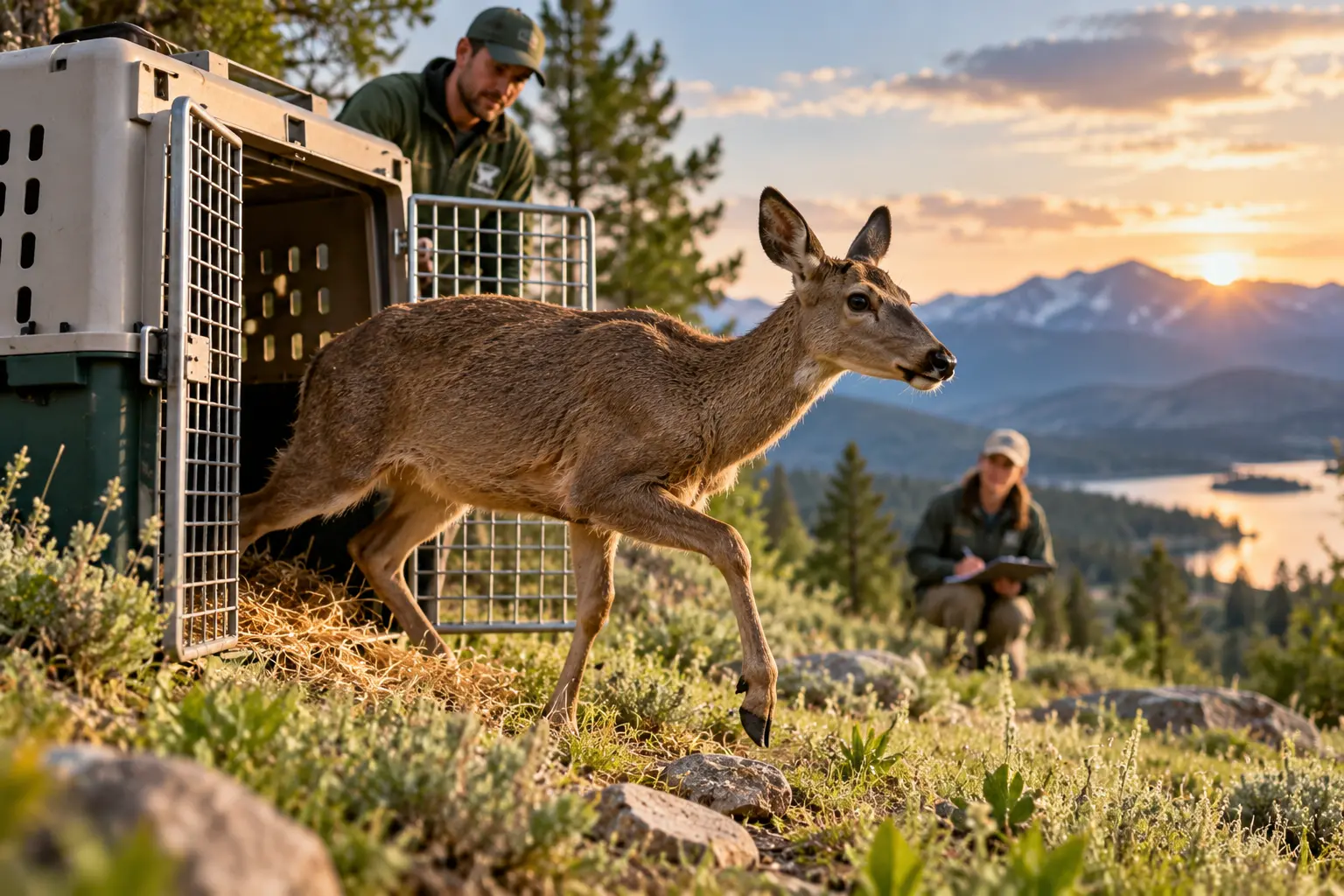
Translocation is not a single event. An animal may be captured, restrained, examined, housed, transported and then released into unfamiliar surroundings. Dickens and colleagues describe these stages as potential stressor exposures that can accumulate across the procedure. Their review focuses on the physiological consequences of that cumulative burden and on how conservation practice might reduce its magnitude or duration.
Acute stress can support immediate survival
The short-term acute stress response is essential in the wild. It mobilizes resources that help an animal respond rapidly to a threat or demanding event. In a translocation, an acute response to capture or handling is therefore not automatically evidence of pathology. The concern arises when repeated or prolonged challenges prevent the stress-response system from returning to its normal operating range.
Chronic stress represents a different biological problem
The review defines chronic stress in terms of a stress-response system that has been pushed beyond normal capacity and becomes dysregulated. Under those conditions, physiological changes intended for short-term survival may persist long enough to contribute to pathology. The authors suggest that chronic stress may be common in translocated animals because several stressful procedures often occur in sequence.
Type of response | Role | Concern during translocation |
Acute stress | Short-term adaptive response important for survival | Not inherently pathological; may occur during capture, handling or transport |
Chronic stress | Prolonged or dysregulated physiological response | May increase vulnerability and contribute to stress-related pathology |
How chronic stress can increase vulnerability after release
A central argument of the review is that stress affects translocation failure indirectly. The authors do not describe chronic stress as a simple switch that determines success or failure. Instead, translocation-induced chronic stress can make individuals more vulnerable to other challenges. An animal arriving in a new environment must still find food and shelter, avoid predators, interact with unfamiliar conspecifics and cope with local weather or disease exposure.
Stress is one factor within a larger conservation outcome
This framing matters because a stressed animal may still survive and reproduce, while an apparently unstressed animal may fail for unrelated ecological reasons. The relevant conservation endpoint is not merely survival immediately after release. Dickens and colleagues emphasize the formation of a new, self-sustaining population, so individual physiological condition must be considered alongside habitat quality, behaviour and demographic performance.
Translocation failure should not be attributed to stress alone
The review explicitly rejects the idea that unavoidable stress makes translocation unsuitable as a conservation tool. Rather, predictable stress creates an opportunity for better planning. If practitioners identify the stages that expose animals to the greatest number or magnitude of stressors, they can redesign procedures to reduce the total burden.
Where stressors arise during the translocation process
The review points to capture techniques and care during captivity as examples of procedures that can be adjusted. More broadly, each stage can introduce a different challenge, and those challenges may interact. A short capture event, for example, may be followed by restraint, confinement and transport before the animal has fully recovered from the preceding disturbance.
Stage | Potential stressor exposure | Planning focus supported by the review |
Capture | Pursuit, restraint and handling | Adjust capture techniques to reduce unnecessary exposure |
Temporary captivity | Confinement and repeated care procedures | Improve care procedures and limit avoidable disturbance |
Transport | Continued confinement and environmental change | Reduce the number and magnitude of stressors where possible |
Release | Abrupt transition to a new environment | Aim to shorten the time course and impact of chronic stress |
Cumulative exposure can matter more than one isolated event
Evaluating each stage in isolation can miss the cumulative physiological load, because translocation consists of multiple procedures. The review therefore encourages a whole-procedure perspective. The practical objective is not to promise a stress-free translocation, which may be unrealistic, but to prevent manageable stressors from accumulating into a prolonged dysregulated state.
How conservation teams can reduce translocation-related stress
Dickens and colleagues propose reducing both the total number of stressor exposures and their magnitude throughout the translocation procedure. This means examining procedures before animals are moved and identifying where handling, captivity or other interventions can be modified. The paper presents stress reduction as a management problem: unavoidable challenges should be distinguished from exposures that can reasonably be shortened, softened or eliminated.
Capture methods can be adjusted
Capture is often the first major intervention and can shape the physiological state in which an animal enters later stages. The review specifically identifies capture techniques as an area that can be adjusted. Appropriate procedures differ among species and conservation programmes, so capture planning has to account for the biology of the animals, the environment and the sequence of later procedures.
Care during captivity can reduce additional exposure
Temporary captivity may be necessary for examination, quarantine, transport preparation or logistical reasons. The review identifies care procedures during captivity as another point where practitioners can reduce stressor exposure. The principle is to avoid adding unnecessary challenges to an animal already coping with capture and environmental change.
What physiological monitoring can and cannot tell managers
The review is concerned with physiological stress, but its broader argument cautions against treating a single stress measurement as a complete prediction of conservation outcome. Stress responses are biologically meaningful only in context: their duration, magnitude and relationship to behaviour, health and subsequent population performance matter. Physiological measurements can therefore contribute to translocation planning and evaluation, but they do not provide one universal diagnostic threshold for every species.
Species and procedures require context-specific interpretation
Different animals encounter different capture methods, captivity periods, transport conditions and release environments. Consequently, the review's general principles should not be converted into identical protocols for all taxa. Its value lies in showing why practitioners should anticipate chronic stress and design translocations to reduce preventable exposures.
What the 2010 review establishes and what it does not
This paper is a review, not a single translocation experiment. Its conclusions synthesize the role of physiological stress in translocation and propose ways to reduce chronic stress-related pathology. It supports the view that stress can increase vulnerability and thereby decrease the probability that a population becomes self-sustaining. It does not establish that every translocated animal becomes chronically stressed or that stress alone determines whether a project succeeds.
Supported by the review | Not established by the review |
Acute stress is an important short-term survival response | That any acute stress response predicts translocation failure |
Chronic stress can occur when the stress system becomes dysregulated | That every translocated animal develops chronic stress |
Chronic stress may increase individual vulnerability | That stress is the sole cause of failed translocations |
Stressors can be reduced through changes in procedures | One universal protocol that is optimal for every species |
Reducing chronic stress may improve the likelihood of success | A guaranteed success rate from any single intervention |
Why the review remains useful for conservation planning
The paper offers a practical conceptual shift: stress is not merely something to measure after problems appear. It can be anticipated during project design. Treating chronic stress as a predictable risk factor encourages teams to examine the entire sequence from capture to release, reduce avoidable exposures and consider how physiological condition may interact with the ecological demands animals face after release.
Practical takeaway: Animal translocation may inevitably involve stress, but the 2010 review does not treat stress as a reason to abandon translocation. Its practical message is to reduce the impact and duration of chronic stress by managing stressor exposure across capture, captivity and other stages, thereby lowering vulnerability and supporting the goal of establishing a self-sustaining population.
Frequently asked questions
Does stress mean an animal translocation will fail?
No. The review argues that stress has an indirect role in failure by increasing individual vulnerability. A stressed animal may still survive and reproduce, so stress should be treated as a predictable risk factor rather than an automatic outcome.
What is the difference between acute and chronic stress?
Acute stress is a short-term response that is critical for survival in challenging situations. Chronic stress develops when the physiological stress-response system is pushed beyond normal capacity and becomes dysregulated. The latter is the condition associated with pathology in the review.
Why can translocation lead to chronic stress?
Translocation can expose animals to several stressors through capture, handling, captivity, transport and release. When these exposures accumulate or persist, recovery may be limited. The review therefore proposes considering the complete translocation procedure rather than focusing on one event alone.
How can conservation teams reduce translocation stress?
The authors propose reducing the number and magnitude of stressor exposures wherever procedures can be adjusted. They specifically identify capture techniques and care during captivity as areas for improvement. The appropriate details still need to be adapted to the species and project.
Sources
- Dickens MJ, Delehanty DJ, Romero LM. Stress: an inevitable component of animal translocation. Biological Conservation. 2010;143(6):1329–1341.
- Teixeira CP, de Azevedo CS, Mendl M, Cipreste CF, Young RJ. Revisiting translocation and reintroduction programmes: the importance of considering stress. Animal Behaviour. 2007;73(1):1–13.
- Dickens MJ, Delehanty DJ, Romero LM. Stress and translocation: alterations in the stress physiology of translocated birds. Proceedings of the Royal Society B. 2009;276:2051–2056.
- Fischer J, Lindenmayer DB. An assessment of the published results of animal relocations. Biological Conservation. 2000;96(1):1–11.
- Seddon PJ, Armstrong DP, Maloney RF. Developing the science of reintroduction biology. Conservation Biology. 2007;21(2):303–312.
- Armstrong DP, Seddon PJ. Directions in reintroduction biology. Trends in Ecology & Evolution. 2008;23(1):20–25.
- Tarszisz E, Dickman CR, Munn AJ. Physiology in conservation translocations. Conservation Physiology. 2014;2(1):cou054.
- Batson WG, Gordon IJ, Fletcher DB, Manning AD. Translocation tactics: a framework to support the IUCN Guidelines for wildlife translocations and improve the quality of applied methods. Journal of Applied Ecology. 2015;52:1598–1607.
- Breed D, Meyer LCR, Steyl JCA, Goddard A, Burroughs R, Kohn TA. Conserving wildlife in a changing world: understanding capture myopathy—a malignant outcome of stress during capture and translocation. Conservation Physiology. 2019;7(1):coz027.

Lucas Merritt — author
Lucas writes the animal science and zoology explainers. His editorial focus includes animal ecology, terrestrial and aquatic invertebrates, molluscs, invasive species, animal behaviour, species distributions and interactions between animals, agriculture and na...
Related
Hereditary dwarfism in beef cattle: genetics and calf outcomes
Biting midges: biology, disease transmission and control
Blackflies: biology, life cycle, ecology and disease-vector roles
Insect pheromones and chemical communication in social insects
Skin tumours in dogs and cats: what pathology data show