
















Why do cats knead and make biscuits on blankets and people
Cats knead by pushing alternately with the front paws into something soft, and why they do it has never been studied directly: the explanations in circulation are inferences from neighbouring research rather than findings about kneading itself. A review of cat cognition published in a specialist journal opens by noting how little scientific work has focused on the domestic cat compared with the dog (Vitale Shreve & Udell, 2015), and kneading sits well down that list of neglected subjects.
What follows separates the three usual explanations from the evidence each can actually draw on: the kitten-suckling account, the scent-marking account and the comfort account. Wider coverage of the subject area sits in the [animals section](/animals/).
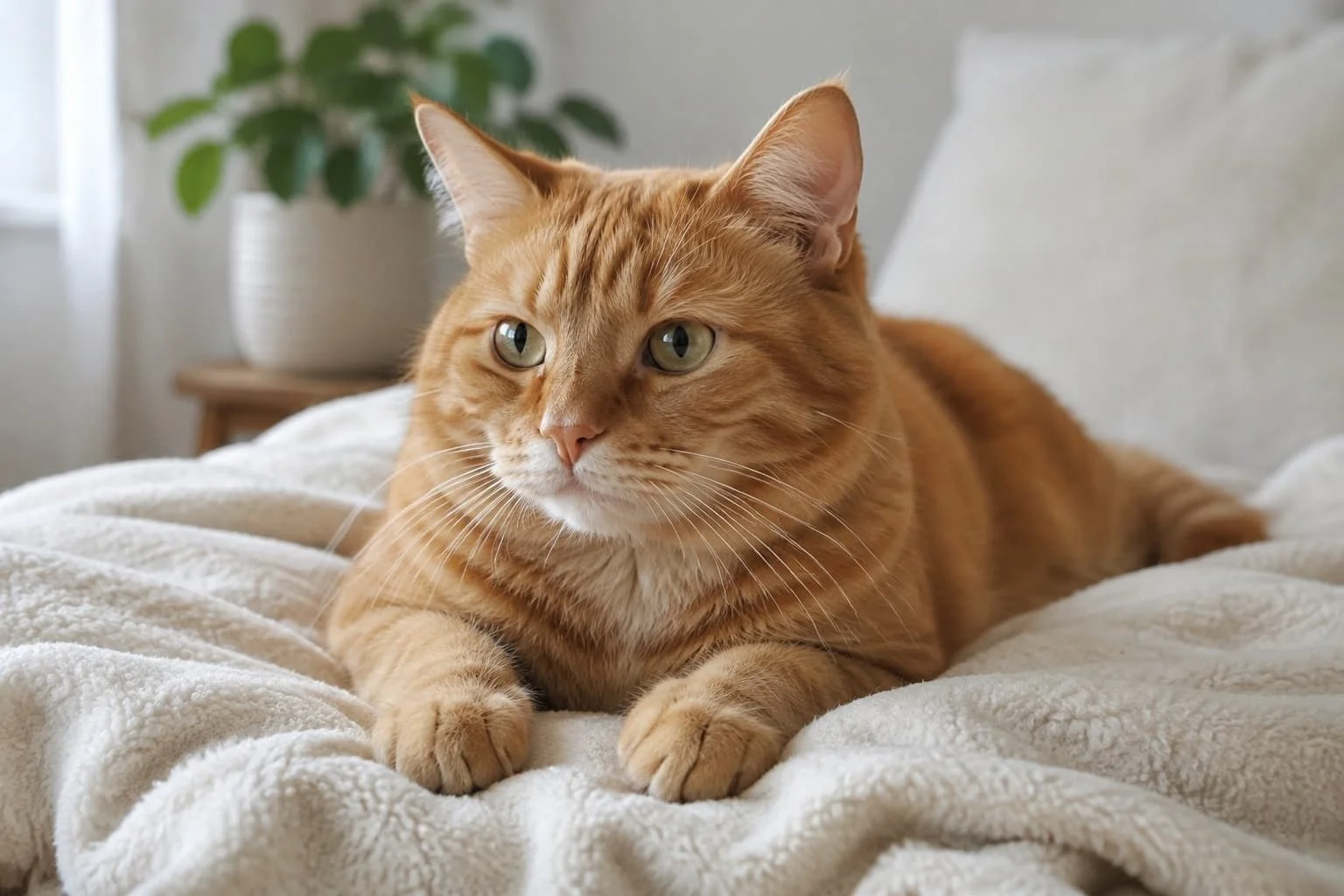
What kneading looks like and how it is recorded
The behaviour itself is easy to describe: a cat pushes alternately with its front paws into a soft surface, claws sometimes extending and retracting, often while purring and settling. Owners call it making biscuits because the motion resembles kneading dough. The description is uncontroversial; what is missing is research built around it.
It is worth being precise about what is missing. Nobody disputes that cats do this; the gap is that no one has recorded how long a bout lasts, how often it happens, in which situations, at what ages, or in what share of cats. Those are the entries an ethogram needs before a behaviour can be compared across studies or linked to anything else.
That absence is easier to understand with the structure of the field in view. Researchers who study cat behaviour work from ethograms, catalogues of defined behaviours that let different studies be compared. A standardised ethogram for the whole cat family was assembled from 95 documents covering 30 species and 40 subspecies, precisely because definitions varied between studies (Stanton et al., 2015).
Behaviours that attract research are usually the ones tied to a practical question: aggression, feeding, elimination, breeding, welfare in captivity. Kneading rarely causes trouble for owners, which may be part of why so little research has grown around it. That is the honest starting position, and it is the reason every confident explanation below rests on inference.
The kitten-suckling explanation
The most common account holds that kneading is a leftover from nursing, when kittens push with their paws against the mother's belly. Work on suckling in free-ranging domestic cats gives this a firm base in the sense that early nursing is organised and individual: in 11 litters totalling 52 kittens, each kitten had settled on particular nipples by the third day after birth, and 86 per cent used one nipple most often, even when the mother changed the side she lay on (Hudson et al., 2009).
The same study recorded contests for access to nipples at an average of one to two per kitten per hour of nursing, and found no relation between which nipple a kitten used and its weight gain or milk intake (Hudson et al., 2009). Early feeding is a structured, competitive business rather than a passive one.
The nursing period that study covered ran to postnatal day 28, just before weaning begins (Hudson et al., 2009). The study did not measure paw movements or test whether kneading behaviour persisted into adulthood.
A behaviour that begins in the first days of life is a plausible origin for one that persists. Plausible is not the same as demonstrated.
A comparative review does place kneading among the kitten-to-mother behaviours that cats redirect at their owners (Bradshaw, 2016), but that is a classification rather than a measurement. What the suckling literature does not contain is a measurement linking paw movements during nursing to kneading in adult cats. No study has followed individuals from nursing into adulthood to see whether those that kneaded more as kittens knead more later, which is the observation the explanation would need.
The scent-marking explanation
The second account holds that kneading deposits scent from glands in the paws, marking a blanket or a person as familiar. Here the relevant evidence is a field study of semi-feral cats that set out specifically to catalogue how cats mark. It recorded urine spraying, concentrated in adult males; scratching of tree bark, which left a visual mark and was placed along frequently used paths; and rubbing against objects (Feldman, 1994).
The design of that study is worth noting, because it is the kind of work the kneading question lacks. Cats were watched in the field rather than in a laboratory, and the results are specific enough to test: scratching trees stood along frequently used paths rather than at the edges of a range, and bark consistency decided which species were scratched, with soft bark preferred (Feldman, 1994).
The detail that matters is which glands the study credited. Rubbing was described as probably using glandular secretions from the face and tail areas, and males rubbed and marked more than females (Feldman, 1994). Kneading does not appear in that catalogue of marking methods.
Explanation | What supports it | What is missing |
Leftover from nursing | Nursing is organised and individual from the first days (Hudson et al., 2009) | No study links nursing paw movements to adult kneading |
Scent marking with the paws | Cats mark by spraying, scratching and rubbing (Feldman, 1994) | Kneading is not among the recorded marking methods |
Comfort and relaxation | Cats form attachment bonds with caregivers (Vitale et al., 2019) | No measurement of kneading against any index of comfort |
Note: the table sets out what each explanation can currently draw on, not a ranking. None of the three has been tested against kneading directly, so the right-hand column is the same kind of gap in every row.
One more point belongs here, because it is often blurred. Having glands in the paws and using them to mark are different claims. The first is anatomy and is not in dispute for cats generally; the second requires showing that a behaviour deposits secretion in a way other cats respond to, which is what the marking study set out to establish for spraying, scratching and rubbing (Feldman, 1994).
There is a narrower version of the scent idea that survives the objection. Cats do mark by contact, and a cat that settles repeatedly on one blanket will leave scent there by rubbing and lying on it whether or not the paws contribute. Saying that the spot becomes familiar is well supported; saying that the kneading is what makes it so is not.
A test of the paw-gland version would not be exotic. It would mean sampling the surface a cat has kneaded and showing that other cats respond to it differently from an untouched one, which is the standard way a marking claim is established. No such experiment on cats turned up in the work reviewed here.
The comfort explanation and kneading on people
The third account treats kneading as something cats do when settled and relaxed, which is where the question most owners ask belongs: why does my cat knead me rather than a cushion. Cats direct a good deal of behaviour at their people, and this has been measured, if not for kneading. Using criteria from the human infant literature, cats were shown to display distinct attachment styles towards human caregivers, including secure attachment (Vitale et al., 2019).
That result used a method borrowed rather than invented, which is part of why it carries weight. The behavioural criteria came from the human infant literature, where secure and insecure attachment styles are defined by how an individual behaves when a caregiver leaves and returns (Vitale et al., 2019). Applying an established test to a new species is a stronger move than describing what owners report.
The wider picture of cat sociality supports treating a person as a social partner rather than furniture. A review of social organisation in the cat concluded that while the species can survive alone, social groups with an internal structure form wherever food resources are sufficient to support them (Crowell-Davis et al., 2004). Cats are not the solitary animals the folk picture assumes.
A comparative review puts a caution next to that. The domestic cat descends from a largely solitary ancestor, and its social behaviour is described as flexible and variable between individuals rather than as a fixed repertoire, and its sociability towards people as recently acquired (Bradshaw, 2016). Whatever kneading at a person means, it is unlikely to mean the same thing in every cat.
What is still missing is the measurement. No work has recorded kneading alongside any independent index of a relaxed state, so the comfort account describes the circumstances in which owners notice the behaviour rather than explaining it. The same limitation applies whether the cat is on a blanket or on a lap.
Individual variation is the part most owners notice and the part least described. Some cats knead daily, some rarely, and some only on one person or one blanket. Whether that reflects early rearing, temperament or simple habit has not been measured, and the attachment work gives a reason to expect differences between individuals rather than one rule (Vitale et al., 2019).
Why so little has been studied
The imbalance between cat and dog research is well documented and not accidental. A review of cat cognition notes that little scientific research has focused on the domestic cat, especially in comparison with the dog, and surveys the areas where work exists: perception, [memory](/animals/chicken-cognition-learning-memory-social-behaviour-and-navigation-animals/), sensitivity to human cues, vocal recognition, attachment, personality (Vitale Shreve & Udell, 2015). Spontaneous comfort behaviours are not on the list.
The dog comparison is the clearest way to see the imbalance. Attachment in dogs had been studied for decades before the equivalent test was run on cats, and the cat result was published as a short report in 2019 (Vitale et al., 2019). A species living in millions of homes had not been given that test until then, which says something about where attention has gone.
Even the better-studied parts of the cat's repertoire are unsettled. A review of feline vocal communication counts up to 21 described call types while noting the repertoire is probably larger and the boundaries between types are not always clear (Tavernier et al., 2020). If the sounds cats make are still being catalogued, a silent habit with no clinical consequence was never likely to be near the front of the queue.
The gap has a consequence beyond the academic. Where research is absent, owner-facing writing fills the space anyway, and the three explanations in this article circulate as settled fact rather than as inference. None of them is absurd, and that is exactly what makes the confident versions hard to correct: they sound reasonable, and there is nothing to measure them against.
Behaviour research also tends to follow welfare questions, since that is where the funding and the practical stakes are. The account of [how zoo enclosures moved from bars to habitat design](/animals/american-zoos-bars-to-habitat-design-animals/) covers one version of that, and the review of [what overstocking does to dairy cows](/animals/dairy-cow-welfare-animals/) another. A cat kneading a blanket raises no such question.
What can honestly be said
Supported: cats begin life with organised, individual suckling patterns, and they mark their surroundings by spraying, scratching and rubbing with glands on the face and tail (Hudson et al., 2009; Feldman, 1994). Cats also form attachment bonds with their people and are more social than the solitary stereotype allows (Vitale et al., 2019; Crowell-Davis et al., 2004).
Not supported: any specific claim about what kneading is for. The suckling origin, the paw-gland marking and the contentment reading are all consistent with what is known, which is a much weaker statement than being shown by it, and consistency is cheap when nothing has been measured.
Worth separating out: the question owners usually mean. Asking why a cat kneads a particular person is asking about that cat, and no general finding answers it. What the attachment work shows is that cats differ from one another in how they relate to their people, which is a reason to expect the answer to vary rather than a reason to expect one (Vitale et al., 2019).
Unsettled, and likely to stay that way: whether kneading has a function at all. Some behaviours persist because they once served a purpose and cost nothing to keep, and distinguishing those from behaviours with a current function needs exactly the kind of targeted study that has not been done (Stanton et al., 2015). A reader is on firmer ground saying that cats knead when settled than saying why.
Designing the missing study would not be difficult in principle. It would mean recording kneading in a defined group of cats with the kind of operational definition an ethogram supplies, noting the situation and what preceded it, and comparing across ages and rearing histories (Stanton et al., 2015). Until something of that sort exists, the subject stays where it is.
One point sits outside the research. Kneading is not described as a symptom in any of the studies cited here, and changes in a cat's habits or signs of illness fall outside what this literature examines.
Frequently asked questions
Why does my cat knead me?
Studies have measured kneading during human-cat interactions, but they have not established why a particular cat kneads a person. Cats also form attachment bonds with caregivers, which makes humans social partners rather than merely convenient surfaces (Vitale et al., 2019; Haywood et al., 2021).
Why do cats knead blankets and soft things?
Soft, yielding surfaces are the ones the movement works on, and the usual explanation traces it to nursing, when kittens push against the mother. That origin is plausible but untested: no research has connected paw movements during nursing to kneading in adult cats.
Does kneading mean a cat is marking its territory?
A field study that catalogued how cats mark recorded spraying, scratching of tree bark and rubbing with glands on the face and tail. Kneading was not among the methods it recorded, so the paw-gland version of the idea has no direct support (Feldman, 1994).
Do all cats knead?
No systematic figures exist, because no survey has counted it. The behaviour is common enough to have an everyday name in several languages, but how many cats do it, how often, and whether it varies by age or background has not been measured.
Should I stop my cat kneading me if it hurts?
None of the studies reviewed here treats kneading as a problem behaviour. None of the studies cited here examined how kneading affects owners or how it changes, so the research offers no tested method for reducing it, and claw discomfort sits outside what has been measured.
Sources
- Hudson R, Raihani G, Gonzalez D, Bautista A, Distel H. Nipple preference and contests in suckling kittens of the domestic cat are unrelated to presumed nipple quality. Developmental Psychobiology. 2009;51(4):322–332. DOI 10.1002/dev.20371.
- Feldman HN. Methods of scent marking in the domestic cat. Canadian Journal of Zoology. 1994;72(6):1093–1099. DOI 10.1139/z94-147.
- Vitale KR, Behnke AC, Udell MAR. Attachment bonds between domestic cats and humans. Current Biology. 2019;29(18):R864–R865. DOI 10.1016/j.cub.2019.08.036.
- Vitale Shreve KR, Udell MAR. What's inside your cat's head? A review of cat (Felis silvestris catus) cognition research past, present and future. Animal Cognition. 2015;18(6):1195–1206. DOI 10.1007/s10071-015-0897-6.
- Crowell-Davis SL, Curtis TM, Knowles RJ. Social organization in the cat: a modern understanding. Journal of Feline Medicine and Surgery. 2004;6(1):19–28. DOI 10.1016/j.jfms.2003.09.013.
- Stanton LA, Sullivan MS, Fazio JM. A standardized ethogram for the Felidae: a tool for behavioral researchers. Applied Animal Behaviour Science. 2015;173:3–16. DOI 10.1016/j.applanim.2015.04.001.
- Tavernier C, Ahmed S, Houpt KA, Yeon SC. Feline vocal communication. Journal of Veterinary Science. 2020;21(1):e18. DOI 10.4142/jvs.2020.21.e18.
- Bradshaw JWS. Sociality in cats: a comparative review. Journal of Veterinary Behavior. 2016;11:113–124. DOI 10.1016/j.jveb.2015.09.004.

Lena Okonjo — author
Lena Okonjo is a Zoology graduate with a master’s-level specialization in Animal Behaviour. Her earlier work involved preparing summaries of field studies on animal behaviour and insects for general audiences. At Cabdirect, Lena covers animal behaviour, insect...
Related

American zoos: how cages gave way to habitat design

Overstocking and Dairy Cows: Lessons from a 2012 Review
Chicken cognition: learning, memory, social behaviour, navigation
Why do cats purr and how the larynx makes the sound
Why do dogs eat grass and what veterinary research has found
How maternal investment and play relate to foal condition

How hormones time seasonal reproduction in temperate-zone birds