American zoos: how cages gave way to habitat design
American zoos changed from cage-centered collections into landscapes designed to place animals within a visible ecological setting, while their public mission expanded from recreation and display to include education, research, animal care and conservation. That transition was gradual rather than a single reform: older cages, newer moated exhibits and later habitat-immersion designs overlapped for decades, and a more natural-looking exhibit did not automatically guarantee better welfare or stronger learning.
This historical tour begins with the nineteenth-century civic zoo, follows the influence of Carl Hagenbeck’s barless panorama on American exhibit design, and then traces the rise of ecological planning and conservation education. A 1981 essay by historian Helen Lefkowitz Horowitz provides the anchor point, but later institutional histories and visitor-learning research are used to show which parts of that snapshot still describe zoos and which have changed.
From menageries to civic zoological gardens
The earliest American zoos grew out of nineteenth-century traditions of menageries, public parks and natural-history collecting. Animals were displayed as individual specimens, often in cages or small compounds that made the boundary between visitor and captive animal unmistakable. The Philadelphia Zoological Society was chartered in 1859 and, after delays caused by the Civil War, opened the Philadelphia Zoo on July 1, 1874. Its claim as the first zoo in the United States matters historically because it marks a shift from temporary animal shows toward a permanent civic institution with a landscaped site, specialized buildings and an organized collection.
The new institutions were not created for a single purpose. Recreation was central: zoos were places where urban residents could stroll, socialize and encounter animals they would otherwise know only through books, specimens or traveling shows. At the same time, science and public instruction were built into some founding statements. When Congress created the National Zoological Park in Washington, D.C., in 1889, the law described its purposes as the advancement of science and the instruction and recreation of the people. William Temple Hornaday’s concern over the collapse of American bison populations also gave the project an early conservation dimension, even though the modern language and methods of conservation biology did not yet exist.
The Bronx Zoo, opened by the New York Zoological Society in 1899, extended the idea of the zoo as a large urban landscape rather than a compact menagerie. Its scale, taxonomic collections and connections to scientific institutions reflected the Progressive Era belief that cities could organize nature for study and public improvement. Yet the architecture still expressed human control. Visitors moved through carefully ordered paths while animals occupied enclosures whose walls, bars, pits and houses framed how each species could be seen.
Why bars shaped the meaning of the zoo
Horowitz’s 1981 essay treated zoo history as more than a sequence of architectural fashions. Its title, “Seeing Ourselves through the Bars,” points to a broader argument: the way societies display captive animals can reveal assumptions about nature, order, danger and the proper relationship between people and other species (Horowitz, 1981).
In a conventional cage, the barrier is visually dominant. It tells the visitor first that the animal is confined and second that it is available for inspection. The animal’s original environment appears, if at all, as painted scenery or a few objects placed inside a human-made room.
Those displays could make comparison easy. A visitor could move quickly from one species to another, while keepers could work within buildings designed around feeding, cleaning and public viewing. But the same arrangement reduced ecological context. A tiger in a barred cat house, a bear in a pit and a primate in a tiled room were presented primarily as representatives of categories. Their habitats, social relationships and opportunities to choose where to move were secondary to visibility and collection order (Horowitz, 1981).
The history of zoo design is also a history of what people believed animals needed—and what visitors should learn from seeing them.
Hagenbeck changes the visual grammar of animal display
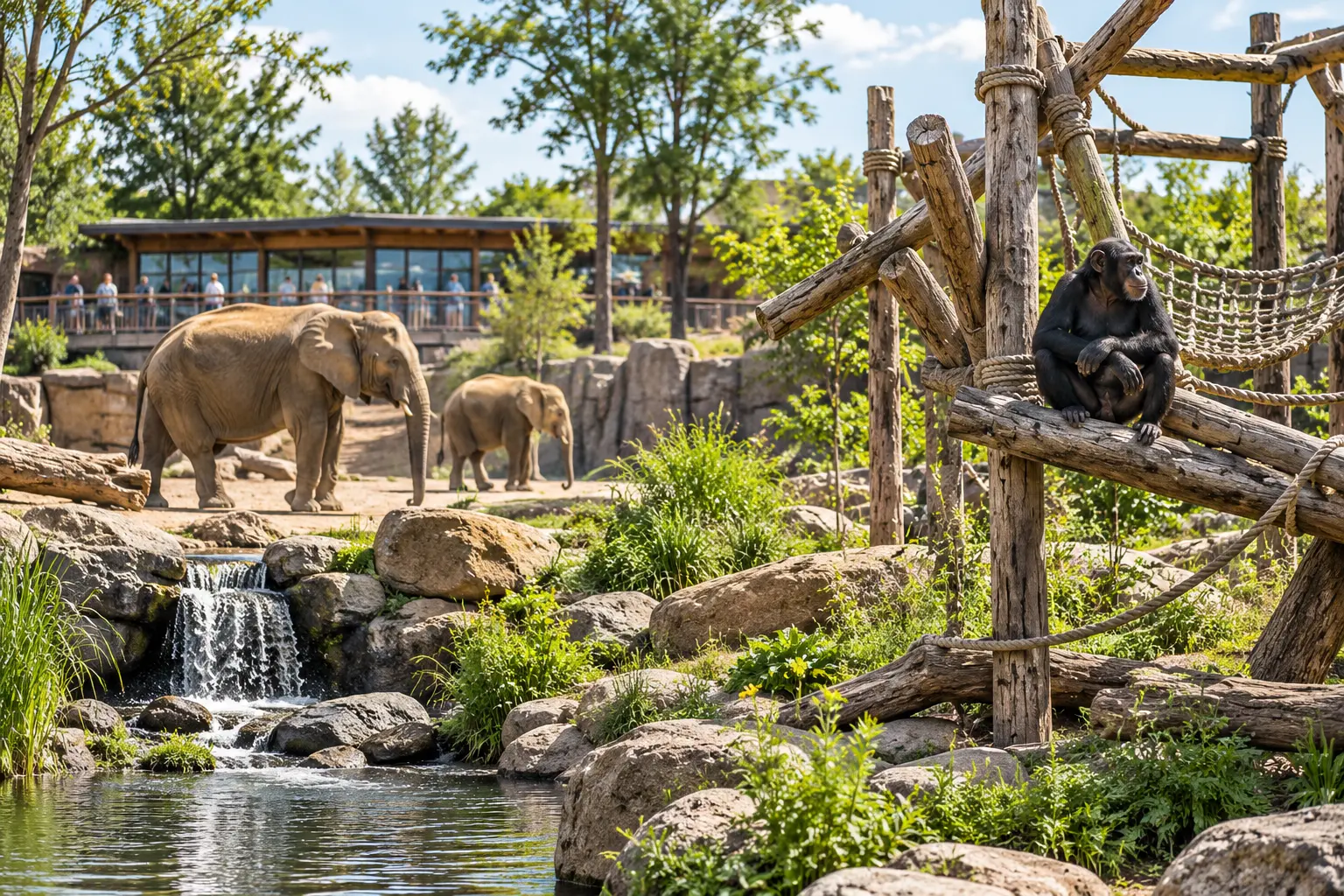
A major alternative emerged from Carl Hagenbeck’s Tierpark in Hamburg, which opened in 1907. Hagenbeck’s panoramas used moats, changes in elevation, artificial rockwork and carefully aligned sightlines to reduce or conceal visible bars. Separate enclosures could appear to merge into a single landscape, allowing visitors to see animals against a scenic background rather than through a cage front. The innovation did not remove captivity; it changed how captivity was staged. The barrier became part of the landscape and, whenever possible, disappeared from the visitor’s direct line of sight.
American zoos adopted versions of this idea during the early twentieth century. Denver Zoo identifies its Bear Mountain, opened in 1918, as the first American zoo exhibit to apply Hagenbeck’s concept of viewing animals at eye level in a naturalistic setting without obvious bars or fences. San Diego Zoo soon experimented with open-air grottoes and moated exhibits, beginning with bears around 1920 and extending the approach to other large animals. These displays made the exhibit itself an attraction: rock faces, pools and vistas were designed to suggest a setting rather than merely contain a specimen.
Naturalistic did not mean natural
The word naturalistic can be misleading if it is taken literally. Hagenbeck-style exhibits were theatrical constructions, often using concrete, artificial rock, hidden walls and precisely calculated viewing positions. They could look more like habitat while still giving animals limited space or choice. The historical importance of the design is therefore not that it made zoos natural, but that it changed the visual standard by which a successful animal exhibit was judged. Increasingly, the exhibit was expected to evoke an environment as well as present an animal.
The habitat becomes part of the exhibit
By the later twentieth century, designers pushed beyond the scenic panorama toward exhibits organized around ecological relationships. Woodland Park Zoo in Seattle adopted a new long-range plan in 1976 that grouped animals by bioclimatic zones and emphasized naturalistic settings. This approach, commonly associated with landscape immersion, tried to place both animal and visitor within a continuous-looking environment. Vegetation, terrain, water, concealed barriers and controlled viewpoints became part of a single composition intended to suggest a habitat rather than a row of adjacent cages.
That planning shift changed the unit of interpretation. The central question was no longer only “What species is this?” but also “What kind of environment does this animal inhabit, and how does it behave there?” In the strongest examples, exhibit design supported species-typical movement, social grouping, retreat from public view and varied use of space. It also gave educators more material for discussing food webs, climate, vegetation and conservation threats. Architectural realism alone, however, could not answer welfare questions. A convincing landscape for visitors could still fail if it did not meet the behavioral and physical needs of the animals using it.
What changed in practice
- Barriers became less visually dominant as moats, glazing, elevation changes and planting replaced many front-facing cage bars.
- Animals were increasingly grouped or interpreted in relation to habitats and ecological regions rather than only by taxonomic categories.
- Exhibit planning paid more attention to behavioral opportunities, retreat spaces, social grouping and environmental complexity.
- Visitor circulation and sightlines became design tools, shaping what could be seen while reducing the sense of looking into a cell.
- Education shifted from labels naming specimens toward interpretation of behavior, habitat, biodiversity and conservation problems.
A 1981 snapshot: recreation, display and limited interpretation
Horowitz’s article appeared at a useful midpoint in this history. Its abstract describes American zoo development as a movement toward a more protective, less interfering and more respectful attitude toward animals, with recognition of species-specific environments transforming zoo planning. It also argues that, by 1981, zoos remained primarily recreational settings and that educational opportunities were often restricted to audiovisual or display material rather than arising automatically from the presence of live animals. That distinction is important: seeing an animal is an experience, but it does not by itself guarantee understanding of ecology or conservation.
The claim should be read as a historical assessment, not as a permanent verdict on every zoo. The late 1970s and early 1980s were precisely when many institutions were formalizing ecological exhibit design, professional education departments and conservation programs. The older recreation-centered model did not vanish, because zoos still had to attract and serve visitors, but education increasingly became a stated institutional responsibility. The resulting tension—between leisure, spectacle, learning and conservation—remains one of the most useful ways to understand why modern zoos are designed as they are.
Education and conservation after 1981
Professional zoo organizations now describe conservation and education as core functions rather than optional additions to recreation. The Association of Zoos and Aquariums, for example, frames accredited institutions around conservation, education, science and recreation, and coordinates cooperative species-management programs. These institutional claims do not prove that every visit changes a visitor’s knowledge or behavior, but they show that the public mission has broadened substantially from the period when zoo interpretation was commonly treated as signage surrounding a collection.
Visitor research provides a more cautious test. In a 2014 study of children aged 7–15 at London Zoo, Eric Jensen found conservation-biology learning in 41% of educator-guided visits and 34% of unguided visits, while also finding that negative changes in understanding occurred more often in unguided visits. The result suggested that live-animal encounters can support learning, but that the quality of interpretation matters. It also undercut the assumption that an animal’s presence is educational in itself.
A broader meta-analysis published online in 2024 and in the 2025 volume of Conservation Biology reviewed 56 studies from 38 institutions. McNally and colleagues reported a small-to-medium overall positive effect of zoo-led interventions on conservation-related knowledge, beliefs and behavior, with a pooled effect size of d+ = 0.40 and substantial variation among studies. Because the included research covered multiple countries, institutions and intervention types, it should not be treated as a single score for American zoos. It does, however, show that the educational question raised in 1981 is now being tested empirically rather than answered only from exhibit form or institutional mission statements.
Milestones in changing zoo design and purpose
Year | Institution or development | Why it matters |
1859 / 1874 | Philadelphia Zoo | Chartered in 1859 and opened in 1874, establishing a permanent civic zoological garden in the United States. |
1889 | National Zoological Park | Congress created a national zoo for science, public instruction and recreation, with early concern for endangered American bison. |
1899 | Bronx Zoo | Opened as a large landscaped zoological park linking public recreation with scientific and conservation ambitions. |
1907 | Hagenbeck Tierpark, Hamburg | Popularized panoramic, moated displays that concealed barriers and strongly influenced later American zoo design. |
1918–1920s | Denver and San Diego | Early U.S. naturalistic and moated exhibits translated the Hagenbeck model into American zoo landscapes. |
1976 | Woodland Park Zoo plan | Bioclimatic zones and landscape immersion made habitat context a central organizing principle for exhibit design. |
2024–2025 | Visitor-learning meta-analysis | Research across 56 studies found an overall positive but heterogeneous effect of zoo-led conservation interventions. |
What this history does-and does not-show
The history of American zoos is often told as a simple progression from bad cages to good habitats. The evidence is more complicated. Barless and immersive designs altered public expectations and could support richer environments, but visual naturalism is not the same thing as animal welfare. Welfare depends on species-specific factors such as space use, social conditions, environmental complexity, health care, opportunities for choice and the ability to avoid unwanted interaction. Those requirements can change as scientific knowledge changes, which means exhibit design has to be evaluated as a working environment rather than as scenery.
The same caution applies to conservation claims. A zoo can breed threatened species, fund field projects, conduct research and teach visitors, but the strength of those contributions varies by institution and program. Accreditation standards and cooperative management programs create frameworks for accountability, while peer-reviewed visitor studies offer one way to test educational outcomes. Historical architecture can show what an institution wanted visitors to see; it cannot, by itself, demonstrate what visitors learned or what conservation effect followed.
Seen this way, Horowitz’s phrase about seeing ourselves through the bars remains useful even when the bars are hidden. Zoo landscapes encode decisions about which animals are collected, which behaviors are encouraged, how much control visitors can perceive and what stories are told about wild nature. The shift from barred cages to habitat immersion therefore records more than a design trend. It tracks changing ideas about animal needs, public leisure, scientific authority and the responsibilities that come with keeping wild species in human care.
Reading the modern zoo as a cultural landscape
A present-day zoo still combines functions that can pull in different directions. Visitors may arrive for a family day out, while keepers focus on daily animal care, educators build structured learning experiences, researchers collect behavioral or reproductive data and conservation teams work with populations beyond the zoo grounds. The physical landscape has to support all of those activities at once. That is one reason contemporary exhibits often include off-view holding areas, flexible management spaces and interpretive elements that a visitor may barely notice even though they are essential to how the institution operates.
The most important historical change is therefore not the disappearance of a single architectural feature. Bars can be replaced by glass or moats, and a habitat can be simulated with vegetation and rockwork, but the deeper shift is from displaying an animal as an isolated curiosity toward treating the animal, its behavior and its ecological relationships as connected subjects. American zoos have developed these approaches in different ways, reflecting changes in animal welfare standards, conservation priorities and public expectations.
Frequently asked questions
What was the first zoo in the United States?
The Philadelphia Zoological Society was chartered in 1859, but the Civil War delayed the public opening of Philadelphia Zoo until July 1, 1874. The institution therefore describes itself as America’s first zoo. Earlier cities kept animal collections and menageries, but Philadelphia established the enduring civic zoological-garden model.
When did American zoos stop using visible bars?
There was no single date. Visible cages remained common while moated and barless exhibits spread during the early twentieth century. Denver’s Bear Mountain opened in 1918, and San Diego experimented with grottoes in the 1920s. Later habitat-immersion designs reduced visible barriers further, but secure containment never disappeared.
What is Hagenbeck-style zoo design?
Carl Hagenbeck’s early twentieth-century panoramas used moats, elevation changes, artificial rock and aligned sightlines to make separate animal enclosures look like a continuous landscape. The approach hid many barriers from visitors and strongly influenced American naturalistic exhibits, even though the spaces remained carefully engineered forms of captivity.
Did zoos in 1981 already see education as a major purpose?
Education existed, but Helen Lefkowitz Horowitz’s 1981 account characterized zoos primarily as recreational settings and argued that much interpretation depended on displays and audiovisual material rather than live experience alone. Since then, accredited zoos have made conservation education a more explicit institutional function and researchers have tested learning outcomes directly.
Do modern zoo visits improve conservation learning?
Research suggests they can, but results vary. A 2025 meta-analysis of 56 studies found a small-to-medium positive overall effect of zoo-led interventions on conservation knowledge, beliefs and behavior. Individual studies also show that guided interpretation can outperform unguided visits, so the educational design surrounding an animal encounter matters.
Sources
- Helen Lefkowitz Horowitz. “Seeing Ourselves through the Bars: A Historical Tour of American Zoos.” Landscape 25, no. 2 (1981): 12–19.
- Hyson, Jeffrey N. “Jungles of Eden: The Design of American Zoos.” In Environmentalism in Landscape Architecture, edited by Michel Conan, 23–44. Dumbarton Oaks Research Library and Collection, 2000.
- Philadelphia Zoo. “About the Zoo.”
- Smithsonian’s National Zoo and Conservation Biology Institute. “History.”
- Bronx Zoo. “About Our Park.”
- Denver Zoo Conservation Alliance. “History.”
- San Diego Zoo Wildlife Alliance. “Exhibit Innovation—and Trouble with Caesar.”
- Woodland Park Zoo. “Zoo History.”
- Association of Zoos and Aquariums. “About Us” and “Conservation Education.”
- Jensen, Eric. “Evaluating Children’s Conservation Biology Learning at the Zoo.” Conservation Biology 28, no. 4 (2014): 1004–1011.
- McNally, Xavier, Thomas L. Webb, Charlotte Smith, Andrew Moss, and Jilly Gibson-Miller. “A Meta-analysis of the Effect of Visiting Zoos and Aquariums on Visitors’ Conservation Knowledge, Beliefs, and Behavior.” Conservation Biology 39, no. 1 (2025): e14237.

Lena Okonjo — author
Lena Okonjo is a Zoology graduate with a master’s-level specialization in Animal Behaviour. Her earlier work involved preparing summaries of field studies on animal behaviour and insects for general audiences. At CAB Direct, Lena covers animal behaviour, insec...
Related
How maternal investment and play relate to foal condition
How hormones time seasonal reproduction in temperate-zone birds
Chicken cognition: learning, memory, social behaviour, navigation
Behavioural Problems of Farm Animals: What the 1977 Review Covered

Animal Translocation Stress: Conservation Risks and Management

Mites That Ride Bark Beetles: Four Species Described in 2000