Eastern Europe's native poultry genetic resources in 1996
A 1996 review recorded 121 native poultry breed, variety and strain entries across Eastern Europe despite major twentieth-century losses. Documentation varied by country, and the figures represent a historical inventory rather than a present-day census.

What the review set out to document
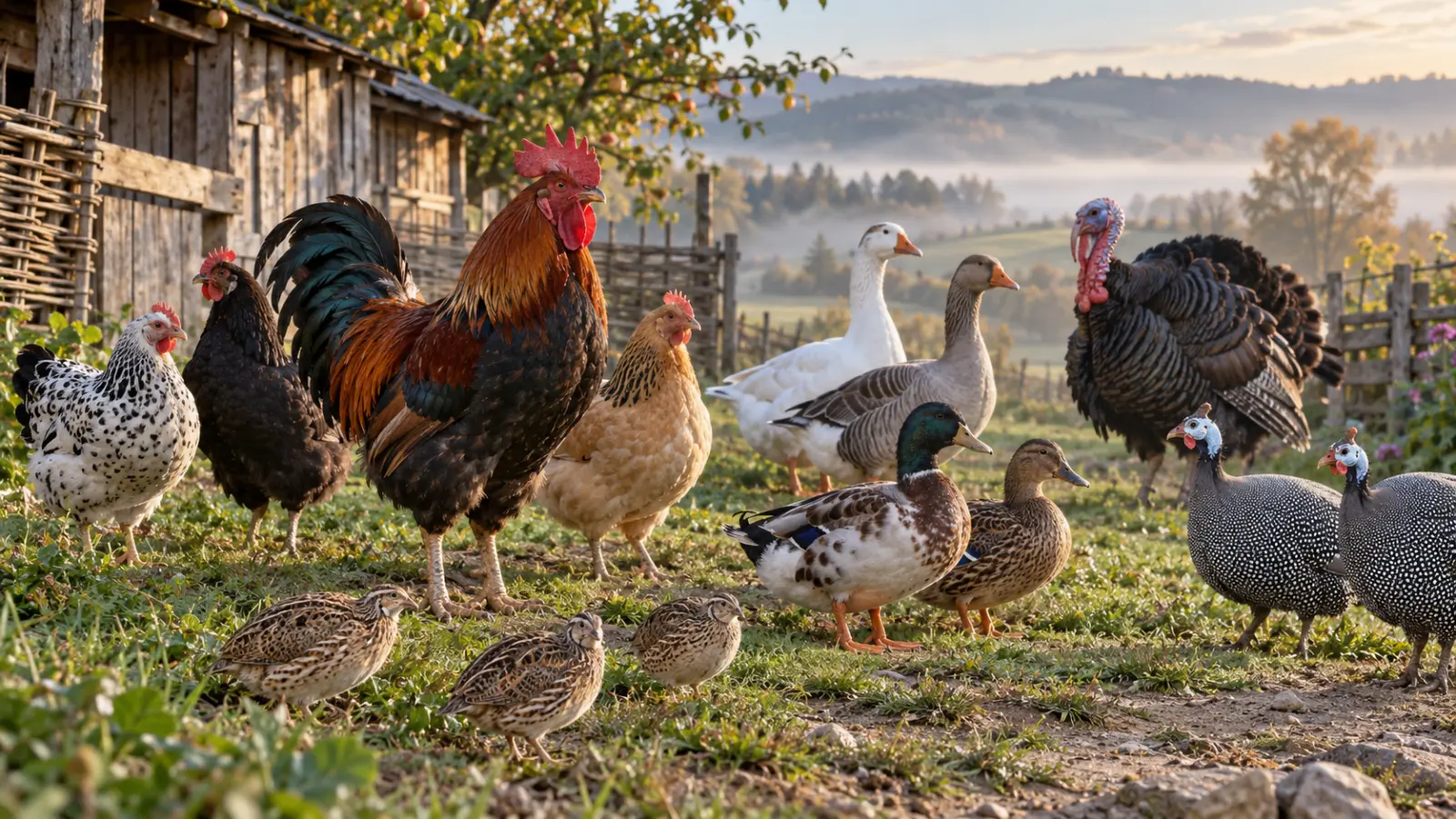
Romanov, Wezyk, Cywa-Benko and Sakhatsky reviewed Eastern European native poultry and preservation programmes in Poultry and Avian Biology Reviews. Their survey covered chickens, turkeys, quail, guineafowl, ducks and geese.
The review associated poultry losses with the Second World War and subsequent agricultural restructuring. It identified comparatively advanced preservation programmes in the Czech Republic, Hungary, Poland, Romania, Russia, Slovakia and Ukraine, alongside substantial gaps elsewhere.
What the regional inventory reported
The review catalogued 121 entries across six poultry groups. Chickens and geese predominated. These counts do not measure genetic diversity, population size or extinction risk.
Poultry group | Reported entries |
Chickens / fowl | 56 |
Geese | 36 |
Turkeys | 13 |
Ducks | 9 |
Japanese quail | 4 |
Guineafowl | 3 |
Total | 121 |
How the country-level figures should be read
Russia had the largest reported collection, with 50 native poultry breeds. Figures associated with Poland and Ukraine are inconsistent: totals of 20 and 18 are attributed differently, and one breakdown for Poland sums to 24 rather than its stated total of 20.
This discrepancy prevents a reliable country-by-country comparison for Poland and Ukraine. The 1996 inventory remains a historical reference.
The figures are a historical baseline, not a current census.
Why these genetic resources mattered
Local breeds preserve inherited traits, regional adaptations and breeding history. Modern conservation combines characterization, sustainable use, viable living populations and stored genetic material to retain diversity for future breeding and research.
Historical inventories record recognized populations and conservation activity.
Population monitoring reveals changes in numbers and isolation.
Genomic tools assess diversity, inbreeding and relationships.
What the 1996 review could not establish
Records were limited for Albania, Bulgaria, Belarus, Estonia, Latvia, Lithuania, Moldova and the former Yugoslavia. Missing documentation may understate a country's poultry resources.
Without contemporary genomic or population data, the review cannot establish genetic distinctness, remaining within-breed variation or current conservation status.
How conservation evidence has changed since 1996
FAO's Domestic Animal Diversity Information System tracks breeds, populations, risk status and gene-bank holdings. The European Regional Focal Point for Animal Genetic Resources coordinates regional conservation efforts.
From inventories to molecular monitoring
A 2013 study used microsatellites to assess five Polish chicken varieties. A 2020 study of six Hungarian breeds detected greater inbreeding over 15 years but little allele loss. The SYNBREED panel used high-density SNP data to compare chicken populations internationally.
A 2024 Ukrainian review describes molecular research and continuing pressure on native flocks. A 2022 French study combines demographic and genomic evidence to assess management of small populations. Neither resolves the 1996 country-count discrepancies.
Why the paper still matters
The review documents historical losses, surviving poultry resources and conservation activity in 1996. Its figures provide context for later surveys and genetic studies but cannot describe present-day breed status.
Frequently asked questions
What are poultry genetic resources?
Poultry genetic resources are the heritable variation carried by domesticated bird populations, including recognized breeds, local varieties, strains and lines. Conservation focuses on keeping populations and their genetic diversity available for future breeding, research and food production. A breed name alone does not show how much diversity remains within that population.
Do the 1996 breed counts describe the situation today?
No. The figures summarize information available to the review authors in the mid-1990s. Breed populations can decline, recover, merge, be reclassified or receive better documentation over time. Present-day status should be checked against current national records, FAO DAD-IS data and recent population-genetic studies rather than inferred from the 1996 inventory.
Why are native poultry breeds conserved?
Native breeds can preserve genetic variation, locally adapted traits and the results of long-term breeding by farming communities. They may also have cultural and historical value. Conservation programmes aim to keep viable populations, limit avoidable inbreeding and maintain options for future breeding, rather than assuming every old breed will have an immediate commercial use.
Which countries had the strongest programmes in the 1996 review?
The review identified the Czech Republic, Hungary, Poland, Romania, Russia, Slovakia and Ukraine as countries with comparatively advanced preservation programmes. That statement reflects the information available to the authors at the time. It should not be read as a current ranking, because conservation programmes and reporting systems have changed substantially since 1996.
How are poultry genetic resources monitored now?
Modern monitoring combines breed inventories with population counts, pedigree or mating information, gene-bank records and molecular data. FAO DAD-IS provides international breed and risk-status information, while European networks support regional coordination. Genomic tools can now quantify population structure, inbreeding and diversity at a resolution that was not available to the 1996 review.
Sources
- Romanov MN, Wezyk S, Cywa-Benko K, Sakhatsky NI. Poultry genetic resources in the countries of Eastern Europe – history and current state. Poultry and Avian Biology Reviews. 1996;7(1):1–29.
- Wezyk S, Cywa-Benko K, Romanov MN. Protection against the extinction of the native breeds of poultry in the countries of Eastern Europe. In: Gavora JS, ed. Proceedings of the 10th International Symposium on Current Problems of Avian Genetics. Nitra, Slovakia; 1994.
- Rischkowsky B, Pilling D, eds. The State of the World's Animal Genetic Resources for Food and Agriculture. Rome: Food and Agriculture Organization of the United Nations; 2007. ISBN 978-92-5-105762-9.
- Scherf BD, Pilling D, eds. The Second Report on the State of the World's Animal Genetic Resources for Food and Agriculture. Rome: FAO; 2015. ISBN 978-92-5-108820-3.
- Food and Agriculture Organization of the United Nations. Domestic Animal Diversity Information System (DAD-IS): breed information, population data and risk-status monitoring.
- European Regional Focal Point for Animal Genetic Resources. Regional platform for conservation and sustainable use of animal genetic resources in Europe.
- Moiseyeva IG, Romanov MN, Kovalenko AT, et al. The Poltava chicken breed of Ukraine: its history, characterization and conservation. Animal Genetic Resources Information. 2007;40:71-78. doi:10.1017/S1014233900002212.
- Antos P, Andres K, Kapkowska E. Preliminary Studies on Genetic Diversity of Selected Polish Local Chicken Varieties. Journal of Central European Agriculture. 2013;14(1):11-22. doi:10.5513/JCEA01/14.1.1147.
- Malomane DK, Simianer H, Weigend A, et al. The SYNBREED chicken diversity panel: a global resource to assess chicken diversity at high genomic resolution. BMC Genomics. 2019;20:345. doi:10.1186/s12864-019-5727-9.
Related
Overstocking and Dairy Cows: Lessons from a 2012 Review
Teart Pastures in Somerset: Molybdenum and Cattle Scouring

Hereditary dwarfism in beef cattle: genetics and calf outcomes
Mites That Ride Bark Beetles: Four Species Described in 2000
How maternal investment and play relate to foal condition

Army Ants: Social Predation, Nomadism and Tropical Ecology